Improving the economic efficiency of data management and artificial intelligence in diverse airline market conditions
DOI:
https://doi.org/10.15587/1729-4061.2026.352883Keywords:
data, artificial intelligence in aviation, digital transformation, operational efficiency, panel regression, cluster analysisAbstract
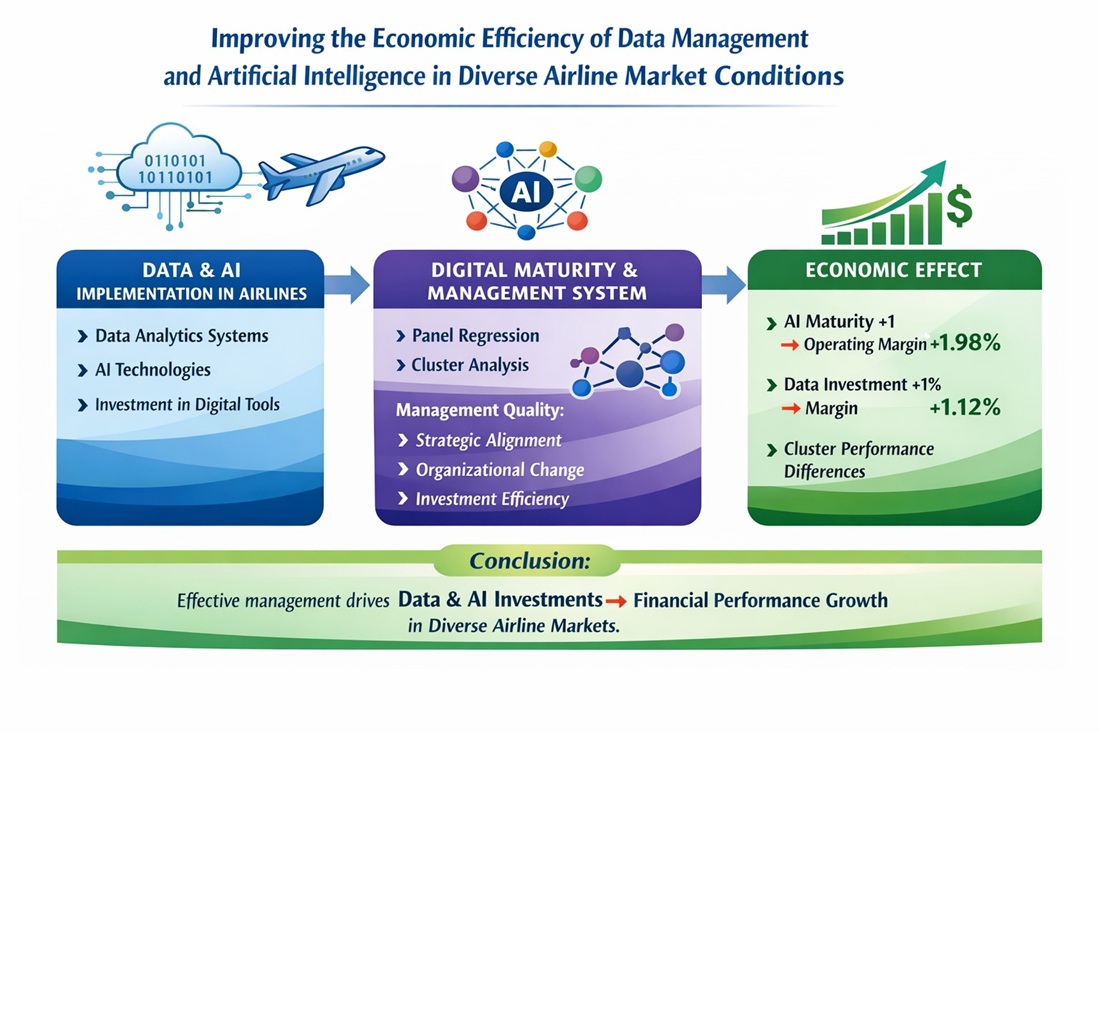
The object of the study is a complex of management practices and organizational mechanisms, which ensure implementation of data analysis and artificial intelligence technologies into airline operations. The study deals with the problem of quantitative evaluation of the impact from the extent and quality of data & artificial intelligence solutions on the key indexes of airline managerial efficiency.
The following results have been obtained:
– analysis of the digital maturity level with financial and operational key performance indicators of airlines has identified a considerable intercluster differentiation;
– a one-point increase in artificial intelligence digital maturity is associated with the growth of operating margin by 1.98%, whereas the 1% increase of data investment share contributes to its growth by 1.12%;
– two standard models of data & artificial intelligence innovation project management, which demonstrated various outputs in studied institutional contexts.
The produced findings can be explained by the fact that translation of technology investments into financial outcomes is mediated by the quality of management system, which includes strategic alignment, coordinating organizational changes and a system of investment efficiency evaluation.
The specifics of obtained results possess a dual nature: on the one hand, they confirm the universally positive effect from data & artificial intelligence implementation; on the other hand, they highlight the critical significance of context-dependent, cluster-specific management strategy.
The practical significance of this study lies in the formation of evidence base for making justified decisions by airline management, as well as producing defined tools for maximizing the output from investment in digital technology
References
- Fondevila-Gascón, J.-F., Gutiérrez-Aragón, Ó., Lopez-Lopez, D., Curiel-Barrios, G., Alabart-Algueró, J. (2025). Passenger perceptions of Artificial Intelligence in airline operations: Implications for air transport management. Journal of Air Transport Management, 129, 102874. https://doi.org/10.1016/j.jairtraman.2025.102874
- Alomar, I., Jacob, C. O. (2025). The Integration of Artificial Intelligence in Management of Airline Operation Control Centre (SmartLynx Airlines Case Study). TRANSBALTICA XV: Transportation Science and Technology, 398–409. https://doi.org/10.1007/978-3-031-85390-6_37
- Ali, W., Khan, A., Asghar, M., Kamran, M., Amin, N. (2024). Influence of artificial intelligence on cost efficiency and organizational performance with the mediating role of cost management control systems in transformational organizations. Bulletin of Management Review, 1 (4), 59–91. Available at: https://www.bulletinofmanagementreview.com/index.php/Journal/article/view/62
- Moghadasnian, S., Ketabchi, M. (2024). Cost efficiency and financial health in airlines leveraging cost management KPIs. Transactions on Data Analysis in Social Science, 6 (3), 31–40. Available at: https://www.researchgate.net/publication/378304569_Cost_Efficiency_and_Financial_Health_in_Airlines_Leveraging_Cost_Management_KPIs
- Moghadasnian, S. A., Rajol, M. (2025). Artificial intelligence in airline business management a paradigm shift in the industry. Journal Business of Data Science Research, 4 (1), 6–12. Available at: https://www.researchgate.net/profile/Seyyedabdolhojjat-Moghadasnian/publication/392270838_Artificial_Intelligence_in_Airline_Business_Management_A_Paradigm_Shift_in_the_Industry/links/683beb208a76251f22eac6f2/Artificial-Intelligence-in-Airline-Business-Management-A-Paradigm-Shift-in-the-Industry.pdf
- Mohamed, H. (2025). AI-Driven Financial Modelling for Airline Profitability and Cost Reduction. Journal of Airline Operations and Aviation Management, 4 (1), 58–73. https://doi.org/10.69978/jaoam.v4.i1.5
- Ivan, B., Olga, B., Oksana, H., Roman, P., Marta, S., Khrystyna, K. (2024). Application of Grey Relational Analysis for Utilizing Artificial Intelligence Methods in Aviation Management. AI in Business: Opportunities and Limitations, 113–123. https://doi.org/10.1007/978-3-031-48479-7_11
- Mustafayeva, A., Karimov, B. A., Ahmadov, H., Manafov, E. (2025). Application of Artificial Intelligence-Based Digital Technologies in Transport Logistics. International Journal of Transportation Research and Technologys, 02, 23. https://doi.org/10.71108/transporttech.vm02is02.02
- Alketbi, M. A., Dweiri, F., Dalalah, D. (2024). The Role of Artificial Intelligence in Aviation Construction Projects in the United Arab Emirates: Insights from Construction Professionals. Applied Sciences, 15 (1), 110. https://doi.org/10.3390/app15010110
- Moghadas Nian, S. A. H. (2026). AI-Driven Inventory Optimization in Airline Logistics: Enhancing Efficiency, Sustainability, and Operational Performance. https://doi.org/10.2139/ssrn.6119086
- Poulaki, I., Koufodontis, N. I., Papadimitriou, S. (2025). Airline revenue management, distribution and passengers: market trends in a technology driven triangle. Worldwide Hospitality and Tourism Themes, 17 (1), 35–47. https://doi.org/10.1108/whatt-12-2024-0304
- Guerrini, A., Ferri, G., Rocchi, S., Cirelli, M., Piña, V., Grieszmann, A. (2023). Personalization @ scale in airlines: combining the power of rich customer data, experiential learning, and revenue management. Journal of Revenue and Pricing Management, 22 (2), 171–180. https://doi.org/10.1057/s41272-022-00404-8
- Geske, A. M., Herold, D. M., Kummer, S. (2025). Using sustainable technology to drive efficiency: Artificial intelligence as an information broker for advancing airline operations management. Sustainable Technology and Entrepreneurship, 4 (3), 100111. https://doi.org/10.1016/j.stae.2025.100111
- Kalai, M., Becha, H., Helali, K. (2024). Effect of artificial intelligence on economic growth in European countries: a symmetric and asymmetric cointegration based on linear and non-linear ARDL approach. Journal of Economic Structures, 13 (1). https://doi.org/10.1186/s40008-024-00345-y
- Drago, C., Costantiello, A., Savorgnan, M., Leogrande, A. (2025). Macroeconomic and Labor Market Drivers of AI Adoption in Europe: A Machine Learning and Panel Data Approach. Economies, 13 (8), 226. https://doi.org/10.3390/economies13080226
- Florido-Benítez, L., del Alcázar Martínez, B. (2024). How Artificial Intelligence (AI) Is Powering New Tourism Marketing and the Future Agenda for Smart Tourist Destinations. Electronics, 13 (21), 4151. https://doi.org/10.3390/electronics13214151
- Eleimat, M., Őszi, A. (2025). Cybersecurity in Aviation: Exploring the Significance, Applications, and Challenges of Cybersecurity in the Aviation Sector. Periodica Polytechnica Transportation Engineering, 53 (2), 169–183. https://doi.org/10.3311/pptr.37153
- Dodgson, M. (2017). Innovation Management. Routledge. https://doi.org/10.4324/9781351240185
- Heiets, I., La, J., Zhou, W., Xu, S., Wang, X., Xu, Y. (2022). Digital transformation of airline industry. Research in Transportation Economics, 92, 101186. https://doi.org/10.1016/j.retrec.2022.101186
Downloads
Published
How to Cite
Issue
Section
License
Copyright (c) 2026 Abdul-Khassen Nurlanuly, Serik Serikbayev, Aizhamal Aidaraliyeva, Nazym Akhmetzhanova, Inna Stecenko, Almira Saktayeva, Oxana Kirichok

This work is licensed under a Creative Commons Attribution 4.0 International License.
The consolidation and conditions for the transfer of copyright (identification of authorship) is carried out in the License Agreement. In particular, the authors reserve the right to the authorship of their manuscript and transfer the first publication of this work to the journal under the terms of the Creative Commons CC BY license. At the same time, they have the right to conclude on their own additional agreements concerning the non-exclusive distribution of the work in the form in which it was published by this journal, but provided that the link to the first publication of the article in this journal is preserved.
A license agreement is a document in which the author warrants that he/she owns all copyright for the work (manuscript, article, etc.).
The authors, signing the License Agreement with TECHNOLOGY CENTER PC, have all rights to the further use of their work, provided that they link to our edition in which the work was published.
According to the terms of the License Agreement, the Publisher TECHNOLOGY CENTER PC does not take away your copyrights and receives permission from the authors to use and dissemination of the publication through the world's scientific resources (own electronic resources, scientometric databases, repositories, libraries, etc.).
In the absence of a signed License Agreement or in the absence of this agreement of identifiers allowing to identify the identity of the author, the editors have no right to work with the manuscript.
It is important to remember that there is another type of agreement between authors and publishers – when copyright is transferred from the authors to the publisher. In this case, the authors lose ownership of their work and may not use it in any way.







