Design of an automatic system for monitoring the technical condition of fiber-optic cables
DOI:
https://doi.org/10.15587/1729-4061.2026.353016Keywords:
fiber-optic cables, micro bends, optical losses, photomatrix, pixel analysis, distributed monitoringAbstract
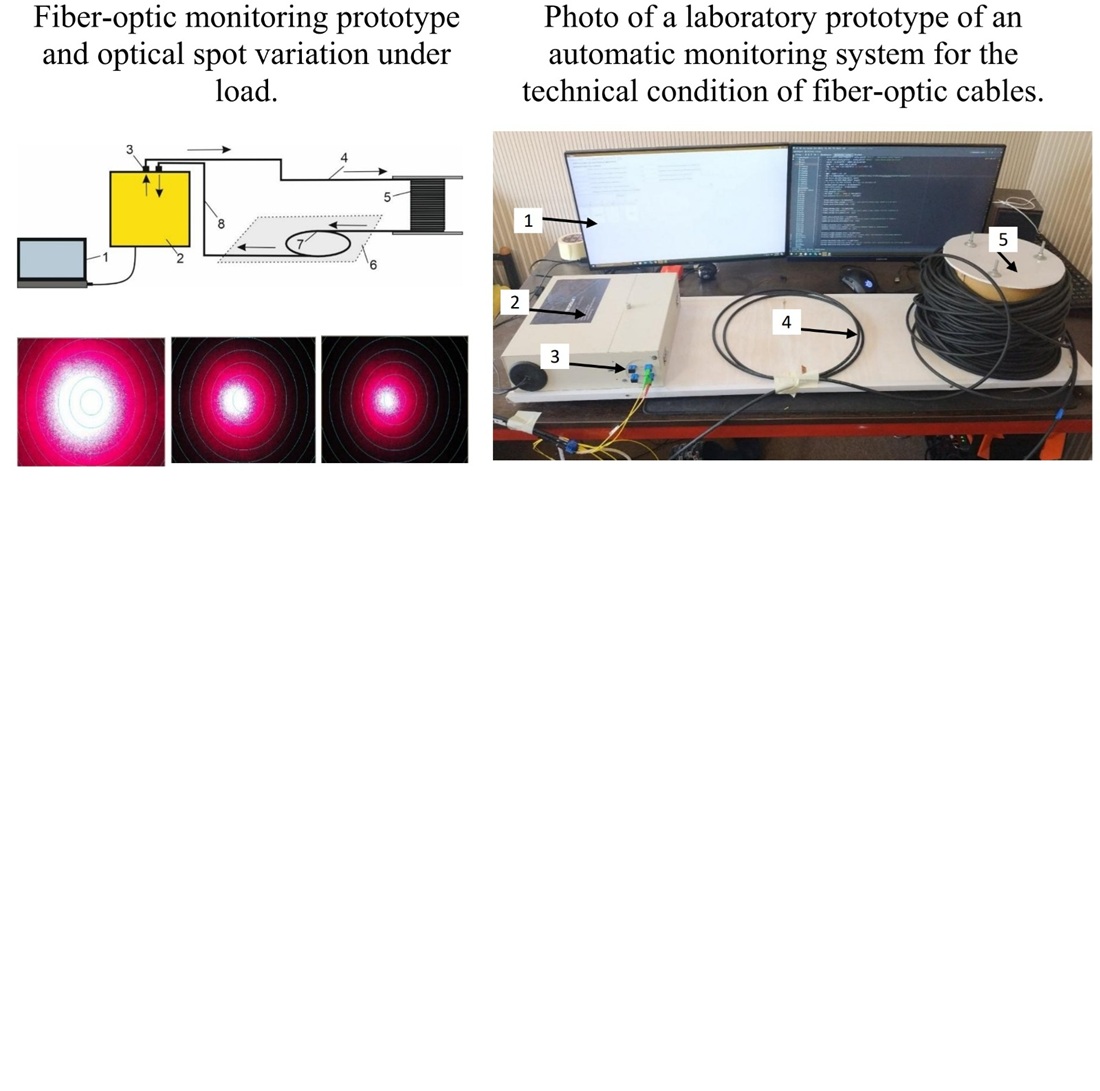
This study examines the process of monitoring the technical condition of fiber-optic cables based on the recording and analysis of changes in the pixel structure of the optical spot formed by cladding radiation under mechanical stress. The task addressed relates to the lack of affordable and easy-to-implement means for continuous monitoring of the integrity of fiber-optic communication lines capable of promptly detecting mechanical stress and unauthorized access attempts.
This paper suggests a monitoring principle based on recording additional optical losses arising from microbending of the optical fiber, followed by image processing on a high-resolution photo matrix. It has been experimentally established that changes in the pixel structure of the optical spot formed by cladding radiation on the surface of the high-resolution photo matrix linearly correlate with the magnitude of the applied load and the level of additional losses.
The results are attributed to the redistribution of optical power between the fiber core and cladding due to the photo-elastic effect. A distinctive feature of the proposed approach is its elimination of interferometric and reflectometric methods and the use of intelligent optical-digital pixel analysis, which reduces system cost, facilitates scalability, and is resistant to interference.
The designed system could be used for continuous monitoring of fiber-optic communication lines, utility lines, as well as long-distance facilities under real-world conditions, with monitored sections up to 60 km long. Laboratory tests confirmed the system's sensitivity to mechanical loads of 5 N and its suitability for integration into existing telecommunications networks
References
- Guemes, A., Mujica, L. E., del-Río-Velilla, D., Fernandez-Lopez, A. (2025). Structural Health Monitoring by Fiber Optic Sensors. Photonics, 12 (6), 604. https://doi.org/10.3390/photonics12060604
- Bado, M. F., Casas, J. R. (2021). A Review of Recent Distributed Optical Fiber Sensors Applications for Civil Engineering Structural Health Monitoring. Sensors, 21 (5), 1818. https://doi.org/10.3390/s21051818
- Wang, W., Yiu, H. H. P., Li, W. J., Roy, V. A. L. (2021). The Principle and Architectures of Optical Stress Sensors and the Progress on the Development of Microbend Optical Sensors. Advanced Optical Materials, 9 (10). https://doi.org/10.1002/adom.202001693
- Zhang, X., Zhu, H., Jiang, X., Broere, W. (2024). Distributed fiber optic sensors for tunnel monitoring: A state-of-the-art review. Journal of Rock Mechanics and Geotechnical Engineering, 16 (9), 3841–3863. https://doi.org/10.1016/j.jrmge.2024.01.008
- Wang, Z., Lu, B., Ye, Q., Cai, H. (2020). Recent Progress in Distributed Fiber Acoustic Sensing with Φ-OTDR. Sensors, 20 (22), 6594. https://doi.org/10.3390/s20226594
- Chapalo, I., Stylianou, A., Mégret, P., Theodosiou, A. (2024). Advances in Optical Fiber Speckle Sensing: A Comprehensive Review. Photonics, 11 (4), 299. https://doi.org/10.3390/photonics11040299
- Cao, L., Abedin, S., Cui, G., Wang, X. (2025). Artificial Intelligence and Machine Learning in Optical Fiber Sensors: A Review. Sensors, 25 (24), 7442. https://doi.org/10.3390/s25247442
- Hu, X., Bai, X., Li, J., He, Y., Li, Y., Li, L. et al. (2025). A fiber optic sensing intrusion detection method based on WPD-EMD and improved ResNet. Optical Fiber Technology, 90, 104125. https://doi.org/10.1016/j.yofte.2024.104125
- Peng, F., Wu, H., Jia, X.-H., Rao, Y.-J., Wang, Z.-N., Peng, Z.-P. (2014). Ultra-long high-sensitivity Φ-OTDR for high spatial resolution intrusion detection of pipelines. Optics Express, 22 (11), 13804. https://doi.org/10.1364/oe.22.013804
- Xu, S., Qin, Z., Zhang, W., Xiong, X. (2020). Monitoring Vehicles on Highway by Dual-Channel φ-OTDR. Applied Sciences, 10 (5), 1839. https://doi.org/10.3390/app10051839
- Hu, X., Qiu, G., Karimi, H. R., Zhang, D. (2024). TFF-CNN: Distributed optical fiber sensing intrusion detection framework based on two-dimensional multi-features. Neurocomputing, 564, 126959. https://doi.org/10.1016/j.neucom.2023.126959
- Yang, N., Zhao, Y., Chen, J. (2022). Real-Time Φ-OTDR Vibration Event Recognition Based on Image Target Detection. Sensors, 22 (3), 1127. https://doi.org/10.3390/s22031127
- Zhang, S., Xie, S., Li, Y., Yuan, M., Qian, X. (2023). Detection of Gas Pipeline Leakage Using Distributed Optical Fiber Sensors: Multi-Physics Analysis of Leakage-Fiber Coupling Mechanism in Soil Environment. Sensors, 23 (12), 5430. https://doi.org/10.3390/s23125430
- Fabbricatore, F., Bertola, N. (2005). Structural performance monitoring for concrete girder bridges with distributed fiber optic sensors. 13th International Conference on Structural Health Monitoring of Intelligent Infrastructure. https://doi.org/10.3217/978-3-99161-057-1-022
- Tan, X., Poorghasem, S., Huang, Y., Feng, X., Bao, Y. (2024). Monitoring of pipelines subjected to interactive bending and dent using distributed fiber optic sensors. Automation in Construction, 160, 105306. https://doi.org/10.1016/j.autcon.2024.105306
- Abdallah, A., Fouad, M. M., Ahmed, H. N. (2021). Low-cost real-time fiber optic sensor for intrusion detection. Sensor Review, 42 (1), 89–101. https://doi.org/10.1108/sr-03-2021-0090
- Mekhtiyev, A., Dunayev, P., Neshina, Y., Alkina, A., Aimagambetova, R., Mukhambetov, G. et al. (2023). Power supply via fiber-optical conductor for sensors of mine working monitoring system. Eastern-European Journal of Enterprise Technologies, 5 (5 (125)), 15–23. https://doi.org/10.15587/1729-4061.2023.289775
- Yugay, V., Mekhtiyev, A., Neshina, Y., Aubakirova, B., Aimagambetova, R., Kozhas, A. et al. (2021). Design of an information-measuring system for monitoring deformation and displacement of rock massif layers based on fiber-optic sensors. Eastern-European Journal of Enterprise Technologies, 6 (5 (114)), 12–27. https://doi.org/10.15587/1729-4061.2021.244897
- Yugay, V., Mekhtiyev, A., Madi, P., Neshina, Y., Alkina, A., Gazizov, F. et al. (2022). Fiber-Optic System for Monitoring Pressure Changes on Mine Support Elements. Sensors, 22 (5), 1735. https://doi.org/10.3390/s22051735
- Mekhtiyev, A., Neshina, Y., Alkina, A., Yugay, V., Kalytka, V., Sarsikeyev, Y., Kirichenko, L. (2023). Developing an Intelligent Fiber-Optic System for Monitoring Reinforced Concrete Foundation Structure Damage. Applied Sciences, 13 (21), 11987. https://doi.org/10.3390/app132111987
- Yang, X., Qiu, J., Gong, X., Ye, J., Yao, F., Chen, J. et al. (2025). Anomaly Diagnosis Using Machine Learning Method in Fiber Fault Diagnosis. Computers, Materials & Continua, 85 (1), 1515–1539. https://doi.org/10.32604/cmc.2025.067518
Downloads
Published
How to Cite
Issue
Section
License
Copyright (c) 2026 Aliya Alkina, Ali Mekhtiyev, Yelena Neshina, Adam Ujma, Ruslan Mekhtiyev, Madiyar Musagazhinov, Yekaterina Bilichenko

This work is licensed under a Creative Commons Attribution 4.0 International License.
The consolidation and conditions for the transfer of copyright (identification of authorship) is carried out in the License Agreement. In particular, the authors reserve the right to the authorship of their manuscript and transfer the first publication of this work to the journal under the terms of the Creative Commons CC BY license. At the same time, they have the right to conclude on their own additional agreements concerning the non-exclusive distribution of the work in the form in which it was published by this journal, but provided that the link to the first publication of the article in this journal is preserved.
A license agreement is a document in which the author warrants that he/she owns all copyright for the work (manuscript, article, etc.).
The authors, signing the License Agreement with TECHNOLOGY CENTER PC, have all rights to the further use of their work, provided that they link to our edition in which the work was published.
According to the terms of the License Agreement, the Publisher TECHNOLOGY CENTER PC does not take away your copyrights and receives permission from the authors to use and dissemination of the publication through the world's scientific resources (own electronic resources, scientometric databases, repositories, libraries, etc.).
In the absence of a signed License Agreement or in the absence of this agreement of identifiers allowing to identify the identity of the author, the editors have no right to work with the manuscript.
It is important to remember that there is another type of agreement between authors and publishers – when copyright is transferred from the authors to the publisher. In this case, the authors lose ownership of their work and may not use it in any way.







