Розробка методу формування команди освітнього проєкту на основі аналізу матриці компетентностей
DOI:
https://doi.org/10.15587/1729-4061.2024.316782Ключові слова:
освітній проєкт, компетентнісний метод, матриця компетентностей, мультиуніверситетска співпраця, кваліфікаційні вимогиАнотація
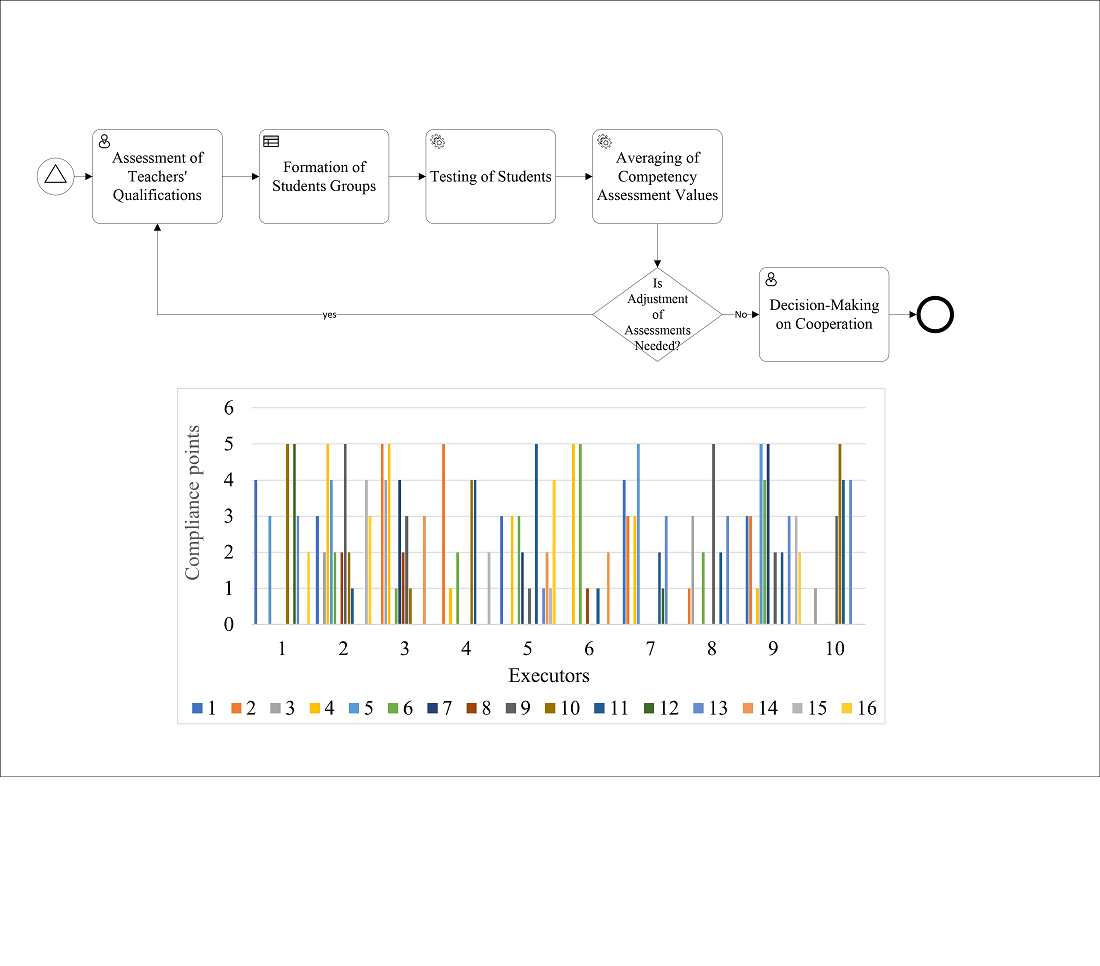
Об’єктом дослідження є процеси формування команд освітніх проєктів. Проблемою є розподіл викладачів за освітніми компонентами враховуючи складний набір функціональних вимог до виконавців конкретних освітніх проєктів. Для успішної реалізації освітніх проєктів пропонується створення резерву кадрів та формування ефективних команд виконавців, що володіють потрібними компетентностями та досвідом впровадження міжнародних проєктів. Формалізовано метод визначення індивідуальних компетентностей виконавців освітніх проєктів у закладах вищої освіти. Запропоновано оцінки викладачів здійснювати на основі їхньої ефективності у викладанні освітніх компонент, що вимірюється за допомогою тестування рівня засвоєння програмних результатів слухачами. В результаті формується матриця компетентностей, що містить оцінки виконавців, яка допомагає керівництву закладу приймати рішення про продовження або завершення контрактів із викладачами, а також можливе преміювання. Метод аналізу матриці компетентностей для формування команди освітнього проєкту полягає у визначенні викладачів, які володіють необхідними компетентностями для забезпечення освітніх компонент. В результаті застосування методу формується команда проєкту, яка здатна забезпечити всі необхідні компетентності, враховуючи кваліфікаційні вимоги. Метод допомагає визначати дефіцит кваліфікованих кадрів та необхідність їхнього розвитку. Метод верифіковано на прикладі освітнього проєкту в Казахстані для формування команди викладачів, що відповідає кваліфікаційним вимогам освітньої програми. Результати показують, що навіть мінімальна команда з трьох осіб здатна забезпечити всі 16 компетентностей на відповідному рівні, а залучення додаткових виконавців розширює можливості гнучкого розподілу обов'язків між ними
Посилання
- Buckley, P., Minette, K., Joy, D., Michaels, J. (2004). The use of an automated employment recruiting and screening system for temporary professional employees: A case study. Human Resource Management, 43 (2-3), 233–241. https://doi.org/10.1002/hrm.20017
- Benneworth, P., Olmos-Peñuela, J. (2022). An openness framework for ex ante evaluation of societal impact of research. Research Evaluation, 33. https://doi.org/10.1093/reseval/rvac023
- Hempel, P. S. (2004). Preparing the HR profession for technology and information work. Human Resource Management, 43 (2-3), 163–177. https://doi.org/10.1002/hrm.20013
- Snell, S. A., Stueber, D., Lepak, D. P. (2001). Virtual HR Departments: Getting Out of the Middle. CAHRS. Available at: https://ecommons.cornell.edu/items/f4a2219f-904a-43fd-94f9-1bba0b3c3df1
- Ball, K. S. (2001). The use of human resource information systems: a survey. Personnel Review, 30 (6), 677–693. https://doi.org/10.1108/eum0000000005979
- Shrivastava, S., Shaw, J. B. (2003). Liberating HR through technology. Human Resource Management, 42 (3), 201–222. https://doi.org/10.1002/hrm.10081
- Twyman, M., Newman, D. A., DeChurch, L., Contractor, N. (2022). Teammate invitation networks: The roles of recommender systems and prior collaboration in team assembly. Social Networks, 68, 84–96. https://doi.org/10.1016/j.socnet.2021.04.008
- Morrison-Smith, S., Ruiz, J. (2020). Challenges and barriers in virtual teams: a literature review. SN Applied Sciences, 2 (6). https://doi.org/10.1007/s42452-020-2801-5
- Gattringer, R., Wiener, M., Strehl, F. (2017). The challenge of partner selection in collaborative foresight projects. Technological Forecasting and Social Change, 120, 298–310. https://doi.org/10.1016/j.techfore.2017.01.018
- Heger, T., Boman, M. (2015). Networked foresight – The case of EIT ICT Labs. Technological Forecasting and Social Change, 101, 147–164. https://doi.org/10.1016/j.techfore.2014.02.002
- Škrinjarić, B. (2022). Competence-based approaches in organizational and individual context. Humanities and Social Sciences Communications, 9 (1). https://doi.org/10.1057/s41599-022-01047-1
- Wong, S.-C. (2020). Competency Definitions, Development and Assessment: A Brief Review. International Journal of Academic Research in Progressive Education and Development, 9 (3). https://doi.org/10.6007/ijarped/v9-i3/8223
- Bronin, S., Kuchansky, A., Biloshchytskyi, A., Zinyuk, O., Kyselov, V. (2020). Concept of Digital Competences in Service Training Systems. Internet of Things, Infrastructures and Mobile Applications, 379–388. https://doi.org/10.1007/978-3-030-49932-7_37
- Biloshchytskyi, A., Kuchansky, A., Andrashko, Y., Bielova, O. (2018). Learning Space Conceptual Model for Computing Games Developers. 2018 IEEE 13th International Scientific and Technical Conference on Computer Sciences and Information Technologies (CSIT), 97–102. https://doi.org/10.1109/stc-csit.2018.8526719
- Biloshchytskyi, A., Omirbayev, S., Mukhatayev, A., Kuchanskyi, O., Biloshchytska, S., Andrashko, Y. et al. (2023). A structural model for building a system for the development of methodological competence and methods for evaluating its effectiveness. Eastern-European Journal of Enterprise Technologies, 5 (3 (125)), 6–22. https://doi.org/10.15587/1729-4061.2023.289045
- Hammer, T., Lewis, A. L. (2023). Which competencies should be fostered in education for sustainable development at higher education institutions? Findings from the evaluation of the study programs at the University of Bern, Switzerland. Discover Sustainability, 4 (1). https://doi.org/10.1007/s43621-023-00134-w
- Ley, T., Albert, D. (2003). Identifying employee competencies in dynamic work domains: Methodological considerations and a case study. Journal of Universal Computer Science, 9 (12), 1500–1518. Available at: https://www.researchgate.net/publication/220348828_Identifying_Employee_Competencies_in_Dynamic_Work_Domains_Methodological_Considerations_and_a_Case_Study
- Hu, B., Wang, X., Wei, Y. (2021). Research on the Construction of Competency Model of ICT Project Manager. In Society for Information Technology & Teacher Education International Conference, 840–849.
- Kowalska-Styczeń, A., Kravets, P., Lytvyn, V., Vysotska, V., Markiv, O. (2023). Game problem of assigning staff to project implementation. Decision Making: Applications in Management and Engineering, 6 (2), 691–721. https://doi.org/10.31181/dmame622023713
- Gaspars-Wieloch, H. (2021). The Assignment Problem in Human Resource Project Management under Uncertainty. Risks, 9 (1), 25. https://doi.org/10.3390/risks9010025
- Niknafs, A., Denzinger, J., Ruhe, G. (2013). A Systematic Literature Review of the Personnel Assignment Problem. Proceedings of the International MultiConference of Engineers and Computer Scientists 2013. Available at: https://www.iaeng.org/publication/IMECS2013/IMECS2013_pp1121-1128.pdf
- Faudzi, S., Abdul-Rahman, S., Abd Rahman, R. (2018). An Assignment Problem and Its Application in Education Domain: A Review and Potential Path. Advances in Operations Research, 2018, 1–19. https://doi.org/10.1155/2018/8958393
- Verykios, V. S., Paxinou, E., Gkoulalas-Divanis, A., Tzagarakis, M., Kotsiantis, S., Feretzakis, G., Kalles, D. (2024). The Faculty Assignment Problem in Higher Education: A Shapley Value-Based Approach. Artificial Intelligence Applications and Innovations, 224–237. https://doi.org/10.1007/978-3-031-63223-5_17
- Gladka, M., Kuchansky, A., Lisnevskyi, R. (2023). Formation of the IT project team based on the competence characteristics of the staff. Advanced Information Technology, 1 (2), 88–97. https://doi.org/10.17721/ait.2023.1.12
- Dalibor, G., Stefan, J., Pavla, L. (2022). Multi-Criteria Decision-Making Approach in Personnel Selection Problem – A Case Study at the University of Pardubice. Economic Computation and Economic Cybernetics Studies and Research, 56 (2), 149–164. https://doi.org/10.24818/18423264/56.2.22.10
- NAKAZ No. 7-124 vid 20.07.2020. Pro zatverdzhennia Polozhennia pro orhanizatsiyu osvitnoho protsesu v KPI im. Ihoria Sikorskoho. Available at: https://document.kpi.ua/files/2020_7-124.pdf
- Educational activities at AITU are carried out in accordance with the Article approved by the founder’s decision № 1 of 05.02.2019. Available at: https://astanait.edu.kz/en/education-process/
- Polenov, D., Sataev, S., Joldasbayev, O. (2020). Project-Oriented Approach of Personnel Management in Higher Educational Institutions of Kazakhstan. Journal of Advanced Research in Law and Economics, 11 (4), 1323. https://doi.org/10.14505/jarle.v11.4(50).29
- Astana IT University. Available at: https://astanait.edu.kz/en/main-page/
##submission.downloads##
Опубліковано
Як цитувати
Номер
Розділ
Ліцензія
Авторське право (c) 2024 Andrii Biloshchytskyi, Myroslava Gladka, Oleksandr Kuchanskyi, Yurii Andrashko, Adil Faizullin

Ця робота ліцензується відповідно до Creative Commons Attribution 4.0 International License.
Закріплення та умови передачі авторських прав (ідентифікація авторства) здійснюється у Ліцензійному договорі. Зокрема, автори залишають за собою право на авторство свого рукопису та передають журналу право першої публікації цієї роботи на умовах ліцензії Creative Commons CC BY. При цьому вони мають право укладати самостійно додаткові угоди, що стосуються неексклюзивного поширення роботи у тому вигляді, в якому вона була опублікована цим журналом, але за умови збереження посилання на першу публікацію статті в цьому журналі.
Ліцензійний договір – це документ, в якому автор гарантує, що володіє усіма авторськими правами на твір (рукопис, статтю, тощо).
Автори, підписуючи Ліцензійний договір з ПП «ТЕХНОЛОГІЧНИЙ ЦЕНТР», мають усі права на подальше використання свого твору за умови посилання на наше видання, в якому твір опублікований. Відповідно до умов Ліцензійного договору, Видавець ПП «ТЕХНОЛОГІЧНИЙ ЦЕНТР» не забирає ваші авторські права та отримує від авторів дозвіл на використання та розповсюдження публікації через світові наукові ресурси (власні електронні ресурси, наукометричні бази даних, репозитарії, бібліотеки тощо).
За відсутності підписаного Ліцензійного договору або за відсутністю вказаних в цьому договорі ідентифікаторів, що дають змогу ідентифікувати особу автора, редакція не має права працювати з рукописом.
Важливо пам’ятати, що існує і інший тип угоди між авторами та видавцями – коли авторські права передаються від авторів до видавця. В такому разі автори втрачають права власності на свій твір та не можуть його використовувати в будь-який спосіб.