Рішення щодо цифрового підприємництва в індонезійських малих підприємствах, керованих жінками: інтегроване моделювання структурних рівнянь трансформації, навичок, інновацій та поведінкового наміру
DOI:
https://doi.org/10.15587/1729-4061.2025.330229Ключові слова:
цифрова трансформація, навички, інновації, поведінкові наміри, підприємництво, МСП, жінки, технології, стратегія, політикаАнотація
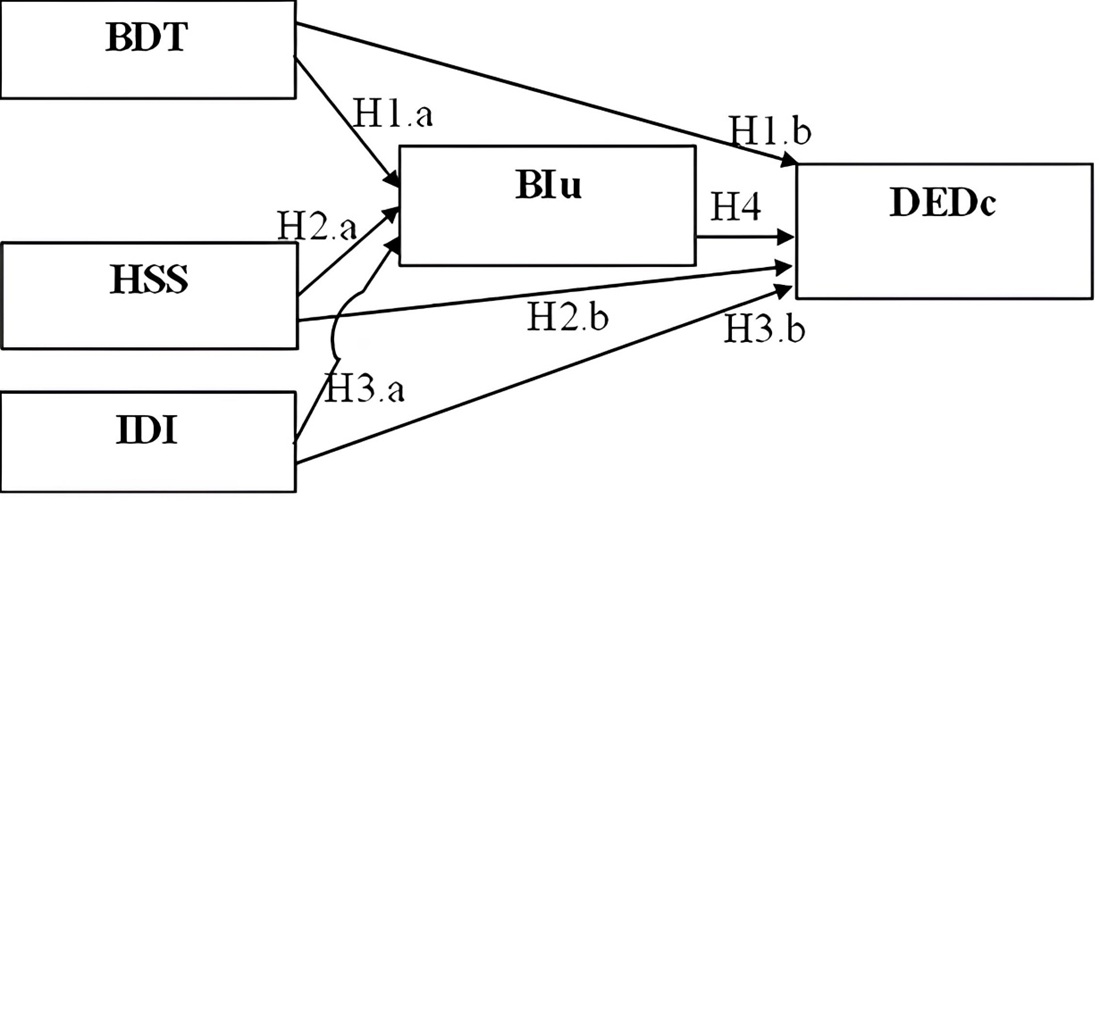
Об'єктом цього дослідження є малі та середні підприємства (МСП), очолювані жінками, розташовані у п'яти районах міста Соло, Індонезія. Малі та середні підприємства (МСП) очолювані жінками в Індонезії стикаються з невирішеними прогалинами в розумінні того, як цифрова трансформація (ЦТ), тверді та м'які навички (ТМН) та інноваційні цифрові ідеї (ІЦІ) впливають на поведінкові наміри (ПН) та рішення щодо цифрового підприємництва (РЦП). Для вирішення цієї проблеми було використано комплексну структуру моделювання структурних рівнянь (МСР) для аналізу впливу ЦТ, ТМН та ІЦІ на ПН та РЦП. Результати дослідження показують, що ЦТ зміцнює ПН та безпосередньо керує РЦП. Навпаки, ТМН та ІЦІ значно посилюють ПН, слугуючи важливим конструктом, який перетворює ТМН та ІЦІ на конкретні рішення. ПН стало основним визначальним фактором вибору цифрового підприємництва, підкреслюючи, що розвиток компетенцій та інновації повинні доповнюватися заходами, що сприяють відданості, проактивності та стратегічній підготовці. ЦТ, ТМН та ІЦІ значно посилюють ПН, основний рушій РЦП, за допомогою ЦТ. Модель пояснила 79,1% дисперсії ПН та 57,3% дисперсії РЦП з високою прогностичною релевантністю (Q2 > 0,35). Базова модель пояснює значну частку дисперсії в ПН та РЦП, підтверджуючи надійність та валідність використаних конструктів. Ці висновки підкреслюють, що малі та середні підприємства (МСП), керовані жінками, можуть ефективно впроваджувати та підтримувати цифрові ініціативи в рамках сприятливих політичних рамок та цільових навчальних програм, зосереджених на трансформації, керованій лідерством, комплексному розвитку навичок та семінарах з генерування ідей. Ця модель SEM пропонує практикам та політикам практичний посібник з визначення пріоритетів втручань, що підвищують цифрову готовність та підприємницькі наміри серед жінок-підприємців в Індонезії та аналогічних контекстах країн, що розвиваються
Посилання
- Deng, W., Orbes, I., Ma, P. (2024). Necessity- and opportunity-based female entrepreneurship across countries: The configurational impact of country-level institutions. Journal of International Management, 30 (4), 101160. https://doi.org/10.1016/j.intman.2024.101160
- Abou-Shouk, M. A., Mannaa, M. T., Elbaz, A. M. (2021). Women’s empowerment and tourism development: A cross-country study. Tourism Management Perspectives, 37, 100782. https://doi.org/10.1016/j.tmp.2020.100782
- Chen, A., Li, L., Shahid, W. (2024). Digital transformation as the driving force for sustainable business performance: A moderated mediation model of market-driven business model innovation and digital leadership capabilities. Heliyon, 10 (8), e29509. https://doi.org/10.1016/j.heliyon.2024.e29509
- Singh, P. (2024). Beyond the basics: Exploring the impact of social media marketing enablers on business success. Heliyon, 10 (5), e26435. https://doi.org/10.1016/j.heliyon.2024.e26435
- Marino-Romero, J. A., Palos-Sánchez, P. R., Velicia-Martín, F. (2024). Evolution of digital transformation in SMEs management through a bibliometric analysis. Technological Forecasting and Social Change, 199, 123014. https://doi.org/10.1016/j.techfore.2023.123014
- Sandoval-Gómez, R. J., Álvarez-Cedillo, J. A., Castellanos-Sanchez, E. I., Álvarez-Sánchez, T., Perez-Garcia, R. (2023). Development of a technological innovation and social entrepreneurship training program to generate services in a Mexican public entity. Eastern-European Journal of Enterprise Technologies, 6 (13 (126)), 74–87. https://doi.org/10.15587/1729-4061.2023.289753
- Day, S. J., Fan, X., Shou, Y. (2024). Digital technology use decisions by micro- and small-sized complementors in ecosystems: The influence of subjective norms. Technological Forecasting and Social Change, 206, 123579. https://doi.org/10.1016/j.techfore.2024.123579
- Nguyen, T. T., Tran, T. N. H., Do, T. H. M., Dinh, T. K. L., Nguyen, T. U. N., Dang, T. M. K. (2024). Digital literacy, online security behaviors and E-payment intention. Journal of Open Innovation: Technology, Market, and Complexity, 10 (2), 100292. https://doi.org/10.1016/j.joitmc.2024.100292
- Bachmann, N., Rose, R., Maul, V., Hölzle, K. (2024). What makes for future entrepreneurs? The role of digital competencies for entrepreneurial intention. Journal of Business Research, 174, 114481. https://doi.org/10.1016/j.jbusres.2023.114481
- Garcez, A., Franco, M., Silva, R. (2023). The influence of the pillars of digital academic entrepreneurship on university students’ entrepreneurial intention. European Journal of Innovation Management, 28 (2), 210–234. https://doi.org/10.1108/ejim-01-2023-0051
- Sufyan, M., Degbey, W. Y., Glavee-Geo, R., Zoogah, B. D. (2023). Transnational digital entrepreneurship and enterprise effectiveness: A micro-foundational perspective. Journal of Business Research, 160, 113802. https://doi.org/10.1016/j.jbusres.2023.113802
- Sedera, D., Tan, C.-W., Xu, D. (2022). Digital business transformation in innovation and entrepreneurship. Information & Management, 59 (3), 103620. https://doi.org/10.1016/j.im.2022.103620
- Vatankhah, S., Bamshad, V., Altinay, L., De Vita, G. (2023). Understanding business model development through the lens of complexity theory: Enablers and barriers. Journal of Business Research, 155, 113350. https://doi.org/10.1016/j.jbusres.2022.113350
- Wu, J., Qu, X., Sheng, L., Chu, W. (2024). Uncovering the dynamics of enterprises digital transformation research: A comparative review on literature before and after the COVID-19 pandemic. Heliyon, 10 (5), e26986. https://doi.org/10.1016/j.heliyon.2024.e26986
- Dabbous, A., Barakat, K. A., Kraus, S. (2023). The impact of digitalization on entrepreneurial activity and sustainable competitiveness: A panel data analysis. Technology in Society, 73, 102224. https://doi.org/10.1016/j.techsoc.2023.102224
- Ismail, M. N., Wan Hussain, W. M. H. (2024). Mapping digital entrepreneurial intention: A comprehensive bibliometric study. Heliyon, 10 (20), e38988. https://doi.org/10.1016/j.heliyon.2024.e38988
- Gliga, G., Evers, N. (2023). Marketing capability development through networking – An entrepreneurial marketing perspective. Journal of Business Research, 156, 113472. https://doi.org/10.1016/j.jbusres.2022.113472
- Jiang, H., Sohail, F. (2023). Skill-biased entrepreneurial decline. Review of Economic Dynamics, 48, 18–44. https://doi.org/10.1016/j.red.2022.03.004
- Iglesias-Sánchez, P. P., Fayolle, A., Jambrino-Maldonado, C., de las Heras-Pedrosa, C. (2022). Open innovation for entrepreneurial opportunities: how can stakeholder involvement foster new products in science and technology-based start-ups? Heliyon, 8 (12), e11897. https://doi.org/10.1016/j.heliyon.2022.e11897
- Al-Mamary, Y. H. S., Alraja, M. M. (2022). Understanding entrepreneurship intention and behavior in the light of TPB model from the digital entrepreneurship perspective. International Journal of Information Management Data Insights, 2 (2), 100106. https://doi.org/10.1016/j.jjimei.2022.100106
- Reuschke, D., Mason, C., Syrett, S. (2022). Digital futures of small businesses and entrepreneurial opportunity. Futures, 135, 102877. https://doi.org/10.1016/j.futures.2021.102877
- Hair, J., Alamer, A. (2022). Partial Least Squares Structural Equation Modeling (PLS-SEM) in second language and education research: Guidelines using an applied example. Research Methods in Applied Linguistics, 1 (3), 100027. https://doi.org/10.1016/j.rmal.2022.100027
- Voorhees, C. M., Brady, M. K., Calantone, R., Ramirez, E. (2015). Discriminant validity testing in marketing: an analysis, causes for concern, and proposed remedies. Journal of the Academy of Marketing Science, 44 (1), 119–134. https://doi.org/10.1007/s11747-015-0455-4
- Priyono, A., Moin, A., Putri, V. N. A. O. (2020). Identifying Digital Transformation Paths in the Business Model of SMEs during the COVID-19 Pandemic. Journal of Open Innovation: Technology, Market, and Complexity, 6 (4), 104. https://doi.org/10.3390/joitmc6040104
- Tseng, T. H., Wang, Y.-M., Lin, H.-H., Lin, S., Wang, Y.-S., Tsai, T.-H. (2022). Relationships between locus of control, theory of planned behavior, and cyber entrepreneurial intention: The moderating role of cyber entrepreneurship education. The International Journal of Management Education, 20 (3), 100682. https://doi.org/10.1016/j.ijme.2022.100682
- Costa Melo, Dr. I., Queiroz, G. A., Alves Junior, P. N., Sousa, T. B. de, Yushimito, W. F., Pereira, J. (2023). Sustainable digital transformation in small and medium enterprises (SMEs): A review on performance. Heliyon, 9 (3), e13908. https://doi.org/10.1016/j.heliyon.2023.e13908
- Herhausen, D., Miočević, D., Morgan, R. E., Kleijnen, M. H. P. (2020). The digital marketing capabilities gap. Industrial Marketing Management, 90, 276–290. https://doi.org/10.1016/j.indmarman.2020.07.022
- Opland, L. E., Pappas, I. O., Engesmo, J., Jaccheri, L. (2022). Employee-driven digital innovation: A systematic review and a research agenda. Journal of Business Research, 143, 255–271. https://doi.org/10.1016/j.jbusres.2022.01.038
- Saarikko, T., Westergren, U. H., Blomquist, T. (2020). Digital transformation: Five recommendations for the digitally conscious firm. Business Horizons, 63 (6), 825–839. https://doi.org/10.1016/j.bushor.2020.07.005
##submission.downloads##
Опубліковано
Як цитувати
Номер
Розділ
Ліцензія
Авторське право (c) 2025 Handojo Wibawanto Soetikno, Haris Maupa, Hadi Cahyadi

Ця робота ліцензується відповідно до Creative Commons Attribution 4.0 International License.
Закріплення та умови передачі авторських прав (ідентифікація авторства) здійснюється у Ліцензійному договорі. Зокрема, автори залишають за собою право на авторство свого рукопису та передають журналу право першої публікації цієї роботи на умовах ліцензії Creative Commons CC BY. При цьому вони мають право укладати самостійно додаткові угоди, що стосуються неексклюзивного поширення роботи у тому вигляді, в якому вона була опублікована цим журналом, але за умови збереження посилання на першу публікацію статті в цьому журналі.
Ліцензійний договір – це документ, в якому автор гарантує, що володіє усіма авторськими правами на твір (рукопис, статтю, тощо).
Автори, підписуючи Ліцензійний договір з ПП «ТЕХНОЛОГІЧНИЙ ЦЕНТР», мають усі права на подальше використання свого твору за умови посилання на наше видання, в якому твір опублікований. Відповідно до умов Ліцензійного договору, Видавець ПП «ТЕХНОЛОГІЧНИЙ ЦЕНТР» не забирає ваші авторські права та отримує від авторів дозвіл на використання та розповсюдження публікації через світові наукові ресурси (власні електронні ресурси, наукометричні бази даних, репозитарії, бібліотеки тощо).
За відсутності підписаного Ліцензійного договору або за відсутністю вказаних в цьому договорі ідентифікаторів, що дають змогу ідентифікувати особу автора, редакція не має права працювати з рукописом.
Важливо пам’ятати, що існує і інший тип угоди між авторами та видавцями – коли авторські права передаються від авторів до видавця. В такому разі автори втрачають права власності на свій твір та не можуть його використовувати в будь-який спосіб.