Визначення впливу агресивних низьковуглецевих інновацій на екологічні, соціальні та управлінські показники компанії
DOI:
https://doi.org/10.15587/1729-4061.2025.335639Ключові слова:
агресивні низьковуглецеві інновації, ЄСУ показники фірми, орієнтація на зелений ринок, зобов'язання керівництваАнотація
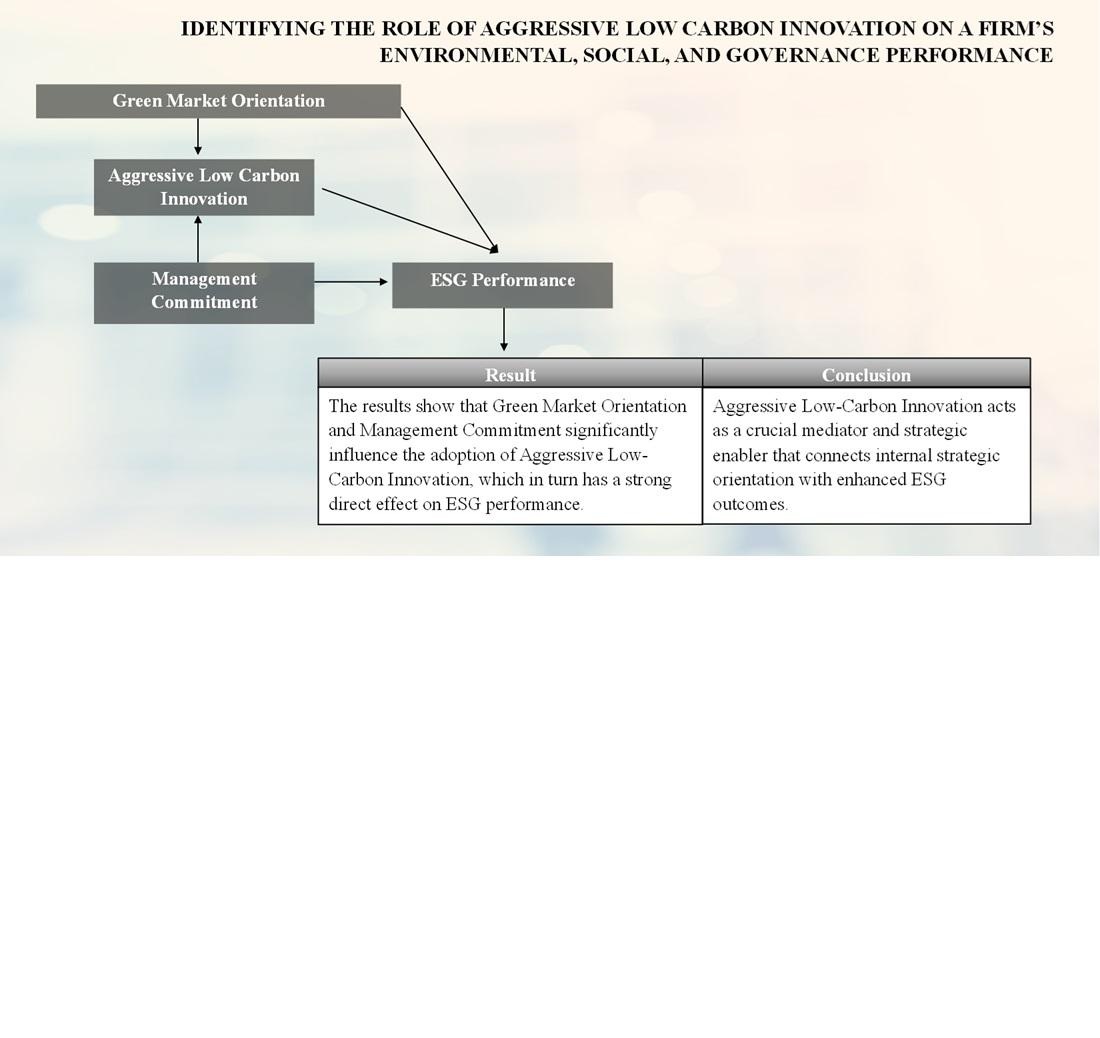
Об'єктом цього дослідження є екологічні, соціальні та управлінські (ЄСУ) показники в енергетичних компаніях ринків, що розвиваються. Проблема, яку необхідно вирішити, полягає у визначенні того, як внутрішні стратегічні орієнтації трансформуються у вимірні результати сталого розвитку. Незважаючи на теоретичне визнання орієнтація на зелений ринок (ОЗР) та зобов'язання керівництва (ЗК) як факторів, що сприяють сталому розвитку, емпіричні дані щодо їхніх шляхів до ЄСУ результатів залишаються обмеженими.
У дослідженні розглядається роль агресивних низьковуглецевих інновацій (АНВІ) як механізму, за допомогою якого ОЗР та ЗК здійснюють свій вплив на ЄСУ показники. Результати дослідження показують, що ЗК має значний непрямий вплив на ЄСУ показники через АНВІ (β = 0,312, p < 0,01), тоді як його прямий вплив не є статистично значущим (β = 0,127, p > 0,05). ОЗР демонструє сильний позитивний вплив на АНВІ (β = 0,488, p < 0,001), але його прямий вплив на ЄСУ показники також незначний (β = 0,089, p > 0,05). На противагу цьому, АНВІ демонструють сильний прямий вплив на ЄСУ показники (β = 0,446, p < 0,001), що підтверджує його роль ключового посередника.
Ці результати свідчать про те, що впровадження АНВІ слугує необхідним мостом між стратегічною орієнтацією та результатами сталого розвитку. Ефективність АНВІ у покращенні ЄСУ показників можна пояснити їх здатністю агресивно інтегрувати екологічні інновації в бізнес-операції, тим самим підвищуючи дотримання вимог, репутацію та довіру зацікавлених сторін. Результати найбільш застосовні в умовах, коли керівництво організації віддане справі, ринкова орієнтація підтримує сталу цінність, а регуляторне середовище заохочує інновації. Це дослідження надає практичну інформацію для фірм, які прагнуть покращити ЄСУ результати шляхом внутрішнього нарощування потенціалу та шляхів стратегічних інновацій
Посилання
- Yenita, Widodo, L. (2023). Environmental, social and governance (ESG) strategy implementation plan during the Covid-19 pandemic at retail company “X” in Jakarta. AIP Conference Proceedings, 2485 (1), 080025. https://doi.org/10.1063/5.0105059
- Mila, G., Primasari, B., Aziz, R. (2021). Application of Life Cycle Assessment (LCA) On Green Tea Product (Case Study in the X Company). IOP Conference Series: Materials Science and Engineering, 1041 (1), 012025. https://doi.org/10.1088/1757-899x/1041/1/012025
- Yusmar, Q. C. M. M., Sumirat, E., Sudrajad, O. Y. (2023). Company Fair Valuation Considering Esg Factor (Case Study: Pt Pertamina Geothermal Energy, Tbk). European Journal of Business and Management Research, 8 (5), 95–101. https://doi.org/10.24018/ejbmr.2023.8.5.2086
- Wang, C. H. (2020). An environmental perspective extends market orientation: Green innovation sustainability. Business Strategy and the Environment, 29 (8), 3123–3134. https://doi.org/10.1002/bse.2561
- Sharma, P., Singh, S. P., Iqbal, H. M. N., Parra-Saldivar, R., Varjani, S., Tong, Y. W. (2022). Genetic modifications associated with sustainability aspects for sustainable developments. Bioengineered, 13 (4), 9509–9521. https://doi.org/10.1080/21655979.2022.2061146
- Niu, S., Park, B. I., Jung, J. S. (2022). The Effects of Digital Leadership and ESG Management on Organizational Innovation and Sustainability. Sustainability, 14 (23), 15639. https://doi.org/10.3390/su142315639
- Andreassen, Å., Brandtzæg, P., Aasmo Finne, M., Lorentz Holck, A., Jevnaker, A.-M., Junttila, O. et al. (2020). Final Health and Environmental Risk Assessment of Genetically Modified Maize 59122. European Journal of Nutrition & Food Safety, 242–245. https://doi.org/10.9734/ejnfs/2019/v11i430169
- Andreassen, Å., Brandtzæg, P., Aasmo Finne, M., Lorentz Holck, A., Jevnaker, A.-M., Junttila, O. et al. (2020). Environmental Risk Assessment of Insect-resistant and Herbicide-tolerant Genetically Modified Maize 1507 x 59122 for Food and Feed Uses, Import and Processing under Regulation (EC) No 1829/2003 (EFSA/GMO/NL/2005/15). European Journal of Nutrition & Food Safety, 221–224. https://doi.org/10.9734/ejnfs/2019/v11i430164
- Andreassen, Å., Brandtzæg, P., Finne, M. A., Holck, A. L., Jevnaker, A.-M. G., Junttila, O. et al. (2020). Food/Feed and Environmental Risk Assessment of Insect-Resistant and Herbicide-Tolerant Genetically Modified Maize Bt11 from Syngenta Seeds for Food and Feed Uses, Import and Processing under Regulation (EC) No 1829/2003 (EFSA/GMO/RX/Bt11). European Journal of Nutrition & Food Safety, 35–38. https://doi.org/10.9734/ejnfs/2020/v12i330206
- Jeong, W., Gaggioli, C. A., Gagliardi, L. (2021). Active Learning Configuration Interaction for Excited-State Calculations of Polycyclic Aromatic Hydrocarbons. Journal of Chemical Theory and Computation, 17 (12), 7518–7530. https://doi.org/10.1021/acs.jctc.1c00769
- Kumar, M., Tsolakis, N., Agarwal, A., Srai, J. S. (2020). Developing distributed manufacturing strategies from the perspective of a product-process matrix. International Journal of Production Economics, 219, 1–17. https://doi.org/10.1016/j.ijpe.2019.05.005
- Goaill, M. M., Al-Hakimi, M., A. (2021). Does absorptive capacity moderate the relationship between entrepreneurial orientation and supply chain resilience? Cogent Business & Management, 8 (1). https://doi.org/10.1080/23311975.2021.1962487
- Barko, T., Cremers, M., Renneboog, L. (2022). Shareholder Engagement on Environmental, Social, and Governance Performance. Journal of Business Ethics, 180 (2), 777–812. https://doi.org/10.1007/s10551-021-04850-z
- Fuadah, L. L., Mukhtaruddin, M., Andriana, I., Arisman, A. (2022). The Ownership Structure, and the Environmental, Social, and Governance (ESG) Disclosure, Firm Value and Firm Performance: The Audit Committee as Moderating Variable. Economies, 10 (12), 314. https://doi.org/10.3390/economies10120314
- Du, Y., Wang, H. (2022). Green Innovation Sustainability: How Green Market Orientation and Absorptive Capacity Matter? Sustainability, 14 (13), 8192. https://doi.org/10.3390/su14138192
- Paluseri, A. H., Kaihatu, T. S., Christian, T. F. (2025). Aggressive low carbon innovation (ALCI): A conceptual framework for sustainable business competitiveness. Jurnal Indonesia Sosial Teknologi, 6 (2), 952–964.
- Tjahjadi, B., Soewarno, N., Hariyati, H., Nafidah, L. N., Kustiningsih, N., Nadyaningrum, V. (2020). The Role of Green Innovation between Green Market Orientation and Business Performance: Its Implication for Open Innovation. Journal of Open Innovation: Technology, Market, and Complexity, 6 (4), 173. https://doi.org/10.3390/joitmc6040173
- He, R., Chen, X., Chen, C., Zhai, J., Cui, L. (2021). Environmental, Social, and Governance Incidents and Bank Loan Contracts. Sustainability, 13 (4), 1885. https://doi.org/10.3390/su13041885
- Senadheera, S. S., Gregory, R., Rinklebe, J., Farrukh, M., Rhee, J. H., Ok, Y. S. (2022). The development of research on environmental, social, and governance (ESG): A bibliometric analysis. Sustainable Environment, 8 (1). https://doi.org/10.1080/27658511.2022.2125869
- Bernardi, C., Stark, A. W. (2018). Environmental, social and governance disclosure, integrated reporting, and the accuracy of analyst forecasts. The British Accounting Review, 50 (1), 16–31. https://doi.org/10.1016/j.bar.2016.10.001
- Mavlutova, I., Fomins, A., Spilbergs, A., Atstaja, D., Brizga, J. (2022). Opportunities to Increase Financial Well-Being by Investing in Environmental, Social and Governance with Respect to Improving Financial Literacy under COVID-19: The Case of Latvia. Sustainability, 14 (1), 339. https://doi.org/10.3390/su14010339
- Venkataramanan, V. S., Shahrukh, M., Papageorgiou, D. J., Rajagopalan, S., Srinivasan, R. (2024). Identifying Key Drivers for a National Transition to Low Carbon Energy using Agent-based Supply Chain Models. Computers & Chemical Engineering, 182, 108541. https://doi.org/10.1016/j.compchemeng.2023.108541
- Lu, J., Li, H. (2024). The impact of ESG ratings on low carbon investment: Evidence from renewable energy companies. Renewable Energy, 223, 119984. https://doi.org/10.1016/j.renene.2024.119984
- Bakenne, A., Nuttall, W., Kazantzis, N. (2016). Sankey-Diagram-based insights into the hydrogen economy of today. International Journal of Hydrogen Energy, 41 (19), 7744–7753. https://doi.org/10.1016/j.ijhydene.2015.12.216
- Matsuhashi, R., Takase, K. (2015). Green Innovation and Green Growth for Realizing an Affluent Low-Carbon Society. Low Carbon Economy, 6 (4), 87–95. https://doi.org/10.4236/lce.2015.64010
- Sovacool, B. K., Griffiths, S. (2020). The cultural barriers to a low-carbon future: A review of six mobility and energy transitions across 28 countries. Renewable and Sustainable Energy Reviews, 119, 109569. https://doi.org/10.1016/j.rser.2019.109569
- Llamas-Orozco, J. A., Meng, F., Walker, G. S., Abdul-Manan, A. F. N., MacLean, H. L., Posen, I. D. et al. (2023). Estimating the environmental impacts of global lithium-ion battery supply chain: A temporal, geographical, and technological perspective. PNAS Nexus, 2 (11). https://doi.org/10.1093/pnasnexus/pgad361
- Hair, J. F., Hult, G. T. M., Ringle, C. M., Sarstedt, M. (2017). A Primer on Partial Least Squares Structural Equation Modeling (PLS-SEM). SAGE Publications.
- Nalule, V. R., Anaman, P., Acheampong, T.; Acheampong, T., Kojo Stephens, T. (Eds.) (2022). Energy Transition and Africa’s Oil and Gas Resources: Challenges and Opportunities. Petroleum Resource Management in Africa. Cham: Palgrave Macmillan, 523–572. https://doi.org/10.1007/978-3-030-83051-9_16
- Gautam, M., Lele, U., Kartodihardjo, H., Khan, A., Erwinsyah, Ir., Rana, S. (2000). Indonesia: The challenges of World Bank involvement in forests. Washington: World Bank Group. https://doi.org/10.1596/0-8213-4763-2
- Sun, L., Saat, N. A. M. (2023). How Does Intelligent Manufacturing Affect the ESG Performance of Manufacturing Firms? Evidence from China. Sustainability, 15 (4), 2898. https://doi.org/10.3390/su15042898
- Tsang, A., Frost, T., Cao, H. (2023). Environmental, Social, and Governance (ESG) disclosure: A literature review. The British Accounting Review, 55 (1), 101149. https://doi.org/10.1016/j.bar.2022.101149
- Rajesh, R. (2020). Exploring the sustainability performances of firms using environmental, social, and governance scores. Journal of Cleaner Production, 247, 119600. https://doi.org/10.1016/j.jclepro.2019.119600
##submission.downloads##
Опубліковано
Як цитувати
Номер
Розділ
Ліцензія
Авторське право (c) 2025 Andi Hendra Paluseri, Thomas S. Kaihatu, Timotius F. C. W. Sutrisno, Denny Bernandus

Ця робота ліцензується відповідно до Creative Commons Attribution 4.0 International License.
Закріплення та умови передачі авторських прав (ідентифікація авторства) здійснюється у Ліцензійному договорі. Зокрема, автори залишають за собою право на авторство свого рукопису та передають журналу право першої публікації цієї роботи на умовах ліцензії Creative Commons CC BY. При цьому вони мають право укладати самостійно додаткові угоди, що стосуються неексклюзивного поширення роботи у тому вигляді, в якому вона була опублікована цим журналом, але за умови збереження посилання на першу публікацію статті в цьому журналі.
Ліцензійний договір – це документ, в якому автор гарантує, що володіє усіма авторськими правами на твір (рукопис, статтю, тощо).
Автори, підписуючи Ліцензійний договір з ПП «ТЕХНОЛОГІЧНИЙ ЦЕНТР», мають усі права на подальше використання свого твору за умови посилання на наше видання, в якому твір опублікований. Відповідно до умов Ліцензійного договору, Видавець ПП «ТЕХНОЛОГІЧНИЙ ЦЕНТР» не забирає ваші авторські права та отримує від авторів дозвіл на використання та розповсюдження публікації через світові наукові ресурси (власні електронні ресурси, наукометричні бази даних, репозитарії, бібліотеки тощо).
За відсутності підписаного Ліцензійного договору або за відсутністю вказаних в цьому договорі ідентифікаторів, що дають змогу ідентифікувати особу автора, редакція не має права працювати з рукописом.
Важливо пам’ятати, що існує і інший тип угоди між авторами та видавцями – коли авторські права передаються від авторів до видавця. В такому разі автори втрачають права власності на свій твір та не можуть його використовувати в будь-який спосіб.