Development of a literacy enhancement system based on IoT and web technologies: integration of ESP8266 and Laravel
DOI:
https://doi.org/10.15587/1729-4061.2025.337999Keywords:
interactive system, multimedia, ESP8266, Websocket, Laravel framework, IoT, language learningAbstract
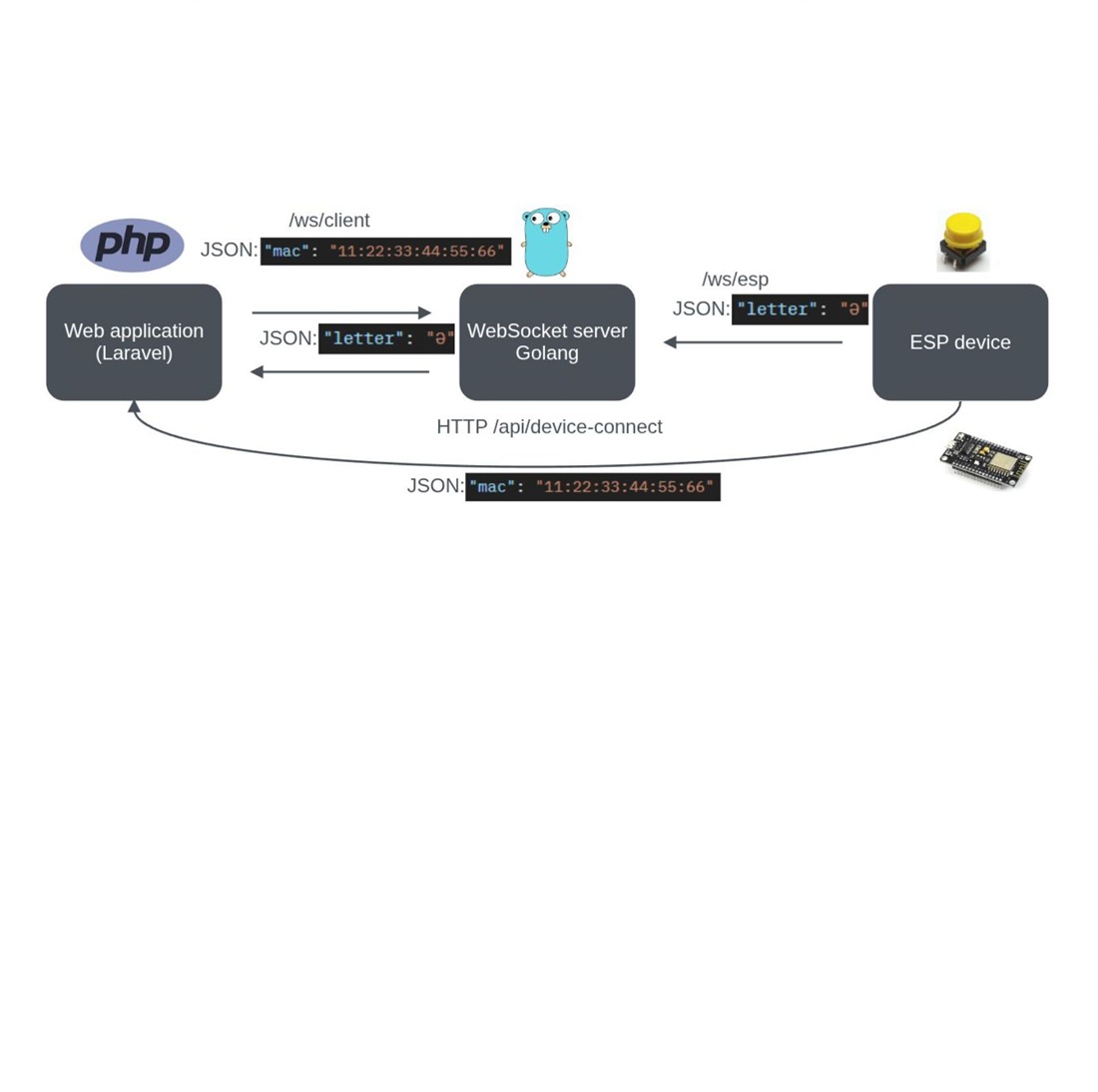
The object of research is the application of multimedia technologies to support literacy learning in the Kazakh language through interactive tools based on the integration of IoT and Web technologies. The problem addressed is the lack of effective, interactive tools for learning correct spelling and pronunciation in the Kazakh language adaptable to different user roles and levels. This study focuses on the development of a multimedia, interactive educational system aimed at enhancing literacy and promoting active language acquisition. To design aimed system in hardware side an ESP8266 microcontroller was used. 74HC165 shift registers, pull-up resistors are also installed on each button to ensure signal stability. A server side software solution built on the Laravel framework. Communication between the microcontroller and the server is established using the WebSocket protocol, a secure connection between the hardware device and the server is provided through the MAC address. The server runs in a Docker container using the Nginx and supports user roles such administrator, teacher, and student. The results obtained include a working prototype of learning system that allows users to complete tasks in five interactive modes. The results show that the integration of real-time hardware input with a flexible server-side architecture improves user engagement and learning personalization. The features of the solution are its real-time two-way communication via Websocket, role-based access, modular design in Docker, and support for Kazakh language content. The solution is intended at supporting educational institutions, kindergartens, and remote learning environments for learning letters and words, advancing digital education practices, and improving adaptable methods and technologies for the development of IoT based educational tools
References
- Bruneo, D., Distefano, S., Giacobbe, M., Longo Minnolo, A., Longo, F., Merlino, G. et al. (2019). An IoT service ecosystem for Smart Cities: The #SmartME project. Internet of Things, 5, 12–33. https://doi.org/10.1016/j.iot.2018.11.004
- AlHammadi, A., AlZaabi, A., AlMarzooqi, B., AlNeyadi, S., AlHashmi, Z., Shatnawi, M. (2019). Survey of IoT-Based Smart Home Approaches. 2019 Advances in Science and Engineering Technology International Conferences (ASET). https://doi.org/10.1109/icaset.2019.8714572
- Dosbayev, Z., Abdrakhmanov, R., Akhmetova, O., Nurtas, M., Iztayev, Z., Zhaidakbaeva, L., Shaimerdenova, L. (2021). Audio Surveillance: Detection of Audio-Based Emergency Situations. Advances in Computational Collective Intelligence. Cham: Springer International Publishing, 413–424. https://doi.org/10.1007/978-3-030-88113-9_33
- Perry, L. (2018). Internet of Things for Architects. Packt Publishing, 524.
- Felicia, A., Wong, W. K., Loh, W. N., Juwono, F. H. (2021). Increasing Role of IoT in Education Sector: A Review of Internet of Educational Things (IoEdT). 2021 International Conference on Green Energy, Computing and Sustainable Technology (GECOST), 1–6. https://doi.org/10.1109/gecost52368.2021.9538781
- Mircea, M., Stoica, M., Ghilic-Micu, B. (2021). Investigating the Impact of the Internet of Things in Higher Education Environment. IEEE Access, 9, 33396–33409. https://doi.org/10.1109/access.2021.3060964
- Badshah, A., Ghani, A., Daud, A., Jalal, A., Bilal, M., Crowcroft, J. (2023). Towards Smart Education through Internet of Things: A Survey. ACM Computing Surveys, 56 (2), 1–33. https://doi.org/10.1145/3610401
- Zeeshan, K., Hämäläinen, T., Neittaanmäki, P. (2022). Internet of Things for Sustainable Smart Education: An Overview. Sustainability, 14 (7), 4293. https://doi.org/10.3390/su14074293
- Hercog, D., Lerher, T., Truntič, M., Težak, O. (2023). Design and Implementation of ESP32-Based IoT Devices. Sensors, 23 (15), 6739. https://doi.org/10.3390/s23156739
- Xie, J., Yang, Y. (2021). IoT-based model for intelligent innovation practice system in higher education institutions. Journal of Intelligent & Fuzzy Systems, 40 (2), 2861–2870. https://doi.org/10.3233/jifs-189326
- Zhou, X., Li, X., Su, N. (2021). Design and Internet of Things Development of Network Teaching Resource Base System for Educational Technology. Journal of Physics: Conference Series, 1769 (1), 012005. https://doi.org/10.1088/1742-6596/1769/1/012005
- Jacko, P., Bereš, M., Kováčová, I., Molnár, J., Vince, T., Dziak, J. et al. (2022). Remote IoT Education Laboratory for Microcontrollers Based on the STM32 Chips. Sensors, 22 (4), 1440. https://doi.org/10.3390/s22041440
- Smailov, N., Uralova, F., Kadyrova, R., Magazov, R., Sabibolda, A. (2025). Optymalizacja metod uczenia maszynowego do deanonimizacji w sieciach społecznościowych. Informatyka, Automatyka, Pomiary w Gospodarce i Ochronie Środowiska, 15 (1), 101–104. https://doi.org/10.35784/iapgos.7098
- Domínguez-Bolaño, T., Campos, O., Barral, V., Escudero, C. J., García-Naya, J. A. (2022). An overview of IoT architectures, technologies, and existing open-source projects. Internet of Things, 20, 100626. https://doi.org/10.1016/j.iot.2022.100626
- Gerasimova, Y., Ivel, V., Moldakhmetov, S., Petrov, P. (2024). Hardware-software implementation of a local Wi-Fi network for the transmission of biomedical signals. Eastern-European Journal of Enterprise Technologies, 4 (9 (130)), 34–43. LOCKSS. https://doi.org/10.15587/1729-4061.2024.309387
- Narender, K., Kareem, D. S., Ali Nasir, Z., Prasad, P. H., Sai Charan, T., Naveed, A. (2024). ESP8266-based Industrial Appliances Control System by Blynk Software via WIFI Module. 2024 International Conference on Augmented Reality, Intelligent Systems, and Industrial Automation (ARIIA), 1–7. https://doi.org/10.1109/ariia63345.2024.11051837
- Mesquita, J., Guimaraes, D., Pereira, C., Santos, F., Almeida, L. (2018). Assessing the ESP8266 WiFi module for the Internet of Things. 2018 IEEE 23rd International Conference on Emerging Technologies and Factory Automation (ETFA), 784–791. https://doi.org/10.1109/etfa.2018.8502562
- Santos, L., Costa, T., Caldeira, J. M. L. P., Soares, V. N. G. J. (2022). Performance Assessment of ESP8266 Wireless Mesh Networks. Information, 13 (5), 210. https://doi.org/10.3390/info13050210
- Gay, W. (2017). More Pi Outputs with 74HC595. Custom Raspberry Pi Interfaces: Design and build hardware interfaces for the Raspberry Pi. Berkeley: Apress, 141–152. https://doi.org/10.1007/978-1-4842-2406-9_10
- Roussos, G., Nicopolitidis, P. (2024). A Project Overview: The Implementation of a Native Android App for Mobile Signal Detection and a PHP Laravel Web-Based Platform for Real-Time Monitoring and Analysis of Wireless Communication Networks for Educational Purposes. Smart Mobile Communication & Artificial Intelligence. Cham: Springer Nature, 114–125. https://doi.org/10.1007/978-3-031-56075-0_11
- Selvaraj, S. (2023). Real-Time Applications with Laravel. Building Real-Time Marvels with Laravel. Apress, 167–197. https://doi.org/10.1007/978-1-4842-9789-6_8
- Jain, D. (2024). Ultimate Laravel for Modern Web Development: Build Robust and Interactive Enterprise-Grade Web Apps using Laravel's MVC, Authentication, APIs, and Cloud Deployment. Orange Education Pvt Ltd.
- Stauffer, M. (2019). Laravel: Up & running: A framework for building modern php apps. O'Reilly Media, Inc.
- Sierra, E., Yuhana, U. L. (2023). Optimizing Software Development through Data Access Speed using Object-Relational Mapping (ORM) on Credit Risk Application. 2023 3rd International Conference on Smart Cities, Automation & Intelligent Computing Systems (ICON-SONICS), 201–206. https://doi.org/10.1109/icon-sonics59898.2023.10435255
- Chen, B., Jiang, Z. M., Matos, P., Lacaria, M. (2019). An Industrial Experience Report on Performance-Aware Refactoring on a Database-Centric Web Application. 2019 34th IEEE/ACM International Conference on Automated Software Engineering (ASE). https://doi.org/10.1109/ase.2019.00066
- Nichter, D. (2021). Efficient MySQL Performance. O'Reilly Media, Inc.
- Eko, C. E., Eteng, I. E., Essien, E. E. (2022). Design and implementation of a fault tolerant web-based examination system for developing countries. Eastern-European Journal of Enterprise Technologies, 1 (2 (115)), 58–67. https://doi.org/10.15587/1729-4061.2022.253146
- Diduk, V., Hrytsenko, V., Yeromenko, A. (2020). Building a model of network interaction between the components of a multiagent system of mobile robots. Eastern-European Journal of Enterprise Technologies, 5 (9 (107)), 57–63. https://doi.org/10.15587/1729-4061.2020.213989
- Zhou, X., Liu, G.-P., Hu, W., Lei, Z. (2024). Design and Implementation of a Mobile Experimental Application for Networked Control Systems. IEEE Transactions on Industrial Informatics, 20 (1), 744–753. https://doi.org/10.1109/tii.2023.3271435
- Schenker, G. N. (2023). The ultimate Docker container book: build, test, ship, and run containers with Docker and Kubernetes. Packt Publishing Ltd, 626.
- Ablyaev, M., Abliakimova, A., Seidametova, Z. (2020). Developing a Mobile Augmented Reality Application for Enhancing Early Literacy Skills. Information and Communication Technologies in Education, Research, and Industrial Applications. Cham: Springer International Publishing, 163–185. https://doi.org/10.1007/978-3-030-39459-2_8
- Özbek, A. B., Torppa, M. (2025). Developing an early literacy mobile app: design process and testing the app with children with special needs. Education and Information Technologies. https://doi.org/10.1007/s10639-025-13599-1
Downloads
Published
How to Cite
Issue
Section
License
Copyright (c) 2025 Zhandos Dosbayev, Amandyk Tuleshov, Arshidin Osmanov, Bibigul Sadykova, Nurzhigit Smailov, Akezhan Sabibolda

This work is licensed under a Creative Commons Attribution 4.0 International License.
The consolidation and conditions for the transfer of copyright (identification of authorship) is carried out in the License Agreement. In particular, the authors reserve the right to the authorship of their manuscript and transfer the first publication of this work to the journal under the terms of the Creative Commons CC BY license. At the same time, they have the right to conclude on their own additional agreements concerning the non-exclusive distribution of the work in the form in which it was published by this journal, but provided that the link to the first publication of the article in this journal is preserved.
A license agreement is a document in which the author warrants that he/she owns all copyright for the work (manuscript, article, etc.).
The authors, signing the License Agreement with TECHNOLOGY CENTER PC, have all rights to the further use of their work, provided that they link to our edition in which the work was published.
According to the terms of the License Agreement, the Publisher TECHNOLOGY CENTER PC does not take away your copyrights and receives permission from the authors to use and dissemination of the publication through the world's scientific resources (own electronic resources, scientometric databases, repositories, libraries, etc.).
In the absence of a signed License Agreement or in the absence of this agreement of identifiers allowing to identify the identity of the author, the editors have no right to work with the manuscript.
It is important to remember that there is another type of agreement between authors and publishers – when copyright is transferred from the authors to the publisher. In this case, the authors lose ownership of their work and may not use it in any way.







