Створення методу оцінки ефективності системи охолодження та визначення теплового стану вертикальних синхронних гідрогенераторів із застосуванням тривимірного CFD-моделювання
DOI:
https://doi.org/10.15587/1729-4061.2026.350505Ключові слова:
система вентиляції гідрогенератора, CFD-моделювання, канали ротора, робоча характеристика вентилятораАнотація
Об’єктом дослідження є процеси тепломасообміну в конструктивних елементах гідрогенератора та система вентиляції і охолодження в активних компонентах гідрогенератора. Досліджується вертикальний синхронний гідрогенератор зонтичного типу з повітряним охолодженням потужністю 60 МВт.
В дослідженні вирішувалась проблема ефективності охолодження вузлів генератора при модернізації системи вентиляції. Традиційні аналітичні методи розрахунку не дозволяють з достатньою точністю виявити локальні зони перегріву та розподіл тиску в складних вентиляційних каналах. Тому виникла необхідність застосування чисельних методів та алгоритмів для розрахунку і аналізу ефективності охолодження активних частин генератора.
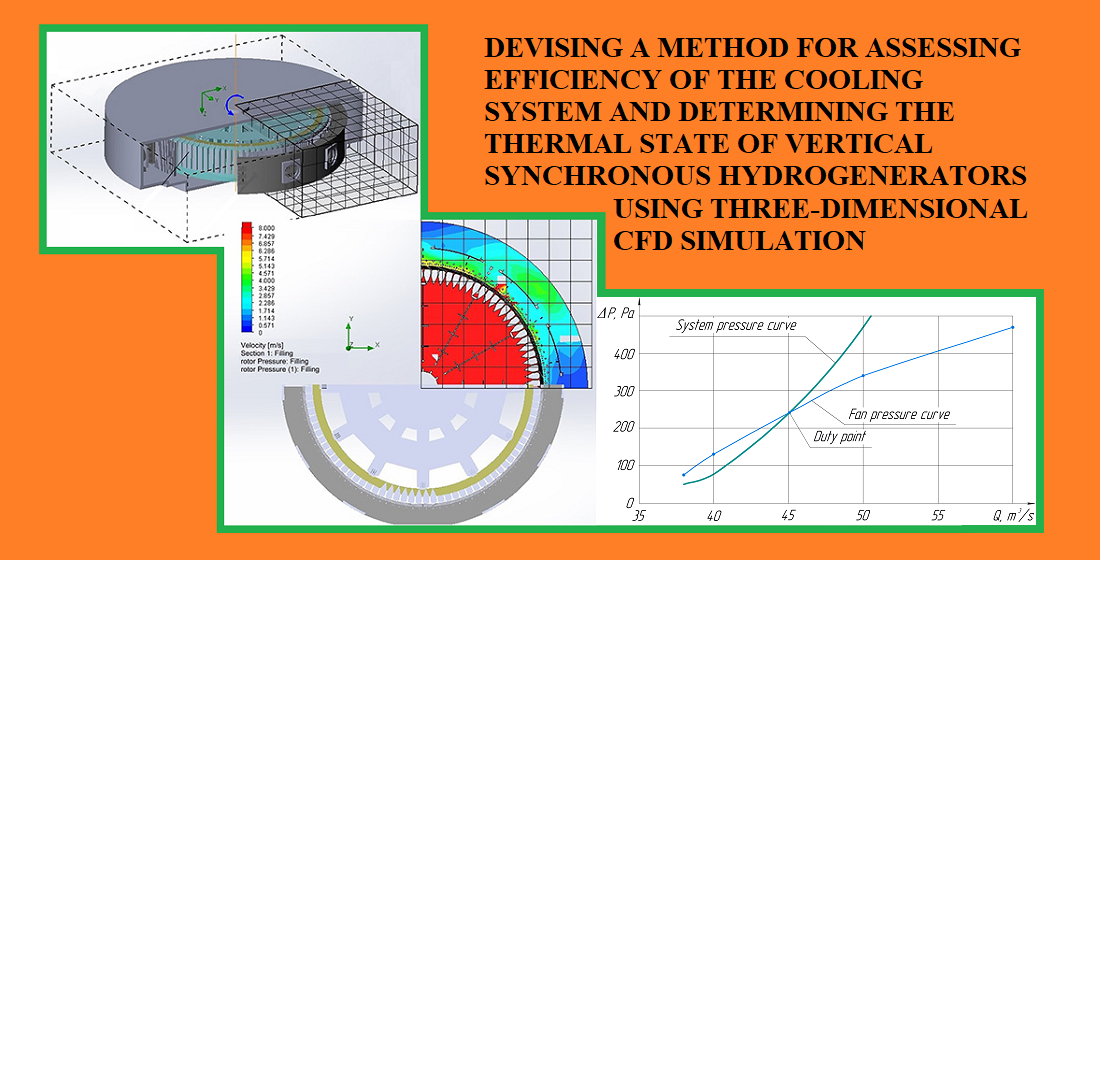
Основним результатом дослідження є створена конструкція напрямних каналів (лопаток) ротора, яка забезпечує необхідну витрату повітря 45 м3/с. При цьому максимальні значення температури обмоток не перевищують допустимих значень для ізоляції класу F.
CFD-розрахунок деталізував дію нагнітачів і показав реальний тиск у каналах та об’єм повітря, що проходить через кожну ділянку генератора. Похибка між результатами моделювання CFD-методом та аналітичними розрахунками становить менше 3%.
Результати пояснюються детальним відтворенням геометрії вентиляційних каналів у 3D-моделі, що дозволило визначити реальні аеродинамічні опори та витрату охолоджуючого середовища.
Запропонований метод використовує граничні умови третього роду, отримані за допомогою чисельного моделювання фізичних процесів, для комплексного розрахунку спряженого тепломасообміну всіх вузлів гідрогенератора.
Запропонована конструкція може бути впроваджена при проєктуванні та модернізації гідрогенераторів з повітряним охолодженням.
Посилання
- Hydropower Special Market Report (2021). International Energy Agency. Available at: https://www.iea.org/reports/hydropower-special-market-report
- Siciliano, G., Urban, F. (Eds.) (2017). Chinese Hydropower Development in Africa and Asia. Routledge. https://doi.org/10.4324/9781315440040
- Rutschmann, P., Kampa, E., Wolter, C., Albayrak, I., David, L., Stoltz, U., Schletterer, M. (Eds.) (2022). Novel Developments for Sustainable Hydropower. Springer International Publishing. https://doi.org/10.1007/978-3-030-99138-8
- Renewable Power Generation Costs in 2022 (2023). IRENA. Available at: https://www.irena.org/Publications/2023/Aug/Renewable-Power-Generation-Costs-in-2022
- World Hydropower Outlook (2023). International Hydropower Association. Available at: https://www.hydropower.org/publications/2023-world-hydropower-outlook
- Quaranta, E., Aggidis, G., Boes, R. M., Comoglio, C., De Michele, C., Ritesh Patro, E. et al. (2021). Assessing the energy potential of modernizing the European hydropower fleet. Energy Conversion and Management, 246, 114655. https://doi.org/10.1016/j.enconman.2021.114655
- Traxler-Samek, G., Binder, A., Bartosch, M. (2020). Combination of Numerical and Analytical Methods for Hydrogenerator Calculation. 2020 International Conference on Electrical Machines (ICEM), 2589–2595. https://doi.org/10.1109/icem49940.2020.9270973
- Traxler-Samek, G., Zickermann, R., Schwery, A. (2010). Cooling Airflow, Losses, and Temperatures in Large Air-Cooled Synchronous Machines. IEEE Transactions on Industrial Electronics, 57 (1), 172–180. https://doi.org/10.1109/tie.2009.2031191
- Yu, W., Fangmian, D., Jiankangy, W., Ziran, C., Lin, R. (2022). Effect of evaporative cooling of stator core on electromagnetic field of large horizontal generator. 2022 25th International Conference on Electrical Machines and Systems (ICEMS), 1–4. https://doi.org/10.1109/icems56177.2022.9982834
- Tome-Robles, D. J., Nøland, J. K., Maurer, F., Øyvang, T. (2023). Thermal Mapping of the Hydrogenerator’s Reactive Power Boosting Ability at Various Time Windows. 2023 IEEE Power & Energy Society General Meeting (PESGM), 1–5. https://doi.org/10.1109/pesgm52003.2023.10252548
- Shan, R., Duan, J., Zeng, Y., Qian, J., Dong, G., Zhu, M., Zhao, J. (2024). Study on the Thermal Field of a Hydro-Generator under the Effect of a Plateau Climate. Energies, 17 (4), 932. https://doi.org/10.3390/en17040932
- Fan, Y., Wen, X., Xu S., Deng, W. (2006). 3D Analysis and Calculation of Stator Temperature Field of Hydro-generator in the Case of Sudden Short Circuit. Conference Record of the 2006 IEEE International Symposium on Electrical Insulation, 155–158. https://doi.org/10.1109/elinsl.2006.1665280
- Fan, Y., Wen, X., Jafri, S. A. K. S. (2012). 3D transient temperature field analysis of the stator of a hydro-generator under the sudden short-circuit condition. IET Electric Power Applications, 6 (3), 143–148. https://doi.org/10.1049/iet-epa.2011.0039
- Yehorov, A., Duniev, O., Masliennikov, A., Gouws, R., Dobzhanskyi, O., Stamann, M. (2025). Study on the Thermal State of a Transverse-Flux Motor. IEEE Access, 13, 20893–20902. https://doi.org/10.1109/access.2025.3534284
- Shevchenko, V. V., Shylkova, L. V., Strokous, A. V. (2022). Determination of the Permissible Range of Turbogenerators Non-Nominal Operating Modes at Thermal Power Plants. 2022 IEEE 4th International Conference on Modern Electrical and Energy System (MEES), 01–05. https://doi.org/10.1109/mees58014.2022.10005663
- SanAndres, U., Almandoz, G., Poza, J., Ugalde, G. (2014). Design of Cooling Systems Using Computational Fluid Dynamics and Analytical Thermal Models. IEEE Transactions on Industrial Electronics, 61 (8), 4383–4391. https://doi.org/10.1109/tie.2013.2286081
- Dang, D.-D., Pham, X.-T., Labbe, P., Torriano, F., Morissette, J.-F., Hudon, C. (2018). CFD analysis of turbulent convective heat transfer in a hydro-generator rotor-stator system. Applied Thermal Engineering, 130, 17–28. https://doi.org/10.1016/j.applthermaleng.2017.11.034
- Vasylenko, S. M., Kulinchenko, V. R., Shevchenko, O. Yu., Piddubnyi, V. A. (2024). Hidrohazodynamika. Kyiv: Vydavnychyi dim «Kondor», 676. Available at: https://condor-books.com.ua/monografiyi/gidrogazodinamika-monografiya
- Howard, G. J. (2017). Finite Element Modelling of Creep for an Industrial Application. University of Pretoria. Available at: http://hdl.handle.net/2263/60133
##submission.downloads##
Опубліковано
Як цитувати
Номер
Розділ
Ліцензія
Авторське право (c) 2026 Andrii Yehorov, Stanislav Kravchenko, Oleksii Duniev, Oleksandr Vasyliev, Denys Hromenko, Serhii Lukashevych, Oleh Buhaiov, Kostiantyn Liakhov, Anton Kovryga, Dmytro Obidin

Ця робота ліцензується відповідно до Creative Commons Attribution 4.0 International License.
Закріплення та умови передачі авторських прав (ідентифікація авторства) здійснюється у Ліцензійному договорі. Зокрема, автори залишають за собою право на авторство свого рукопису та передають журналу право першої публікації цієї роботи на умовах ліцензії Creative Commons CC BY. При цьому вони мають право укладати самостійно додаткові угоди, що стосуються неексклюзивного поширення роботи у тому вигляді, в якому вона була опублікована цим журналом, але за умови збереження посилання на першу публікацію статті в цьому журналі.
Ліцензійний договір – це документ, в якому автор гарантує, що володіє усіма авторськими правами на твір (рукопис, статтю, тощо).
Автори, підписуючи Ліцензійний договір з ПП «ТЕХНОЛОГІЧНИЙ ЦЕНТР», мають усі права на подальше використання свого твору за умови посилання на наше видання, в якому твір опублікований. Відповідно до умов Ліцензійного договору, Видавець ПП «ТЕХНОЛОГІЧНИЙ ЦЕНТР» не забирає ваші авторські права та отримує від авторів дозвіл на використання та розповсюдження публікації через світові наукові ресурси (власні електронні ресурси, наукометричні бази даних, репозитарії, бібліотеки тощо).
За відсутності підписаного Ліцензійного договору або за відсутністю вказаних в цьому договорі ідентифікаторів, що дають змогу ідентифікувати особу автора, редакція не має права працювати з рукописом.
Важливо пам’ятати, що існує і інший тип угоди між авторами та видавцями – коли авторські права передаються від авторів до видавця. В такому разі автори втрачають права власності на свій твір та не можуть його використовувати в будь-який спосіб.