Evaluating the impact of graalvm and JVM on mobile banking microservices performance
DOI:
https://doi.org/10.15587/1729-4061.2025.315493Keywords:
GraalVM, Java Spring Boot, Java Virtual Machine, application performance, resource optimizationAbstract
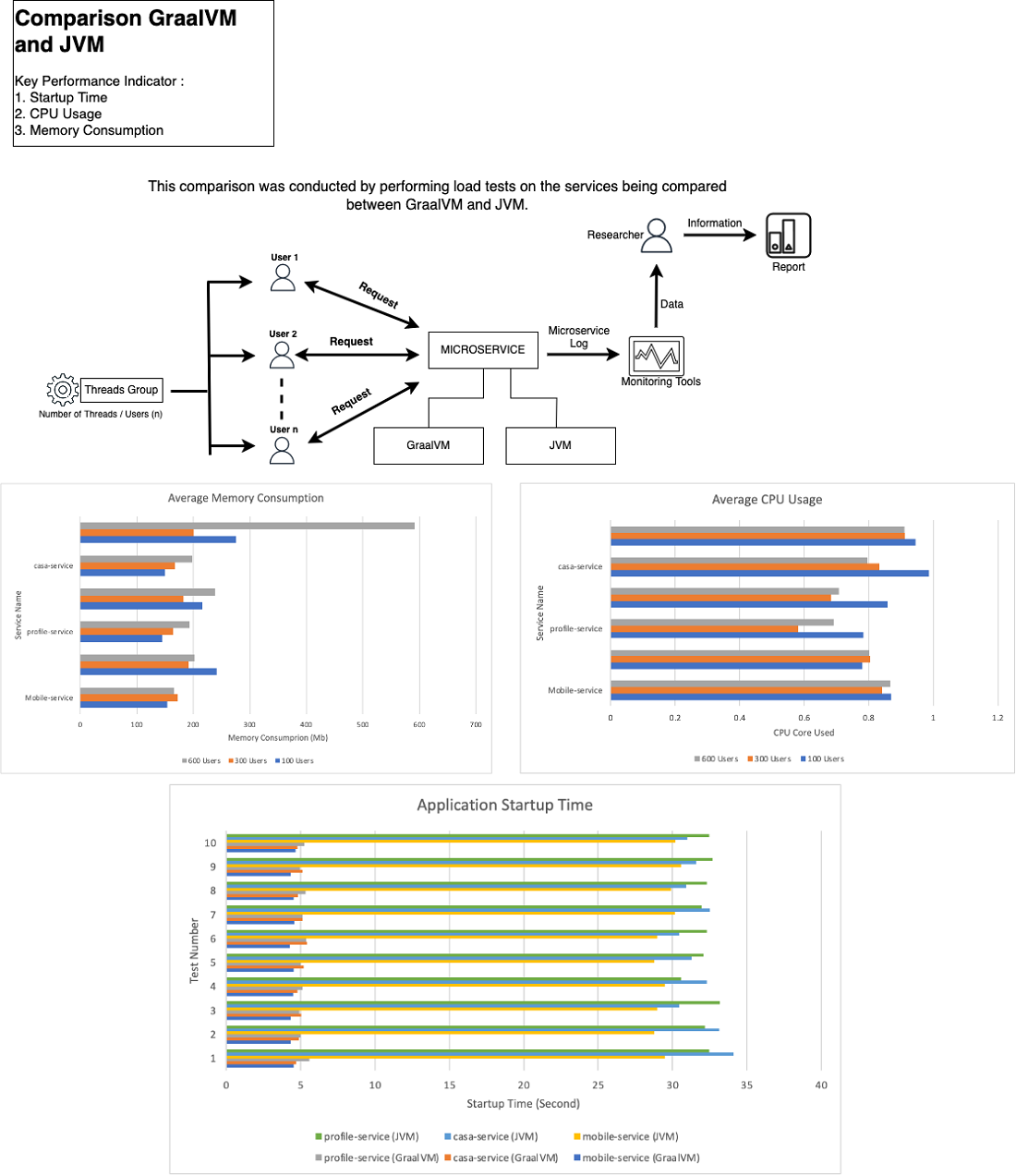
This study investigates the implementation of Graal Virtual Machine (GraalVM) in Java Spring Boot microservices for mobile banking applications. Increasing digital banking demand and user growth necessitate systems that can handle high transaction volumes efficiently. Java Virtual Machine (JVM) environments face challenges, including slower application startup times, higher CPU usage, and increased memory consumption, limiting their suitability for such high-demand scenarios. To address these issues, this research uses a quasi-experimental design to compare microservices' performance on GraalVM and JVM by analyzing key metrics: application startup time, CPU usage, and memory consumption under various load scenarios. Results show that GraalVM significantly improves startup times, reducing delays by 25–30 seconds across services, thus enhancing responsiveness. CPU usage showed varied outcomes: mobile-service demonstrated reductions (e.g., 0.8678 to 0.7798 for 100 users), whereas profile-service and casa-service recorded slight increases under certain workloads (e.g., 0.7829 to 0.8569 for profile-service at 100 users). Memory consumption increased notably for GraalVM, particularly in high-load scenarios such as casa-service at 600 users (198.47 MB to 591.38 MB). These findings highlight the trade-offs of adopting GraalVM, with faster startup times offset by higher memory usage in specific services. The results underscore the importance of workload-specific evaluations when optimizing microservices. Practical applications of this research include guiding system architects in selecting appropriate runtime environments to enhance the performance and scalability of mobile banking systems, ensuring efficient operation under varying demands
References
- Grigorescu, A., Oprisan, O., Lincaru, C., Pirciog, C. S. (2023). E-Banking Convergence and the Adopter’s Behavior Changing Across EU Countries. Sage Open, 13 (4). https://doi.org/10.1177/21582440231220455
- Ionașcu, A. E., Gheorghiu, G., Spătariu, E. C., Munteanu, I., Grigorescu, A., Dănilă, A. (2023). Unraveling Digital Transformation in Banking: Evidence from Romania. Systems, 11 (11), 534. https://doi.org/10.3390/systems11110534
- Kim, L., Jindabot, T. (2022). Evolution of customer satisfaction in the e-banking service industry. Innovative Marketing, 18 (1), 131–141. https://doi.org/10.21511/im.18(1).2022.11
- Aydemir, F., Başçiftçi, F. (2022). Building a Performance Efficient Core Banking System Based on the Microservices Architecture. Journal of Grid Computing, 20 (4). https://doi.org/10.1007/s10723-022-09624-z
- Yin, P., Cheng, J. (2023). A MySQL-Based Software System of Urban Land Planning Database of Shanghai in China. Computer Modeling in Engineering & Sciences, 135 (3), 2387–2405. https://doi.org/10.32604/cmes.2023.023666
- Larsson, R. (2020). Evaluation of GraalVM Performance for Java Programs. Available at: http://www.diva-portal.org/smash/get/diva2:1457592/FULLTEXT01.pdf
- Fong, F., Raed, M. (2021). Performance comparison of GraalVM, Oracle JDK and OpenJDK for optimization of test suite execution time. Available at: https://www.diva-portal.org/smash/get/diva2:1597213/FULLTEXT01.pdf
- Kozak, D., Jovanovic, V., Stancu, C., Vojnar, T., Wimmer, C. (2023). Comparing Rapid Type Analysis with Points-To Analysis in GraalVM Native Image. Proceedings of the 20th ACM SIGPLAN International Conference on Managed Programming Languages and Runtimes, 129–142. https://doi.org/10.1145/3617651.3622980
- Wyciślik, Ł., Latusik, Ł., Kamińska, A. M. (2023). A Comparative Assessment of JVM Frameworks to Develop Microservices. Applied Sciences, 13 (3), 1343. https://doi.org/10.3390/app13031343
- Sipek, M., Mihaljevic, B., Radovan, A. (2019). Exploring Aspects of Polyglot High-Performance Virtual Machine GraalVM. 2019 42nd International Convention on Information and Communication Technology, Electronics and Microelectronics (MIPRO), 1671–1676. https://doi.org/10.23919/mipro.2019.8756917
- Kreindl, J., Rigger, M., Mössenböck, H. (2018). Debugging native extensions of dynamic languages. Proceedings of the 15th International Conference on Managed Languages & Runtimes - ManLang ’18, 1–7. https://doi.org/10.1145/3237009.3237017
- Li, S., Jia, Z., Li, Y., Liao, X., Xu, E., Liu, X. et al. (2019). Detecting Performance Bottlenecks Guided by Resource Usage. IEEE Access, 7, 117839–117849. https://doi.org/10.1109/access.2019.2936599
- Sampaio, A. R., Rubin, J., Beschastnikh, I., Rosa, N. S. (2019). Improving microservice-based applications with runtime placement adaptation. Journal of Internet Services and Applications, 10 (1). https://doi.org/10.1186/s13174-019-0104-0
- Cosmina, I. (2021). Java 17 for Absolute Beginners. Apress, 801. https://doi.org/10.1007/978-1-4842-7080-6
- Indrianto, I. (2023). Performance testing on web information system using apache jmeter and blazemeter. Jurnal Ilmiah Ilmu Terapan Universitas Jambi, 7 (2), 138–149. https://doi.org/10.22437/jiituj.v7i2.28440
- Gravetter, F. J., Wallnau, L. B. (2017). Statistics for the Behavioral Sciences. Cengage Learning. Available at: http://ndl.ethernet.edu.et/bitstream/123456789/29095/1/Frederick%20J%20Gravetter_2017.pdf
- Deshpande, J. V., Naik-Nimbalkar, U., Dewan, I. (2018). Nonparametric Statistics Theory and Methods. World Scientific. Available at: https://sadbhavnapublications.org/research-enrichment-material/2-Statistical-Books/Nonparametric-Statistics-Theory-and-Methods.pdf
- Corder, G. W., Foreman, D. I. (2014). Nonparametric Statistics. A Step by Step Approach. Wiley. Available at: https://faculty.ksu.edu.sa/sites/default/files/nonparametric_statistics_a_step-by-step_approach.pdf
Downloads
Published
How to Cite
Issue
Section
License
Copyright (c) 2025 Edwin Yosef Setiawan Sihombing, Muhammad Zarlis

This work is licensed under a Creative Commons Attribution 4.0 International License.
The consolidation and conditions for the transfer of copyright (identification of authorship) is carried out in the License Agreement. In particular, the authors reserve the right to the authorship of their manuscript and transfer the first publication of this work to the journal under the terms of the Creative Commons CC BY license. At the same time, they have the right to conclude on their own additional agreements concerning the non-exclusive distribution of the work in the form in which it was published by this journal, but provided that the link to the first publication of the article in this journal is preserved.
A license agreement is a document in which the author warrants that he/she owns all copyright for the work (manuscript, article, etc.).
The authors, signing the License Agreement with TECHNOLOGY CENTER PC, have all rights to the further use of their work, provided that they link to our edition in which the work was published.
According to the terms of the License Agreement, the Publisher TECHNOLOGY CENTER PC does not take away your copyrights and receives permission from the authors to use and dissemination of the publication through the world's scientific resources (own electronic resources, scientometric databases, repositories, libraries, etc.).
In the absence of a signed License Agreement or in the absence of this agreement of identifiers allowing to identify the identity of the author, the editors have no right to work with the manuscript.
It is important to remember that there is another type of agreement between authors and publishers – when copyright is transferred from the authors to the publisher. In this case, the authors lose ownership of their work and may not use it in any way.








