Evaluating the effects of electrokinetic stabilization variables on Atterberg limits and shear strength of clay soil using Taguchi method
DOI:
https://doi.org/10.15587/1729-4061.2025.317995Keywords:
electrokinetic stabilization, clay soil, Taguchi experimental design, Atterberg limit, shear strengthAbstract
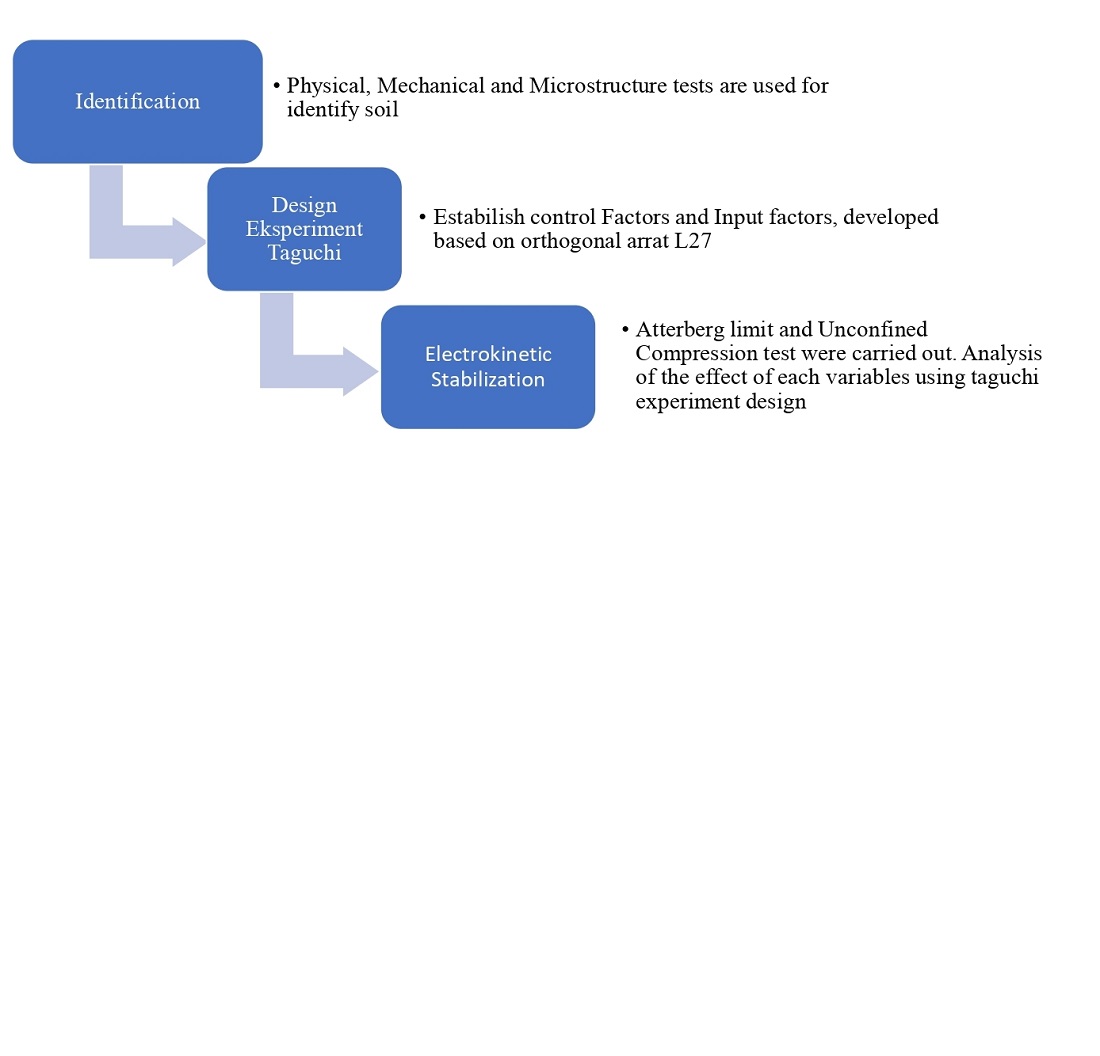
Clay soil often poses a significant challenge in construction projects due to its plasticity, low bearing capacity, and tendency to shrink or expand as moisture levels change. The properties and characteristics of clay soil make it have a low bearing capacity. Electrokinetic stabilization is an effective technique to overcome this clay soil problem. Previous research has identified the variables that influence electrokinetic stabilization, namely the voltage applied, the electrokinetic application time, the type of solution, the pH solution concentration, and the drying of the soil after electrokinetic stabilization. Of all the variables that influence electrokinetic stabilization, it is known that it can increase the Atterberg limit value and the bearing capacity (qu). This study aims to determine the percentage contribution of each variable to the increase in IP and qu values. A Taguchi experimental design was used to determine the contribution of each electrokinetic stabilization variable to the IP and qu values. The variables used in this study were solution concentration, voltage, electrokinetic duration, and curing time. The experiment was carried out by identifying the soil, determining the control and input factors based on the L27 orthogonal matrix, performing electrokinetic stabilization, testing the Atterberg limits and unconfined compressive strength, and analyzing the effect of each variable using statistical analysis. The results showed that the most influential variables in increasing the bearing capacity of the soil (qu) were the duration of the electrokinetic application, the voltage applied, and the concentration of the solution used.
The most influential variable in increasing the qu value is the duration of electrokinetic application, which is 66.9 %; then the concentration of the solution is 29.72 %, and the voltage applied is 16.91 %. The treatment duration variable has no effect on increasing the qu value.
From the results of this study, the application in the field in electrokinetic stabilization for clay soil needs to be considered for the duration of application, voltage, and concentration of the solution used so that there is optimum soil improvement
References
- Irawati, I., Djakfar, L., Arifin, M. Z. (2023). Comparison of the moisture resistance of a steel-slag stone mastic asphalt mixture modified with Ca(OH)2. Eastern-European Journal of Enterprise Technologies, 6 (6 (126)), 62–70. https://doi.org/10.15587/1729-4061.2023.289054
- Gunarti, A. S. S., Zaika, Y., Munawir, A., Suryo, E. A., Harimurti, H. (2023). Identifying the microstructure and mechanical properties of expansive soil stabilized using fly ash and waste foundry sand. Eastern-European Journal of Enterprise Technologies, 6 (6 (126)), 31–40. LOCKSS. https://doi.org/10.15587/1729-4061.2023.286991
- Gunarti, A. S. S., Zaika, Y., Munawir, A., Suryo, E. A., Harimurti, H. (2024). Identifying the effect of subgrade layer thickness of soil stabilized with waste foundry sand and fly ash on bearing capacity. Engineering Technological Systems, 4 (1 (130)), 27–36. https://doi.org/10.15587/1729-4061.2024.306754
- Tuan, P.-A., Mika, S., Pirjo, I. (2012). Sewage Sludge Electro-Dewatering Treatment – A Review. Drying Technology, 30 (7), 691–706. https://doi.org/10.1080/07373937.2012.654874
- Estabragh, A. R., Naseh, M., Javadi, A. A. (2014). Improvement of clay soil by electro-osmosis technique. Applied Clay Science, 95, 32–36. https://doi.org/10.1016/j.clay.2014.03.019
- Touch, N., Hibino, T., Nakashita, S., Nakamoto, K. (2016). Variation in properties of the sediment following electrokinetic treatments. Environmental Technology, 38 (3), 277–284. https://doi.org/10.1080/09593330.2016.1190408
- Lee, J. K., Shang, J. Q. (2013). Electrical vertical drains in geotechnical engineering applications. Geotechnical Engineering, 44 (4), 24–35. Available at: http://seags.ait.asia/e-journal/E-Journal%202013/dec/SEAGS-E-Journal-2013-December-24-35-Shang.pdf
- Ou, C.-Y., Chien, S.-C., Yang, C.-C., Chen, C.-T. (2015). Mechanism of soil cementation by electroosmotic chemical treatment. Applied Clay Science, 104, 135–142. https://doi.org/10.1016/j.clay.2014.11.020
- Dutta, J., Mishra, A. K. (2016). Consolidation behaviour of bentonites in the presence of salt solutions. Applied Clay Science, 120, 61–69. https://doi.org/10.1016/j.clay.2015.12.001
- Hamza, O., Ikin, J. (2020). Electrokinetic treatment of desiccated expansive clay. Géotechnique, 70 (5), 421–431. https://doi.org/10.1680/jgeot.18.p.266
- Ayodele, A. L., Pamukcu, S., Agbede, O. A. (2020). Plasticity modification of a tropical laterite by electrochemical stabilization. Electrochimica Acta, 341, 136047. https://doi.org/10.1016/j.electacta.2020.136047
- Iwata, M., Tanaka, T., Jami, M. S. (2013). Application of Electroosmosis for Sludge Dewatering – A Review. Drying Technology, 31 (2), 170–184. https://doi.org/10.1080/07373937.2012.691592
- Gu, Y.-Y., Yeung, A. T., Koenig, A., Li, H.-J. (2009). Effects of Chelating Agents on Zeta Potential of Cadmium-Contaminated Natural Clay. Separation Science and Technology, 44 (10), 2203–2222. https://doi.org/10.1080/01496390902976731
- Liu, J., Afroz, M., Ahmad, A. (2020). Experimental investigation of the impact of salinity on Champlain Sea clay. Marine Georesources & Geotechnology, 39 (4), 494–504. https://doi.org/10.1080/1064119x.2020.1718811
- Estabragh, A. R., Moghadas, M., Javadi, A. A., Abdollahi, J. (2019). Stabilisation of clay soil with polymers through electrokinetic technique. European Journal of Environmental and Civil Engineering, 26 (3), 819–837. https://doi.org/10.1080/19648189.2019.1680444
- Chien, S.-C., Teng, F.-C., Ou, C.-Y. (2014). Soil improvement of electroosmosis with the chemical treatment using the suitable operation process. Acta Geotechnica, 10 (6), 813–820. https://doi.org/10.1007/s11440-014-0319-y
- Jayasekera, S. (2007). Stabilising volume change characteristics of expansive soils using electrokinetics: A laboratory based investigation. Available at: https://researchonline.federation.edu.au/vital/access/manager/Repository/vital:3601;jsessionid=664E7C0BBF4B59B995F9E01B1DBA5DAE
- Zhang, L., Hu, L. (2022). Numerical simulation of electro-osmotic consolidation considering tempo-spatial variation of soil pH and soil parameters. Computers and Geotechnics, 147, 104802. https://doi.org/10.1016/j.compgeo.2022.104802
- Utami, S. R., Mees, F., Dumon, M., Qafoku, N. P., Van Ranst, E. (2019). Charge fingerprint in relation to mineralogical composition of Quaternary volcanic ash along a climatic gradient on Java Island, Indonesia. CATENA, 172, 547–557. https://doi.org/10.1016/j.catena.2018.09.024
- Zhao, Y., Song, M., Tang, X., Wu, M., Li, B. (2023). Design and Validation of a Rapid and Accurate Identification Scheme for Clay Minerals in Soils by Combining Different Optical Analysis Methods. IEEE Transactions on Instrumentation and Measurement, 72, 1–11. https://doi.org/10.1109/tim.2023.3328027
- Jamsawang, P., Poorahong, H., Yoobanpot, N., Songpiriyakij, S., Jongpradist, P. (2017). Improvement of soft clay with cement and bagasse ash waste. Construction and Building Materials, 154, 61–71. https://doi.org/10.1016/j.conbuildmat.2017.07.188
- Cameselle, C. (2015). Enhancement Of Electro-Osmotic Flow During The Electrokinetic Treatment Of A Contaminated Soil. Electrochimica Acta, 181, 31–38. https://doi.org/10.1016/j.electacta.2015.02.191
- Tang, X., Xue, Z., Yang, Q., Li, T., VanSeveren, M. (2017). Water content and shear strength evaluation of marine soil after electro-osmosis experiments. Drying Technology, 35 (14), 1696–1710. https://doi.org/10.1080/07373937.2016.1270299
Downloads
Published
How to Cite
Issue
Section
License
Copyright (c) 2025 Lydia Darmiyanti, As’ad Munawir, Arief Rachmansyah, Yulvi Zaika, Eko Andi Suryo

This work is licensed under a Creative Commons Attribution 4.0 International License.
The consolidation and conditions for the transfer of copyright (identification of authorship) is carried out in the License Agreement. In particular, the authors reserve the right to the authorship of their manuscript and transfer the first publication of this work to the journal under the terms of the Creative Commons CC BY license. At the same time, they have the right to conclude on their own additional agreements concerning the non-exclusive distribution of the work in the form in which it was published by this journal, but provided that the link to the first publication of the article in this journal is preserved.
A license agreement is a document in which the author warrants that he/she owns all copyright for the work (manuscript, article, etc.).
The authors, signing the License Agreement with TECHNOLOGY CENTER PC, have all rights to the further use of their work, provided that they link to our edition in which the work was published.
According to the terms of the License Agreement, the Publisher TECHNOLOGY CENTER PC does not take away your copyrights and receives permission from the authors to use and dissemination of the publication through the world's scientific resources (own electronic resources, scientometric databases, repositories, libraries, etc.).
In the absence of a signed License Agreement or in the absence of this agreement of identifiers allowing to identify the identity of the author, the editors have no right to work with the manuscript.
It is important to remember that there is another type of agreement between authors and publishers – when copyright is transferred from the authors to the publisher. In this case, the authors lose ownership of their work and may not use it in any way.








