Identifying patterns in the resistance of thermally modified ash wood to weathering
DOI:
https://doi.org/10.15587/1729-4061.2025.322368Keywords:
wood, ash, degree of thermal modification, weathering, moisture removalmoisture removal, drying cracks, strengthAbstract
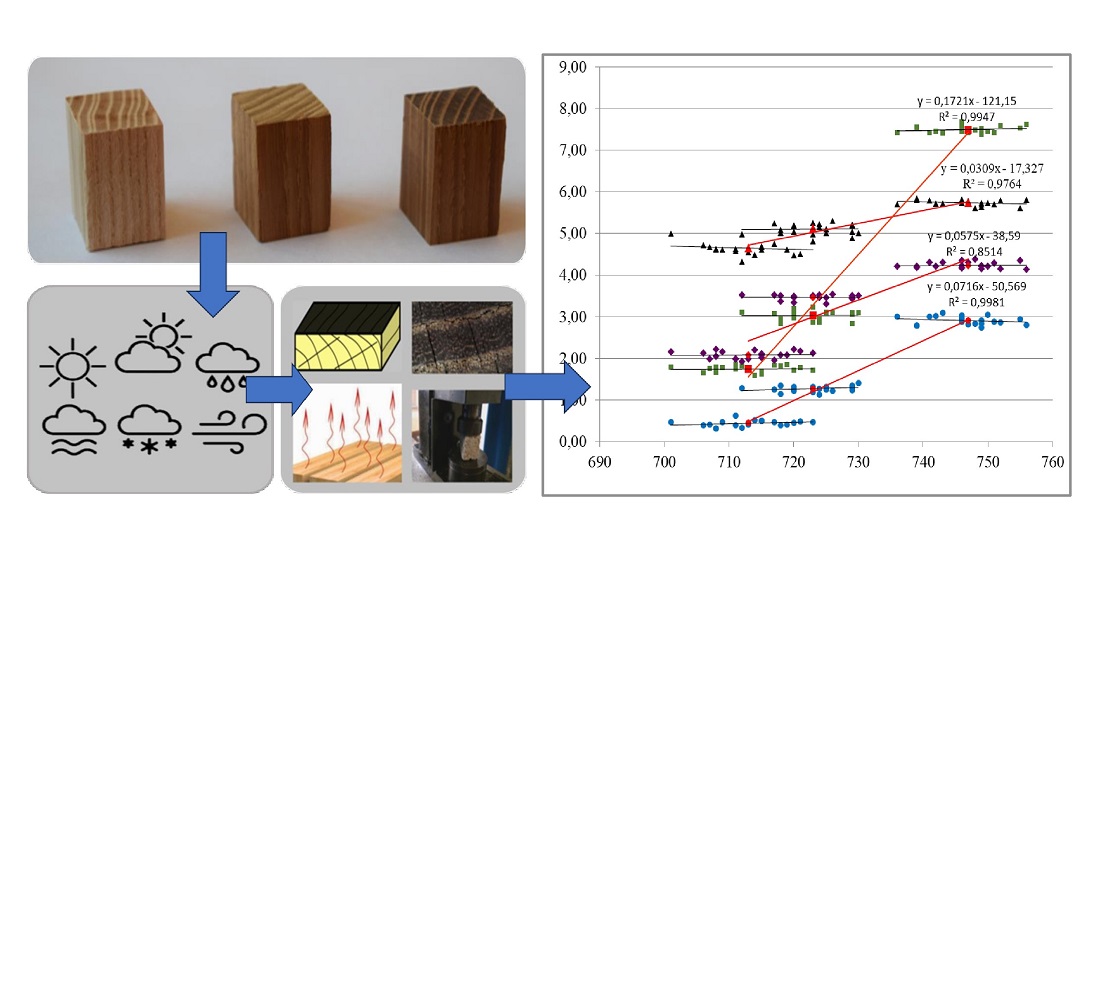
Weathering of thermally modified wood negatively affects both the appearance of structures and their physical-mechanical characteristics, which further determines their service life. Given this, the object of the study was the resistance of ash wood varying degrees modification to abiotic environmental factors. It was found that the color stability of thermally modified wood samples is higher compared to untreated ones. A decrease in the value of the coordinate L from 68.4 to 33.6 indicates a decrease in lightness, that is darkening of the wood. Analysis of dimensional changes revealed increased swelling for untreated wood and amounted to 7.49 %, and for modified at a temperature of 200 °С – 1.75 %. The difference in shrinkage rates is much smaller – 2.09 % for wood of group III, which is 2 times less than untreated wood. The results confirm that thermal modification makes wood cell walls more hydrophobic by eliminating hydrophilic and hydroxyl groups of hemicelluloses. A linear dependence (R2≈1) of change in the physical characteristics of wood depending on its density due to the degree of modification has been established. Analysis of mechanical properties revealed that thermal modification increases the resistance of wood to compressive across the fibers by 2 times. Therefore, a comprehensive approach to analyzing the impact of weathering on the aesthetic, physical, and mechanical properties of thermally modified wood makes it possible to identify the principles of material stability depending on the treatment schedule. The identified mechanisms of transformation of material parameters contribute to the establishment of optimal parameters of thermal modification, which improve its characteristics. This creates the prerequisites for implementing new technological solutions focused on environmental friendliness and energy efficiency in production
References
- Kránitz, K., Sonderegger, W., Bues, C.-T., Niemz, P. (2015). Effects of aging on wood: a literature review. Wood Science and Technology, 50 (1), 7–22. https://doi.org/10.1007/s00226-015-0766-0
- Kiktev, N., Nykyforova, L., Lendiel, T., Mazurchuk, P., Lendiel, M. (2023). Wireless Subsystem for Control Technological Parameters of Electrophysical Influence to Increase Plant Productivity. CEUR Workshop Proceedings, 3646, 149–159. Available at: https://ceur-ws.org/Vol-3646/Paper_15.pdf
- Pinchevska, O., Spirochkin, A., Oliynyk, R., Sedliačik, J. (2018). Selection of the efficient drying schedule in conventional chambers. Acta Facultatis Xylologiae, 60 (2), 125–134. https://doi.org/10.17423/afx.2018.60.2.12
- Horbachova, O., Buiskykh, N., Mazurchuk, S., Lomaha, V. (2024). Acetylation of Aspen and Alder Wood - Preliminary Tests. Key Engineering Materials, 986, 45–52. https://doi.org/10.4028/p-d9fylx
- Mattonai, M., Watanabe, A., Shiono, A., Ribechini, E. (2019). Degradation of wood by UV light: A study by EGA-MS and Py-GC/MS with on line irradiation system. Journal of Analytical and Applied Pyrolysis, 139, 224–232. https://doi.org/10.1016/j.jaap.2019.02.009
- Fathi, H., Kazemirad, S., Nasir, V. (2021). Mechanical degradation of wood under ultraviolet radiation characterized by Lamb wave propagation. Structural Control and Health Monitoring, 28 (6). https://doi.org/10.1002/stc.2731
- Yorur, H., Kurt, S., Yumrutas, I. (2014). The Effect of Aging on Various Physical and Mechanical Properties of Scotch Pine Wood Used in Construction of Historical Safranbolu Houses. Drvna Industrija, 65 (3), 191–196. https://doi.org/10.5552/drind.2014.1328
- Han, L., Xi, G., Dai, W., Zhou, Q., Sun, S., Han, X., Guo, H. (2023). Influence of Natural Aging on the Moisture Sorption Behaviour of Wooden Structural Components. Molecules, 28 (4), 1946. https://doi.org/10.3390/molecules28041946
- Cai, C., Zhou, F. (2022). Sorption Characteristic of Thermally Modified Wood at Varying Relative Humidity. Forests, 13 (10), 1687. https://doi.org/10.3390/f13101687
- Liu, X. Y., Liu, M., Lv, M. Q., Lv, J. F. (2019). Photodegradation of three hardwood species by sunlight and xenon light sources. BioResources, 14 (3), 6909–6922. https://doi.org/10.15376/biores.14.3.6909-6922
- Horbachova, O., Tsapko, Y., Mazurchuk, S., Tsapko, O. (2022). Mobile technology of thermal modification of wood. Ukrainian Journal of Forest and Wood Science, 13 (3). https://doi.org/10.31548/forest.13(3).2022.22-31
- Čermák, P., Rautkari, L., Horáček, P., Saake, B., Rademacher, P., Sablík, P. (2015). Analysis of Dimensional Stability of Thermally Modified Wood Affected by Re-Wetting Cycles. BioResources, 10 (2). https://doi.org/10.15376/biores.10.2.3242-3253
- Tsapko, Y., Horbachova, O., Mazurchuk, S., Tsapko, А., Sokolenko, K., Matviichuk, A. (2021). Determining patterns in reducing the level of bio-destruction of thermally modified timber after applying protective coatings. Eastern-European Journal of Enterprise Technologies, 5 (10 (113)), 48–55. https://doi.org/10.15587/1729-4061.2021.242899
- Pedersen, N. B., Matthiesen, H., Blanchette, R. A., Alfredsen, G., Held, B. W., Westergaard-Nielsen, A., Hollesen, J. (2020). Fungal attack on archaeological wooden artefacts in the Arctic-implications in a changing climate. Scientific Reports, 10 (1). https://doi.org/10.1038/s41598-020-71518-5
- Björdal, C. G., Dayton, P. K. (2020). First evidence of microbial wood degradation in the coastal waters of the Antarctic. Scientific Reports, 10 (1). https://doi.org/10.1038/s41598-020-68613-y
- Tsapko, Y., Horbachova, O., Mazurchuk, S., Bondarenko, O. (2023). Research of certain aspects of improving the color resistance of thermomodified wood. World Multidisciplinary Civil Engineering-Architecture-Urban Planning Symposium WMCAUS 2022, 2928, 050009. https://doi.org/10.1063/5.0124506
- Tarmian, A., Mastouri, A. (2019). Changes in moisture exclusion efficiency and crystallinity of thermally modified wood with aging. IForest - Biogeosciences and Forestry, 12 (1), 92–97. https://doi.org/10.3832/ifor2723-011
- Teacă, C. A., Roşu, D., Bodîrlău, R., Roşu, L. (2013). Structural Changes in Wood under Artificial UV Light Irradiation Determined by FTIR Spectroscopy and Color Measurements – A Brief Review. BioResources, 8 (1). https://doi.org/10.15376/biores.8.1.1478-1507
- Cogulet, A., Blanchet, P., Landry, V. (2016). Wood degradation under UV irradiation: A lignin characterization. Journal of Photochemistry and Photobiology B: Biology, 158, 184–191. https://doi.org/10.1016/j.jphotobiol.2016.02.030
- Obataya, E., Zeniya, N., Endo-Ujiie, K. (2019). Effects of water-soluble extractives on the moisture sorption properties of spruce wood hygrothermally treated at 120°C and different humidity levels. Wood Material Science & Engineering, 16 (2), 124–131. https://doi.org/10.1080/17480272.2019.1635642
- Tsapko, Y., Horbachova, O., Likhnyovskyi, R., Mazurchuk, S., Tsapko, А., Buiskykh, N. et al. (2023). Establishment of patterns in the thermal modification of dry pine wood. Eastern-European Journal of Enterprise Technologies, 4 (10 (124)), 24–36. https://doi.org/10.15587/1729-4061.2023.285509
- Bhat, I.-H., Abdul Khalil, H. P. S., Awang, K. B., Bakare, I. O., Issam, A. M. (2010). Effect of weathering on physical, mechanical and morphological properties of chemically modified wood materials. Materials & Design, 31 (9), 4363–4368. https://doi.org/10.1016/j.matdes.2010.03.045
- Tsapko, Y., Bondarenko, O., Horbachova, O., Mazurchuk, S., Buyskikh, N. (2021). Research activation energy in thermal modification of wood. E3S Web of Conferences, 280, 07009. https://doi.org/10.1051/e3sconf/202128007009
- Martín, J. A., López, R. (2023). Biological Deterioration and Natural Durability of Wood in Europe. Forests, 14 (2), 283. https://doi.org/10.3390/f14020283
- Tsapko, Y., Buiskykh, N., Likhnyovskyi, R., Horbachova, O., Tsapko, А., Mazurchuk, S. et al. (2022). Establishing regularities in the application of dry pine wood. Eastern-European Journal of Enterprise Technologies, 4 (10 (118)), 51–59. https://doi.org/10.15587/1729-4061.2022.262203
Downloads
Published
How to Cite
Issue
Section
License
Copyright (c) 2025 Oleksandra Horbachova, Serhii Mazurchuk, Vasyl Lomaha, Nataliia Buiskykh, Andrii Matviichuk, Nataliia Marchenko

This work is licensed under a Creative Commons Attribution 4.0 International License.
The consolidation and conditions for the transfer of copyright (identification of authorship) is carried out in the License Agreement. In particular, the authors reserve the right to the authorship of their manuscript and transfer the first publication of this work to the journal under the terms of the Creative Commons CC BY license. At the same time, they have the right to conclude on their own additional agreements concerning the non-exclusive distribution of the work in the form in which it was published by this journal, but provided that the link to the first publication of the article in this journal is preserved.
A license agreement is a document in which the author warrants that he/she owns all copyright for the work (manuscript, article, etc.).
The authors, signing the License Agreement with TECHNOLOGY CENTER PC, have all rights to the further use of their work, provided that they link to our edition in which the work was published.
According to the terms of the License Agreement, the Publisher TECHNOLOGY CENTER PC does not take away your copyrights and receives permission from the authors to use and dissemination of the publication through the world's scientific resources (own electronic resources, scientometric databases, repositories, libraries, etc.).
In the absence of a signed License Agreement or in the absence of this agreement of identifiers allowing to identify the identity of the author, the editors have no right to work with the manuscript.
It is important to remember that there is another type of agreement between authors and publishers – when copyright is transferred from the authors to the publisher. In this case, the authors lose ownership of their work and may not use it in any way.








