Assessment of the chemical resistance of concrete with an additive based on granite dust and acrylic latex
DOI:
https://doi.org/10.15587/1729-4061.2025.323027Keywords:
concrete, granite dust, acrylic latex, chemical resistance, bending strengthAbstract
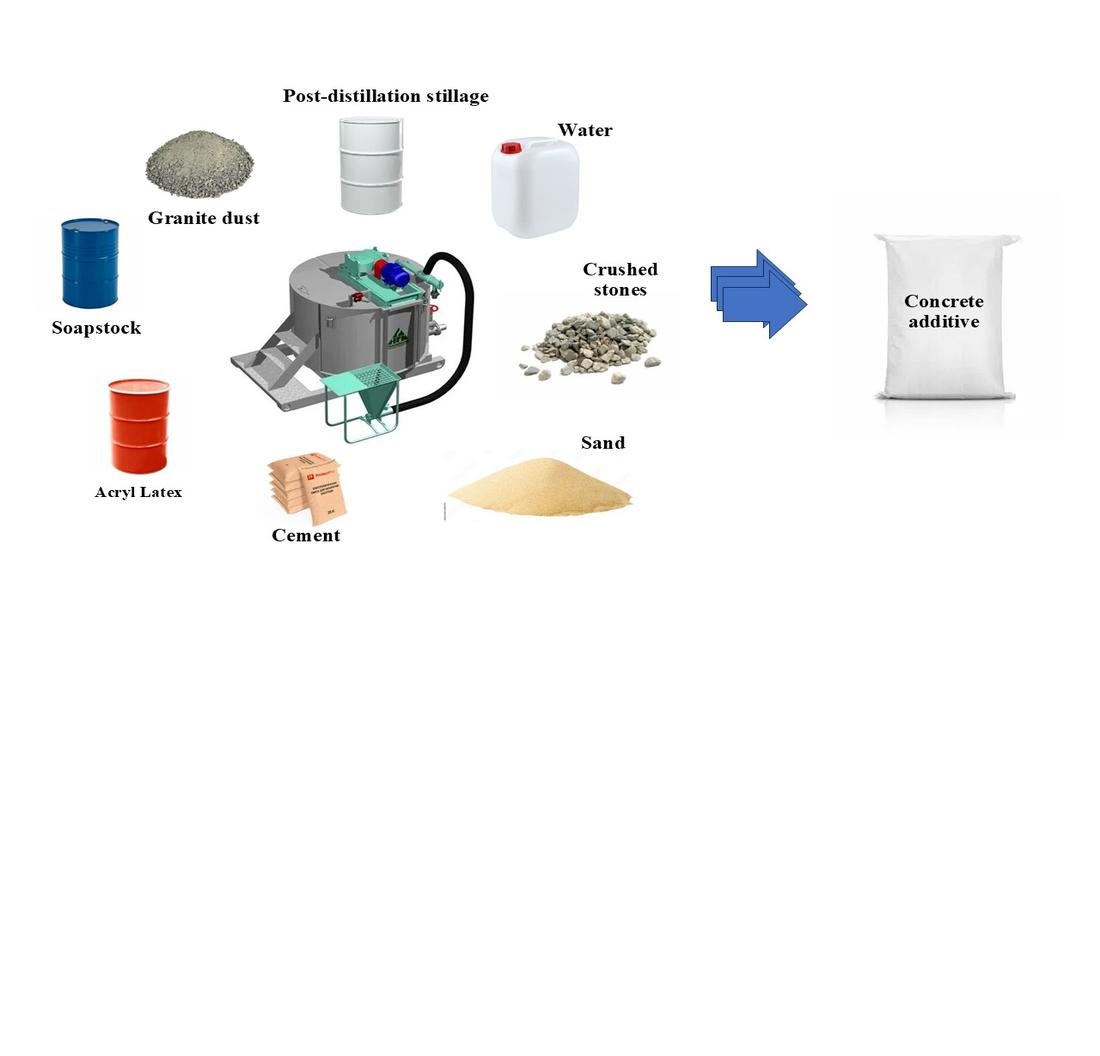
The object of the study is the chemical resistance of concrete modified with granite dust and acrylic latex. The materials used in the study were concrete samples with a variable composition of additive components, which were subsequently exposed to an aggressive environment. The problem, which the research is aimed at solving, is the tendency of concrete structures to fail under prolonged exposure to acidic conditions, which significantly reduces their service life. This research aims to address this issue by incorporating modifying additives that improve concrete’s resistance to chemical attack. The experimental program involved testing concrete specimens with different concentrations of granite dust (1–4 % by cement mass) and acrylic latex (0.1–0.4 % by water mass) in a 10 % sulfuric acid solution for up to 360 days. Strength loss was assessed at regular intervals, and chemical resistance coefficients were calculated to evaluate durability. Additionally, long-term degradation predictions were made using logarithmic models. The results show that the optimal composition – 4 % granite dust and 0.4 % acrylic latex –significantly improves chemical resistance, with specimens retaining up to 49 % of their initial strength after 100 years of exposure. The enhancement is attributed to the densification effect of granite dust, which reduces permeability, and the hydrophobizing properties of acrylic latex, which minimize acid penetration. Compared to unmodified concrete, the proposed composition demonstrates lower strength loss and higher durability under aggressive conditions. The proposed modified composition offers a reliable solution for extending the service life of reinforced concrete structures exposed to chemical degradation
References
- Paul, S., van Zijl, G., Šavija, B. (2020). Effect of Fibers on Durability of Concrete: A Practical Review. Materials, 13 (20), 4562. https://doi.org/10.3390/ma13204562
- Baloch, W. L., Siad, H., Lachemi, M., Sahmaran, M. (2021). A review on the durability of concrete-to-concrete bond in recent rehabilitated structures. Journal of Building Engineering, 44, 103315. https://doi.org/10.1016/j.jobe.2021.103315
- Zhang, S. P., Zong, L. (2014). Evaluation of Relationship between Water Absorption and Durability of Concrete Materials. Advances in Materials Science and Engineering, 2014, 1–8. https://doi.org/10.1155/2014/650373
- Zhang, J., Shi, C., Zhang, Z., Ou, Z. (2017). Durability of alkali-activated materials in aggressive environments: A review on recent studies. Construction and Building Materials, 152, 598–613. https://doi.org/10.1016/j.conbuildmat.2017.07.027
- Mendes, D. D., Mari, J. de J., Singer, M., Barros, G. M., Mello, A. F. (2009). Estudo de revisão dos fatores biológicos, sociais e ambientais associados com o comportamento agressivo. Revista Brasileira de Psiquiatria, 31, S77–S85. https://doi.org/10.1590/s1516-44462009000600006
- Gu, L., Bennett, T., Visintin, P. (2019). Sulphuric acid exposure of conventional concrete and alkali-activated concrete: Assessment of test methodologies. Construction and Building Materials, 197, 681–692. https://doi.org/10.1016/j.conbuildmat.2018.11.166
- Zhang, G., Wu, C., Hou, D., Yang, J., Sun, D., Zhang, X. (2021). Effect of environmental pH values on phase composition and microstructure of Portland cement paste under sulfate attack. Composites Part B: Engineering, 216, 108862. https://doi.org/10.1016/j.compositesb.2021.108862
- Teymouri, M., Behfarnia, K., Shabani, A. (2021). Mix Design Effects on the Durability of Alkali-Activated Slag Concrete in a Hydrochloric Acid Environment. Sustainability, 13 (14), 8096. https://doi.org/10.3390/su13148096
- Xie, Y., Lin, X., Ji, T., Liang, Y., Pan, W. (2019). Comparison of corrosion resistance mechanism between ordinary Portland concrete and alkali-activated concrete subjected to biogenic sulfuric acid attack. Construction and Building Materials, 228, 117071. https://doi.org/10.1016/j.conbuildmat.2019.117071
- Koenig, A., Herrmann, A., Overmann, S., Dehn, F. (2017). Resistance of alkali-activated binders to organic acid attack: Assessment of evaluation criteria and damage mechanisms. Construction and Building Materials, 151, 405–413. https://doi.org/10.1016/j.conbuildmat.2017.06.117
- Gado, R. A. (2022). The feasibility of recycling marble & granite sludge in the polymer-modified cementitious mortars Part A: In polymer-modified cementitious adhesive mortar. Process Safety and Environmental Protection, 159, 978–991. https://doi.org/10.1016/j.psep.2022.01.059
- Chen, K., Wu, D., Xia, L., Cai, Q., Zhang, Z. (2021). Geopolymer concrete durability subjected to aggressive environments – A review of influence factors and comparison with ordinary Portland cement. Construction and Building Materials, 279, 122496. https://doi.org/10.1016/j.conbuildmat.2021.122496
- Kapeluszna, E., Kotwica, Ł., Pichór, W., Nocuń-Wczelik, W. (2020). Cement-based composites with waste expanded perlite - Structure, mechanical properties and durability in chloride and sulphate environments. Sustainable Materials and Technologies, 24, e00160. https://doi.org/10.1016/j.susmat.2020.e00160
- Shojaei Baghini, M., Ismail, A., Karim, M. R., Shokri, F., Firoozi, A. A. (2014). Effect of styrene–butadiene copolymer latex on properties and durability of road base stabilized with Portland cement additive. Construction and Building Materials, 68, 740–749. https://doi.org/10.1016/j.conbuildmat.2014.06.061
- Li, X., Chu, H., Yao, N., Long, B., Li, W., Jiang, L. (2025). Experimental study of styrene-acrylic emulsion modified mortar with manufactured sand and its performance exposed to combined chloride-sulfate attack. Construction and Building Materials, 458, 139682. https://doi.org/10.1016/j.conbuildmat.2024.139682
- Veloso Moura, H. R. de C., Pedroti, L. G., Salgado Lopes, M. M., Franco de Carvalho, J. M., Lopes Ribeiro, J. C., Bernardes Dias, J. C. (2023). Influence of biocide and dispersant additives on the performance and durability of building paints produced with granite waste. Construction and Building Materials, 409, 134112. https://doi.org/10.1016/j.conbuildmat.2023.134112
- Interstate Standard GOST P 58896-2020. Chemically resistant concretes. Test methods.
- Interstate Standard GOST Р 58895-2020. Chemically resistant concretes. Specifications.
- Lukpanov, R., Dyussembinov, D., Altynbekova, A., Yenkebayev, S., Awwad, T. (2023). Optimal concentration of post-alcohol bard and microsilica in cement-sand mixtures determination. Kompleksnoe Ispolʹzovanie Mineralʹnogo Syrʹâ/Complex Use of Mineral Resources/Mineraldik Shikisattardy Keshendi Paidalanu, 330 (3), 92–103. https://doi.org/10.31643/2024/6445.33
- Lukpanov, R., Dyussembinov, D., Tsygulyov, D., Yenkebayev, S. (2022). Complex modified additive for concrete based on industrial waste. Magazine of Civil Engineering, 115(7), 11507. https://doi.org/10.34910/MCE.115.7
- Altynbekova, A. D., Lukpanov, R. E., Dyussembinov, D. S., Askerbekova, A. M., Gunasekaran, M. (2023). Effect of a complex modified additive based on post-alcohol bard on the strength behavior of concrete. Kompleksnoe Ispolʹzovanie Mineralʹnogo Syrʹâ/Complex Use of Mineral Resources/Mineraldik Shikisattardy Keshendi Paidalanu, 327 (4), 5–14. https://doi.org/10.31643/2023/6445.34
- Altynbekova, A., Lukpanov, R., Yenkebayev, S., Tsygulyov, D., Nurbayeva, M. (2022). Complex laboratory studies of modified additive influence on concrete physical and mechanical properties. International Journal of GEOMATE, 23 (100), 26–33. https://doi.org/10.21660/2022.100.3641
- Lukpanov, R., Dyussembinov, D., Zhantlessova, Z., Altynbekova, A., Yenkebayev, S., Orazova, D. (2024). Durability assessment of cellular concrete through strength evaluation under adverse environmental conditions. International Journal of GEOMATE, 27 (124), 16–23. https://doi.org/10.21660/2024.124.4271
Downloads
Published
How to Cite
Issue
Section
License
Copyright (c) 2025 Rauan Lukpanov, Aliya Altynbekova, Serik Yenkebaev, Denis Tsygulyov, Dinara Orazova, Zhumabek Omarov, Kuanysh Makashev

This work is licensed under a Creative Commons Attribution 4.0 International License.
The consolidation and conditions for the transfer of copyright (identification of authorship) is carried out in the License Agreement. In particular, the authors reserve the right to the authorship of their manuscript and transfer the first publication of this work to the journal under the terms of the Creative Commons CC BY license. At the same time, they have the right to conclude on their own additional agreements concerning the non-exclusive distribution of the work in the form in which it was published by this journal, but provided that the link to the first publication of the article in this journal is preserved.
A license agreement is a document in which the author warrants that he/she owns all copyright for the work (manuscript, article, etc.).
The authors, signing the License Agreement with TECHNOLOGY CENTER PC, have all rights to the further use of their work, provided that they link to our edition in which the work was published.
According to the terms of the License Agreement, the Publisher TECHNOLOGY CENTER PC does not take away your copyrights and receives permission from the authors to use and dissemination of the publication through the world's scientific resources (own electronic resources, scientometric databases, repositories, libraries, etc.).
In the absence of a signed License Agreement or in the absence of this agreement of identifiers allowing to identify the identity of the author, the editors have no right to work with the manuscript.
It is important to remember that there is another type of agreement between authors and publishers – when copyright is transferred from the authors to the publisher. In this case, the authors lose ownership of their work and may not use it in any way.








