Devising an approach to preventing information chaos in chat bots using generative artificial intelligence
DOI:
https://doi.org/10.15587/1729-4061.2025.324957Keywords:
Large Language Model, LLM, Copilot, ChatGPT, cyclic class element, attractorAbstract
The object of this study is the linguistic constructions of queries to chatbots with Large Language Models (LLMs). The area of research is the emergence of information chaos during communication between the user and the chatbot, which leads to errors in forming a response to the query. It is assumed that the user and the chatbot are separate complex systems, the events and actions of which are difficult to predict for a long period. Behavior models of complex systems are subject to the influence of chaos theory. To demonstrate this, the work used one of the simple mathematical problems with a logical component. The Copilot and ChatGPT 4o mini chatbots that were studied gave erroneous results in response to a query for the task. The error occurred when generating a query due to the introduction of a logical component. A similar process was represented by a system of differential equations solving which establishes clear rules for obtaining an accurate answer to the query.
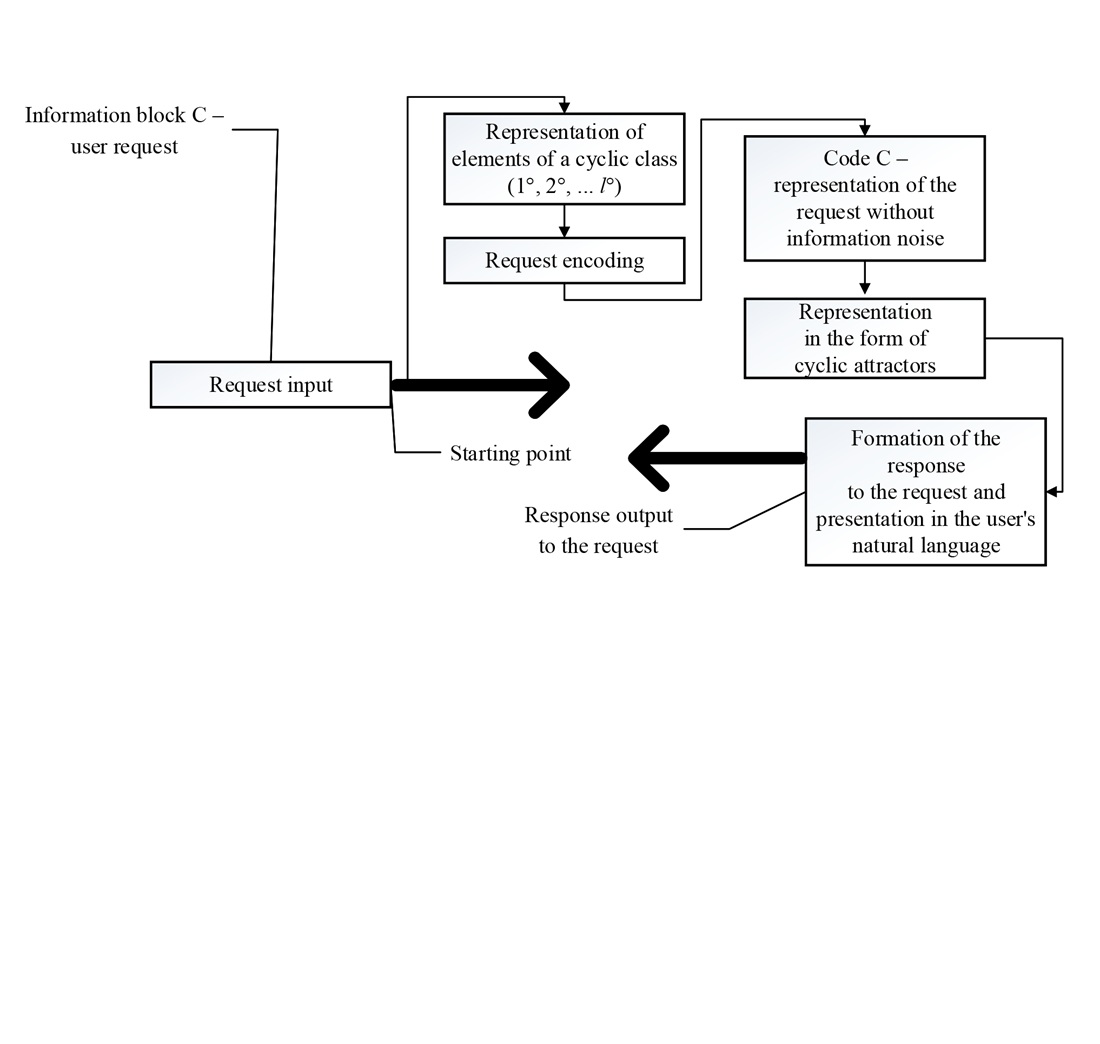
To submit a request from the user, an approach has been proposed that makes it possible to break down the information block of the request by constructing piecewise linear attractors. That is, paired semantic expressions are formed with the formation of a request cleared of information noise. The problem is solved by presenting a methodology for controlling the selection of substitute words, based on the operations of generating the next substitution and calculating the number of the given substitution.
According to the devised approach, the best options for a request to the Copilot chatbot were obtained in 182 characters or 48 words, numbers, and special characters. For the ChatGPT 4o mini chatbot, such a request consisted of 219 characters.
The proposal could be used in practical activities to improve chatbot technologies and form key data sets in artificial intelligence systems, which would further make it possible to avoid errors when solving problems with a logical component
References
- Errichiello, O., Wernke, M. (2022). Order in Chaos - Cybernetics of Brand Management. Springer. https://doi.org/10.1007/978-3-662-65958-8
- Cappa, F., Oriani, R., Peruffo, E., McCarthy, I. (2020). Big Data for Creating and Capturing Value in the Digitalized Environment: Unpacking the Effects of Volume, Variety, and Veracity on Firm Performance. Journal of Product Innovation Management, 38 (1), 49–67. https://doi.org/10.1111/jpim.12545
- Saadia, D. (2021). Integration of Cloud Computing, Big Data, Artificial Intelligence, and Internet of Things. International Journal of Web-Based Learning and Teaching Technologies, 16 (1), 10–17. https://doi.org/10.4018/ijwltt.2021010102
- Junaid, M., Ali, S., Siddiqui, I. F., Nam, C., Qureshi, N. M. F., Kim, J., Shin, D. R. (2022). Performance Evaluation of Data-driven Intelligent Algorithms for Big data Ecosystem. Wireless Personal Communications, 126 (3), 2403–2423. https://doi.org/10.1007/s11277-021-09362-7
- Fuchs, A. (2013). Nonlinear Dynamics in Complex Systems. Springer Berlin Heidelberg. https://doi.org/10.1007/978-3-642-33552-5
- Kryazhych, O., Vasenko, O., Isak, L., Havrylov, I., Gren, Y. (2024). Construction of a model for matching user’s linguistic structures to a chat-bot language model. Eastern-European Journal of Enterprise Technologies, 3 (2 (129)), 34–41. https://doi.org/10.15587/1729-4061.2024.304048
- Gravett, W. (2021). Sentenced by an algorithm – Bias and lack of accuracy in risk-assessment software in the United States criminal justice system. South African Journal of Criminal Justice, 34 (1), 31–54. https://doi.org/10.47348/sacj/v34/i1a2
- Taghia, J. (2024). Exploring the Synergy of Chaos Theory and AI: Predictive Modeling and Understanding of Complex Systems Through Machine Learning and Deep Neural Networks Review. COJ Robotics & Artificial Intelligence, 3 (4). Available at: https://crimsonpublishers.com/cojra/fulltext/COJRA.000566.php
- Elabid, Z., Chakraborty, T., Hadid, A. (2022). Knowledge-based Deep Learning for Modeling Chaotic Systems. 2022 21st IEEE International Conference on Machine Learning and Applications (ICMLA), 1203–1209. https://doi.org/10.1109/icmla55696.2022.00194
- Wang, H., Fu, T., Du, Y., Gao, W., Huang, K., Liu, Z. et al. (2023). Scientific discovery in the age of artificial intelligence. Nature, 620 (7972), 47–60. https://doi.org/10.1038/s41586-023-06221-2
- Demszky, D., Yang, D., Yeager, D. S., Bryan, C. J., Clapper, M., Chandhok, S. et al. (2023). Using large language models in psychology. Nature Reviews Psychology. https://doi.org/10.1038/s44159-023-00241-5
- Mirzadeh, I., Alizadeh, K., Shahrokhi, H., Tuzel, O., Bengio, S., Farajtabar, M. (2024). GSM-Symbolic: Understanding the Limitations of Mathematical Reasoning in Large Language Models. arXiv. https://doi.org/10.48550/arXiv.2410.05229
- Zhao, W., Zhou, K., Junyi, L., Tianyi, T., Wang, X., Hou, Y. et al. (2023). A Survey of Large Language Models. arXiv. https://doi.org/10.48550/arXiv.2303.18223
- Ai, J., Cai, Y., Su, Z., Zhang, K., Peng, D., Chen, Q. (2022). Predicting user-item links in recommender systems based on similarity-network resource allocation. Chaos, Solitons & Fractals, 158, 112032. https://doi.org/10.1016/j.chaos.2022.112032
- Du, F., Ma, X.-J., Yang, J.-R., Liu, Y., Luo, C.-R., Wang, X.-B. et al. (2024). A Survey of LLM Datasets: From Autoregressive Model to AI Chatbot. Journal of Computer Science and Technology, 39 (3), 542–566. https://doi.org/10.1007/s11390-024-3767-3
- Matsumoto, N., Moran, J., Choi, H., Hernandez, M. E., Venkatesan, M., Wang, P., Moore, J. H. (2024). KRAGEN: a knowledge graph-enhanced RAG framework for biomedical problem solving using large language models. Bioinformatics, 40 (6). https://doi.org/10.1093/bioinformatics/btae353
- Zhang, Y., Zhang, C. (2024). Extracting problem and method sentence from scientific papers: a context-enhanced transformer using formulaic expression desensitization. Scientometrics, 129 (6), 3433–3468. https://doi.org/10.1007/s11192-024-05048-6
- Shen, B.-W., Pielke, R. A., Zeng, X., Baik, J.-J., Faghih-Naini, S., Cui, J. et al. (2021). Is Weather Chaotic? Coexisting Chaotic and Non-chaotic Attractors Within Lorenz Models. 13th Chaotic Modeling and Simulation International Conference, 805–825. https://doi.org/10.1007/978-3-030-70795-8_57
- Martines-Arano, H., García-Pérez, B. E., Vidales-Hurtado, M. A., Trejo-Valdez, M., Hernández-Gómez, L. H., Torres-Torres, C. (2019). Chaotic Signatures Exhibited by Plasmonic Effects in Au Nanoparticles with Cells. Sensors, 19 (21), 4728. https://doi.org/10.3390/s19214728
- Stankevich, N. V., Kuznetsov, N. V., Leonov, G. A., Chua, L. O. (2017). Scenario of the Birth of Hidden Attractors in the Chua Circuit. International Journal of Bifurcation and Chaos, 27 (12), 1730038. https://doi.org/10.1142/s0218127417300385
- Voronka, H. V. (2014). Informatsiynyi shum u dovidkovykh vydanniakh. Obriyi drukarstva, 1, 89–95. Available at: https://horizons.vpi.kpi.ua/article/view/95451
- Anh, L. Q. (2021). Various Types of Well-Posedness for Vector Equilibrium Problems with Respect to the Lexicographic Order. Vietnam Journal of Mathematics, 51 (2), 397–414. https://doi.org/10.1007/s10013-021-00530-7
Downloads
Published
How to Cite
Issue
Section
License
Copyright (c) 2025 Olha Kryazhych, Ivan Ivanov, Kateryna Iushchenko, Oleksii Kupri, Oleksandr Vasenko, Viacheslav Riznyk, Oleksandr Ryzhkov

This work is licensed under a Creative Commons Attribution 4.0 International License.
The consolidation and conditions for the transfer of copyright (identification of authorship) is carried out in the License Agreement. In particular, the authors reserve the right to the authorship of their manuscript and transfer the first publication of this work to the journal under the terms of the Creative Commons CC BY license. At the same time, they have the right to conclude on their own additional agreements concerning the non-exclusive distribution of the work in the form in which it was published by this journal, but provided that the link to the first publication of the article in this journal is preserved.
A license agreement is a document in which the author warrants that he/she owns all copyright for the work (manuscript, article, etc.).
The authors, signing the License Agreement with TECHNOLOGY CENTER PC, have all rights to the further use of their work, provided that they link to our edition in which the work was published.
According to the terms of the License Agreement, the Publisher TECHNOLOGY CENTER PC does not take away your copyrights and receives permission from the authors to use and dissemination of the publication through the world's scientific resources (own electronic resources, scientometric databases, repositories, libraries, etc.).
In the absence of a signed License Agreement or in the absence of this agreement of identifiers allowing to identify the identity of the author, the editors have no right to work with the manuscript.
It is important to remember that there is another type of agreement between authors and publishers – when copyright is transferred from the authors to the publisher. In this case, the authors lose ownership of their work and may not use it in any way.








