Determining the influence of thermomechanical loading on the measurement errors of fiber-optic gyroscope
DOI:
https://doi.org/10.15587/1729-4061.2025.324960Keywords:
thermomechanical deformation, finite element method, misalignment of a fiber-optic gyroscope, measurement errorsAbstract
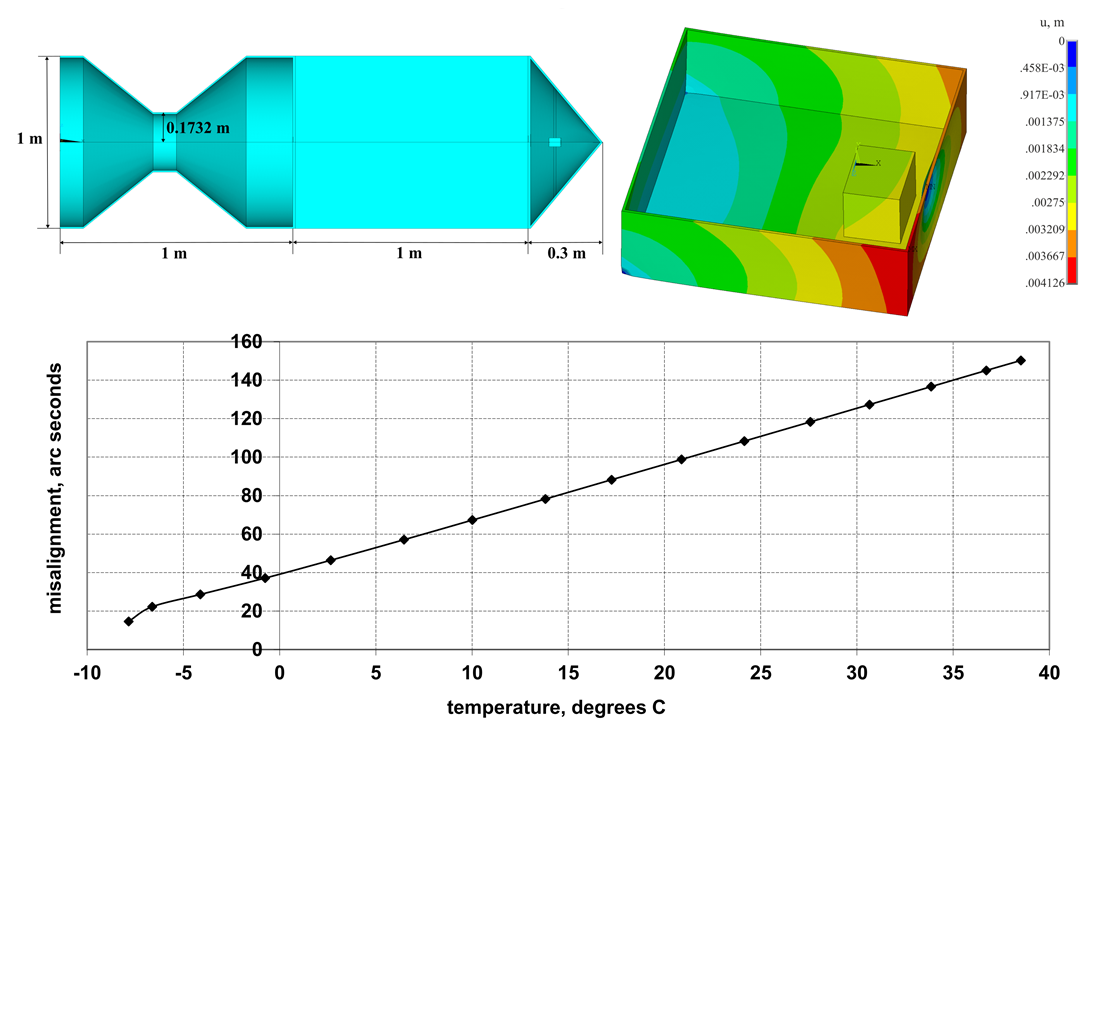
The object of this study is the measurement errors of a fiber-optic gyroscope, which is an element of the spacecraft orientation control system. The task to determine the patterns of thermomechanical loading influence on the measurement errors of gyroscopes has been solved by using mathematical modeling. The study was conducted using the finite element method, which has made it possible to analyze the stress-strain state of structural elements under different conditions of temperature and mechanical loading. Temperature and deformation distributions of the spacecraft structural elements were obtained. These data were used to estimate the misalignment parameters of the sensitivity axes of the onboard system gyroscopes, which arise due to structural deformation. Under certain modeling conditions, they exceed one hundred arc seconds, which could lead to an unacceptable error in controlling the spacecraft orientation.
To specify the magnitude of gyroscopes’ measurement error, high-frequency oscillations that occur when the jet engine is turned on during the correction of the spacecraft's orbit were considered together with thermal deformation of the structure. This combination of thermal and mechanical effects creates conditions under which the accuracy of the control systems is significantly compromised. It was determined that under the conditions studied, the measurement error increases 8 times when the temperature of the structure changes by 40 °C.
Thus, to solve the task set, a procedure for determining the measurement error under specific conditions of thermomechanical loading was devised and described. Using such a procedure in the design of control systems in the future will contribute to increasing the accuracy of their operation. This will be achieved by optimally placing gyroscopes on board, taking into account the influence of thermal fields
References
- Nurgizat, Y., Balbayev, G., Galayko, D. (2021). Solar sensor for Cubesat attitude determination. 2021 28th IEEE International Conference on Electronics, Circuits, and Systems (ICECS), 1–5. https://doi.org/10.1109/icecs53924.2021.9665513
- Zbrutsky, O., Meleshko, V., Ganja, A., Tarnavsky, S., Bondarenko, O., Pjnomarenko, S., Saurova, K. (2022). System definition of micro - nano satellite orientation. MECHANICS OF GYROSCOPIC SYSTEMS, 43, 46–60. https://doi.org/10.20535/0203-3771432022275282
- El-Sheimy, N., Youssef, A. (2020). Inertial sensors technologies for navigation applications: state of the art and future trends. Satellite Navigation, 1 (1). https://doi.org/10.1186/s43020-019-0001-5
- Wang, X., Cui, Y., Cao, H. (2023). Temperature Drift Compensation of Fiber Optic Gyroscopes Based on an Improved Method. Micromachines, 14 (9), 1712. https://doi.org/10.3390/mi14091712
- Kucherenko, O. (2024). Methods of reducing the influence of temperature gradients on the sensitivity of fiber-optic gyroscope. Bulletin of Kyiv Polytechnic Institute. Series Instrument Making, 67 (1), 13–17. https://doi.org/10.20535/1970.67(1).2024.306720
- Ban, J., Chen, G., Meng, Y., Shu, J. (2022). Calibration method for misalignment angles of a fiber optic gyroscope in single-axis rotational inertial navigation systems. Optics Express, 30 (5), 6487. https://doi.org/10.1364/oe.449629
- Gorev, V., Pelemeshko, A., Zadorozhny, A., Sidorchuk, A. (2018). Thermal deformation of 3U CubeSat in low Earth orbit. MATEC Web of Conferences, 158, 01013. https://doi.org/10.1051/matecconf/201815801013
- Bonnici, M., Mollicone, P., Fenech, M., Azzopardi, M. A. (2019). Analytical and numerical models for thermal related design of a new pico-satellite. Applied Thermal Engineering, 159, 113908. https://doi.org/10.1016/j.applthermaleng.2019.113908
- Abdelal, G. F., Abuelfoutouh, N., Gad, A. H. (2013). Finite Element Analysis for Satellite Structures. Springer London. https://doi.org/10.1007/978-1-4471-4637-7
- Breslavsky, D., Uspensky, V., Kozlyuk, A., Paschenko, S., Tatarinova, O., Kuznyetsov, Y. (2017). Estimation of heat field and temperature models of errors in fiber-optic gyroscopes used in aerospace systems. Eastern-European Journal of Enterprise Technologies, 1 (9 (85)), 44–53. https://doi.org/10.15587/1729-4061.2017.93320
- Reza Eslami, M., Hetnarski, R. B., Ignaczak, J., Noda, N., Sumi, N., Tanigawa, Y. (2013). Theory of Elasticity and Thermal Stresses. In Solid Mechanics and Its Applications. Springer Netherlands. https://doi.org/10.1007/978-94-007-6356-2
- Parkus, H. (1976). Thermoelasticity. Springer Vienna. https://doi.org/10.1007/978-3-7091-8447-9
- Nowacki, W. (1986). Thermoelasticity. Oxford, 578.
- Day, W. A. (1985). Heat Conduction Within Linear Thermoelasticity. In Springer Tracts in Natural Philosophy. Springer New York. https://doi.org/10.1007/978-1-4613-9555-3
- Zienkiewicz, O. C., Taylor, R. L., Fox, D. D. (2014). The finite element method for solid and structural mechanics. Elsevier. https://doi.org/10.1016/c2009-0-26332-x
- Stolarski, T. (2018). Engineering analysis with ANSYS software. Butterworth-Heinemann. https://doi.org/10.1016/c2016-0-01966-6
- Breslavsky, D., Morachkovsky, O., Tatarinova, O. (2014). Creep and damage in shells of revolution under cyclic loading and heating. International Journal of Non-Linear Mechanics, 66, 87–95. https://doi.org/10.1016/j.ijnonlinmec.2014.02.005
- Breslavskii, D. V., Metelev, V. A., Morachkovskii, O. K. (2015). Anisotropic Creep and Damage in Structural Elements Under Cyclic Loading. Strength of Materials, 47 (2), 235–241. https://doi.org/10.1007/s11223-015-9653-z
- Breslavsky, D. V., Morachkovsky, O. K., Tatarinova, O. A. (2008). High-temperature creep and long-term strength of structural elements under cyclic loading. Strength of Materials, 40 (5), 531–537. https://doi.org/10.1007/s11223-008-9067-2
- Uspenskyi, V. B., Kuznyetsov, Y. O., Shyriaieva, N. V. (2021). The Location Optimization of the On-Board Measuring System for Moving Objects Accounting Vibration. 2021 IEEE 2nd KhPI Week on Advanced Technology (KhPIWeek), 317–322. https://doi.org/10.1109/khpiweek53812.2021.9570091
Downloads
Published
How to Cite
Issue
Section
License
Copyright (c) 2025 Dmytro Breslavsky, Valerii Uspenskyi, Volodymyr Mietielov, Alyona Senko, Oksana Tatarinova

This work is licensed under a Creative Commons Attribution 4.0 International License.
The consolidation and conditions for the transfer of copyright (identification of authorship) is carried out in the License Agreement. In particular, the authors reserve the right to the authorship of their manuscript and transfer the first publication of this work to the journal under the terms of the Creative Commons CC BY license. At the same time, they have the right to conclude on their own additional agreements concerning the non-exclusive distribution of the work in the form in which it was published by this journal, but provided that the link to the first publication of the article in this journal is preserved.
A license agreement is a document in which the author warrants that he/she owns all copyright for the work (manuscript, article, etc.).
The authors, signing the License Agreement with TECHNOLOGY CENTER PC, have all rights to the further use of their work, provided that they link to our edition in which the work was published.
According to the terms of the License Agreement, the Publisher TECHNOLOGY CENTER PC does not take away your copyrights and receives permission from the authors to use and dissemination of the publication through the world's scientific resources (own electronic resources, scientometric databases, repositories, libraries, etc.).
In the absence of a signed License Agreement or in the absence of this agreement of identifiers allowing to identify the identity of the author, the editors have no right to work with the manuscript.
It is important to remember that there is another type of agreement between authors and publishers – when copyright is transferred from the authors to the publisher. In this case, the authors lose ownership of their work and may not use it in any way.








