Design and assessment of AI-enabled sustainable HR practices affecting employee performance with engagement mediation and personality moderation in the Indian IT industry
DOI:
https://doi.org/10.15587/1729-4061.2025.325623Keywords:
AI-driven HR practices, employee performance, employee engagement, conscientiousness, strategy, Indian IT sectorAbstract
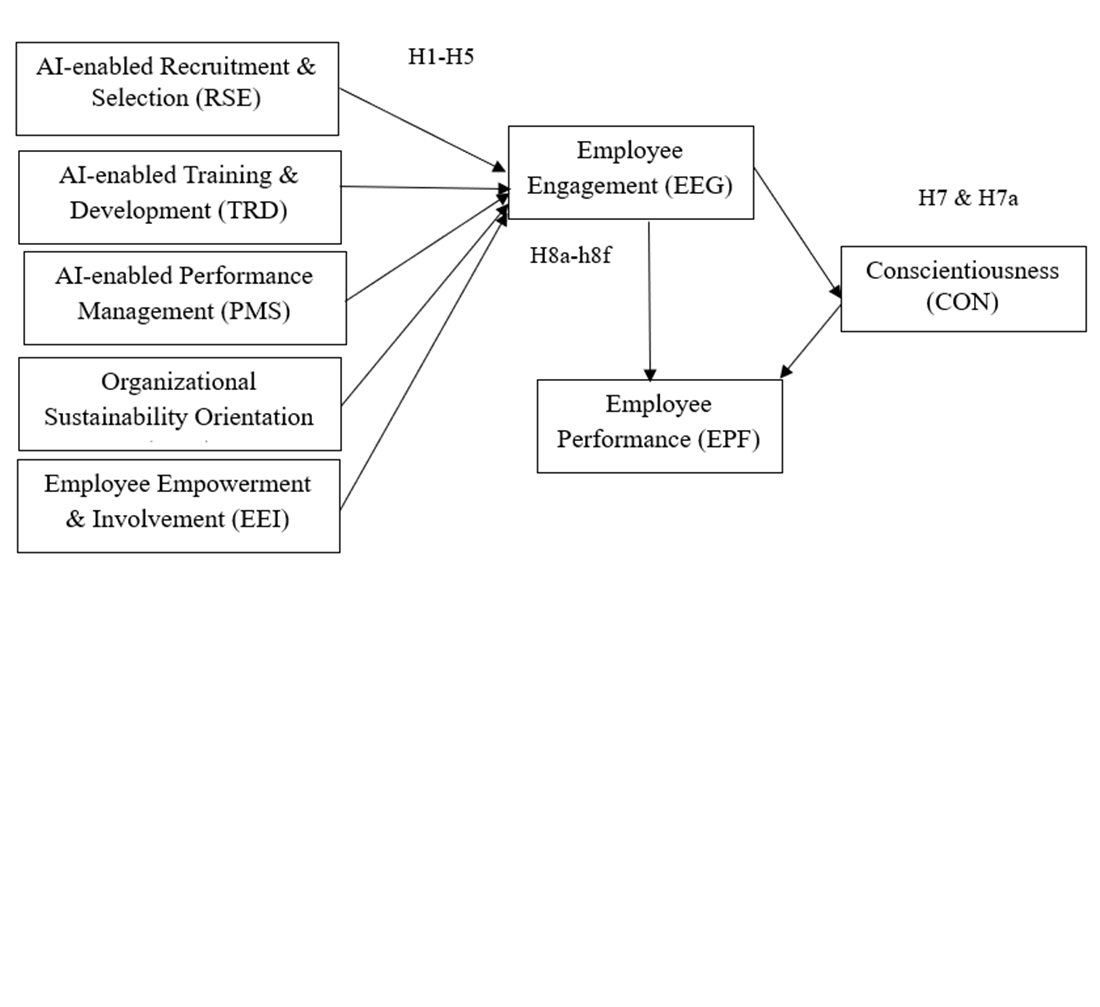
The object of this study is the impact of AI-enabled sustainable HR practices on employee performance in India's IT industry. The problem addressed is the lack of empirical evidence on how AI-driven HR practices influence performance, with a focus on the mediating role of employee engagement and the moderating role of conscientiousness.
The research responds to the vital question of how AI-based HR innovations, which include AI-based recruitment and development, AI-enabled performance feedback, organizational sustainability orientation, and AI-based employee empowerment, influence the performance of IT professionals.
Data were collected from 340 Indian IT professionals using structured instruments with snowball sampling method. The findings explore the impact of AI-based HR practices on employee performance in the Indian IT industry. The findings show significant positive effects of AI-driven recruitment (β = 0.116, p = 0.007), performance management (β = 0.180, p < 0.001), and training (β = 0.204, p < 0.001). Employee engagement mediates these relationships (β = 0.136, p = 0.002), while conscientiousness moderates the engagement-performance link (β = 0.150, p = 0.006).
From a practical point of view, the results suggest that it is important for IT managers to adopt future-oriented and viable HR digital solutions that capitalize on both technology and human elements in an effort to enhance productivity in an industry in which the pace of change is rapid
References
- Ehnert, I., Parsa, S., Roper, I., Wagner, M., Muller-Camen, M. (2015). Reporting on sustainability and HRM: a comparative study of sustainability reporting practices by the world’s largest companies. The International Journal of Human Resource Management, 27 (1), 88–108. https://doi.org/10.1080/09585192.2015.1024157
- Tambe, P., Cappelli, P., Yakubovich, V. (2019). Artificial Intelligence in Human Resources Management: Challenges and a Path Forward. California Management Review, 61 (4), 15–42. https://doi.org/10.1177/0008125619867910
- Renkema, M., Meijerink, J., Bondarouk, T. (2021). Routes for employee-driven innovation: how HRM supports the emergence of innovation in a formalized context. The International Journal of Human Resource Management, 33 (17), 3526–3559. https://doi.org/10.1080/09585192.2021.1913625
- Wang, L., Wang, Y., Chen, J. (2019). Assessment of the Ecological Niche of Photovoltaic Agriculture in China. Sustainability, 11 (8), 2268. https://doi.org/10.3390/su11082268
- Orlando, B., Tortora, D., Pezzi, A., Bitbol-Saba, N. (2022). The disruption of the international supply chain: Firm resilience and knowledge preparedness to tackle the COVID-19 outbreak. Journal of International Management, 28 (1), 100876. https://doi.org/10.1016/j.intman.2021.100876
- Campbell, J. P., McCloy, R. A., Oppler, S. H., Sager, C. E. (1993). A theory of performance. In Personnel selection in organizations. Jossey-Bass, 35–70.
- Black, J. S., van Esch, P. (2020). AI-enabled recruiting: What is it and how should a manager use it? Business Horizons, 63 (2), 215–226. https://doi.org/10.1016/j.bushor.2019.12.001
- Schaufeli, W. B., Salanova, M., González-romá, V., Bakker, A. B. (2002). The Measurement of Engagement and Burnout: A Two Sample Confirmatory Factor Analytic Approach. Journal of Happiness Studies 3, 71–92. https://doi.org/10.1023/a:1015630930326
- Donnellan, M. B., Oswald, F. L., Baird, B. M., Lucas, R. E. (2006). The Mini-IPIP Scales: Tiny-yet-effective measures of the Big Five Factors of Personality. Psychological Assessment, 18 (2), 192–203. https://doi.org/10.1037/1040-3590.18.2.192
- Bakker, A. B., Demerouti, E. (2017). Job demands–resources theory: Taking stock and looking forward. Journal of Occupational Health Psychology, 22 (3), 273–285. https://doi.org/10.1037/ocp0000056
- Alkashami, M. (2025). The Integration of AI in HRM: Exploring Its Past, Present, and Future Implications. Pakistan Journal of Life and Social Sciences (PJLSS), 23 (1). https://doi.org/10.57239/pjlss-2025-23.1.00525
- Ulrich, D., Dulebohn, J. H. (2015). Are we there yet? What’s next for HR? Human Resource Management Review, 25 (2), 188–204. https://doi.org/10.1016/j.hrmr.2015.01.004
- Cruz-Cárdenas, J., González, R., del Val Núñez, M. T. (2015). The use of disliked gifts from a consumer behavior perspective. Journal of Business Research, 68 (7), 1635–1637. https://doi.org/10.1016/j.jbusres.2015.02.008
- Ngima, W. M., Kyongo, J. (2013). Contribution of motivational management to employee performance. International Journal of Humanities and Social Science, 3 (14), 219–239. https://www.ijhssnet.com/journals/Vol_3_No_14_Special_Issue_July_2013/26.pdf
- Guest, D. E. (2017). Human resource management and employee well‐being: towards a new analytic framework. Human Resource Management Journal, 27 (1), 22–38. https://doi.org/10.1111/1748-8583.12139
- Kutaula, S., Chowdhury, S., Gillani, A., Budhwar, P. S., Dey, P. K. (2024). Linking HRM with Sustainability Performance Through Sustainability Practices: Unlocking the Black Box. British Journal of Management, 36 (2), 615–632. https://doi.org/10.1111/1467-8551.12861
- Ireri, A., N. Mathuvi, P., M. Njagi, A., G. Mwenda, E., N. Gatumu, H., M. Njagi, J. et al. (2012). Assessing Young Peoples’ Momentary Thoughts About Sex: A Proposal of the Sex Envelope Game. International Journal of Applied Psychology, 2(3), 31–35. https://doi.org/10.5923/j.ijap.20120203.03
- Bürgel, T. R., Hiebl, M. R. W., Pielsticker, D. I. (2023). Digitalization and entrepreneurial firms’ resilience to pandemic crises: Evidence from COVID-19 and the German Mittelstand. Technological Forecasting and Social Change, 186, 122135. https://doi.org/10.1016/j.techfore.2022.122135
- Spreitzer, G. M. (1995). Psychological, empowerment in the workplace: dimensions, measurement and validation. Academy of Management Journal, 38 (5), 1442–1465. https://doi.org/10.2307/256865
- Marler, J. H., Boudreau, J. W. (2016). An evidence-based review of HR Analytics. The International Journal of Human Resource Management, 28 (1), 3–26. https://doi.org/10.1080/09585192.2016.1244699
- Hemalatha, A., Kumari, P. B., Nawaz, N., Gajenderan, V. (2021). Impact of Artificial Intelligence on Recruitment and Selection of Information Technology Companies. 2021 International Conference on Artificial Intelligence and Smart Systems (ICAIS), 60–66. https://doi.org/10.1109/icais50930.2021.9396036
- Garavan, T., McCarthy, A., Sheehan, M., Lai, Y., Saunders, M. N. K., Clarke, N. et al. (2019). Measuring the organizational impact of training: The need for greater methodological rigor. Human Resource Development Quarterly, 30 (3), 291–309. https://doi.org/10.1002/hrdq.21345
- Jaiswal, A., Arun, C. J., Varma, A. (2021). Rebooting employees: upskilling for artificial intelligence in multinational corporations. The International Journal of Human Resource Management, 33 (6), 1179–1208. https://doi.org/10.1080/09585192.2021.1891114
- Collins, C. J. (2020). Expanding the resource based view model of strategic human resource management. The International Journal of Human Resource Management, 32 (2), 331–358. https://doi.org/10.1080/09585192.2019.1711442
- Ekuma, K. (2023). Artificial Intelligence and Automation in Human Resource Development: A Systematic Review. Human Resource Development Review, 23 (2), 199–229. https://doi.org/10.1177/15344843231224009
- Giraud, L., Zaher, A., Hernandez, S., Akram, A. A. (2022). The impacts of artificial intelligence on managerial skills. Journal of Decision Systems, 32 (3), 566–599. https://doi.org/10.1080/12460125.2022.2069537
Downloads
Published
How to Cite
Issue
Section
License
Copyright (c) 2025 Karthikeyan Thangaraju, Poonguzhali Palani

This work is licensed under a Creative Commons Attribution 4.0 International License.
The consolidation and conditions for the transfer of copyright (identification of authorship) is carried out in the License Agreement. In particular, the authors reserve the right to the authorship of their manuscript and transfer the first publication of this work to the journal under the terms of the Creative Commons CC BY license. At the same time, they have the right to conclude on their own additional agreements concerning the non-exclusive distribution of the work in the form in which it was published by this journal, but provided that the link to the first publication of the article in this journal is preserved.
A license agreement is a document in which the author warrants that he/she owns all copyright for the work (manuscript, article, etc.).
The authors, signing the License Agreement with TECHNOLOGY CENTER PC, have all rights to the further use of their work, provided that they link to our edition in which the work was published.
According to the terms of the License Agreement, the Publisher TECHNOLOGY CENTER PC does not take away your copyrights and receives permission from the authors to use and dissemination of the publication through the world's scientific resources (own electronic resources, scientometric databases, repositories, libraries, etc.).
In the absence of a signed License Agreement or in the absence of this agreement of identifiers allowing to identify the identity of the author, the editors have no right to work with the manuscript.
It is important to remember that there is another type of agreement between authors and publishers – when copyright is transferred from the authors to the publisher. In this case, the authors lose ownership of their work and may not use it in any way.








