Design and optimization of model predictive control (MPC) for energy efficient microgrid
DOI:
https://doi.org/10.15587/1729-4061.2025.325929Keywords:
model predictive control, photovoltaic systems, DC microgrid, decentralized controlAbstract
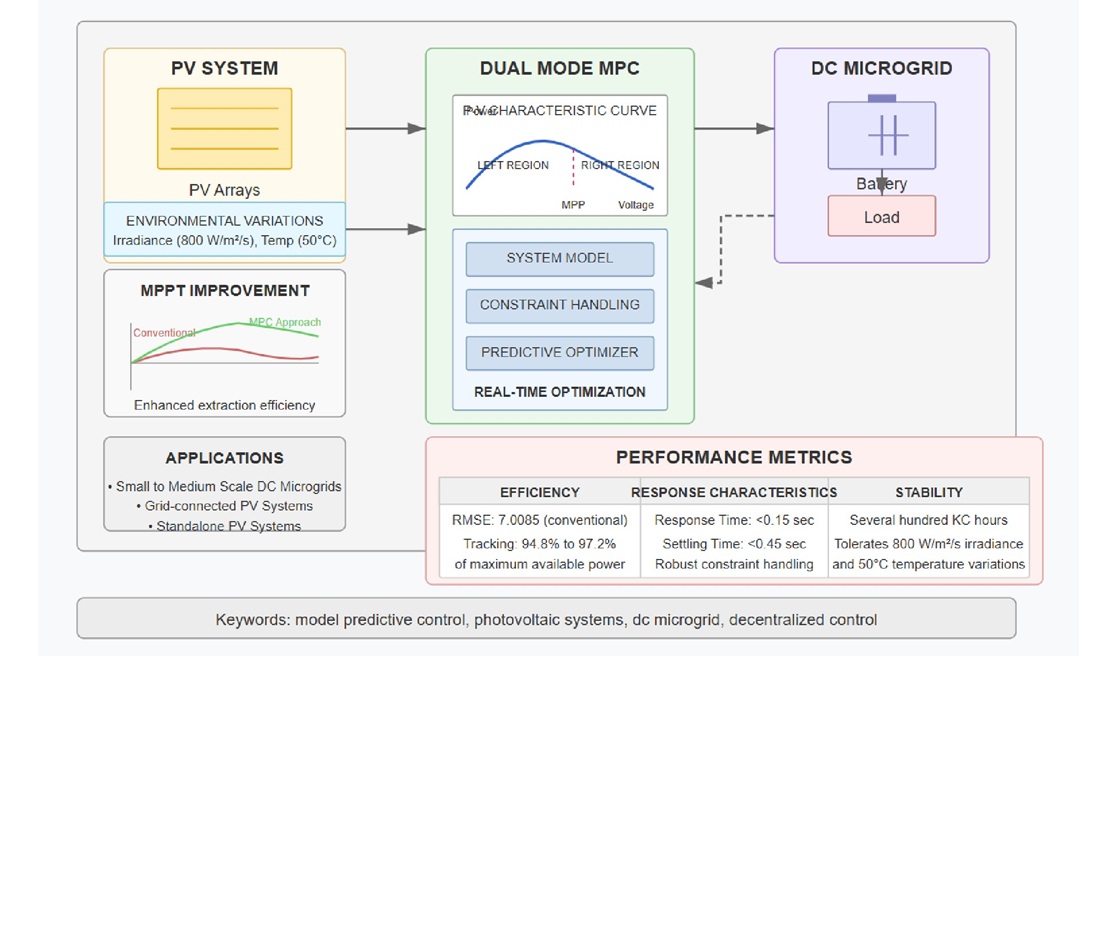
This research focuses on the DC microgrid system combined with the photovoltaic (PV) arrays and the control mechanics for maximum power point tracking (MPPT) as its object. The main problem tackled is that power extraction from PV systems is very inefficient due to variation of the environment or load that conventional MPPT approaches cannot effectively handle. The superior MPPT performance of this study’s novel dual mode model predictive control (MPC) approach is derived from a new dual mode model predictive control (MPC) approach. The implemented system shows RMSE of 7.0085 for conventional MPPT methods, whereas tracking efficiency is maintained within between 94.8 % to 97.2 % of the maximum power, which is available. Under standard test conditions, the system achieved less than 0.15 sec response time and less than 0.45 sec settling time, while degrading less, yet handling various environmental changes. It is due to the MPC’s predictive capability and real time optimization framework. The major contributions of the proposed solution, among others, include its dual mode design that supports both left and the right side regions in the PV curve together with the integrated charging management of the battery, as well as its robust constraint handling that enables safe operation and maximal power extraction. This system is well suited to implementation in small to medium scale DC microgrids that can be tolerant of up to 800 W/m2 per second of irradiance variations and up to 50 °C temperature range and demonstrated several hundred kilocycles hours of stability. The solution can offer practical benefits to the grid connected and standalone PV systems with the requirements of rapid response to environmental change and high extraction efficiency of power
References
- Llanos-Proano, J., Pilatasig, M., Curay, D., Vaca, A. (2016). Design and implementation of a model predictive control for a pressure control plant. 2016 IEEE International Conference on Automatica (ICA-ACCA), 1–7. https://doi.org/10.1109/ica-acca.2016.7778490
- Venkatesan, N., Anantharaman, N. (2012). Controller design based on Model Predictive Control for a nonlinear process. 2012 8th International Symposium on Mechatronics and Its Applications, 1–6. https://doi.org/10.1109/isma.2012.6215173
- Rawlings, J. B. (2000). Tutorial overview of model predictive control. IEEE Control Systems, 20 (3), 38–52. https://doi.org/10.1109/37.845037
- Li, X., Wen, H., Hu, Y. (2016). Evaluation of different maximum power point tracking (MPPT) techniques based on practical meteorological data. 2016 IEEE International Conference on Renewable Energy Research and Applications (ICRERA), 696–701. https://doi.org/10.1109/icrera.2016.7884423
- Parisio, A., Rikos, E., Tzamalis, G., Glielmo, L. (2014). Use of model predictive control for experimental microgrid optimization. Applied Energy, 115, 37–46. https://doi.org/10.1016/j.apenergy.2013.10.027
- Bruni, G., Cordiner, S., Mulone, V., Rocco, V., Spagnolo, F. (2015). A study on the energy management in domestic micro-grids based on Model Predictive Control strategies. Energy Conversion and Management, 102, 50–58. https://doi.org/10.1016/j.enconman.2015.01.067
- Nair, U. R., Costa-Castello, R. (2020). A Model Predictive Control-Based Energy Management Scheme for Hybrid Storage System in Islanded Microgrids. IEEE Access, 8, 97809–97822. https://doi.org/10.1109/access.2020.2996434
- Bemporad, A. (2006). Model Predictive Control Design: New Trends and Tools. Proceedings of the 45th IEEE Conference on Decision and Control, 6678–6683. https://doi.org/10.1109/cdc.2006.377490
- Parisio, A., Glielmo, L. (2011). Energy efficient microgrid management using Model Predictive Control. IEEE Conference on Decision and Control and European Control Conference, 5449–5454. https://doi.org/10.1109/cdc.2011.6161246
- Hyl, R., Wagnerova, R. (2016). Design and realization of embedded model predictive controller with software support. 2016 17th International Carpathian Control Conference (ICCC), 259–264. https://doi.org/10.1109/carpathiancc.2016.7501105
- Prodan, I., Zio, E. (2014). A model predictive control framework for reliable microgrid energy management. International Journal of Electrical Power & Energy Systems, 61, 399–409. https://doi.org/10.1016/j.ijepes.2014.03.017
- Simon, D. (2014). Model Predictive Control in Flight Control Design: Stability and Reference Tracking. Linköping: Linköping University Electronic Press, 96. https://doi.org/10.3384/lic.diva-103742
- Rahman, M., Sarker, S. K., Das, S. K., Ali, M. F. (2019). Model Predictive Control Framework Design for Frequency Regulation of PREYs Participating in Interconnected Smart Grid. 2019 International Conference on Electrical, Computer and Communication Engineering (ECCE), 1–6. https://doi.org/10.1109/ecace.2019.8679201
- Guo, Z. (2017). Model predictive control for two-stage photovoltaic system. California: Department of Electrical and Electronic Engineering California State University.
- Syed, I. M., Raahemifar, K. (2015). Model Predictive Control of Three Phase Inverter for PV Systems. International Journal of Energy and Power Engineering, 9 (10). Available at: https://publications.waset.org/10002756/model-predictive-control-of-three-phase-inverter-for-pv-systems
- Camacho, E. F., Bordons, C. (2007). Model Predictive control. Springer London, 405. https://doi.org/10.1007/978-0-85729-398-5
- García, C. E., Prett, D. M., Morari, M. (1989). Model predictive control: Theory and practice – A survey. Automatica, 25 (3), 335–348. https://doi.org/10.1016/0005-1098(89)90002-2
- del Real, A. J., Arce, A., Bordons, C. (2014). Combined environmental and economic dispatch of smart grids using distributed model predictive control. International Journal of Electrical Power & Energy Systems, 54, 65–76. https://doi.org/10.1016/j.ijepes.2013.06.035
- Hooshmand, A., Malki, H. A., Mohammadpour, J. (2012). Power flow management of microgrid networks using model predictive control. Computers & Mathematics with Applications, 64 (5), 869–876. https://doi.org/10.1016/j.camwa.2012.01.028
- McLarty, D., Civit Sabate, C., Brouwer, J., Jabbari, F. (2015). Micro-grid energy dispatch optimization and predictive control algorithms; A UC Irvine case study. International Journal of Electrical Power & Energy Systems, 65, 179–190. https://doi.org/10.1016/j.ijepes.2014.09.039
- Pan, X., Niu, X., Yang, X., Jacquet, B., Zheng, D. (2015). Microgrid energy management optimization using model predictive control: a case study in China. IFAC-PapersOnLine, 48 (30), 306–311. https://doi.org/10.1016/j.ifacol.2015.12.395
- Aboelhassan, A., Abdelgeliel, M., Zakzouk, E. E., Galea, M. (2020). Design and Implementation of Model Predictive Control Based PID Controller for Industrial Applications. Energies, 13 (24), 6594. https://doi.org/10.3390/en13246594
- García Vera, Y. E., Dufo-López, R., Bernal-Agustín, J. L. (2019). Energy Management in Microgrids with Renewable Energy Sources: A Literature Review. Applied Sciences, 9 (18), 3854. https://doi.org/10.3390/app9183854
- Kamal, F., Chowdhury, B. (2022). Model predictive control and optimization of networked microgrids. International Journal of Electrical Power & Energy Systems, 138, 107804. https://doi.org/10.1016/j.ijepes.2021.107804
- Garcia-Torres, F., Zafra-Cabeza, A., Silva, C., Grieu, S., Darure, T., Estanqueiro, A. (2021). Model Predictive Control for Microgrid Functionalities: Review and Future Challenges. Energies, 14 (5), 1296. https://doi.org/10.3390/en14051296
- De Nicolao, G., Magni, L., Scattolini, R. (2000). Stability and Robustness of Nonlinear Receding Horizon Control. Nonlinear Model Predictive Control, 3–22. https://doi.org/10.1007/978-3-0348-8407-5_1
- Morari, M., H. Lee, J. (1999). Model predictive control: past, present and future. Computers & Chemical Engineering, 23 (4-5), 667–682. https://doi.org/10.1016/s0098-1354(98)00301-9
- Qin, S. J., Badgwell, T. A. (2003). A survey of industrial model predictive control technology. Control Engineering Practice, 11 (7), 733–764. https://doi.org/10.1016/s0967-0661(02)00186-7
- Wang, L. (2009). Model Predictive Control System Design and Implementation Using MATLAB®. Springer London. https://doi.org/10.1007/978-1-84882-331-0
- Hu, J., Shan, Y., Guerrero, J. M., Ioinovici, A., Chan, K. W., Rodriguez, J. (2021). Model predictive control of microgrids – An overview. Renewable and Sustainable Energy Reviews, 136, 110422. https://doi.org/10.1016/j.rser.2020.110422
Downloads
Published
How to Cite
Issue
Section
License
Copyright (c) 2025 Jawaher M S H Taher

This work is licensed under a Creative Commons Attribution 4.0 International License.
The consolidation and conditions for the transfer of copyright (identification of authorship) is carried out in the License Agreement. In particular, the authors reserve the right to the authorship of their manuscript and transfer the first publication of this work to the journal under the terms of the Creative Commons CC BY license. At the same time, they have the right to conclude on their own additional agreements concerning the non-exclusive distribution of the work in the form in which it was published by this journal, but provided that the link to the first publication of the article in this journal is preserved.
A license agreement is a document in which the author warrants that he/she owns all copyright for the work (manuscript, article, etc.).
The authors, signing the License Agreement with TECHNOLOGY CENTER PC, have all rights to the further use of their work, provided that they link to our edition in which the work was published.
According to the terms of the License Agreement, the Publisher TECHNOLOGY CENTER PC does not take away your copyrights and receives permission from the authors to use and dissemination of the publication through the world's scientific resources (own electronic resources, scientometric databases, repositories, libraries, etc.).
In the absence of a signed License Agreement or in the absence of this agreement of identifiers allowing to identify the identity of the author, the editors have no right to work with the manuscript.
It is important to remember that there is another type of agreement between authors and publishers – when copyright is transferred from the authors to the publisher. In this case, the authors lose ownership of their work and may not use it in any way.








