Determining the potential noise immunity of separation-demodulation of two intermittent mutually non-orthogonal signals by binary phase-shift keying
DOI:
https://doi.org/10.15587/1729-4061.2025.326094Keywords:
multi-user detection, mutually non-orthogonal digital signals, discrete parameter, potential noise immunityAbstract
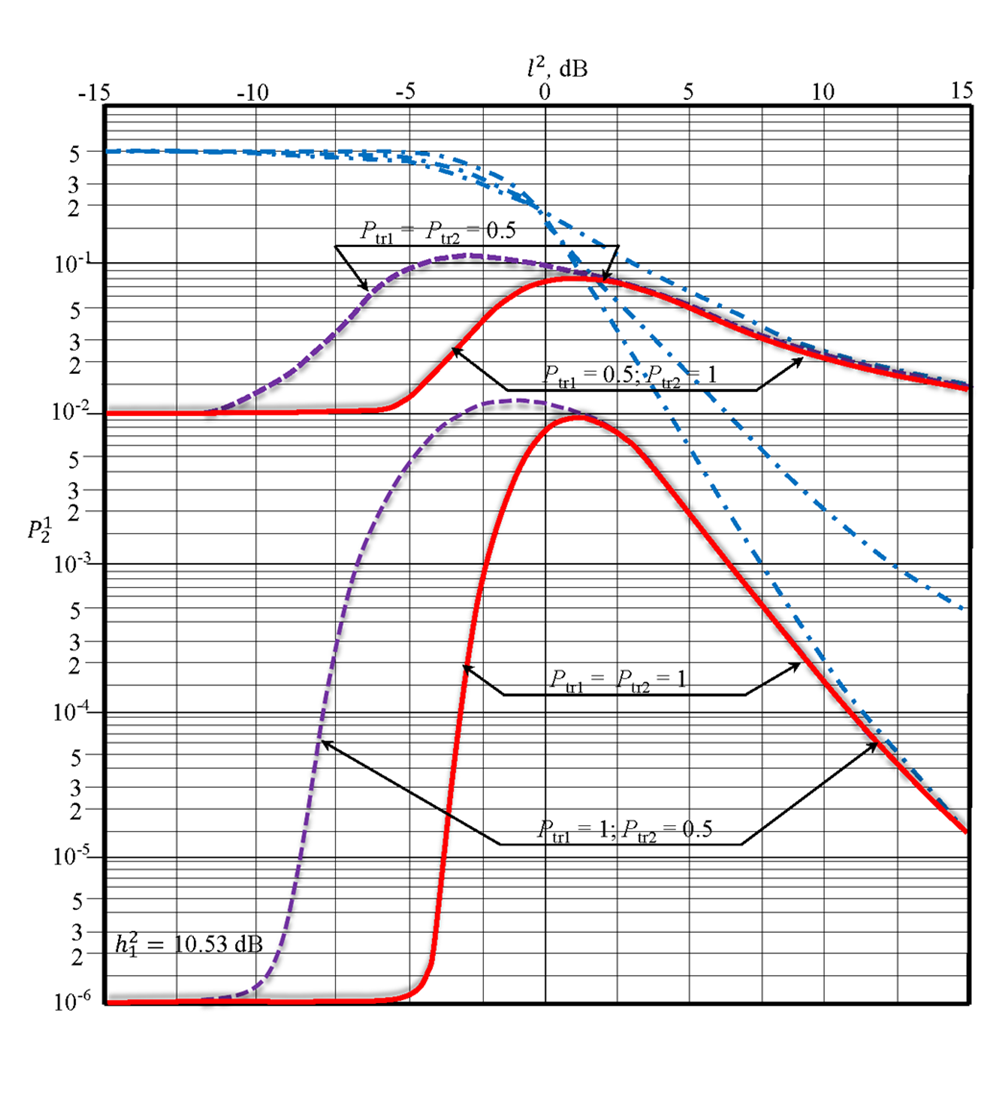
The growth in the number of mobile users of electronic communications services leads to the exhaustion of the radio frequency resource, which has made it urgent to find ways to reuse it. The use of methods from the modern theory of multi-user detection allows simultaneous transmission of a certain number of mutually non-orthogonal signals with different power in a common channel resource. These methods provide for the possibility of algorithms development for detecting and separating two digital signals in the processes of information transmission in radio channels with mutually non-orthogonal digital signals, which are the object of this study. Here, we propose a solution to the problem of determining the potential noise immunity of separation-demodulation of two mutually non-orthogonal BPSK signals, which involves taking into account the intermittency of their radiation. For this purpose, the results of the synthesis of the algorithm for detecting-separating two mutually non-orthogonal intermittent BPSK signals, optimal according to the criterion of minimum probability of error in estimating their discrete information parameters, have been used as initial data. This criterion is a necessary condition for solving this problem. The characteristic differences of the represented methodology for analyzing potential interference immunity are the absence of restrictions on the energy characteristics of signals, the degree of their non-orthogonality, and the probability of radiation.
The results allow developers to determine in practice the minimum required differences in the instantaneous signal powers in order to achieve maximum energy efficiency of radio channels under the given requirements for the error probability. In particular, it has been shown that the difference in such powers should reach at least 5÷6 dB in the case when both signals are emitted continuously, and with optimal detection and separation of intermittent signals, this difference increases to 9÷10 dB, depending on the degree of mutual non-orthogonality between the signals
References
- Honig, M., Madhow, U., Verdu, S. (1995). Blind adaptive multiuser detection. IEEE Transactions on Information Theory, 41 (4), 944–960. https://doi.org/10.1109/18.391241
- Verdú, S. (1997). Demodulation in the Presence of Multiuser Interference: Progress and Misconceptions. Intelligent Methods in Signal Processing and Communications, 15–45. https://doi.org/10.1007/978-1-4612-2018-3_2
- Verdu, S. (1998). Multiuser detection. New York: Cambridge University Press, 451.
- Honig, M. L. (Ed.) (2008). Advances in Multiuser Detection. John Wiley & Sons. https://doi.org/10.1002/9780470473818
- Guo, D., Shamai, S., Verdu, S. (2005). Mutual Information and Minimum Mean-Square Error in Gaussian Channels. IEEE Transactions on Information Theory, 51 (4), 1261–1282. https://doi.org/10.1109/tit.2005.844072
- Jain, A., Kulkarni, S. R., Verdu, S. (2011). Energy Efficiency of Decode-and-Forward for Wideband Wireless Multicasting. IEEE Transactions on Information Theory, 57 (12), 7695–7713. https://doi.org/10.1109/tit.2011.2170120
- Bamisaye, A. J., Ogidan, O. K., Osalope, B. (2011). The Behaviour of Vertical Bell Laboratories Layered Space-Time Algorithm Combined with Multiuser Detection Schemes in Wireless Communication System. Communications and Network, 03 (02), 51–56. https://doi.org/10.4236/cn.2011.32007
- Yang, Z., Xu, W., Xu, H., Shi, J., Chen, M. (2017). Energy Efficient Non-Orthogonal Multiple Access for Machine-to-Machine Communications. IEEE Communications Letters, 21 (4), 817–820. https://doi.org/10.1109/lcomm.2016.2641423
- Yerohin, V., Peleshok, Ye. (2012). Optimum algorithms of division two mutually unortogonal signals. Visnyk Natsionalnoho tekhnichnoho universytetu Ukrainy "Kyivskyi politekhnichnyi instytut". Ser.: Radiotekhnika. Radioaparatobuduvannia, 49, 33–41. Available at: http://nbuv.gov.ua/UJRN/VKPI_rr_2012_49_5
- Yerokhin, V. F., Irkha, M. S. (2020). Methodology and Results of Synthesis and Analysis of Potential Resilience for Noise Immunity Compensator of an Asynchronous Intermittent Interference Similar to a Useful Phase-Manipulated Signal. Visnyk NTUU KPI Seriia - Radiotekhnika Radioaparatobuduvannia, 82, 14–24. https://doi.org/10.20535/radap.2020.82.14-24
- Yerokhin, V., Vakulenko, O. (2022). Evolutoin of algorithms for separation of optimal two mutually unorthogonal signals of binary phase modulation. Collection “Information Technology and Security,” 10 (1), 83–97. https://doi.org/10.20535/2411-1031.2022.10.1.261178
Downloads
Published
How to Cite
Issue
Section
License
Copyright (c) 2025 Oleksandr Vakulenko, Viktor Yerokhin

This work is licensed under a Creative Commons Attribution 4.0 International License.
The consolidation and conditions for the transfer of copyright (identification of authorship) is carried out in the License Agreement. In particular, the authors reserve the right to the authorship of their manuscript and transfer the first publication of this work to the journal under the terms of the Creative Commons CC BY license. At the same time, they have the right to conclude on their own additional agreements concerning the non-exclusive distribution of the work in the form in which it was published by this journal, but provided that the link to the first publication of the article in this journal is preserved.
A license agreement is a document in which the author warrants that he/she owns all copyright for the work (manuscript, article, etc.).
The authors, signing the License Agreement with TECHNOLOGY CENTER PC, have all rights to the further use of their work, provided that they link to our edition in which the work was published.
According to the terms of the License Agreement, the Publisher TECHNOLOGY CENTER PC does not take away your copyrights and receives permission from the authors to use and dissemination of the publication through the world's scientific resources (own electronic resources, scientometric databases, repositories, libraries, etc.).
In the absence of a signed License Agreement or in the absence of this agreement of identifiers allowing to identify the identity of the author, the editors have no right to work with the manuscript.
It is important to remember that there is another type of agreement between authors and publishers – when copyright is transferred from the authors to the publisher. In this case, the authors lose ownership of their work and may not use it in any way.








