Identifying the stress-strain state of railroad overpass spans
DOI:
https://doi.org/10.15587/1729-4061.2025.327147Keywords:
railroad overpass, span structure, monitoring system, stress-strain state, deformations, strains, stressesAbstract
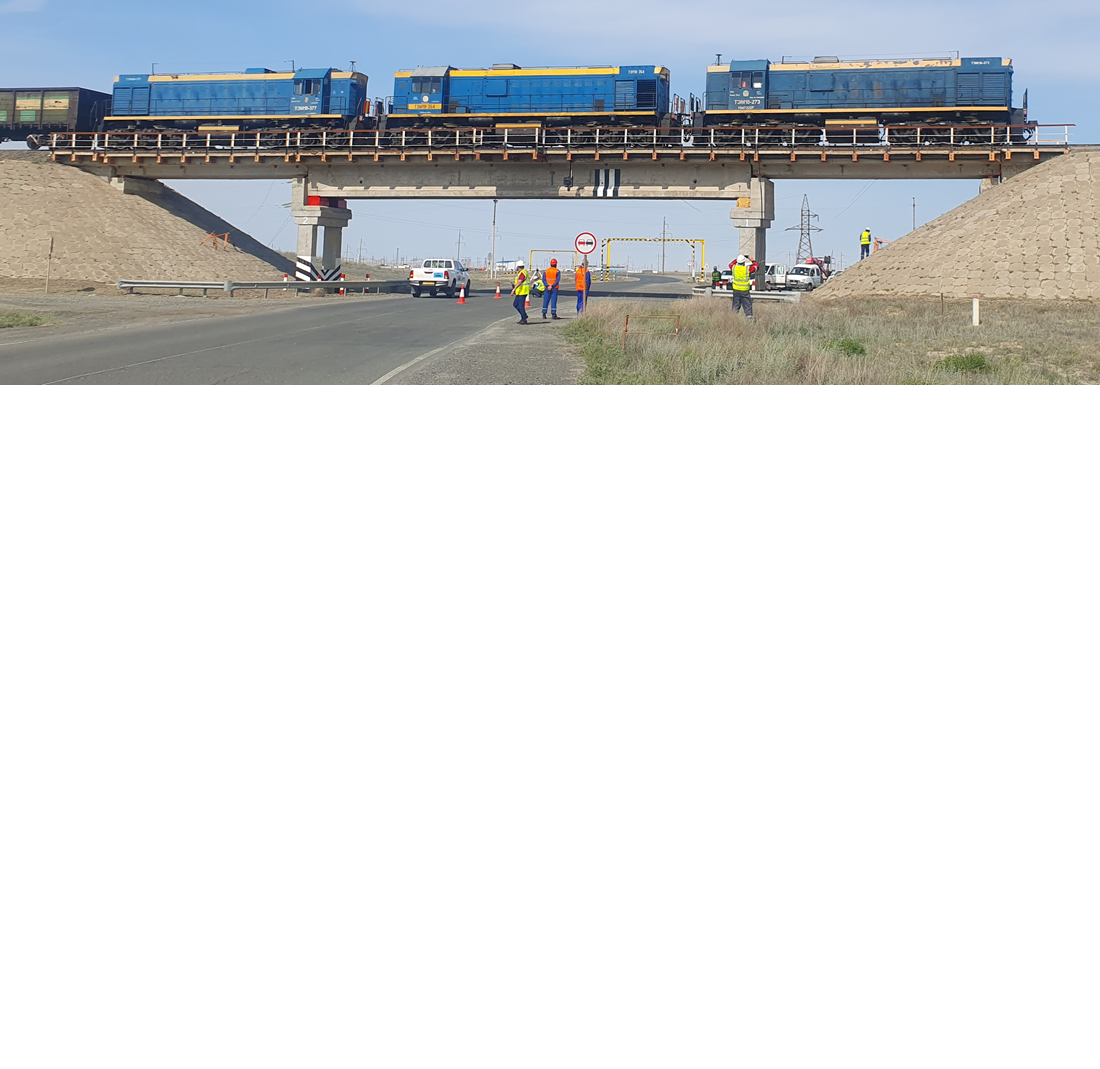
This paper presents the results of the study of stress-strain state of reinforced concrete spans of two overpasses. With increasing volumes of cargo transportation by rail, the axle load increases up to 25 tons. Bridges and overpasses built about 100 years ago have acquired hidden defects during the years of operation. The safe operation of artificial structures requires additional research using the TENZO software and hardware complex, which processes digital records from primary transducers based on strain gauges. In 2018 and 2023, deflections, strains and stresses were obtained for typical beam spans of 11.5 m and 16.5 m of two reinforced concrete overpasses, from static and dynamic loads. For example, in 2018, the “spread” of stresses from the test load (TEM18) for the right-hand blocks of the 11.5 m spans ranged from 3.7 MPa to 3.71 MPa at different loading stages, and for the left-hand blocks of the 11.5 m spans ranged from 3.46 MPa to 3.9 MPa at different loading stages. In 2023, the stress range was from 2.58 MPa to 4.65 MPa for the right span blocks of 11.5 m span and from 2.67 MPa to 4.7 MPa for the left span blocks at different stages of loading. The 2018 data show uneven loading of the span blocks, indicating that the track axis is offset from the axis of the transportation structure. In 2023, the span structure blocks worked uniformly, which indicates that the track axis and the axis of the transportation structure are aligned (coincide). The obtained dependences “deformations and stresses” for typical beam spans of 11.5 m show the technical condition of the structures of the investigated objects, confirming the possibility of increasing the passage through them of a larger tonnage of transported cargo (increase in axial load up to 25 tons per axle). The spans have demonstrated reliable behavior under dynamic loads, with no signs of significant degradation in the period from 2018 to 2023. The use of data from scientific monitoring methods with the use of digital hardware and software systems will significantly reduce the cost of maintaining artificial structures on railroads and improve the safety of transportation infrastructure
References
- Abdullayev, S. S., Bondar, I. S., Bakyt, G. B., Ashirbayev, G. K., Budiukin, A. M., Baubekov, Ye. Ye. (2021). Interaction of frame structures with rolling stock. Series of Geology and Technical Sciences, 445 (1), 22–28. https://doi.org/10.32014/2021.2518-170x.3
- Abdullayev, S. S., Bakyt, G. B., Aikumbekov, M. N., Bondar, I. S., Auyesbayev, Y. T. (2021). Determination of natural modes of railway overpasses. Journal of Applied Research and Technology, 19 (1), 1–10. https://doi.org/10.22201/icat.24486736e.2021.19.1.1487
- Zhussupov, K., Toktamyssova, A., Abdullayev, S., Bakyt, G., Yessengaliyev, M. (2018). Investigation of the Stress-Strain State of a Wheel Flange of the Locomotive by the Method of Finite Element Modeling. Mechanics, 24 (2). https://doi.org/10.5755/j01.mech.24.2.17637
- Abdullayev, S., Tokmurzina, N., Bakyt, G. (2016). The Determination of Admissible Speed of Locomotives on the Railway Tracks of the Republic of Kazakhstan. Transport Problems, 11 (1), 61–68. https://doi.org/10.20858/tp.2016.11.1.6
- Zhumanov, A. U. (2018). Locomotive fleet of the Republic of Kazakhstan. Transport vehicles and equipment. Journal "Transport of the Russian Federation", 6 (79), 45–48.
- Abdullayev, S., Imasheva, G., Tomkurzina, N., Adilova, N., Bakyt, G. (2018). Prospects for the Use of Gondola Cars on Bogies of Model ZK1 in the Organization of Heavy Freight Traffic in the Republic of Kazakhstan. Mechanics, 24 (1). https://doi.org/10.5755/j01.mech.24.1.17710
- Bondar, I. S. (2016). Effect of moving load on deformations of the superstructure of a railway bridge. Collection of papers with international participation, 7, 64–67.
- Bondar, I. S., Makhmetova, N. M., Kvashnin, M. Ya., Khasenov, S. S. (2023). Determination of the stress state and dynamic coefficients of beam bridges. Bulletin of the Siberian State Transport University, 4 (67), 92–100.
- Plevris, V., Papazafeiropoulos, G. (2024). AI in Structural Health Monitoring for Infrastructure Maintenance and Safety. Infrastructures, 9 (12), 225. https://doi.org/10.3390/infrastructures9120225
- Aktan, E., Bartoli, I., Glišić, B., Rainieri, C. (2024). Lessons from Bridge Structural Health Monitoring (SHM) and Their Implications for the Development of Cyber-Physical Systems. Infrastructures, 9 (2), 30. https://doi.org/10.3390/infrastructures9020030
- Vijayan, D. S., Sivasuriyan, A., Devarajan, P., Krejsa, M., Chalecki, M., Żółtowski, M. et al. (2023). Development of Intelligent Technologies in SHM on the Innovative Diagnosis in Civil Engineering – A Comprehensive Review. Buildings, 13 (8), 1903. https://doi.org/10.3390/buildings13081903
- Lanis, A., Razuvaev, D., Lomov, P. (2016). Conjugation of approach fill with bridge and overbridge. The Russian Automobile and Highway Industry Journal. 2 (48), 110–120.
- Bonessio, N., Lomiento, G., Benzoni, G. (2011). Damage identification procedure for seismically isolated bridges. Structural Control and Health Monitoring, 19 (5), 565–578. https://doi.org/10.1002/stc.448
- Yang, Y., Li, Q., Yan, B. (2017). Specifications and applications of the technical code for monitoring of building and bridge structures in China. Advances in Mechanical Engineering, 9 (1). https://doi.org/10.1177/1687814016684272
- Vičan, J., Gocál, J., Odrobiňák, J., Hlinka, R. (2012). Analysis and Load-carrying Capacity Estimation of Existing Railway Filler-beam Deck Bridges. Sspjce, 7 (2), 5–14. https://doi.org/10.2478/v10299-012-0001-6
- Kvočák, V., Kožlejová, V., Chupayeva, K. (2013). State of the Art in the Utilization of Deck Bridges with Encased Filler-Beams in the Standard Construction Practice. Sspjce, 8 (1), 107–114. https://doi.org/10.2478/sspjce-2013-0012
- Odrobiňák, J., Bujňák, J., Žilka, J. (2012). Study on Short Span Deck Bridges with Encased Steel Beams. Procedia Engineering, 40, 333–338. https://doi.org/10.1016/j.proeng.2012.07.104
- Samani, R. R., Nunez, A., De Schutter, B. (2024). A Bidirectional Long Short Term Memory Approach for Infrastructure Health Monitoring Using On-board Vibration Response. arXiv. https://doi.org/10.48550/arXiv.2412.02643
- Febrianto, E., Butler, L., Girolami, M., Cirak, F. (2022). Digital twinning of self-sensing structures using the statistical finite element method. Data-Centric Engineering, 3. https://doi.org/10.1017/dce.2022.28
- Wang, X., Zhuo, Y., Li, S. (2023). Damage Detection of High-Speed Railway Box Girder Using Train-Induced Dynamic Responses. Sustainability, 15 (11), 8552. https://doi.org/10.3390/su15118552
- Barkhordari, P., Galeazzi, R., Blanke, M. (2021). Monitoring of Railpad Long-term Condition in Turnouts Using Extreme Value Distributions. arXiv. https://doi.org/10.48550/arXiv.2101.02567
- Sasy Chan, Y. W., Wang, H.-P., Xiang, P. (2021). Optical Fiber Sensors for Monitoring Railway Infrastructures: A Review towards Smart Concept. Symmetry, 13 (12), 2251. https://doi.org/10.3390/sym13122251
- Radicioni, L., Bernardini, L., Bono, F. M., Anghileri, M., Capacci, L., Cazzulani, G. et al. (2023). Structural Health Monitoring of a steel truss railway bridge studying its low frequency response. Ce/Papers, 6 (5), 876–885. https://doi.org/10.1002/cepa.2184
- Saravanan, U., Lenka, K. (2023). On condition monitoring of a corroding steel truss bridge – a case study. Proceedings of the 14th International Workshop on Structural Health Monitoring. https://doi.org/10.12783/shm2023/36929
Downloads
Published
How to Cite
Issue
Section
License
Copyright (c) 2025 Ivan Bondar, Seidulla Abdullayev, Arailym Tursynbayeva, Asel Abdullayeva, Yerlan Auyesbayev, Aliya Izbairova

This work is licensed under a Creative Commons Attribution 4.0 International License.
The consolidation and conditions for the transfer of copyright (identification of authorship) is carried out in the License Agreement. In particular, the authors reserve the right to the authorship of their manuscript and transfer the first publication of this work to the journal under the terms of the Creative Commons CC BY license. At the same time, they have the right to conclude on their own additional agreements concerning the non-exclusive distribution of the work in the form in which it was published by this journal, but provided that the link to the first publication of the article in this journal is preserved.
A license agreement is a document in which the author warrants that he/she owns all copyright for the work (manuscript, article, etc.).
The authors, signing the License Agreement with TECHNOLOGY CENTER PC, have all rights to the further use of their work, provided that they link to our edition in which the work was published.
According to the terms of the License Agreement, the Publisher TECHNOLOGY CENTER PC does not take away your copyrights and receives permission from the authors to use and dissemination of the publication through the world's scientific resources (own electronic resources, scientometric databases, repositories, libraries, etc.).
In the absence of a signed License Agreement or in the absence of this agreement of identifiers allowing to identify the identity of the author, the editors have no right to work with the manuscript.
It is important to remember that there is another type of agreement between authors and publishers – when copyright is transferred from the authors to the publisher. In this case, the authors lose ownership of their work and may not use it in any way.








