Optimization of load distribution and fuel consumption for diesel generator 1000 kW for remote area using biodiesel B35 power station
DOI:
https://doi.org/10.15587/1729-4061.2025.327179Keywords:
diesel generator, biodiesel B35, remote power systems, efficiency, renewable energyAbstract
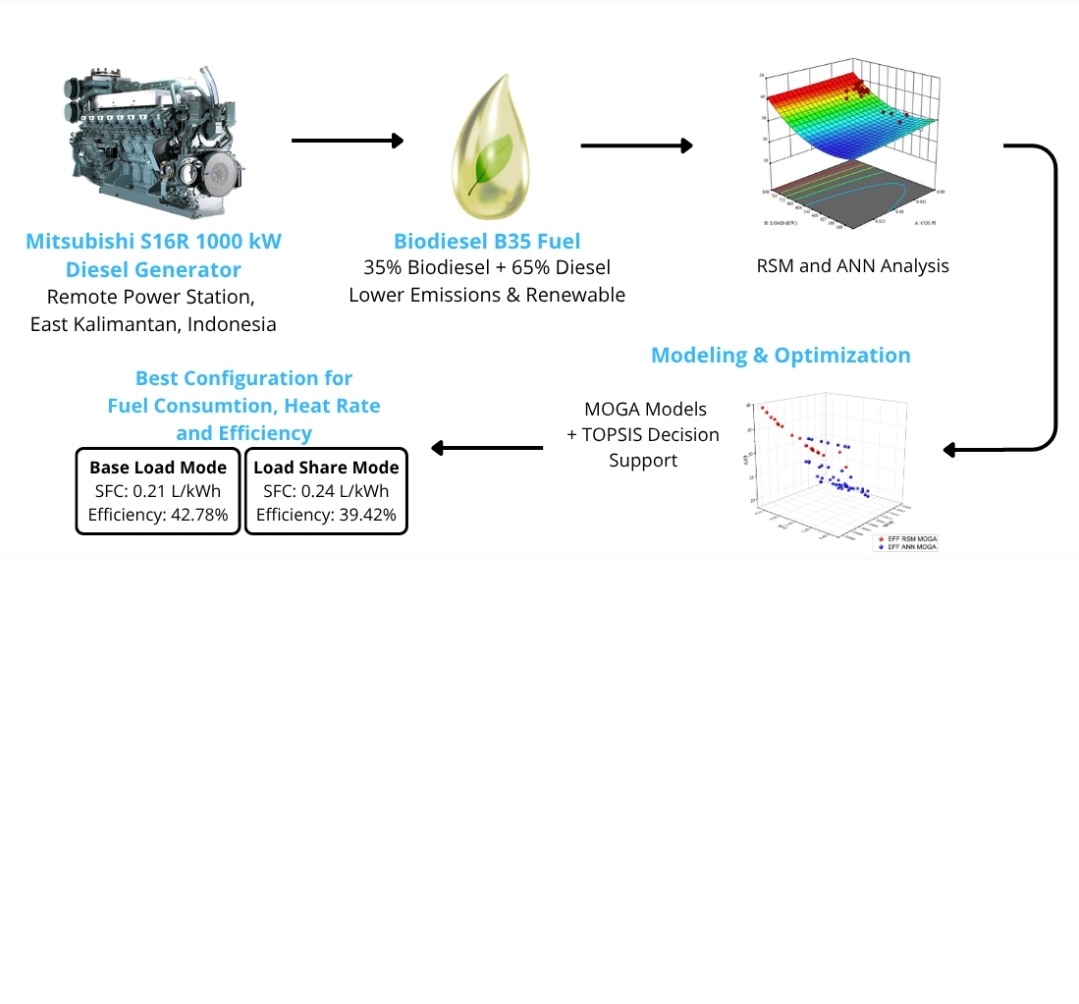
This study focuses on the operational optimization of a 1000 kW high-speed diesel generator (Mitsubishi S16R) located at PLTD Muara Wahau, a remote power station in East Kalimantan, Indonesia. The generator operates with Biodiesel B35, a national renewable fuel standard containing 35% biodiesel and 65% petroleum diesel. While B35 offers environmental benefits, its lower heating value and distinct combustion characteristics result in an 18% reduction in generator output and increased specific fuel consumption (SFC), posing challenges to performance and fuel efficiency in isolated areas. To address these issues, a hybrid modeling and optimization framework is proposed, combining response surface methodology (RSM), artificial neural networks (ANN), and multi-objective genetic algorithm (MOGA). A multi-criteria decision-making approach using TOPSIS is applied to evaluate alternative operating scenarios. The study investigates two modes: base load (cos φ = 0.96, load = 698 kW) and load share (cos φ = 0.97, load = 829 kW). The RSM model in base load mode achieves a fuel consumption of 0.21 l/kWh and efficiency of 42.78%, while the ANN-MOGA model in load share mode records 0.24 l/kWh and 39.42% efficiency. The results demonstrate that parameter optimization can significantly improve the performance of B35-fueled generators. The integrated methodology provides a practical solution for enhancing operational efficiency and sustainability in remote, off-grid power systems, with potential for broader application in similar decentralized energy contexts
References
- Bakirtas, T., Akpolat, A. G. (2018). The relationship between energy consumption, urbanization, and economic growth in new emerging-market countries. Energy, 147, 110–121. https://doi.org/10.1016/j.energy.2018.01.011
- Terms. Terms and conditions. IEA. Available at: https://www.iea.org/terms
- Nirbito, W., Budiyanto, M. A., Muliadi, R. (2020). Performance Analysis of Combined Cycle with Air Breathing Derivative Gas Turbine, Heat Recovery Steam Generator, and Steam Turbine as LNG Tanker Main Engine Propulsion System. Journal of Marine Science and Engineering, 8 (9), 726. https://doi.org/10.3390/jmse8090726
- Budiyanto, M. A., Pamitran, A. S., Wibowo, H. T., Murtado, F. N. (2020). Study on the Performance Analysis of Dual Fuel Engines on the Medium Speed Diesel Engine. Journal of Advanced Research in Fluid Mechanics and Thermal Sciences, 68 (1), 163–174. https://doi.org/10.37934/arfmts.68.1.163174
- Muzhaffar, M. H., Budiyanto, M. A. (2024). Exploring Eco-Friendly Paths: A Comparative Study of Emissions in Medium Speed Diesel Engines Utilizing Alternative Fuels through Simulation Analysis. Journal of Advanced Research in Fluid Mechanics and Thermal Sciences, 124 (2), 235–247. https://doi.org/10.37934/arfmts.124.2.235247
- Wirawan, S. S., Solikhah, M. D., Setiapraja, H., Sugiyono, A. (2024). Biodiesel implementation in Indonesia: Experiences and future perspectives. Renewable and Sustainable Energy Reviews, 189, 113911. https://doi.org/10.1016/j.rser.2023.113911
- Dubey, A., Prasad, R. S., Kumar Singh, J., Nayyar, A. (2022). Optimization of diesel engine performance and emissions with biodiesel-diesel blends and EGR using response surface methodology (RSM). Cleaner Engineering and Technology, 8, 100509. https://doi.org/10.1016/j.clet.2022.100509
- Raja, A., Srivastava, A. P., Dwivedi, M. (2006). Power Plant Engineering. New Age International, 470.
- Pitchaiah, S., Juchelková, D., Sathyamurthy, R., Atabani, A. E. (2023). Prediction and performance optimisation of a DI CI engine fuelled diesel–Bael biodiesel blends with DMC additive using RSM and ANN: Energy and exergy analysis. Energy Conversion and Management, 292, 117386. https://doi.org/10.1016/j.enconman.2023.117386
- Li, J., Zhong, W., Zhang, J., Zhao, Z., Hu, J. (2023). The combustion and emission improvements for diesel–biodiesel hybrid engines based on response surface methodology. Frontiers in Energy Research, 11. https://doi.org/10.3389/fenrg.2023.1201815
- Khoobbakht, G., Najafi, G., Karimi, M., Akram, A. (2016). Optimization of operating factors and blended levels of diesel, biodiesel and ethanol fuels to minimize exhaust emissions of diesel engine using response surface methodology. Applied Thermal Engineering, 99, 1006–1017. https://doi.org/10.1016/j.applthermaleng.2015.12.143
- Khoobbakht, G., Akram, A., Karimi, M., Najafi, G. (2016). Exergy and Energy Analysis of Combustion of Blended Levels of Biodiesel, Ethanol and Diesel Fuel in a DI Diesel Engine. Applied Thermal Engineering, 99, 720–729. https://doi.org/10.1016/j.applthermaleng.2016.01.022
- Liu, K., Deng, B., Shen, Q., Yang, J., Li, Y. (2022). Optimization based on genetic algorithms on energy conservation potential of a high speed SI engine fueled with butanol–gasoline blends. Energy Reports, 8, 69–80. https://doi.org/10.1016/j.egyr.2021.11.289
- Mustayen, A. G. M. B., Rasul, M. G., Wang, X., Negnevitsky, M., Hamilton, J. M. (2022). Remote areas and islands power generation: A review on diesel engine performance and emission improvement techniques. Energy Conversion and Management, 260, 115614. https://doi.org/10.1016/j.enconman.2022.115614
- Nhieu, N.-L., Dang, T. D. (2024). Harnessing Vietnam’s coastal potential: Prioritizing marine energy technologies with an objectively weighting decision-making approach. Renewable Energy, 230, 120881. https://doi.org/10.1016/j.renene.2024.120881
- Eputusan Direktur Jenderal Minyak Dan Gas Bumiі Kementerian Energi Dan Sumber Daya Mineral (2023). No. 170.K.HK.02.DJM.2023. Available at: https://migas.esdm.go.id/cms/uploads/regulasi/regulasi-kkkl/2023/170.K.HK.02.DJM.2023.pdf
- Belke, A., Dobnik, F., Dreger, C. (2011). Energy consumption and economic growth: New insights into the cointegration relationship. Energy Economics, 33 (5), 782–789. https://doi.org/10.1016/j.eneco.2011.02.005
- Jeremiah Barasa Kabeyi, M., Akanni Olanrewaju, O. (2020). Performance Analysis Of Diesel Engine Power Plants For Grid Electricity Supply. SAIIE31 Proceedings. Available at: https://www.researchgate.net/publication/348575084
- Soto, D. (2018). Modeling and measurement of specific fuel consumption in diesel microgrids in Papua, Indonesia. Energy for Sustainable Development, 45, 180–185. https://doi.org/10.1016/j.esd.2018.06.013
- Baughn, J. W., Bagheri, N. (1985). The Effect of Thermal Matching on the Thermodynamic Performance of Gas Turbine and IC Engine Cogeneration Systems. Volume 4: Manufacturing Materials and Metallurgy; Ceramics; Structures and Dynamics; Controls, Diagnostics and Instrumentation; Process Industries; Technology Resources; General. https://doi.org/10.1115/85-igt-106
- Gunst, R. F., Myers, R. H., Montgomery, D. C. (1996). Response Surface Methodology: Process and Product Optimization Using Designed Experiments. Technometrics, 38 (3), 285. https://doi.org/10.2307/1270613
- Manojkumar, N., Muthukumaran, C., Sharmila, G. (2022). A comprehensive review on the application of response surface methodology for optimization of biodiesel production using different oil sources. Journal of King Saud University - Engineering Sciences, 34 (3), 198–208. https://doi.org/10.1016/j.jksues.2020.09.012
- Chen, W.-H., Carrera Uribe, M., Kwon, E. E., Lin, K.-Y. A., Park, Y.-K., Ding, L., Saw, L. H. (2022). A comprehensive review of thermoelectric generation optimization by statistical approach: Taguchi method, analysis of variance (ANOVA), and response surface methodology (RSM). Renewable and Sustainable Energy Reviews, 169, 112917. https://doi.org/10.1016/j.rser.2022.112917
- Dongare, A. D., Kharde, R. R., Kachare, A. D. (2008). Introduction to Artificial Neural Network. International Journal of Engineering and Innovative Technology (IJEIT), 2 (1). Available at: https://citeseerx.ist.psu.edu/document?repid=rep1&type=pdf&doi=04d0b6952a4f0c7203577afc9476c2fcab2cba06
- Viera-Martin, E., Gómez-Aguilar, J. F., Solís-Pérez, J. E., Hernández-Pérez, J. A., Escobar-Jiménez, R. F. (2022). Artificial neural networks: a practical review of applications involving fractional calculus. The European Physical Journal Special Topics, 231 (10), 2059–2095. https://doi.org/10.1140/epjs/s11734-022-00455-3
- Yunus, R. B., Zainuddin, N., Daud, H., Kannan, R., Yahaya, M. M., Al-Yaari, A. (2024). An improved accelerated 3-term conjugate gradient algorithm with second-order Hessian approximation for nonlinear least-squares optimization. Journal of Mathematics and Computer Science, 36 (03), 263–274. https://doi.org/10.22436/jmcs.036.03.02
- Huang, X., Cao, H., Jia, B. (2023). Optimization of Levenberg Marquardt Algorithm Applied to Nonlinear Systems. Processes, 11 (6), 1794. https://doi.org/10.3390/pr11061794
- Kayri, M. (2016). Predictive Abilities of Bayesian Regularization and Levenberg–Marquardt Algorithms in Artificial Neural Networks: A Comparative Empirical Study on Social Data. Mathematical and Computational Applications, 21 (2), 20. https://doi.org/10.3390/mca21020020
- Gao, Y., Shi, L., Yao, P. (2000). Study on multi-objective genetic algorithm. Proceedings of the 3rd World Congress on Intelligent Control and Automation (Cat. No.00EX393), 1, 646–650. https://doi.org/10.1109/wcica.2000.860052
- Lambora, A., Gupta, K., Chopra, K. (2019). Genetic Algorithm- A Literature Review. 2019 International Conference on Machine Learning, Big Data, Cloud and Parallel Computing (COMITCon), 380–384. https://doi.org/10.1109/comitcon.2019.8862255
- Murata, T., Ishibuchi, H., Tanaka, H. (1996). Multi-objective genetic algorithm and its applications to flowshop scheduling. Computers & Industrial Engineering, 30 (4), 957–968. https://doi.org/10.1016/0360-8352(96)00045-9
- Hajabdollahi, F., Rafsanjani, H. H., Hajabdollahi, Z., Hamidi, Y. (2012). Multi-objective optimization of pin fin to determine the optimal fin geometry using genetic algorithm. Applied Mathematical Modelling, 36 (1), 244–254. https://doi.org/10.1016/j.apm.2011.05.048
- Wang, P., Zhu, Z., Huang, S. (2014). The use of improved TOPSIS method based on experimental design and Chebyshev regression in solving MCDM problems. Journal of Intelligent Manufacturing, 28 (1), 229–243. https://doi.org/10.1007/s10845-014-0973-9
- Bezerra, M. A., Santelli, R. E., Oliveira, E. P., Villar, L. S., Escaleira, L. A. (2008). Response surface methodology (RSM) as a tool for optimization in analytical chemistry. Talanta, 76 (5), 965–977. https://doi.org/10.1016/j.talanta.2008.05.019
- Bhattacharya, S. (2021). Central Composite Design for Response Surface Methodology and Its Application in Pharmacy. Response Surface Methodology in Engineering Science. https://doi.org/10.5772/intechopen.95835
- Bharadwaz, A., Dhar, S., Jayasuriya, A. C. (2023). Full factorial design of experiment-based and response surface methodology approach for evaluating variation in uniaxial compressive mechanical properties, and biocompatibility of photocurable PEGDMA-based scaffolds. Biomedical Materials, 18 (2), 025019. https://doi.org/10.1088/1748-605x/acb7bd
- Sahoo, P. (2011). Optimization of Turning Parameters for Surface Roughness Using RSM and GA. Advances in Production Engineering & Management, 6, 197–208. Available at: https://apem-journal.org/Archives/2011/APEM6-3_197-208.pdf
- Kanani, H., Shams, M., Hasheminasab, M., Bozorgnezhad, A. (2015). Model development and optimization of operating conditions to maximize PEMFC performance by response surface methodology. Energy Conversion and Management, 93, 9–22. https://doi.org/10.1016/j.enconman.2014.12.093
- Ali, P. J. M., Faraj, R. H. (2014). Data Normalization and Standardization: A Technical Report. Machine Learning Technical Reports, 1 (1). http://doi.org/10.13140/RG.2.2.28948.04489
- Singla, P., Duhan, M., Saroha, S. (2022). Different normalization techniques as data preprocessing for one step ahead forecasting of solar global horizontal irradiance. Artificial Intelligence for Renewable Energy Systems, 209–230. https://doi.org/10.1016/b978-0-323-90396-7.00004-3
- Khan, H., Hussain, S., Hussain, S. F., Gul, S., Ahmad, A., Ullah, S. (2021). Multivariate modeling and optimization of Cr(VI) adsorption onto carbonaceous material via response surface models assisted with multiple regression analysis and particle swarm embedded neural network. Environmental Technology & Innovation, 24, 101952. https://doi.org/10.1016/j.eti.2021.101952
- Madhiarasan, M., Louzazni, M. (2022). Analysis of Artificial Neural Network: Architecture, Types, and Forecasting Applications. Journal of Electrical and Computer Engineering, 2022, 1–23. https://doi.org/10.1155/2022/5416722
- Selvakumar, S., Ravikumar, R. (2018). A Novel Approach for Optimization to Verify RSM Model by Using Multi-Objective Genetic Algorithm (MOGA). Materials Today: Proceedings, 5 (5), 11386–11394. https://doi.org/10.1016/j.matpr.2018.02.106
Downloads
Published
How to Cite
Issue
Section
License
Copyright (c) 2025 Dhimas Adi Purbandono, Muhammad Arif Budiyanto, Firman Ramdan, Muhamad Iqbal Felani

This work is licensed under a Creative Commons Attribution 4.0 International License.
The consolidation and conditions for the transfer of copyright (identification of authorship) is carried out in the License Agreement. In particular, the authors reserve the right to the authorship of their manuscript and transfer the first publication of this work to the journal under the terms of the Creative Commons CC BY license. At the same time, they have the right to conclude on their own additional agreements concerning the non-exclusive distribution of the work in the form in which it was published by this journal, but provided that the link to the first publication of the article in this journal is preserved.
A license agreement is a document in which the author warrants that he/she owns all copyright for the work (manuscript, article, etc.).
The authors, signing the License Agreement with TECHNOLOGY CENTER PC, have all rights to the further use of their work, provided that they link to our edition in which the work was published.
According to the terms of the License Agreement, the Publisher TECHNOLOGY CENTER PC does not take away your copyrights and receives permission from the authors to use and dissemination of the publication through the world's scientific resources (own electronic resources, scientometric databases, repositories, libraries, etc.).
In the absence of a signed License Agreement or in the absence of this agreement of identifiers allowing to identify the identity of the author, the editors have no right to work with the manuscript.
It is important to remember that there is another type of agreement between authors and publishers – when copyright is transferred from the authors to the publisher. In this case, the authors lose ownership of their work and may not use it in any way.








