Devising a method to adaptively determine human movement speed in crowd behavior simulation at extreme events
DOI:
https://doi.org/10.15587/1729-4061.2025.327279Keywords:
adaptation, speed, modeling, crowd, density, behavior, vision, evacuation, management, safetyAbstract
The subject of this study is the dynamics of human flow at extreme events, which are modeled using a computer simulation model.
The task addressed relates to the insufficient accuracy in determining human speed with existing approaches when modeling crowd behavior at extreme events. Specifically, the desired walking speed of a person is set fixed or discretely, which can lead to significant errors as it does not correspond to real-world conditions. Models based on pre-collected data compromise accuracy under different conditions.
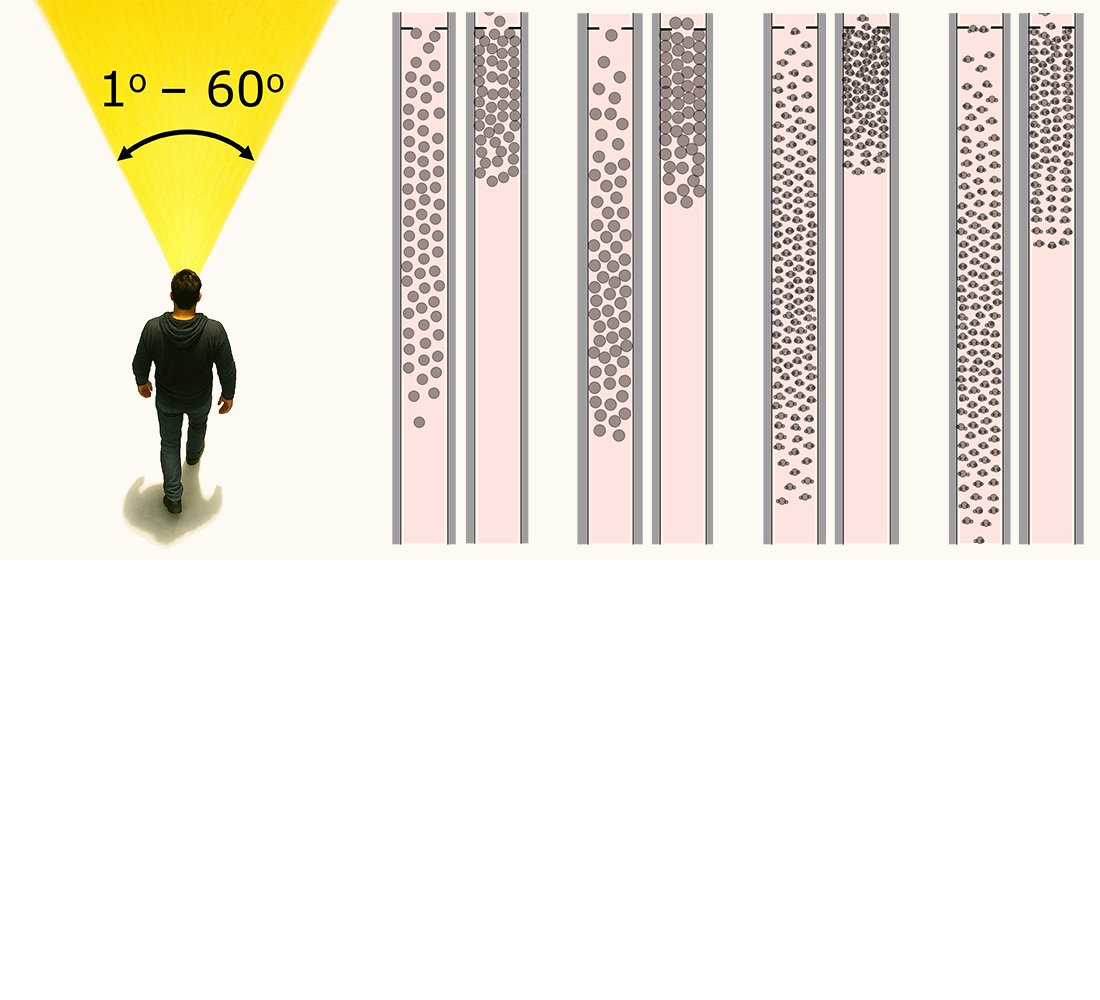
A method is proposed to adaptively determine human movement speed at extreme events, which takes into account individual spatial constraints and the narrowing of the effective field of view under stress. Simulation modeling has shown that the method devised significantly improves the accuracy of the models. The average modeling error decreased from 28.05 % to 12.06 % for a circular profile of human projection, and from 31.5 % to 6.09 % for an elliptical profile.
The results are explained by the individual consideration of local crowd density, realistic narrowing of the field of view within the range of 30° to 0.5°, and corresponding adaptive adjustment of the desired speed.
A feature of the devised method is its universality as it does not depend on a specific scenario or pre-collected empirical data. The method is based on general patterns of human interaction with the environment and is therefore suitable for use even in cases where field studies are impossible or difficult.
Provided that two-dimensional models are used, the proposed method could be applied to simulate crowd behavior in automated crowd management systems, software packages for assessing the safety of mass events, and designing evacuation routes
References
- Odeychuk, A. M., Adamenko, M. I., Tkachenko, V. I. (2017). The three-component two-dimensional model of the human for description of crowd in the extreme situation. Systemy obrobky informatsiyi, 1 (147), 103–108. Available at: http://nbuv.gov.ua/UJRN/soi_2017_1_21
- Yak podolaty strakh i diyaty pid chas povitrianoi tryvohy. Interfax Ukraine. Available at: https://interfax.com.ua/news/press-release/987893.html
- Odeychuk, A. N., Adamenko, N. I., Tkachenko, V. I. (2015). Modeli panikuyuschey tolpy: sovremennyy vzglyad na problemu. Kharkiv: KhHAFK, 48.
- Odeychuk, A. N., Adamenko, N. I., Tkachenko, V. I. (2015). Comparative analysis of models for computer calculations of crowd behavior. East European Journal of Physics, 2 (3), 4–16. Available at: https://periodicals.karazin.ua/eejp/article/view/4444
- Akopov, A., Beklaryan, L. (2012). Simulation of human crowd behavior in extreme situations. International Journal of Pure and Applied Mathematics, 79 (1), 121–138. Available at: https://www.researchgate.net/publication/267656334_Simulation_of_human_crowd_behavior_in_extreme_situations
- Ding, N., Zhu, Y., Liu, X., Dong, D., Wang, Y. (2024). A modified social force model for crowd evacuation considering collision predicting behaviors. Applied Mathematics and Computation, 466, 128448. https://doi.org/10.1016/j.amc.2023.128448
- Yan, D., Ding, G., Huang, K., Bai, C., He, L., Zhang, L. (2024). Enhanced Crowd Dynamics Simulation with Deep Learning and Improved Social Force Model. Electronics, 13 (5), 934. https://doi.org/10.3390/electronics13050934
- Wang, H., Liu, H., Li, W. (2025). Crowd evacuation path planning and simulation method based on deep reinforcement learning and repulsive force field. Applied Intelligence, 55 (4). https://doi.org/10.1007/s10489-024-06074-w
- Liu, P., Chao, Q., Huang, H., Wang, Q., Zhao, Z., Peng, Q. et al. (2022). Velocity-based dynamic crowd simulation by data-driven optimization. The Visual Computer, 38 (9-10), 3499–3512. https://doi.org/10.1007/s00371-022-02556-5
- Bendali-Braham, M., Weber, J., Forestier, G., Idoumghar, L., Muller, P.-A. (2021). Recent trends in crowd analysis: A review. Machine Learning with Applications, 4, 100023. https://doi.org/10.1016/j.mlwa.2021.100023
- Akopov, A. S., Beklaryan, L. A., Beklaryan, A. L. (2020). Cluster-Based Optimization of an Evacuation Process Using a Parallel Bi-Objective Real-Coded Genetic Algorithm. Cybernetics and Information Technologies, 20 (3), 45–63. https://doi.org/10.2478/cait-2020-0027
- Sharbini, H., Masrizal, N. A. binti, Chan, C. P., Shiang, C. W., Julaihi, A. A., Ping, T. P., Bolhassan, N. A. (2019). The Analysis of 2D Crowd Behaviour Simulation during Emergency Situation. Proceedings of the 2019 5th International Conference on Industrial and Business Engineering, 296–300. https://doi.org/10.1145/3364335.3365586
- Lungaro, P., Sjoberg, R., Valero, A. J. F., Mittal, A., Tollmar, K. (2018). Gaze-Aware Streaming Solutions for the Next Generation of Mobile VR Experiences. IEEE Transactions on Visualization and Computer Graphics, 24 (4), 1535–1544. https://doi.org/10.1109/tvcg.2018.2794119
- Psychological Causes of Tunnel Vision: Stress and Panic Attacks. Available at: https://my.klarity.health/psychological-causes-of-tunnel-vision-stress-and-panic-attacks
- Ma, Y., Qi, S., Zhang, Y., Lian, G., Lu, W., Chan, C.-Y. (2020). Drivers’ Visual Attention Characteristics under Different Cognitive Workloads: An On-Road Driving Behavior Study. International Journal of Environmental Research and Public Health, 17 (15), 5366. https://doi.org/10.3390/ijerph17155366
- Ross, D. L., Vilke, G. M. (2017). Guidelines for Investigating Officer-Involved Shootings, Arrest-Related Deaths, and Deaths in Custody. Routledge. https://doi.org/10.4324/9781315560953
- Tunnel Vision (2014). California Training Institute. Available at: https://www.hptc-pro.com/wp-content/uploads/2014/01/Newsletter-4-Tunnel-Vision.pdf
- Voronoi, G. (1908). Nouvelles applications des paramètres continus à la théorie des formes quadratiques. Premier mémoire. Sur quelques propriétés des formes quadratiques positives parfaites. Journal Für Die Reine Und Angewandte Mathematik (Crelles Journal), 1908 (133), 97–102. https://doi.org/10.1515/crll.1908.133.97
Downloads
Published
How to Cite
Issue
Section
License
Copyright (c) 2025 Andrii Odeychuk

This work is licensed under a Creative Commons Attribution 4.0 International License.
The consolidation and conditions for the transfer of copyright (identification of authorship) is carried out in the License Agreement. In particular, the authors reserve the right to the authorship of their manuscript and transfer the first publication of this work to the journal under the terms of the Creative Commons CC BY license. At the same time, they have the right to conclude on their own additional agreements concerning the non-exclusive distribution of the work in the form in which it was published by this journal, but provided that the link to the first publication of the article in this journal is preserved.
A license agreement is a document in which the author warrants that he/she owns all copyright for the work (manuscript, article, etc.).
The authors, signing the License Agreement with TECHNOLOGY CENTER PC, have all rights to the further use of their work, provided that they link to our edition in which the work was published.
According to the terms of the License Agreement, the Publisher TECHNOLOGY CENTER PC does not take away your copyrights and receives permission from the authors to use and dissemination of the publication through the world's scientific resources (own electronic resources, scientometric databases, repositories, libraries, etc.).
In the absence of a signed License Agreement or in the absence of this agreement of identifiers allowing to identify the identity of the author, the editors have no right to work with the manuscript.
It is important to remember that there is another type of agreement between authors and publishers – when copyright is transferred from the authors to the publisher. In this case, the authors lose ownership of their work and may not use it in any way.