Estimating deflections of castellated beams using SolidWorks Simulation
DOI:
https://doi.org/10.15587/1729-4061.2025.327557Keywords:
castellated beam, hexagonal openings, deflections, finite element analysis, SOLIDWORKS SimulationAbstract
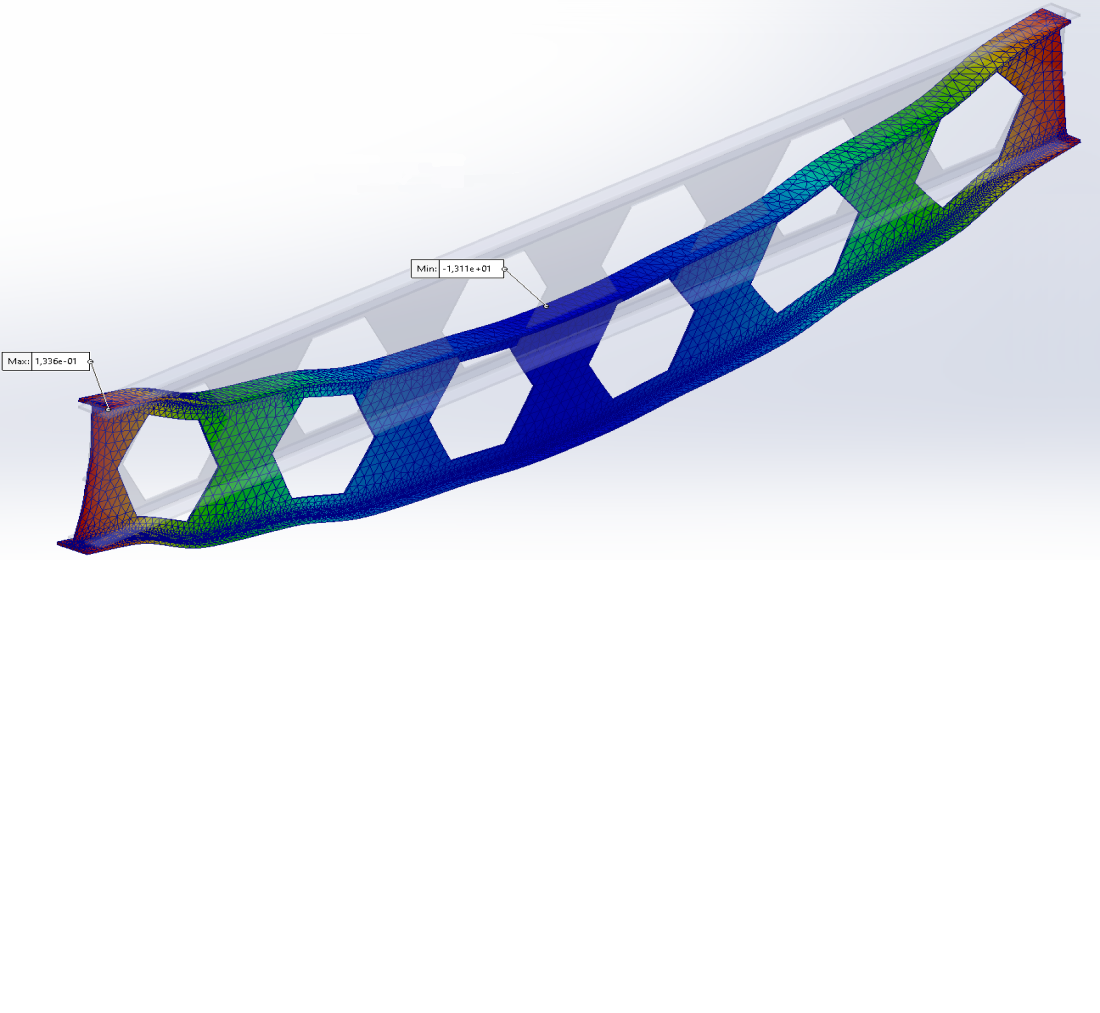
The object of this study is a castellated beam, in which the large openings in the web have the shape of a regular hexagon. The beam is investigated for the purpose of assessing deflections. Based on a set of experimental studies, the features of the stress-strain state of castellated beams have been defined. The need to take into account the increased deflections of castellated beams due to the openings in the beam web when calculating the deflections of castellated beams at the serviceability limit state verifications has been determined. A comparative analysis of the deflections obtained as a result of the numerical experiment with the deflections of beams determined using the design code technique has been performed. It was established that for verifications of castellated beams at the serviceability limit state, the error in assessing the deflections of a single-span hinged beam loaded with a uniformly distributed transverse load in some cases reaches 20 %. Recommendations have been devised for estimating deflections of castellated beams. According to the proposed recommendations, the error in estimating castellated beam deflections does not exceed 3 % for the range of the beam span to the total height of its cross-section 8.5<L/h<25.
The results are valid only for the range of I-section profiles and only for the case of a uniformly distributed load acting on the beam when the compressed beam flange is out of bending plane restrained and the beam web is perforated with large openings in the form of regular hexagons. It is under such conditions that the results could be implemented in practice both at the stage of selecting cross-sections of the studied class of structures and when designing effective ranges of castellated beams
References
- Pavlović, S. (2021). Techno-economic analysis of castellated and solid "I" – profiled steel beams in terms of load capacity and serviceability. STEPGRAD, 1 (13). https://doi.org/10.7251/stp1813739p
- ACB and Angelina beams. A new generation of beams with large web openings. ArcelorMittal Europe - Long products. ArcelorMittal, 64.
- Perelmuter, A., Kriksunov, E., Gavrilenko, I., Yurchenko, V. (2010). Designing bolted end-plate connections in compliance with Eurocode and Ukrainian codes: consistency and contradictions. Selected papers of the 10th International Conference “Modern Building Materials, Structures and Techniques”. Vol. II. Vilnius: Technika, 733–743. Available at: https://www.researchgate.net/publication/266038627_Designing_bolted_end-plate_connections_in_compliance_with_eurocode_and_ukrainian_codes_Consistency_and_contradictions
- Gezentsvey, Y., Olevskyi, V., Volchok, D., Olevskyi, O. (2021). Calculation of the improved steel beams of buildings and structures of the mining and metallurgical complex. Strength of Materials and Theory of Structures, 106, 54–67. https://doi.org/10.32347/2410-2547.2021.106.54-67
- Pritykin, A. I. (2022). Prediction of the castellated beams deflections. Vestnik MGSU, 9, 1160–1174. https://doi.org/10.22227/1997-0935.2022.9.1160-1174
- Sonck, D., Kinget, L., Belis, J. (2015). Deflections of cellular and castellated beams. Future Visions (International Association for Shell and Spatial Structures), Proceedings, 1–12. https://biblio.ugent.be/publication/6913948
- Pidgurskyi, I., Slobodian, V., Bykiv, D., Pidgurskyi, M. (2021). Investigation of the stress-strain state of beams with different types of web perforation. Scientific Journal of the Ternopil National Technical University, 103 (3), 79–87. https://doi.org/10.33108/visnyk_tntu2021.03.079
- Morkhade, S. G., Gupta, L. M. (2015). Analysis of steel I-beams with rectangular web openings: experimental and finite element investigation. Engineering Structures and Technologies, 7 (1), 13–23. https://doi.org/10.3846/2029882x.2015.1085332
- Panedpojaman, P., Thepchatri, T. (2013). Finite element investigation on deflection of cellular beams with various configurations. International Journal of Steel Structures, 13 (3), 487–494. https://doi.org/10.1007/s13296-013-3008-z
- Durif, S., Bouchaïr, A. (2012). Behavior of Cellular Beams with Sinusoidal Openings. Procedia Engineering, 40, 108–113. https://doi.org/10.1016/j.proeng.2012.07.064
- Jiang, T.-Y., Xu, M.-X., Geng, S., Wang, L. (2024). Calculation of deformation behavior and deflection of regular hexagonal castellated beams considering web weld damage. Engineering Mechanics, 41 (4), 199–209. http://doi.org/10.6052/j.issn.1000-4750.2022.04.0382
- Kaveh, A., Shokohi, F. (2015). Optimum design of laterally-supported castellated beams using CBO algorithm. Steel and Composite Structures, 18 (2), 305–324. https://doi.org/10.12989/scs.2015.18.2.305
- Yurchenko, V., Peleshko, I. (2021). Methodology for solving parametric optimization problems of steel structures. Magazine of Civil Engineering, 7 (107). http://doi.org/10.34910/MCE.107.5
- Yurchenko, V., Peleshko, I. (2020). Improved gradient projection method for parametric optimisation of bar structures. Magazine of Civil Engineering, 6 (98). http://doi.org/10.18720/MCE.98.12
- Peleshko, I. D., Yurchenko, V. V. (2021). Parametric Optimization of Metal Rod Structures Using the Modified Gradient Projection Method. International Applied Mechanics, 57 (4), 440–454. https://doi.org/10.1007/s10778-021-01096-0
- Yurchenko, V., Peleshko, I. (2022). Optimization of cross-section dimensions of structural members made of cold-formed profiles using compromise search. Eastern-European Journal of Enterprise Technologies, 5 (7 (119)), 84–95. https://doi.org/10.15587/1729-4061.2022.261037
- Yurchenko, V., Peleshko, I., Rusyn, P. (2024). Optimization of cross-sectional dimensions of castellated beams with hexagonal openings. Eastern-European Journal of Enterprise Technologies, 3 (7 (129)), 6–16. https://doi.org/10.15587/1729-4061.2024.304803
- Morkhade, S. G., Gupta, L. M. (2019). Behavior of Castellated Steel Beams: State of the Art Review. Electronic Journal of Structural Engineering, 19, 39–48. https://doi.org/10.56748/ejse.19234
- Ranisavljević, M., Dobrić, J. (2024). Failure modes of steel beams with web openings. Gradjevinski Materijali i Konstrukcije, 67 (4), 201–209. https://doi.org/10.5937/grmk2400011r
- Elaiwi, S., Kim, B., Li, L.-Y. (2019). Bending Analysis of Castellated Beams. Athens Journal of Τechnology & Engineering, 6 (1), 1–16. https://doi.org/10.30958/ajte.6-1-1
- Liu, T. C. H., Chung, K. F. (2003). Steel beams with large web openings of various shapes and sizes: finite element investigation. Journal of Constructional Steel Research, 59 (9), 1159–1176. https://doi.org/10.1016/s0143-974x(03)00030-0
- Soltani, M. R., Bouchaïr, A., Mimoune, M. (2012). Nonlinear FE analysis of the ultimate behavior of steel castellated beams. Journal of Constructional Steel Research, 70, 101–114. https://doi.org/10.1016/j.jcsr.2011.10.016
- Elaiwi, S. S., Kim, B., Li, L. (2019). Linear and Nonlinear Buckling Analysis of Castellated Beams. International Journal of Structural and Civil Engineering Research, 83–93. https://doi.org/10.18178/ijscer.8.2.83-93
- EN 1993-1-13:2022. Eurocode 3: Design of steel structures - Part 1-13: Rules for beams with large web openings. European committee for standardization, Brussels, 43.
- Yuan, W., Yu, N., Bao, Z., Wu, L. (2016). Deflection of castellated beams subjected to uniformly distributed transverse loading. International Journal of Steel Structures, 16 (3), 813–821. https://doi.org/10.1007/s13296-015-0120-2
Downloads
Published
How to Cite
Issue
Section
License
Copyright (c) 2025 Pavlo Rusyn, Ivan Peleshko, Vitalina Yurchenko

This work is licensed under a Creative Commons Attribution 4.0 International License.
The consolidation and conditions for the transfer of copyright (identification of authorship) is carried out in the License Agreement. In particular, the authors reserve the right to the authorship of their manuscript and transfer the first publication of this work to the journal under the terms of the Creative Commons CC BY license. At the same time, they have the right to conclude on their own additional agreements concerning the non-exclusive distribution of the work in the form in which it was published by this journal, but provided that the link to the first publication of the article in this journal is preserved.
A license agreement is a document in which the author warrants that he/she owns all copyright for the work (manuscript, article, etc.).
The authors, signing the License Agreement with TECHNOLOGY CENTER PC, have all rights to the further use of their work, provided that they link to our edition in which the work was published.
According to the terms of the License Agreement, the Publisher TECHNOLOGY CENTER PC does not take away your copyrights and receives permission from the authors to use and dissemination of the publication through the world's scientific resources (own electronic resources, scientometric databases, repositories, libraries, etc.).
In the absence of a signed License Agreement or in the absence of this agreement of identifiers allowing to identify the identity of the author, the editors have no right to work with the manuscript.
It is important to remember that there is another type of agreement between authors and publishers – when copyright is transferred from the authors to the publisher. In this case, the authors lose ownership of their work and may not use it in any way.








