Multi-level processing of vibroacoustic signals for improving the diagnostics of gas turbine engines
DOI:
https://doi.org/10.15587/1729-4061.2025.327905Keywords:
gas turbine engine, foreign object ingestion, signal processing, fractal analysisAbstract
The object of this study is the process of monitoring the technical condition of an aircraft gas turbine engine (GTE). One of the most dangerous causes of accidents is damage caused by foreign objects, in particular small metal particles, hailstones, bolts, fuselage fragments, etc., entering the engine turbine during flight or during takeoff and landing.
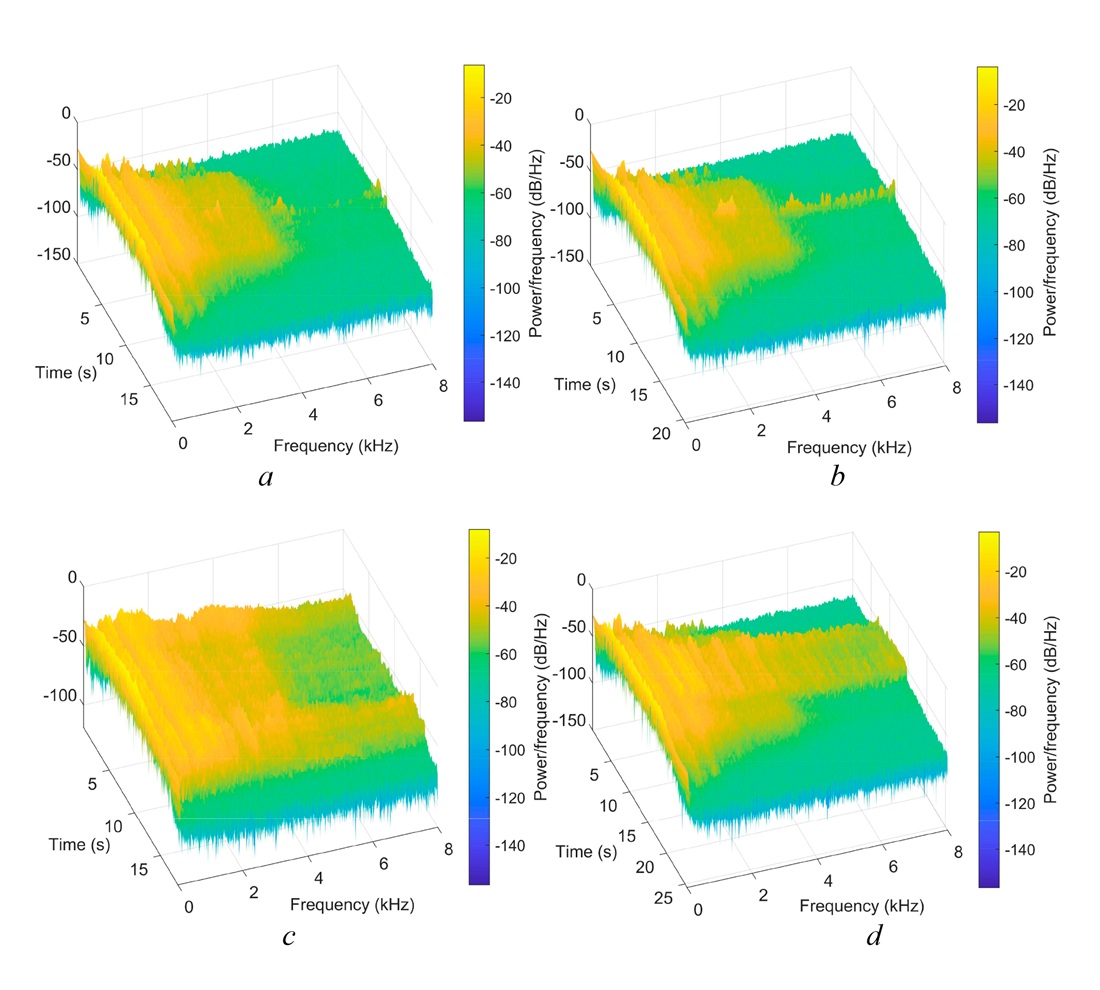
The task addressed was to improve the methods of gas turbine engine vibroacoustic diagnostics, which would increase its sensitivity to small changes in diagnostic signals caused by the ingress of small foreign objects into the engine turbine. To solve this problem, it has been proposed to use multi-level processing of vibration signals obtained as a result of physical modeling of the rotating system (RS) and simulation of the ingress of small foreign objects.
Multi-level processing combines the use of time-frequency, bispectral, and fractal analysis methods to determine the quantitative integrated diagnostic indicator – Minkowski dimensionality. The following average values of Minkowski dimensionality were obtained for the estimates of the bispectral modulus: without external influence – 1.075; ingress of small foreign objects – 1.01; friction of the blades against a foreign object as a result of its ingress into the RS turbine – 1.21.
It has been established that an increase in the Minkowski dimensionality indicates the development of an operational disturbance caused by the ingress of foreign objects, even very small ones.
This paper reports experimental confirmation of the effectiveness of using multi-level processing of vibration signals for diagnosing operational disturbances due to the ingress of foreign objects into RS.
It has been established that multi-level processing makes it possible to detect hidden trends in a noisy signal that are difficult to detect using conventional processing methods
References
- Bouraou, N. (2023). Methodology of Vibroacoustic Monitoring and Diagnosis of Initial Damage of Elements of Rotating Systems. Advanced System Development Technologies I, 311–344. https://doi.org/10.1007/978-3-031-44347-3_9
- Rossmann, A. (2015). Aircraft turbine engine safety volume 4B: Problem. Oriented technology for professionals. Axel Rossmann Turboconsult, 434.
- Sharma, R., Singh, S., Singh, A. K. (2018). Foreign Object Damage Investigation of a Bypass Vane of an Aero-engine. Materials Today: Proceedings, 5 (9), 17717–17724. https://doi.org/10.1016/j.matpr.2018.06.094
- Strack, W., Zhang, D., Turso, J., Pavlik, W., Lopez, I. (2005). Foreign object damage identification in turbine engines. NASA/TM-2005-213588. Available at: https://www.researchgate.net/publication/24330663
- Madhavan, S., Jain, R., Sujatha, C., Sekhar, A. S. (2014). Vibration based damage detection of rotor blades in a gas turbine engine. Engineering Failure Analysis, 46, 26–39. https://doi.org/10.1016/j.engfailanal.2014.07.021
- Tsai, G.-C. (2004). Rotating vibration behavior of the turbine blades with different groups of blades. Journal of Sound and Vibration, 271 (3-5), 547–575. https://doi.org/10.1016/s0022-460x(03)00280-3
- Kriston, B. J., Jálics, K. (2021). Application of vibro-acoustic methods in failure diagnostics. Journal of Physics: Conference Series, 1935 (1), 012002. https://doi.org/10.1088/1742-6596/1935/1/012002
- Doshi, S., Katoch, A., Suresh, A., Razak, F. A., Datta, S., Madhavan, S. et al. (2021). A Review on Vibrations in Various Turbomachines such as Fans, Compressors, Turbines and Pumps. Journal of Vibration Engineering & Technologies, 9 (7), 1557–1575. https://doi.org/10.1007/s42417-021-00313-x
- Pazdrii, O., Bouraou, N. (2020). Vibroacoustic condition monitoring of the complex rotation system based on multilevel signal processing. Vibrations in Physical Systems, 31 (2). https://doi.org/10.21008/j.0860-6897.2020.2.24
- Bouraou, N. I., Ignatovich, S. R., Pazdrii, O. Ya. (2018). Using fractal analysis of the time-frequency spectra of vibroacoustical signals for diagnostic of gas-turbine engines. Visnyk NTUU KPI Seriia - Radiotekhnika Radioaparatobuduvannia, 74, 73–83. https://doi.org/10.20535/radap.2018.74.73-83
- Mishra, R. K., Srivastav, D. K., Srinivasan, K., Nandi, V., Bhat, R. R. (2014). Impact of Foreign Object Damage on an Aero Gas Turbine Engine. Journal of Failure Analysis and Prevention, 15 (1), 25–32. https://doi.org/10.1007/s11668-014-9914-3
- Turso, J. A., Litt, J. S. (2005). A Foreign Object Damage Event Detector Data Fusion System for Turbofan Engines. Journal of Aerospace Computing, Information, and Communication, 2 (7), 291–308. https://doi.org/10.2514/1.12348
- Yang, S., Du, T., Zhang, X., Ma, L., Zhang, G. (2023). Effect of foreign object damage on vibration fatigue crack propagation of blades. Binggong Xuebao/Acta Armamentarii, 44 (6), 1713–1721. https://doi.org/10.12382/bgxb.2022.0109
- Sopilka, Yu. V. (2005). Vykorystannia chastotnochasovykh peretvoren Vihnera vyshchykh poriadkiv u zadachakh vibroakustychnoi diahnostyky. Naukovi visti NTUU "KPI", 6, 110–117.
- Bouraou, N. I., Protasov, A. G., Sopilka, Y. V., Zazhitsky, O. V. (2005). Decision making of aircraft engine blades condition based on bispectral analysis of the vibroacoustical signal. AIP Conference Proceedings, 760 (1), 760–766. https://doi.org/10.1063/1.1916751
- Ma, H., Wu, Z., Zeng, J., Wang, W., Wang, H., Guan, H., Zhang, W. (2023). Review on Dynamic Modeling and Vibration Characteristics of Rotating Cracked Blades. Journal of Dynamics, Monitoring and Diagnostics. https://doi.org/10.37965/jdmd.2023.465
- Samadani, M., Kitio Kwuimy, C. A., Nataraj, C. (2015). Model-based fault diagnostics of nonlinear systems using the features of the phase space response. Communications in Nonlinear Science and Numerical Simulation, 20 (2), 583–593. https://doi.org/10.1016/j.cnsns.2014.06.010
- Ma, C., Wang, Y.-N., Wu, Y.-G., Xu, J.-X. (2017). Hard object impact damage characteristics of aero engine fan blade. Hangkong Dongli Xuebao/Journal of Aerospace Power, 32 (5), 1105–1111. https://doi.org/10.13224/j.cnki.jasp.2017.05.011
- Zhang, Z. H., Li, J. W., Mei, K., Wang, J., Wang, N. F. (2020). Foreign Object Impact Detection of Aero-Engine Fan Based on Statistical Characteristics. Tuijin Jishu/Journal of Propulsion Technology, 41 (10), 2325–2331. https://doi.org/10.13675/j.cnki.tjjs.190401
- Zhang, S., Dong, J. (2024). Numerical simulation and experimental analysis of foreign object impact on aero-engine fan rotor blade. Journal of Physics: Conference Series, 2762 (1), 012038. https://doi.org/10.1088/1742-6596/2762/1/012038
- Yang, X., Lei, X. (2020). Foreign Object Impact Detection and Identification Test of Fan Blade. 2020 11th International Conference on Prognostics and System Health Management (PHM-2020 Jinan), 575–580. https://doi.org/10.1109/phm-jinan48558.2020.00112
- Ogaili, A. A. F., Jaber, A. A., Hamzah, M. N. (2023). A methodological approach for detecting multiple faults in wind turbine blades based on vibration signals and machine learning. Curved and Layered Structures, 10 (1). https://doi.org/10.1515/cls-2022-0214
- Mo, Y., Wang, L., Hong, W., Chu, C., Li, P., Xia, H. (2024). Small-Scale Foreign Object Debris Detection Using Deep Learning and Dual Light Modes. Applied Sciences, 14 (5), 2162. https://doi.org/10.3390/app14052162
- Zmeskal, O., Dzik, P., Vesely, M. (2013). Entropy of fractal systems. Computers & Mathematics with Applications, 66 (2), 135–146. https://doi.org/10.1016/j.camwa.2013.01.017
- Moreno-Gomez, A., Machorro-Lopez, J. M., Amezquita-Sanchez, J. P., Perez-Ramirez, C. A., Valtierra-Rodriguez, M., Dominguez-Gonzalez, A. (2020). Fractal dimension analysis for assessing the health condition of a truss structure using vibration signals. Fractals, 28 (07), 2050127. https://doi.org/10.1142/s0218348x20501273
- Pazdriy, O. Ya. (2024). Vdoskonalennia bortovoi systemy keruvannia i kontroliu dlia bahatoklasovoi diahnostyky aviatsiynoho hazoturbinnoho dvyhuna. Kyiv, 236. Available at: https://ela.kpi.ua/items/23e11037-1a0a-45d4-a79b-97b17efd5f81
Downloads
Published
How to Cite
Issue
Section
License
Copyright (c) 2025 Nadiia Bouraou, Olha Pazdrii, Oleksandr Povcshenko

This work is licensed under a Creative Commons Attribution 4.0 International License.
The consolidation and conditions for the transfer of copyright (identification of authorship) is carried out in the License Agreement. In particular, the authors reserve the right to the authorship of their manuscript and transfer the first publication of this work to the journal under the terms of the Creative Commons CC BY license. At the same time, they have the right to conclude on their own additional agreements concerning the non-exclusive distribution of the work in the form in which it was published by this journal, but provided that the link to the first publication of the article in this journal is preserved.
A license agreement is a document in which the author warrants that he/she owns all copyright for the work (manuscript, article, etc.).
The authors, signing the License Agreement with TECHNOLOGY CENTER PC, have all rights to the further use of their work, provided that they link to our edition in which the work was published.
According to the terms of the License Agreement, the Publisher TECHNOLOGY CENTER PC does not take away your copyrights and receives permission from the authors to use and dissemination of the publication through the world's scientific resources (own electronic resources, scientometric databases, repositories, libraries, etc.).
In the absence of a signed License Agreement or in the absence of this agreement of identifiers allowing to identify the identity of the author, the editors have no right to work with the manuscript.
It is important to remember that there is another type of agreement between authors and publishers – when copyright is transferred from the authors to the publisher. In this case, the authors lose ownership of their work and may not use it in any way.








