Assessing the possibilities of CNT and EFB fiber reinforcement in rammed earth nanocomposites for structural stability enhancement
DOI:
https://doi.org/10.15587/1729-4061.2025.328309Keywords:
buckling, rammed earth, empty bunch fibers, composite, nanotubesAbstract
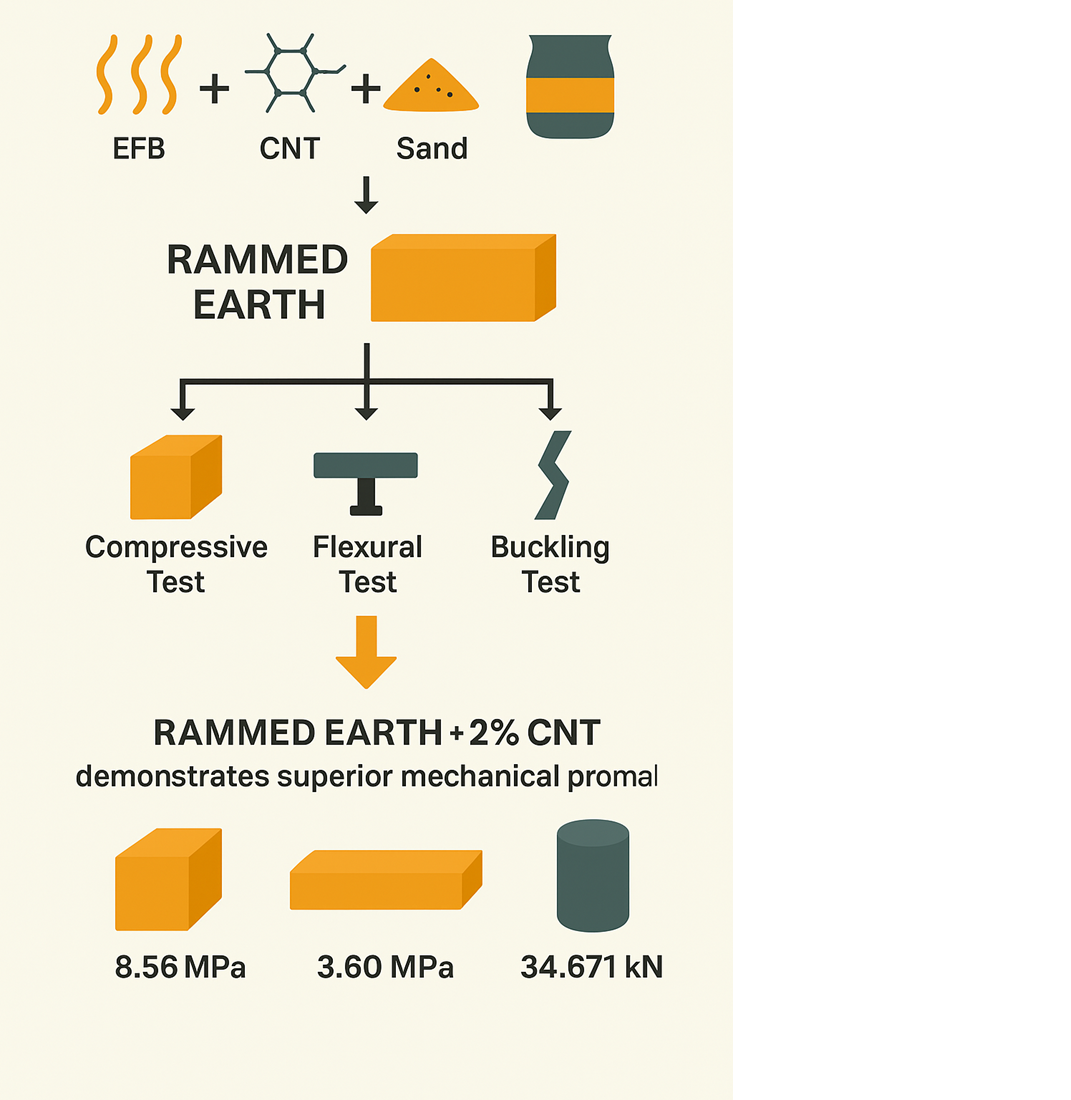
The object of the study is the rammed earth nanocomposites. Rammed earth nanocomposites reinforced with carbon nanotubes (CNT) and oil palm empty bunch (EFB) fibers provide nanoscale cohesion, and EFB fibers offer macroscale crack bridging, this research aims to significantly improve the material’s mechanical performance. This study pioneers a nanocomposite approach by integrating 1-2 % CNT and EFB fibers into rammed earth, achieving a 539 % increase in compressive strength (from 1.43 MPa to 9.13 MPa) and 34.671 kN buckling resistance to improve structural performance especially for the stability for sustainable construction applications. Standard rammed earth had a compressive strength of 1.43 MPa and buckling resistance, limiting its use; however, when 1 % CNT was added, increased compressive strength to 6.43 MPa (cube) and 6.58 MPa (cylinder), while 2 % CNT further enhanced it to 8.56 MPa and 9.13 MPa, respectively. Flexural strength also improved from 0.98 MPa to 3.60 MPa (beam). Cylindrical specimens showed optimal performance due to uniform stress distribution (34.671 kN buckling resistance). Microstructural analysis reveals CNT enhance nano-scale cohesion while EFB fibers provide macro-scale crack bridging. Compared to conventional concrete, the composite reduces embodied carbon by 62 % (per ISO 14040 LCA standards) and material density by 26 % (1.48 vs 2.0 g/cm3). These findings establish a new paradigm for sustainable seismic-resistant construction in developing tropical regions where both laterite soil and palm oil waste are abundant. The synergy of CNT (nanoscale cohesion) and EFB (load distribution) addresses key limitations. This material is suitable for eco-friendly construction, seismic-resistant structures, and lightweight partitions, offering a sustainable alternative to concrete/steel. The project simultaneously advances sustainable construction materials and provides a blueprint for vocational education that bridges technical and soft skills
References
- Aditama, A. G., Ardhyananta, H. (2017). Isolasi Selulosa dari Serat Tandan Kosong Kelapa Sawit untuk Nano Filler Komposit Absorpsi Suara: Analisis FTIR. Jurnal Teknik ITS, 6 (2). https://doi.org/10.12962/j23373539.v6i2.24098
- Sidebang, E., Bukit, N. (2019). Analisis Sifat Mekanik Kompon Karet. EINSTEIN E-JOURNAL, 6 (2). https://doi.org/10.24114/einstein.v6i2.12081
- Saragih, M. T., Ginting, E. M. (2019). Analisis Sifat Mekanik Kompon Karet Dengan Bahan Pengisi Abu Tandan Kosong Kelapa Sawit. EINSTEIN E-JOURNAL, 6 (3). https://doi.org/10.24114/einstein.v6i3.12108
- Rahman, T., Fadhlulloh, M. A., Nandiyanto, A. B. D., Mudzakir, A. (2015). REVIEW: Sintesis Karbon Nanopartikel. J. Integr. Proses, 5 (3).
- Handayani, N. (2021). Nanokomposit Ramah Lingkungan Melalui Isolasi Nanofibril Selulosa (NFS) Dari Tandan Kosong Sawit Dan Poly Lactid Acid (PLA) Sebagai Matrik. Jurnal Sains Dan Teknologi Reaksi, 18 (02). ttps://doi.org/10.30811/jstr.v18i02.2254
- Zhou, T., Zhang, H., Zhang, Z., Zhang, L., Tan, W. (2023). Investigation of intralayer and interlayer shear properties of stabilized rammed earth by direct shear tests. Construction and Building Materials, 367, 130320. https://doi.org/10.1016/j.conbuildmat.2023.130320
- Toufigh, V., Samadianfard, S. (2022). Experimental and numerical investigation of thermal enhancement methods on rammed-earth materials. Solar Energy, 244, 474–483. https://doi.org/10.1016/j.solener.2022.08.049
- Strazzeri, V., Karrech, A. (2022). Energy and thermal performance of a typical rammed earth residential building in Western Australia. Energy and Buildings, 260, 111901. https://doi.org/10.1016/j.enbuild.2022.111901
- Espinach, F. X., Vilaseca, F., Tarrés, Q., Delgado-Aguilar, M., Aguado, R. J., Mutjé, P. (2024). An alternative method to evaluate the micromechanics tensile strength properties of natural fiber strand reinforced polyolefin composites. The case of hemp strand-reinforced polypropylene. Composites Part B: Engineering, 273, 111211. https://doi.org/10.1016/j.compositesb.2024.111211
- Ávila, F., Puertas, E., Gallego, R. (2021). Characterization of the mechanical and physical properties of unstabilized rammed earth: A review. Construction and Building Materials, 270, 121435. https://doi.org/10.1016/j.conbuildmat.2020.121435
- Gil-Martín, L. M., Fernández-Ruiz, M. A., Hernández-Montes, E. (2022). Mechanical characterization and elastic stiffness degradation of unstabilized rammed earth. Journal of Building Engineering, 56, 104805. https://doi.org/10.1016/j.jobe.2022.104805
- The creep of Rammed Earth material (2015). Rammed Earth Construction, 61–66. https://doi.org/10.1201/b18046-10
- Majidifard, H., Adu-Gyamfi, Y., Buttlar, W. G. (2020). Deep machine learning approach to develop a new asphalt pavement condition index. Construction and Building Materials, 247, 118513. https://doi.org/10.1016/j.conbuildmat.2020.118513
- Narloch, P. L., Lidner, M., Kunicka, E., Bielecki, M. (2015). Flexural Tensile Strength of Construction Elements Made out of Cement Stabilized Rammed Earth. Procedia Engineering, 111, 589–595. https://doi.org/10.1016/j.proeng.2015.07.049
- Khan, R. (2019). Fiber bridging in composite laminates: A literature review. Composite Structures, 229, 111418. https://doi.org/10.1016/j.compstruct.2019.111418
- Rahman, T., Fadhlulloh, M. A., Nandiyanto, A. B. D., Mudzakir, A. (2015). Review: Synthesis of Carbon Nanoparticles. Available at: https://api.semanticscholar.org/CorpusID:100363740
- Cheah, C. B., Liew, J. J., Khaw Le Ping, K., Siddique, R., Tangchirapat, W. (2022). Properties of ternary blended cement containing ground granulated blast furnace slag and ground coal bottom ash. Construction and Building Materials, 315, 125249. https://doi.org/10.1016/j.conbuildmat.2021.125249
- Zhang, L., Zhang, J., Lv, C., Gao, L., Luo, S., Ren, Y. et al. (2024). Fabrication and characterization of flexible natural cellulosic fiber composites through collaborative modification strategy of sodium hydroxide and γ-Aminopropyl triethoxysilane. International Journal of Biological Macromolecules, 261, 129831. https://doi.org/10.1016/j.ijbiomac.2024.129831
- Ramachandrarao, M., Khan, S. H., Abdullah, K. (2025). Carbon nanotubes and nanofibers – reinforcement to carbon fiber composites - synthesis, characterizations and applications: A review. Composites Part C: Open Access, 16, 100551. https://doi.org/10.1016/j.jcomc.2024.100551
- Tarfaoui, M., Lafdi, K., El Moumen, A. (2016). Mechanical properties of carbon nanotubes based polymer composites. Composites Part B: Engineering, 103, 113–121. https://doi.org/10.1016/j.compositesb.2016.08.016
Downloads
Published
How to Cite
Issue
Section
License
Copyright (c) 2025 Kinanti Wijaya, Syafiatun Siregar, Sutrisno Sutrisno, Iswandi Idris

This work is licensed under a Creative Commons Attribution 4.0 International License.
The consolidation and conditions for the transfer of copyright (identification of authorship) is carried out in the License Agreement. In particular, the authors reserve the right to the authorship of their manuscript and transfer the first publication of this work to the journal under the terms of the Creative Commons CC BY license. At the same time, they have the right to conclude on their own additional agreements concerning the non-exclusive distribution of the work in the form in which it was published by this journal, but provided that the link to the first publication of the article in this journal is preserved.
A license agreement is a document in which the author warrants that he/she owns all copyright for the work (manuscript, article, etc.).
The authors, signing the License Agreement with TECHNOLOGY CENTER PC, have all rights to the further use of their work, provided that they link to our edition in which the work was published.
According to the terms of the License Agreement, the Publisher TECHNOLOGY CENTER PC does not take away your copyrights and receives permission from the authors to use and dissemination of the publication through the world's scientific resources (own electronic resources, scientometric databases, repositories, libraries, etc.).
In the absence of a signed License Agreement or in the absence of this agreement of identifiers allowing to identify the identity of the author, the editors have no right to work with the manuscript.
It is important to remember that there is another type of agreement between authors and publishers – when copyright is transferred from the authors to the publisher. In this case, the authors lose ownership of their work and may not use it in any way.








