Devising a recipe for a functional milk drink based on Moringa powder
DOI:
https://doi.org/10.15587/1729-4061.2025.329644Keywords:
functional drinks, powdered milk, vegetable powders, vitamin C, energy value, citrus fruitsAbstract
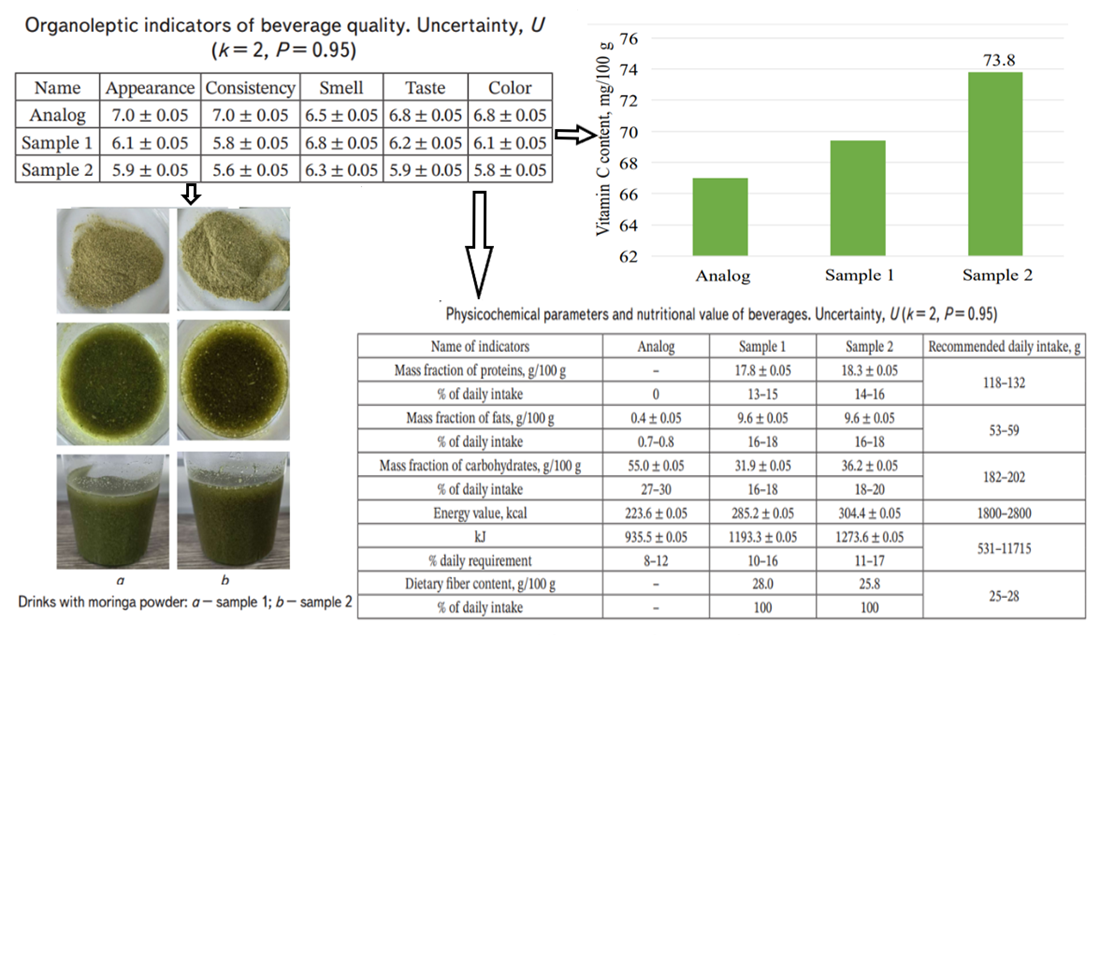
The object of this study is a technique for producing functional instant drinks based on powdered milk and a mixture of plant raw materials. Moringa powder was used as the main functional plant component, which contains biologically active components but has the least desirable sensory properties. It was proposed to hide the herbal taste and smell of moringa with mint and citrus powders. The results of the organoleptic evaluation of the experimental samples showed that the introduction of mint and lime powders into the recipe made it possible to obtain a sweet and sour drink (sample 1) with a pleasant aroma. This combination of flavors gives an additional refreshing effect. Due to the high content of dietary fiber (28 g/100 g), the appearance of the drink was rated at 6.1 ± 0.05 points out of seven. The energy value of this drink was 285.2 ± 0.05 kcal. It contained 17.8 ± 0.05 g/100 g of proteins, which provides 13–15% of the daily physiological needs of the body. Sample 2 with orange powder, which had a sweet and sour taste, was liked by consumers only for its smell. However, it contains 0.5% more proteins and 4.3% carbohydrates. Due to the high content of carbohydrates (36.2 g/100 g), its energy value is 304.4 ± 0.05 kcal. The drink with orange powder contains the largest amount of vitamin C (73.8 mg/100 g), which is 82–98% of the recommended daily intake. The content of vitamin C in the drink based on lime powder is 69.4 mg/100 g. Thus, the addition of mint and citrus powder made it possible to obtain drinks with acceptable sensory parameters, hiding the shortcomings caused by the use of moringa. Unlike similar products, their composition includes only natural ingredients. The results could become the basis for the industrial production of instant drinks
References
- Panou, A., Karabagias, I. K. (2025). Composition, Properties, and Beneficial Effects of Functional Beverages on Human Health. Beverages, 11 (2), 40. https://doi.org/10.3390/beverages11020040
- Bhandari, S. D., Gallegos-Peretz, T., Wheat, T., Jaudzems, G., Kouznetsova, N., Petrova, K. et al. (2022). Amino Acid Fingerprinting of Authentic Nonfat Dry Milk and Skim Milk Powder and Effects of Spiking with Selected Potential Adulterants. Foods, 11 (18), 2868. https://doi.org/10.3390/foods11182868
- Wang, D., Zhou, Y., Zhao, J., Guo, Y., Yan, W. (2025). Analysis of Flavor Differences in Yak Milk Powder at Different Milk Production Stages by Headspace Solid-Phase Microextraction and Gas Chromatography–Mass Spectrometry. Foods, 14 (1), 91. https://doi.org/10.3390/foods14010091
- Gilmour, S. R., Holroyd, S. E., Fuad, M. D., Elgar, D., Fanning, A. C. (2024). Amino Acid Composition of Dried Bovine Dairy Powders from a Range of Product Streams. Foods, 13 (23), 3901. https://doi.org/10.3390/foods13233901
- Bakshi, S., Paswan, V. K., Yadav, S. P., Bhinchhar, B. K., Kharkwal, S., Rose, H. et al. (2023). A comprehensive review on infant formula: nutritional and functional constituents, recent trends in processing and its impact on infants’ gut microbiota. Frontiers in Nutrition, 10. https://doi.org/10.3389/fnut.2023.1194679
- Ozkan, G., Capanoglu, E., Esatbeyoglu, T. (2022). Formulation of Functional Drink with Milk Fortification: Effects on the Bioaccessibility and Intestinal Absorption of Phenolics. Plants, 11 (23), 3364. https://doi.org/10.3390/plants11233364
- Lima Nascimento, L. G., Odelli, D., Fernandes de Carvalho, A., Martins, E., Delaplace, G., Peres de sá Peixoto Júnior, P. et al. (2023). Combination of Milk and Plant Proteins to Develop Novel Food Systems: What Are the Limits? Foods, 12 (12), 2385. https://doi.org/10.3390/foods12122385
- Samilyk, M., Tsyrulyk, R., Bolgova, N., Vechorka, V., Ryzhkova, T., Severin, R. et al. (2022). Devising a technique for improving the biological value of A2 milk by adding carrot powder. Eastern-European Journal of Enterprise Technologies, 6 (11 (120)), 44–50. https://doi.org/10.15587/1729-4061.2022.266924
- Gull, T., Nouman, W., Olson, M. E. (2025). Industrial applications, toxicological impact and marketing trends of Moringa oleifera food products, a review. South African Journal of Botany, 176, 141–157. https://doi.org/10.1016/j.sajb.2024.11.012
- Lisak Jakopović, K., Repajić, M., Rumora Samarin, I., Božanić, R., Blažić, M., Barukčić Jurina, I. (2022). Fortification of Cow Milk with Moringa oleifera Extract: Influence on Physicochemical Characteristics, Antioxidant Capacity and Mineral Content of Yoghurt. Fermentation, 8 (10), 545. https://doi.org/10.3390/fermentation8100545
- Rodrigues, J. F., Soares, C., Moreira, M. M., Ramalhosa, M. J., Duarte, N. F., Delerue-Matos, C., Grosso, C. (2023). Moringa oleifera Lam. Commercial Beverages: A Multifaceted Investigation of Consumer Perceptions, Sensory Analysis, and Bioactive Properties. Foods, 12 (11), 2253. https://doi.org/10.3390/foods12112253
- Bala, E., Patra, S., Singha, S. (2023). Flavour enhancement strategy for herbal beverages and kinetic modelling of their antioxidant and sensory properties in accelerated storage conditions. International Journal of Gastronomy and Food Science, 33, 100788. https://doi.org/10.1016/j.ijgfs.2023.100788
- Gupta, A., Sanwal, N., Bareen, M. A., Barua, S., Sharma, N., Joshua Olatunji, O. et al. (2023). Trends in functional beverages: Functional ingredients, processing technologies, stability, health benefits, and consumer perspective. Food Research International, 170, 113046. https://doi.org/10.1016/j.foodres.2023.113046
- Kelly, R. K., Calhoun, J., Hanus, A., Payne-Foster, P., Stout, R., Sherman, B. W. (2023). Increased dietary fiber is associated with weight loss among Full Plate Living program participants. Frontiers in Nutrition, 10. https://doi.org/10.3389/fnut.2023.1110748
Downloads
Published
How to Cite
Issue
Section
License
Copyright (c) 2025 Nataliia Bolhova, Vadym Karachov, Olena Koshel, Tatyana Chernyavska, Tetyana Yudina, Victoriya Gnitsevych, Grygoriy Deinychenko, Valerii Sukmanov

This work is licensed under a Creative Commons Attribution 4.0 International License.
The consolidation and conditions for the transfer of copyright (identification of authorship) is carried out in the License Agreement. In particular, the authors reserve the right to the authorship of their manuscript and transfer the first publication of this work to the journal under the terms of the Creative Commons CC BY license. At the same time, they have the right to conclude on their own additional agreements concerning the non-exclusive distribution of the work in the form in which it was published by this journal, but provided that the link to the first publication of the article in this journal is preserved.
A license agreement is a document in which the author warrants that he/she owns all copyright for the work (manuscript, article, etc.).
The authors, signing the License Agreement with TECHNOLOGY CENTER PC, have all rights to the further use of their work, provided that they link to our edition in which the work was published.
According to the terms of the License Agreement, the Publisher TECHNOLOGY CENTER PC does not take away your copyrights and receives permission from the authors to use and dissemination of the publication through the world's scientific resources (own electronic resources, scientometric databases, repositories, libraries, etc.).
In the absence of a signed License Agreement or in the absence of this agreement of identifiers allowing to identify the identity of the author, the editors have no right to work with the manuscript.
It is important to remember that there is another type of agreement between authors and publishers – when copyright is transferred from the authors to the publisher. In this case, the authors lose ownership of their work and may not use it in any way.








