Investigating polyols to improve the efficiency of extracting anthocyans from elderberry (Sambucus nigra L.) pomace
DOI:
https://doi.org/10.15587/1729-4061.2025.330457Keywords:
pomace, black elderberry, extraction, polyols, coloring substances, natural dyes, anthocyaninsAbstract
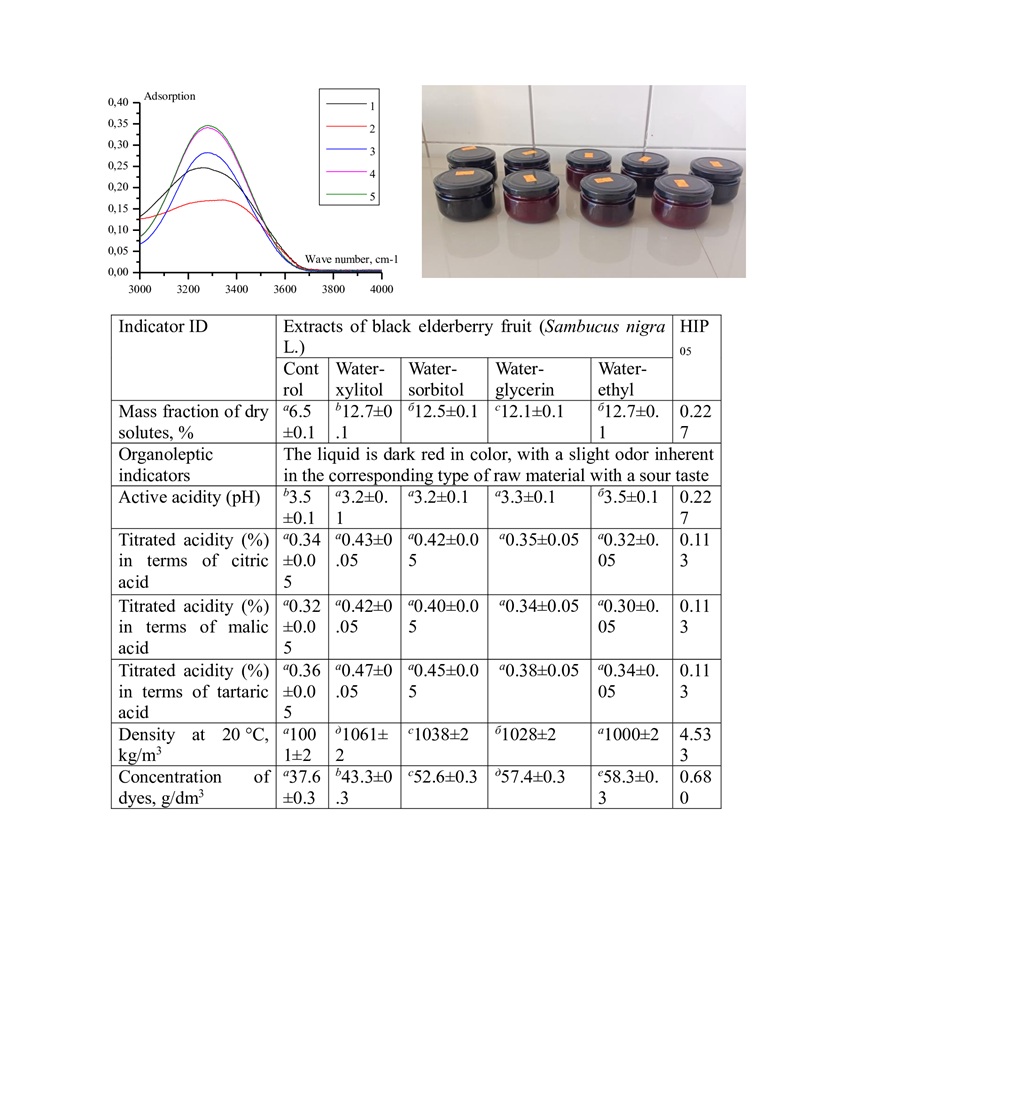
The object of this study is the extracts from black elderberry fruit pomace obtained using various polyols (glycerol, xylitol, sorbitol), as well as their ability to extract anthocyanins, stability, persistence, and spectral characteristics. It was found that black elderberry fruit pomace is characterized by an increased content of anthocyanins (0.42±0.02 %) compared to fresh fruits (0.29±0.02 %) and juice (0.23±0.02 %), as well as a high concentration of flavonoids: rutin (1.52±0.03 %), quercetin (0.26±0.01 %), and luteolin (2.77±0.04 %). Water-ethyl and water-glycerol extracts demonstrated the highest concentration of coloring substances (57.4–58.3 g/dm3). Microstructural analysis revealed amorphous formations with a size of 50–300 nm, which contribute to the stable retention of anthocyanins. Spectral analysis confirmed the intense absorption bands of anthocyanins (1625–1725 cm⁻1) in glycerin extracts. The high extraction capacity of glycerin solvents is due to their polarity, electrostatic interaction with anthocyanins and stabilizing properties of glycerin. Water-sorbitol and water-xylitol extracts were less stable due to their hydrophilicity and weaker ability to retain pigments. The use of glycerin as a solvent ensured maximum stability of the extracts due to the formation of amorphous structures that slow down the oxidation of anthocyanins.
The results could be used in practice in the food industry for manufacturing natural dyes, in particular in beverages, confectionery, dairy and fermented milk products. Practical implementation is possible under the following conditions: extraction temperature 65±1.5 °C, pH 3.2–3.5, concentration in a vacuum evaporator and storage at a temperature of 4±2 °C to preserve the biological activity of anthocyanins and prevent their degradation. In addition, the results of the study open up prospects for the rational use of berry pomace, which is usually subject to disposal
References
- Gürses, A., Açıkyıldız, M., Güneş, K., Şahin, E. (2024). Natural dyes and pigments in food and beverages. Renewable Dyes and Pigments, 49–76. https://doi.org/10.1016/b978-0-443-15213-9.00013-2
- Damotharan, K., Sudhakaran, G., Ramu, M., Krishnan, M., S, K. R. N., Arockiaraj, J. (2024). Biochemical processes mediating neurotoxicity induced by synthetic food dyes: A review of current evidence. Chemosphere, 364, 143295. https://doi.org/10.1016/j.chemosphere.2024.143295
- Şenol, Z. M., El Messaoudi, N., Ciğeroglu, Z., Miyah, Y., Arslanoğlu, H., Bağlam, N. et al. (2024). Removal of food dyes using biological materials via adsorption: A review. Food Chemistry, 450, 139398. https://doi.org/10.1016/j.foodchem.2024.139398
- Alegbe, E. O., Uthman, T. O. (2024). A review of history, properties, classification, applications and challenges of natural and synthetic dyes. Heliyon, 10 (13), e33646. https://doi.org/10.1016/j.heliyon.2024.e33646
- Kowalska, G., Wyrostek, J., Kowalski, R., Pankiewicz, U. (2021). Evaluation of glycerol usage for the extraction of anthocyanins from black chokeberry and elderberry fruits. Journal of Applied Research on Medicinal and Aromatic Plants, 22, 100296. https://doi.org/10.1016/j.jarmap.2021.100296
- Chemat, F., Abert-Vian, M., Fabiano-Tixier, A. S., Strube, J., Uhlenbrock, L., Gunjevic, V., Cravotto, G. (2019). Green extraction of natural products. Origins, current status, and future challenges. TrAC Trends in Analytical Chemistry, 118, 248–263. https://doi.org/10.1016/j.trac.2019.05.037
- Yarmosh, T., Pertsevoi, F. (2024). Study of the effectiveness of glycerin for the extraction of coloring substances from black elder. Scientific Bulletin of the Tavria State Agrotechnological University, 14 (1). https://doi.org/10.32782/2220-8674-2024-24-1-16
- Yarmosh, T. А., Pertsevoi, F. V. (2024). Study of the influence of technological factors on the release of coloring substances from black elder presses. Таuridа Scientific Herald. Series: Technical Sciences, 3, 151–163. https://doi.org/10.32782/tnv-tech.2024.3.16
- Dai, Y., van Spronsen, J., Witkamp, G.-J., Verpoorte, R., Choi, Y. H. (2013). Natural deep eutectic solvents as new potential media for green technology. Analytica Chimica Acta, 766, 61–68. https://doi.org/10.1016/j.aca.2012.12.019
- Wang, H., Chen, T., Yao, S., Tang, Y. (2022). Comparison of polyol-based deep eutectic solvents (DESs) on pretreatment of moso bamboo (Phyllostachys pubescens) for enzymatic hydrolysis. Industrial Crops and Products, 189, 115767. https://doi.org/10.1016/j.indcrop.2022.115767
- Pires, I. V., da Silva, L. H. M., Rodrigues, A. M. da C., Saldaña, M. D. A. (2024). Natural deep eutectic solvents for anthocyanin extraction from agricultural sources: Process parameters, economic and environmental analysis, and industrial challenges. Comprehensive Reviews in Food Science and Food Safety, 23 (6). https://doi.org/10.1111/1541-4337.70057
- Soutelino, M. E. M., Vieira, G. de P., Goulart, M. B., Miranda, K. C., da Conceição, R. P., Pimentel, T. C. et al. (2024). Natural food dyes on dairy products: A critical approach between 2012-2023 literature regarding the technological and functional aspects, health benefits and future trends. Trends in Food Science & Technology, 146, 104370. https://doi.org/10.1016/j.tifs.2024.104370
- Domínguez, R., Pateiro, M., Munekata, P. E. S., Santos López, E. M., Rodríguez, J. A., Barros, L., Lorenzo, J. M. (2021). Potential Use of Elderberry (Sambucus nigra L.) as Natural Colorant and Antioxidant in the Food Industry. A Review. Foods, 10 (11), 2713. https://doi.org/10.3390/foods10112713
- Diez-Sánchez, E., Quiles, A., Hernando, I. (2021). Use of Berry Pomace to Design Functional Foods. Food Reviews International, 39 (6), 3204–3224. https://doi.org/10.1080/87559129.2021.2010217
- Aguilera, J. M. (2024). Berries as Foods: Processing, Products, and Health Implications. Annual Review of Food Science and Technology, 15 (1), 1–26. https://doi.org/10.1146/annurev-food-072023-034248
- Torabian, G., Valtchev, P., Adil, Q., Dehghani, F. (2019). Anti-influenza activity of elderberry (Sambucus nigra). Journal of Functional Foods, 54, 353–360. https://doi.org/10.1016/j.jff.2019.01.031
- Banach, M., Khaidakov, B., Korewo, D., Węsierska, M., Cyplik, W., Kujawa, J. et al. (2021). The Chemical and Cytotoxic Properties of Sambucus nigra Extracts – A Natural Food Colorant. Sustainability, 13 (22), 12702. https://doi.org/10.3390/su132212702
- Haug, I. J., Draget, K. I. (2009). Gelatin. Handbook of Hydrocolloids, 142–163. https://doi.org/10.1533/9781845695873.142
- Sabadash, S., Savchenko-Pererva, M., Radchuk, O., Rozhkova, L., Zahorulko, A. (2020). Improvement of equipment in order to intensify the process of drying dispersed food products. Eastern-European Journal of Enterprise Technologies, 1 (11 (103)), 15–21. https://doi.org/10.15587/1729-4061.2020.192363
- Wongsa, P., Phatikulrungsun, P., Prathumthong, S. (2022). FT-IR characteristics, phenolic profiles and inhibitory potential against digestive enzymes of 25 herbal infusions. Scientific Reports, 12 (1). https://doi.org/10.1038/s41598-022-10669-z
- Thummajitsakul, S., Boonburapong, B., Silprasit, K. (2022). Analysis of flower extract and natural dye solution from Sesbania javanica using Fourier-transform infrared spectroscopy (FTIR) chemometrics, and determination of its antioxidant and anti-glucosidase activities. International Food Research Journal, 29 (3), 707–722. https://doi.org/10.47836/ifrj.29.3.22
- Yarmosh, T., Pertsevoi, F., Marenkova, T. (2024). Study of the efficiency of sorbitum and xylite for the extraction of coloring substances from black elder. Scientific Bulletin of the Tavria State Agrotechnological University, 14 (1). https://doi.org/10.32782/2220-8674-2024-24-1-21
- Kataoka, Y., Kitadai, N., Hisatomi, O., Nakashima, S. (2011). Nature of Hydrogen Bonding of Water Molecules in Aqueous Solutions of Glycerol by Attenuated Total Reflection (ATR) Infrared Spectroscopy. Applied Spectroscopy, 65 (4), 436–441. https://doi.org/10.1366/10-06183
- Bhushan, B., Bibwe, B., Pal, A., Mahawar, M. K., Dagla, M. C., KR, Y. et al. (2023). FTIR spectra, antioxidant capacity and degradation kinetics of maize anthocyanin extract under variable process conditions. Applied Food Research, 3 (1), 100282. https://doi.org/10.1016/j.afres.2023.100282
- Bokovets, S. P., Pertsevoi, F. V., Murlykina, N. V., Smetanska, I. M., Borankulova, A. S., Ianchyk, M. V. et al. (2023). Investigation of infrared spectra of agar-based gel systems for the production of jelly bars. Journal of Chemistry and Technologies, 31 (1): https://doi.org/10.15421/jchemtech.v31i1.252647
- Tereucan, G., Ercoli, S., Cornejo, P., Winterhalter, P., Contreras, B., Ruiz, A. (2021). Stability of antioxidant compounds and activities of a natural dye from coloured-flesh potatoes in dairy foods. LWT, 144, 111252. https://doi.org/10.1016/j.lwt.2021.111252
Downloads
Published
How to Cite
Issue
Section
License
Copyright (c) 2025 Tetiana Yarmosh, Fedir Pertsevoi, Oksana Melnyk, Petro Gurskyi, Tаtyana Marenkova, Iryna Smetanska, Svetlana Omelchenko, Aliona Dikhtyar, Nina Chorna, Yana Yevchuk

This work is licensed under a Creative Commons Attribution 4.0 International License.
The consolidation and conditions for the transfer of copyright (identification of authorship) is carried out in the License Agreement. In particular, the authors reserve the right to the authorship of their manuscript and transfer the first publication of this work to the journal under the terms of the Creative Commons CC BY license. At the same time, they have the right to conclude on their own additional agreements concerning the non-exclusive distribution of the work in the form in which it was published by this journal, but provided that the link to the first publication of the article in this journal is preserved.
A license agreement is a document in which the author warrants that he/she owns all copyright for the work (manuscript, article, etc.).
The authors, signing the License Agreement with TECHNOLOGY CENTER PC, have all rights to the further use of their work, provided that they link to our edition in which the work was published.
According to the terms of the License Agreement, the Publisher TECHNOLOGY CENTER PC does not take away your copyrights and receives permission from the authors to use and dissemination of the publication through the world's scientific resources (own electronic resources, scientometric databases, repositories, libraries, etc.).
In the absence of a signed License Agreement or in the absence of this agreement of identifiers allowing to identify the identity of the author, the editors have no right to work with the manuscript.
It is important to remember that there is another type of agreement between authors and publishers – when copyright is transferred from the authors to the publisher. In this case, the authors lose ownership of their work and may not use it in any way.








