Devising a method for increasing data transmission speed in monitoring systems based on the mobile high-density internet of things
DOI:
https://doi.org/10.15587/1729-4061.2025.330644Keywords:
Internet of Things, Markov chain, high-density, random multiple access systemAbstract
The object of this study is the process that improves the efficiency of data transmission in monitoring systems that arrive from low-power devices within the mobile high-density Internet of Things. The task addressed was to reduce the average delay time of information transmission through the transmitting station of the monitoring system gateway. To this end, it was proposed to improve the multiple output procedure and use the technique for building temporary dynamic clusters of dependent sources.
During the research, a model of a monitoring system with multiple node outputs was built. Its process involved the procedure for constructing a temporary subset of active devices dependent on data. That made it possible to reduce the redundancy of data coming to the monitoring system gateway.
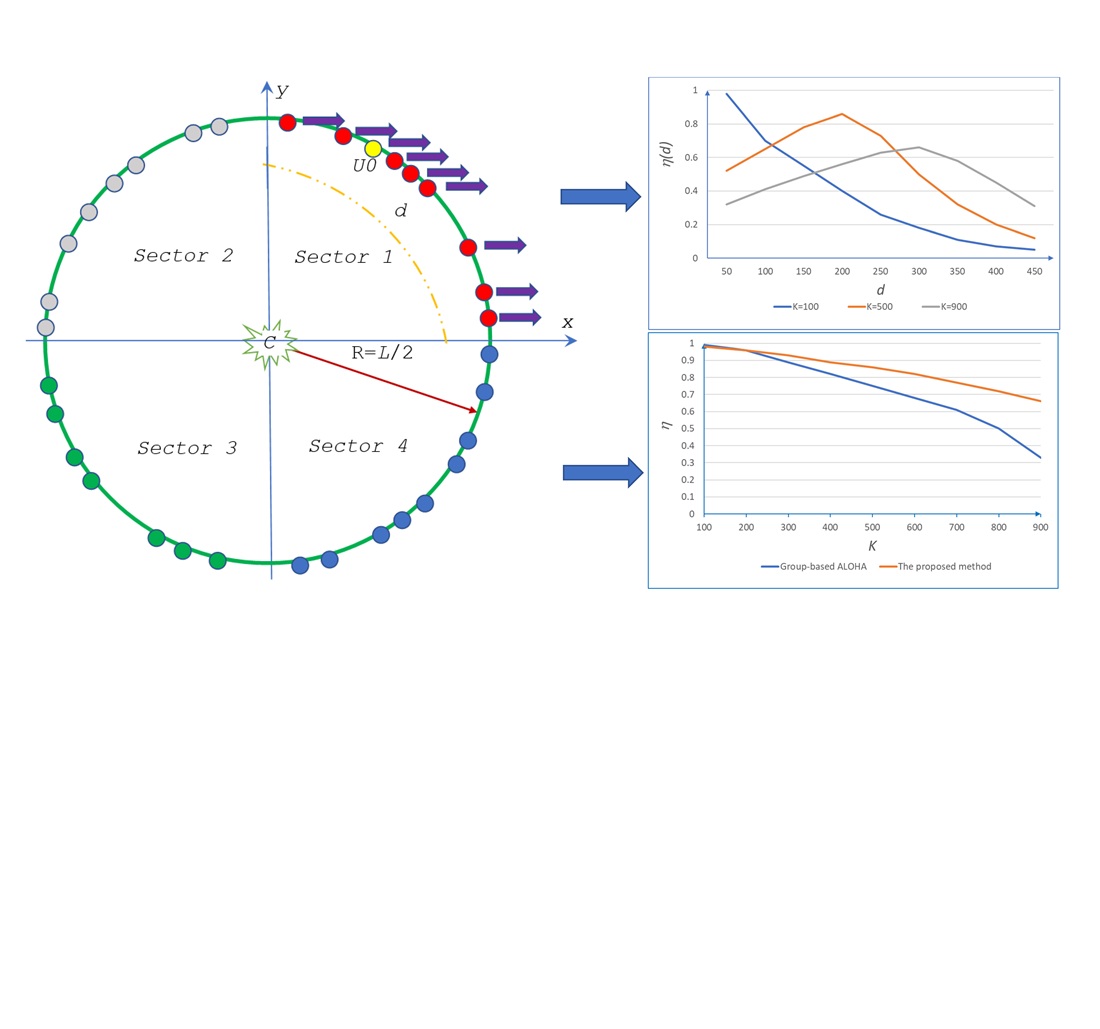
An approach has been proposed for finding the values of the upper and lower limits of the average data transmission delay. The approach is based on simplifying calculations by switching to a one-dimensional Markov chain. The use of a uniform distribution of active subscribers has made it possible to find an analytical expression for the upper limit of the average delay. A feature of the lower bound calculation process is the introduction of a fixed division of the receiving zone of the transmitting station into equal sectors.
The algorithm developed for multiple node output is aimed at reducing the average data transmission delay with a limited number of subscribers. A feature of the method is the limitation of the number of transitions when forming a stationary distribution of the Markov chain. As a result of using the method, the average delay is reduced and the speed of data transmission increases. Studies of the proposed method have shown that the speed of data transmission increases in comparison with existing methods from 5 to 50%. The research results are attributed to the use of the procedure of multiple subscriber output
References
- Kuchuk, H., Malokhvii, E. (2024). Integration of IoT with Cloud, Fog, and Edge Computing: a Review. Advanced Information Systems, 8 (2), 65–78. https://doi.org/10.20998/2522-9052.2024.2.08
- Amitu, D. M., Akol, R. N., Serugunda, J. (2025). Hybrid access control mechanism for massive machine type communications. Discover Internet of Things, 5 (1). https://doi.org/10.1007/s43926-025-00106-8
- Zhao, D., Wang, H., Du, H., Cheng, H., Peng, L., Liang, Y. et al. (2025). An intelligent bridge multi-dimension deflection IoT monitoring system based on laser datum and imaging. Journal of Traffic and Transportation Engineering (English Edition), 12 (2), 269–287. https://doi.org/10.1016/j.jtte.2023.06.006
- Harwahyu, R., Cheng, R.-G., Liu, D.-H., Sari, R. F. (2021). Fair Configuration Scheme for Random Access in NB-IoT with Multiple Coverage Enhancement Levels. IEEE Transactions on Mobile Computing, 20 (4), 1408–1419. https://doi.org/10.1109/tmc.2019.2962422
- Kuchuk, H., Kalinin, Y., Dotsenko, N., Chumachenko, I., Pakhomov, Y. (2024). Decomposition of integrated high-density IoT data flow. Advanced Information Systems, 8 (3), 77–84. https://doi.org/10.20998/2522-9052.2024.3.09
- Vaiyapuri, T., Parvathy, V. S., Manikandan, V., Krishnaraj, N., Gupta, D., Shankar, K. (2021). A Novel Hybrid Optimization for Cluster‐Based Routing Protocol in Information-Centric Wireless Sensor Networks for IoT Based Mobile Edge Computing. Wireless Personal Communications, 127 (1), 39–62. https://doi.org/10.1007/s11277-021-08088-w
- Shokeen, S., Singh, H. (2023). Multiple Input Multiple Output: An IOT based Application. 2023 International Conference on Advancement in Computation & Computer Technologies (InCACCT), 634–638. https://doi.org/10.1109/incacct57535.2023.10141742
- Kuchuk, H., Mozhaiev, O., Kuchuk, N., Tiulieniev, S., Mozhaiev, M., Gnusov, Y. et al. (2024). Devising a method for the virtual clustering of the Internet of Things edge environment. Eastern-European Journal of Enterprise Technologies, 1 (9 (127)), 60–71. https://doi.org/10.15587/1729-4061.2024.298431
- Singh, S. P., Kumar, N., Kumar, G., Balusamy, B., Bashir, A. K., Dabel, M. M. A. (2025). Enhancing Quality of Service in IoT-WSN through Edge-Enabled Multi-Objective Optimization. IEEE Transactions on Consumer Electronics. https://doi.org/10.1109/tce.2025.3526992
- Choi, J. (2018). On Multichannel Random Access for Correlated Sources. IEEE Transactions on Communications, 66 (8), 3444–3454. https://doi.org/10.1109/tcomm.2018.2823318
- Chetot, L., Egan, M., Gorce, J.-M. (2023). Active User Detection and Channel Estimation for Grant-Free Random Access with Gaussian Correlated Activity. 2023 IEEE 97th Vehicular Technology Conference (VTC2023-Spring), 1–6. https://doi.org/10.1109/vtc2023-spring57618.2023.10199877
- Kuchuk, H., Mozhaiev, O., Tiulieniev, S., Mozhaiev, M., Kuchuk, N., Tymoshchyk, L. et al. (2025). Devising a method for forming a stable mobile cluster of the internet of things fog layer. Eastern-European Journal of Enterprise Technologies, 1 (4 (133)), 6–14. https://doi.org/10.15587/1729-4061.2025.322263
- Alqasimi, A., Al Marzouqi, K., Alhammadi, A., Aljasmi, A., Alnabulsi, A., Al-Ali, A. R. (2025). An IoT-Based Mobile Air Pollution Monitoring System. Proceedings of IEMTRONICS 2024, 221–233. https://doi.org/10.1007/978-981-97-4784-9_16
- Wing Lo, Y., Ho Tsoi, M., Chow, C.-F., Mung, S. W. Y. (2025). An NB-IoT Monitoring System for Digital Mobile Radio With Industrial IoT Performance and Reliability Evaluation. IEEE Sensors Journal, 25 (3), 5337–5348. https://doi.org/10.1109/jsen.2024.3512859
- Kuchuk, H., Husieva, Y., Novoselov, S., Lysytsia, D., Krykhovetskyi, H. (2025). Load balancing of the layers IoT Fog-Cloud support network. Advanced Information Systems, 9 (1), 91–98. https://doi.org/10.20998/2522-9052.2025.1.11
- Foss, S., Turlikov, A., Grankin, M. (2017). Spatial random multiple access with multiple departure. 2017 IEEE International Symposium on Information Theory (ISIT), 2728–2731. https://doi.org/10.1109/isit.2017.8007025
- Moon, S., Lee, H.-S., Lee, J.-W. (2018). SARA: Sparse Code Multiple Access-Applied Random Access for IoT Devices. IEEE Internet of Things Journal, 5 (4), 3160–3174. https://doi.org/10.1109/jiot.2018.2835828
- Kuchuk, H., Mozhaiev, O., Tiulieniev, S., Mozhaiev, M., Kuchuk, N., Tymoshchyk, L. et al. (2025). Devising a method for stabilizing control over a load on a cluster gateway in the internet of things edge layer. Eastern-European Journal of Enterprise Technologies, 2 (9 (134)), 24–32. https://doi.org/10.15587/1729-4061.2025.326040
- Zhu, W., Tao, M., Yuan, X., Guan, Y. (2023). Message Passing-Based Joint User Activity Detection and Channel Estimation for Temporally-Correlated Massive Access. IEEE Transactions on Communications, 71 (6), 3576–3591. https://doi.org/10.1109/tcomm.2023.3261382
- Kuchuk, N., Kashkevich, S., Radchenko, V., Andrusenko, Y., Kuchuk, H. (2024). Applying edge computing in the execution IoT operative transactions. Advanced Information Systems, 8 (4), 49–59. https://doi.org/10.20998/2522-9052.2024.4.07
- Aqeel Abdulhussein M, A.-M., Smirnova, T., Buravchenko, K., Smirnov, O. (2023). The method of assessing and improving the user experience of subscribers in software-configured networks based on the use of machine learning. Advanced Information Systems, 7 (2), 49–56. https://doi.org/10.20998/2522-9052.2023.2.07
- Asvadi, S., Ashtiani, F. (2023). Peak Age of Information in Slotted ALOHA Networks. IEEE Transactions on Communications, 71 (10), 6018–6030. https://doi.org/10.1109/tcomm.2023.3296590
- Semenov, S., Mozhaiev, O., Kuchuk, N., Mozhaiev, M., Tiulieniev, S., Gnusov, Y. et al. (2022). Devising a procedure for defining the general criteria of abnormal behavior of a computer system based on the improved criterion of uniformity of input data samples. Eastern-European Journal of Enterprise Technologies, 6 (4 (120)), 40–49. https://doi.org/10.15587/1729-4061.2022.269128
- Munari, A. (2021). Modern Random Access: An Age of Information Perspective on Irregular Repetition Slotted ALOHA. IEEE Transactions on Communications, 69 (6), 3572–3585. https://doi.org/10.1109/tcomm.2021.3060429
- Tzeng, S.-S., Lin, Y.-J., Wang, S.-W. (2025). Age of Information in IoT Devices with Integrated Heterogeneous Sensors under Slotted ALOHA. IEEE Sensors Journal, 1–1. https://doi.org/10.1109/jsen.2025.3563452
- Petrovska, I., Kuchuk, H., Kuchuk, N., Mozhaiev, O., Pochebut, M., Onishchenko, Y. (2023). Sequential Series-Based Prediction Model in Adaptive Cloud Resource Allocation for Data Processing and Security. 2023 13th International Conference on Dependable Systems, Services and Technologies (DESSERT), 1–6. https://doi.org/10.1109/dessert61349.2023.10416496
- Zhang, Y., Jing, R., Zou, Y., Cao, Z. (2025). Optimizing power allocation in contemporary IoT systems: A deep reinforcement learning approach. Sustainable Computing: Informatics and Systems, 46, 101114. https://doi.org/10.1016/j.suscom.2025.101114
- Sobchuk, V., Pykhnivskyi, R., Barabash, O., Korotin, S., Omarov, S. (2024). Sequential intrusion detection system for zero-trust cyber defense of IoT/IIoT networks. Advanced Information Systems, 8 (3), 92–99. https://doi.org/10.20998/2522-9052.2024.3.11
- Cui, Y., Shi, G., Xu, L., Ji, J. (2023). Average dwell time based networked predictive control for switched linear systems with data transmission time-varying delays. IMA Journal of Mathematical Control and Information, 40 (2), 210–231. https://doi.org/10.1093/imamci/dnad007
- Czapla, D. (2024). On the Existence and Uniqueness of Stationary Distributions for Some Piecewise Deterministic Markov Processes with State-Dependent Jump Intensity. Results in Mathematics, 79 (5). https://doi.org/10.1007/s00025-024-02195-3
Downloads
Published
How to Cite
Issue
Section
License
Copyright (c) 2025 Heorhii Kuchuk, Oleksandr Mozhaiev, Serhii Tiulieniev, Mykhailo Mozhaiev, Nina Kuchuk, Liliia Tymoshchyk, Andrii Lubentsov, Yurii Onishchenko, Yurii Gnusov, Mykhailo Tsuranov

This work is licensed under a Creative Commons Attribution 4.0 International License.
The consolidation and conditions for the transfer of copyright (identification of authorship) is carried out in the License Agreement. In particular, the authors reserve the right to the authorship of their manuscript and transfer the first publication of this work to the journal under the terms of the Creative Commons CC BY license. At the same time, they have the right to conclude on their own additional agreements concerning the non-exclusive distribution of the work in the form in which it was published by this journal, but provided that the link to the first publication of the article in this journal is preserved.
A license agreement is a document in which the author warrants that he/she owns all copyright for the work (manuscript, article, etc.).
The authors, signing the License Agreement with TECHNOLOGY CENTER PC, have all rights to the further use of their work, provided that they link to our edition in which the work was published.
According to the terms of the License Agreement, the Publisher TECHNOLOGY CENTER PC does not take away your copyrights and receives permission from the authors to use and dissemination of the publication through the world's scientific resources (own electronic resources, scientometric databases, repositories, libraries, etc.).
In the absence of a signed License Agreement or in the absence of this agreement of identifiers allowing to identify the identity of the author, the editors have no right to work with the manuscript.
It is important to remember that there is another type of agreement between authors and publishers – when copyright is transferred from the authors to the publisher. In this case, the authors lose ownership of their work and may not use it in any way.








