Devising an automated method for experimental measurement of the rotor inertia moment in low-power asynchronous generators of renewable energy sources
DOI:
https://doi.org/10.15587/1729-4061.2025.331740Keywords:
rotor moment of inertia, measurement, induction motor, mathematical model, transient processAbstract
The object of this study is the electromechanical transient process in low-power asynchronous generators, suitable for operation in conjunction with renewable energy sources, when applying and removing the supply voltage, as well as the influence of the rotor moment of inertia of a low-power asynchronous generator on the duration of the specified transient process. The study addresses the task of reducing the complexity and duration of the pre-operational testing of the specified equipment.
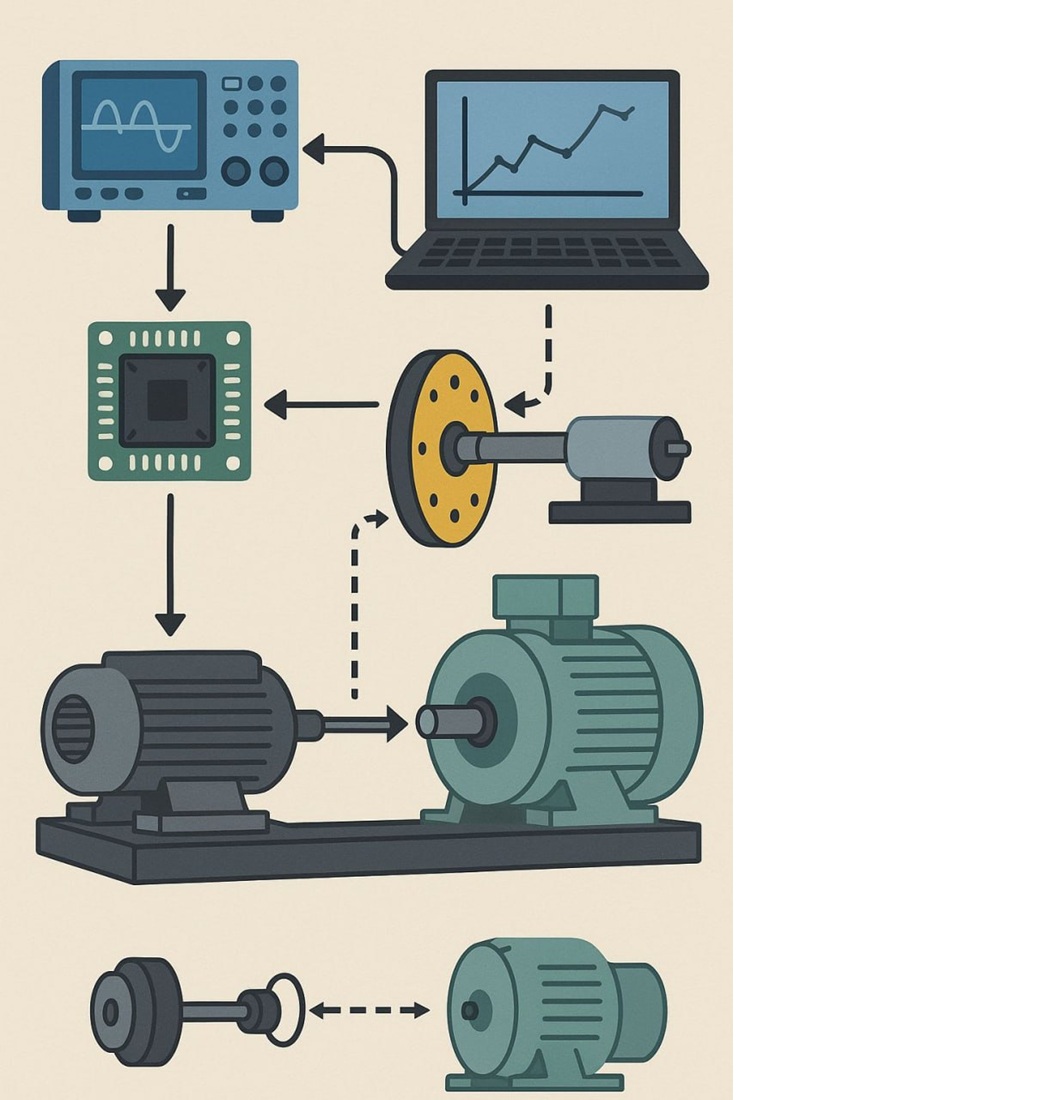
A new automated method for measuring the rotor moment of inertia has been proposed, which is based on the excitation of the generator under the motor mode of operation by the rated frequency voltage under the conditions of mechanical braking of the rotor. The specified measurement method is characterized by reasonable accuracy, high speed, and is suitable for use under both production and laboratory conditions.
Within the framework of the study, a structural diagram of a technical means that implements the proposed method in practice has bene designed; a corresponding mathematical model of the electromechanical system “induction motor – measuring converter” was derived.
A detailed metrological analysis revealed that the methodological error of the proposed method does not exceed 8%, which is acceptable for most applied tasks. A linear relationship between the parameters of the transient process and the characteristics of the electromechanical system was also established, which significantly simplifies the calibration of the device and increases the accuracy and repeatability of the measurement results.
The research results confirm the high efficiency and practical feasibility of using the proposed approach in the field of technical control, maintenance and modernization of electric drive systems. The method could be adapted for a wide range of models of induction motors, as well as integrated into automated equipment condition monitoring systems
References
- Palka, R. (Ed.) (2022). Performance of Induction Machines. MDPI. https://doi.org/10.3390/books978-3-0365-4786-2
- Trzynadlowski, A. M. (2001). Control of Induction Motors. Academic Press. https://doi.org/10.1016/B978-0-12-701510-1.X5000-4
- Kukharchuk, V., Hraniak, V., Katsyv, S., Holodyuk, V. (2020). Torque measuring channels: dynamic and static metrological characteristics. Informatyka, Automatyka, Pomiary w Gospodarce i Ochronie Środowiska, 10 (3), 82–85. https://doi.org/10.35784/iapgos.2080
- Gunawan, R., Luniara Siregar, M., Yusivar, F. (2013). The Influence of Moment of Inertia to Induction Motor Rotation in Sensorless Direct Torque Control and Duty Ratio. Applied Mechanics and Materials, 313-314, 55–60. https://doi.org/10.4028/www.scientific.net/amm.313-314.55
- Zeng, H., Xu, J., Yu, C., Li, Z., Zhang, Q., Li, W. (2023). Analysis of equivalent inertia of induction motors and its influencing factors. Electric Power Systems Research, 225, 109820. https://doi.org/10.1016/j.epsr.2023.109820
- Arjona, M. A., Ramirez, F. A. (2016). An analytical and experimental calculation of the inertia moment of a squirrel-cage induction motor. Electrical Engineering, 99 (2), 665–672. https://doi.org/10.1007/s00202-016-0397-y
- Szántó, A., Ádámkó, É., Juhász, G., Sziki, G. Á. (2022). Simultaneous measurement of the moment of inertia and braking torque of electric motors applying additional inertia. Measurement, 204, 112135. https://doi.org/10.1016/j.measurement.2022.112135
- Egorov, A. V., Kozlov, K. E., Belogusev, V. N. (2016) Experimental identification of the electric motor moment of inertia and its efficiency using the additional inertia. ARPN Journal of Engineering and Applied Sciences, 11 (17), 10582–10588.
- Vasilevskyi, O. V. (2013). Researches of metrology descriptions of mean measuring of moment inertia rotors electromotors. Proceedings of National Aviation University, 55 (2), 62–67. https://doi.org/10.18372/2306-1472.55.5416
- El-Shahat, A. (Ed.) (2023). Induction Motors - Recent Advances, New Perspectives and Applications. IntechOpen. https://doi.org/10.5772/intechopen.104031
- Veselić, K. (2011). Damped Oscillations of Linear Systems. In Lecture Notes in Mathematics. Springer Berlin Heidelberg. https://doi.org/10.1007/978-3-642-21335-9
- Abenov, A., Vedmitskyi, Y. G., Kukharchuk, V. V., Hraniak, V. F., Vishtak, I. V., Kacejko, P. (2018). Newton binomial in the generalized Cauchy problem as exemplified by electrical systems. Photonics Applications in Astronomy, Communications, Industry, and High-Energy Physics Experiments 2018, 153. https://doi.org/10.1117/12.2501600
- Boukhnifer, M., Djilali, L. (2024). Modeling, Control and Diagnosis of Electrical Machines and Devices. Energies, 17 (10), 2250. https://doi.org/10.3390/en17102250
- Figliola, R. S., Beasley, D. E. (2019). Theory and Design for Mechanical Measurements. John Wiley & Sons Inc, 592.
- Kukharchuk, V. V., Katsyv, S. Sh., Hraniak, V. F., Madyarov, V. G., Kyivskyi, V. V., Prychepa, I. V. et al. (2020). Analysis of dependency current harmonics on load and filter parameters for asymmetrical network models. Przeglad Elektrotechniczny, 96 (9), 103–107. https://doi.org/10.15199/48.2020.09.22
- Ladde, A. G., Ladde, G. S. (2012). Introduction to differential equations, an: deterministic modeling, methods and analysis. World Scientific Publishing Company, 544.
- Schott, R., Stacey Staples, G. (2011). Operator Calculus on Graphs. World Scientific. https://doi.org/10.1142/p843
- Prudnikov, A. P., Skórnik, K. A. (2006). Operational Calculus and Related Topics. Chapman and Hall/CRC. https://doi.org/10.1201/9781420011494
- Hraniak, V. F., Matviychuk, V. A., Kupchuk, I. M. (2022). Mathematical Model and Practical Implementation of Transformer Oil Humidity Sensor. Electronics ETF, 26 (1), 3–8. https://doi.org/10.53314/els2226003h
- Demerdash, N. A. O., He, J. B., Chen, H. (2025). Electric Machinery and Drives: An Electromagnetics Perspective. Wiley-IEEE Press, 544.
- Hraniak, V., Romanyuk, O., Tishkov, B., Rohach, V. (2024). Intelligent system for diagnosing rotating electric machines. The 1st International Workshop on Bioinformatics and Applied Information Technologies 2024, 218–231. Available at: https://ceur-ws.org/Vol-3842/paper14.pdf
- Sziki, G. Á., Szántó, A., Ádámkó, É. (2024). Review of Methods for Determining the Moment of Inertia and Friction Torque of Electric Motors. Acta Polytechnica Hungarica, 21 (4), 203–218. https://doi.org/10.12700/aph.21.4.2024.4.11
Downloads
Published
How to Cite
Issue
Section
License
Copyright (c) 2025 Inna Honcharuk, Valerii Hraniak, Oleksii Tokarchuk, Dina Tokarchuk

This work is licensed under a Creative Commons Attribution 4.0 International License.
The consolidation and conditions for the transfer of copyright (identification of authorship) is carried out in the License Agreement. In particular, the authors reserve the right to the authorship of their manuscript and transfer the first publication of this work to the journal under the terms of the Creative Commons CC BY license. At the same time, they have the right to conclude on their own additional agreements concerning the non-exclusive distribution of the work in the form in which it was published by this journal, but provided that the link to the first publication of the article in this journal is preserved.
A license agreement is a document in which the author warrants that he/she owns all copyright for the work (manuscript, article, etc.).
The authors, signing the License Agreement with TECHNOLOGY CENTER PC, have all rights to the further use of their work, provided that they link to our edition in which the work was published.
According to the terms of the License Agreement, the Publisher TECHNOLOGY CENTER PC does not take away your copyrights and receives permission from the authors to use and dissemination of the publication through the world's scientific resources (own electronic resources, scientometric databases, repositories, libraries, etc.).
In the absence of a signed License Agreement or in the absence of this agreement of identifiers allowing to identify the identity of the author, the editors have no right to work with the manuscript.
It is important to remember that there is another type of agreement between authors and publishers – when copyright is transferred from the authors to the publisher. In this case, the authors lose ownership of their work and may not use it in any way.








