Development of biotechnologically modified fat compositions enriched with omega-3 fatty acids using a two-stage transesterification method
DOI:
https://doi.org/10.15587/1729-4061.2025.337272Keywords:
two-step transesterification, ω-3 polyunsaturated fatty acids, Lipozyme TL IM, oxidative stability, fat compositionsAbstract
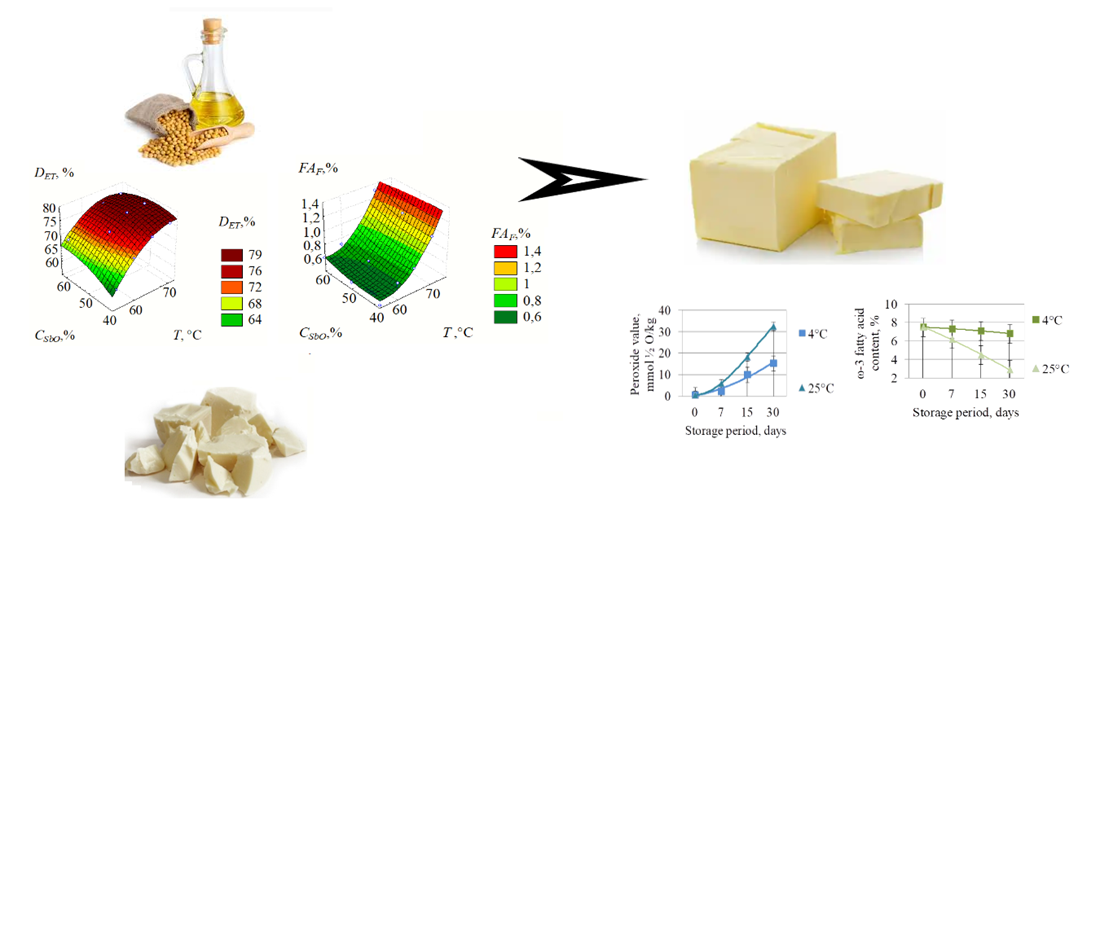
The object of the study is a two-stage combined transesterification of a fat composition to enrich the latter with ω-3 polyunsaturated fatty acids (PUFA). The problem was the need to create a stable fat system enriched with ω-3 PUFA, which is minimally oxidized during the production process. The rational parameters of the enzymatic stage of transesterification of fat substrates were substantiated (process temperature 65°C, fat substrate composition: refined deodorized soybean oil: intermediate fat system PMS-MF). The proposed conditions ensure the degree of transesterification of the fat composition at the level of 74.2% with the formation of 0.6% free fatty acids. The oxidative stability of the resulting product is maximum at 4°C, when in 30 days the peroxide value increases to 15.3 mmol ½O2/kg with losses of ω-3 PUFA of 5.1%. The results of the research are explained by the combination of two stages of transesterification: chemical modification of the fat matrix (product – PMS-MF) and enzymatic using Lipozyme TL IM, which minimizes hydrolytic and oxidative processes of labile components. The key distinguishing feature of the research is the combination of a high degree of enzymatic transesterification (74.2%) with a low level of by-products (0.6% free fatty acids). This was achieved due to the rational ratio of substrates and the temperature of enzymatic transesterification, at which ω-3 PUFA are introduced into the fat system. The obtained results open up prospects for the industrial production of health-promoting fat products with an increased content of ω-3 PUFA and specialized food systems. The technology is effective for fat raw materials with a content of ω-3 PUFA of 7±1% and a peroxide value of less than 1 mmol ½O2/kg
References
- Norazlina, M. R., Jahurul, M. H. A., Hasmadi, M., Mansoor, A. H., Norliza, J., Patricia, M. et al. (2021). Trends in blending vegetable fats and oils for cocoa butter alternative application: A review. Trends in Food Science & Technology, 116, 102–114. https://doi.org/10.1016/j.tifs.2021.07.016
- Belinska, A., Bliznjuk, O., Masalitina, N., Bielykh, I., Zviahintseva, O., Gontar, T. et al. (2023). Development of biotechnologically transesterified three-component fat systems stable to oxidation. Eastern-European Journal of Enterprise Technologies, 5 (6 (125)), 21–28. https://doi.org/10.15587/1729-4061.2023.287326
- Belinska, A., Ryshchenko, I., Bliznjuk, O., Masalitina, N., Chuiko, M., Svishchova, Y. et al. (2025). Development of approaches for the bioconversion of dietary fibers in flax meal using cellulolytic enzymes. Eastern-European Journal of Enterprise Technologies, 2 (11 (134)), 89–95. https://doi.org/10.15587/1729-4061.2025.325418
- Belinska, A., Ryshchenko, I., Bliznjuk, O., Masalitina, N., Siedykh, K., Zolotarova, S. et al. (2024). Development of a method for inactivating lipoxygenases in linseed using chemical reagents. Eastern-European Journal of Enterprise Technologies, 4 (6 (130)), 14–21. https://doi.org/10.15587/1729-4061.2024.309079
- Sivakanthan, S., Madhujith, T. (2020). Current trends in applications of enzymatic interesterification of fats and oils: A review. LWT, 132, 109880. https://doi.org/10.1016/j.lwt.2020.109880
- Lai, O. M., Ghazali, H. M., Cho, F., Chong, C. L. (2000). Enzymatic transesterification of palm stearin: anhydrous milk fat mixtures using 1,3-specific and non-specific lipases. Food Chemistry, 70 (2), 221–225. https://doi.org/10.1016/s0308-8146(00)00085-6
- Belinska, A., Bliznjuk, O., Shcherbak, O., Masalitina, N., Myronenko, L., Varankina, O. et al. (2022). Improvement of fatty systems biotechnological interesterification with immobilized enzyme preparation usage. Eastern-European Journal of Enterprise Technologies, 6 (6 (120)), 6–13. https://doi.org/10.15587/1729-4061.2022.268373
- Nurhasanah, S., Munarso, S. J. (2024). Structured Lipids Based on Palm Oil. Biomass Conversion and Sustainable Biorefinery, 193–206. https://doi.org/10.1007/978-981-99-7769-7_9
- Şahin‐Yeşilçubuk, N., Akoh, C. C. (2017). Biotechnological and Novel Approaches for Designing Structured Lipids Intended for Infant Nutrition. Journal of the American Oil Chemists’ Society, 94 (8), 1005–1034. https://doi.org/10.1007/s11746-017-3013-z
- Khasgiwale, V. N., Waghmare, J. T., Gogate, P. R. (2025). Ultrasound-Assisted Synthesis of OPO-Based Structured Lipids Using Two-Step Chemoenzymatic Esterification for Human Milk Fat Substitution. Food and Bioprocess Technology, 18 (8), 7229–7253. https://doi.org/10.1007/s11947-025-03860-3
- Alves, V., Furtado, G. de F., Alves Macedo, G. (2024). Chemical and Enzymatic Interesterification for Food Lipid Production: An Introduction. Chemical and Enzymatic Interesterification for Food Lipid Production, 1–15. https://doi.org/10.1007/978-3-031-67405-1_1
- Agapay, R. C., Ju, Y.-H., Tran-Nguyen, P. L., Angkawijaya, A. E., Santoso, S. P., Go, A. W. (2020). Synthesizing Precursors for Functional Food Structured Lipids from Soybean Oil Deodorized Distillates. Waste and Biomass Valorization, 12 (7), 3899–3911. https://doi.org/10.1007/s12649-020-01284-y
- Puranik, S. S. (2025). Emulsions of Omega-3 Fatty Acids for Better Bioavailability and Beneficial Health Effects. Omega-3 Fatty Acids, 225–236. https://doi.org/10.1007/978-3-031-84200-9_21
- Fuster, M. G., Moulefera, I., Montalbán, M. G., Víllora, G. (2024). Biocatalytic transesterification of salmon oil in ionic liquid media to obtain concentrates of omega-3 polyunsaturated fatty acids. European Food Research and Technology, 250 (6), 1707–1719. https://doi.org/10.1007/s00217-024-04484-1
- Zhang, Z., Liu, F., Ma, X., Huang, H., Wang, Y. (2017). Two-Stage Enzymatic Preparation of Eicosapentaenoic Acid (EPA) And Docosahexaenoic Acid (DHA) Enriched Fish Oil Triacylglycerols. Journal of Agricultural and Food Chemistry, 66 (1), 218–227. https://doi.org/10.1021/acs.jafc.7b04101
- de Carvalho Silva, A. K., Lima, F. J. L., Borges, K. R. A., Wolff, L. A. S., de Andrade, M. S., Alves, R. de N. S. et al. (2024). Utilization of Fusarium Solani lipase for enrichment of polyunsaturated Omega-3 fatty acids. Brazilian Journal of Microbiology, 55 (3), 2211–2226. https://doi.org/10.1007/s42770-024-01411-0
- Petik, P., Stankevych, S., Zabrodina, I., Zhulinska, O., Mezentseva, I., Haliasnyi, I. et al. (2023). Determination of fat-soluble dyes influence on the oxidation induction period of their oil solutions. Eastern-European Journal of Enterprise Technologies, 3 (6 (123)), 13–21. https://doi.org/10.15587/1729-4061.2023.279619
- Langseter, A. M., Dzurendova, S., Shapaval, V., Kohler, A., Ekeberg, D., Zimmermann, B. (2021). Evaluation and optimisation of direct transesterification methods for the assessment of lipid accumulation in oleaginous filamentous fungi. Microbial Cell Factories, 20 (1). https://doi.org/10.1186/s12934-021-01542-1
Downloads
Published
How to Cite
Issue
Section
License
Copyright (c) 2025 Serhii Stankevych, Viktoriia Kalyna, Iryna Mezentseva, Oleg Kolontaievskyi, Maryna Ponomarova, Anna Belinska, Yana Svishchova, Viktoriia Novikova, Yevhen Barkar, Yana Honcharenko

This work is licensed under a Creative Commons Attribution 4.0 International License.
The consolidation and conditions for the transfer of copyright (identification of authorship) is carried out in the License Agreement. In particular, the authors reserve the right to the authorship of their manuscript and transfer the first publication of this work to the journal under the terms of the Creative Commons CC BY license. At the same time, they have the right to conclude on their own additional agreements concerning the non-exclusive distribution of the work in the form in which it was published by this journal, but provided that the link to the first publication of the article in this journal is preserved.
A license agreement is a document in which the author warrants that he/she owns all copyright for the work (manuscript, article, etc.).
The authors, signing the License Agreement with TECHNOLOGY CENTER PC, have all rights to the further use of their work, provided that they link to our edition in which the work was published.
According to the terms of the License Agreement, the Publisher TECHNOLOGY CENTER PC does not take away your copyrights and receives permission from the authors to use and dissemination of the publication through the world's scientific resources (own electronic resources, scientometric databases, repositories, libraries, etc.).
In the absence of a signed License Agreement or in the absence of this agreement of identifiers allowing to identify the identity of the author, the editors have no right to work with the manuscript.
It is important to remember that there is another type of agreement between authors and publishers – when copyright is transferred from the authors to the publisher. In this case, the authors lose ownership of their work and may not use it in any way.