Development of a method for assessing the society national security level based on the triple helix concept
DOI:
https://doi.org/10.15587/1729-4061.2025.337398Keywords:
triple helix, clusters, national security system, integral assessment indicatorAbstract
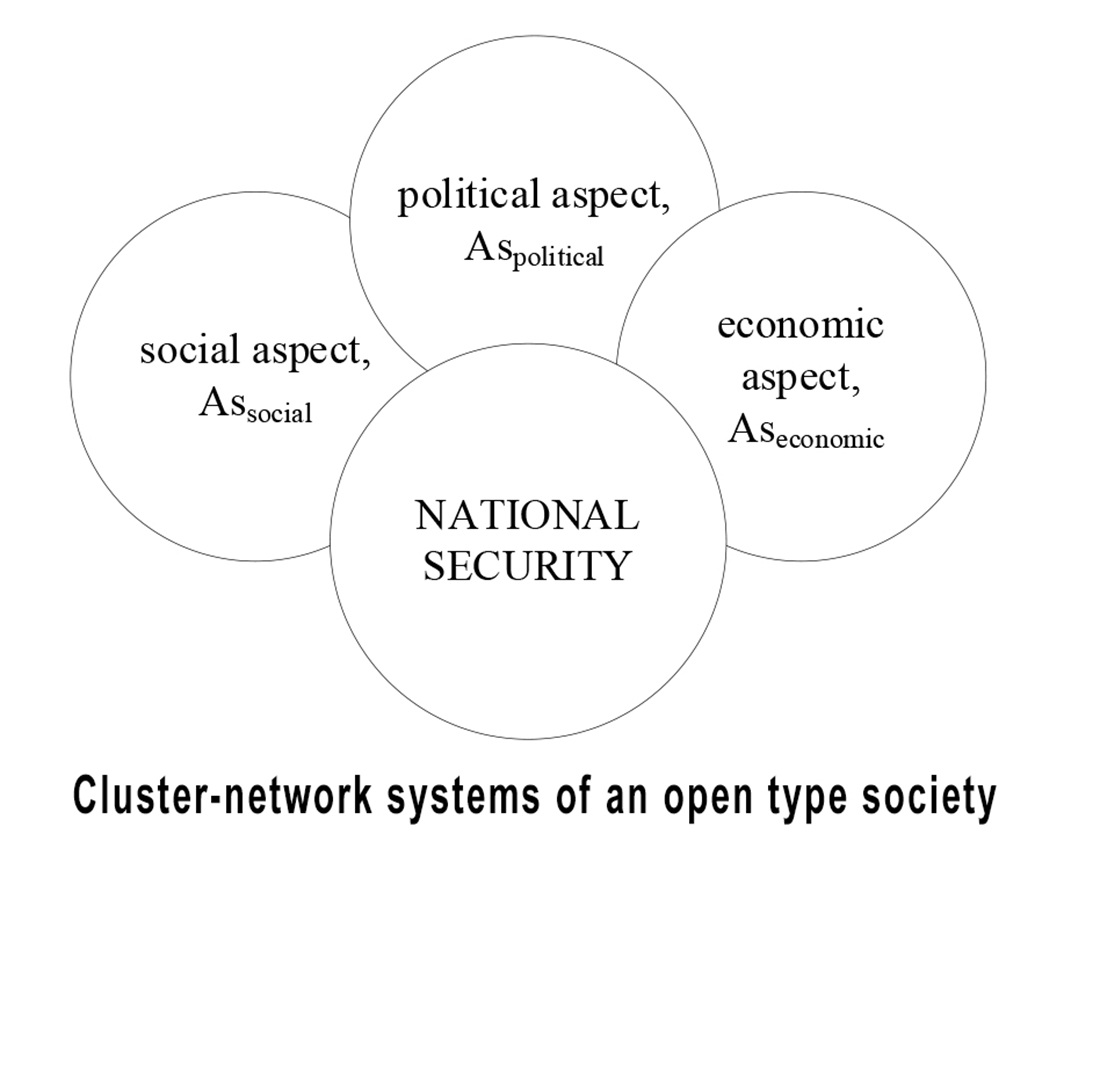
The object of research is the process of formation of a network structure and a new, non-hierarchical method of coordinating the links of assessing the society national security level, based on the triple helix concept. The triple helix (network interaction of science, business and the state) is presented as a universal institutional matrix for an innovative type of growth and conditions for continuous updates of the relationships of the political, social and economic part of the society national security level. From these positions, the concept of the triple helix allows to form the principles of managing the society national security level under the conditions of interaction of its parts. In this case, the main indicators of national security are taken into account. The economic and social situation at the local level directly affects the stability, manageability, civic cohesion and the country’s ability to resist external and internal threats. The proposed models provide the formation of the national security level integrated indicator model through the main factors of the political, social and economic components. The conducted studies provide a more objective assessment of "preventive" security measures in the context of providing data from state bodies and operational information from law enforcement agencies. At the same time, both quantitative and qualitative assessments of the national security level are taken into account, which provides confidence in ensuring the national security level of the state as a whole. The proposed method for assessing the national security level is based on a model for calculating the integral indicator of the regional society national security level, which ensures timely intervention by authorities and state institutions in stabilizing and/or increasing the national security level. Thus, at the beginning of 2022 in Lviv (Ukraine) it was 65.75 (stable region), in Mariupol (Ukraine) – 32.75 (before occupation, risk to security)
References
- Etzkowitz, H., Leydesdorff, L. (1995). The Triple Helix---University-Industry-Government Relations: A Laboratory For Knowledge Based Economic Development. EASST Review, 14 (1). Available at: https://www.researchgate.net/publication/241858820_The_Triple_Helix_-_-University-Industry-Government_Relations_A_Laboratory_for_Knowledge_Based_Economic_Development
- Etzkowitz, H. (2008). The Triple Helix: University-Industry-Government Innovation in Action. Routledge, 180. https://doi.org/10.4324/9780203929605
- Hasumi, Y. (2007). Roles of International Organizations and the EU in Governing the Global Economy: Implications for Regional Cooperation in Asia. The Third EU-NESCA Workshop. Korea University.
- Lindholm, A. (2010). The EU Strategy for the Baltic Sea Region. Update from European Commission. State of the Region Report 2010.
- Gadetska, S., Dubnitskiy, V., Kushneruk, Y., Ponochovnyi, Y., Khodyrev, A. (2024). Simulation of exchange processes in multi-component environments with account of data uncertainty. Advanced Information Systems, 8 (1), 12–23. https://doi.org/10.20998/2522-9052.2024.1.02
- Hospers, G.-J., Desrochers, P., Sautet, F. (2008). The next Silicon Valley? On the relationship between geographical clustering and public policy. International Entrepreneurship and Management Journal, 5 (3), 285–299. https://doi.org/10.1007/s11365-008-0080-5
- Drucker, P. F. (1992). The New Society of Organizations. Harvard Business Review.
- Ketels, C. (2009). Clusters, Cluster Policy, and Swedish Competitiveness in the Global Economy. Expert report No. 30 to Sweden's Globalisation Council.
- Schebesch, K. B., ȘSoim, H. F., Blaga, R. L. (2024). The triple-helix model as foundation of innovative entrepreneurial ecosystems. Journal of Ethics in Entrepreneurship and Technology, 4 (2), 104–129. https://doi.org/10.1108/jeet-08-2024-0026
- Kunwar, R. R., Ulak, N. (2024). Extension of the Triple Helix to Quadruple to Quintuple Helix Model. Journal of APF Command and Staff College, 7 (1), 241–280. https://doi.org/10.3126/japfcsc.v7i1.67006
- Lassa, J. (2021). Food Security is a Triple-helix security phenomenon: An observation from COVID-19 in Indonesia. COVID-19 beyond Health Insecurity. Available at: https://conference.ihsa.info/call-for-papers/view/2714/
- Yang, Y., Egelund Holgaard, J. (2012). The important role of civil society groups in eco‐innovation: a triple helix perspective. Journal of Knowledge-Based Innovation in China, 4 (2), 132–148. https://doi.org/10.1108/17561411211235730
- Giraldo Martinez, G. A., Valencia Pérez, L. R. (2022). The Triple Helix and its Intervention in the Research and Development of Products for International Security and Defense. Revista de Relaciones Internacionales, Estrategia y Seguridad, 17 (1), 31–46. https://doi.org/10.18359/ries.5600
- Kotnik, Ž., Klun, M. (2025). The Reluctance of the Local Public Administration to Participate in the Triple Helix. NISPAcee Journal of Public Administration and Policy, 18 (1), 77–99. https://doi.org/10.2478/nispa-2025-0005
- Kośmider, T. (2023). National Security And Social Capacity. International Journal of Legal Studies ( IJOLS ), 15 (3), 11–19. https://doi.org/10.5604/01.3001.0054.2801
- Katz, Y. (2025). The Controversy Over Equitable Burden-Sharing In Israel’s National Defense. International Journal of Social Science and Human Research, 08 (04). https://doi.org/10.47191/ijsshr/v8-i4-34
- Grubicka, J. G., Nitka, M. (2023). Security versus the inclusive vision of the digital society determinants of selected aspects of cyber security. Zeszyty Naukowe SGSP, 86, 205–219. https://doi.org/10.5604/01.3001.0053.7155
- Linton, G. (2024). Triple Helix Dynamics and Hybrid Organizations: An Analysis of Value Creation Processes. Journal of the Knowledge Economy, 15 (4), 20797–20822. https://doi.org/10.1007/s13132-024-01911-2
- Espuny, M., Reis, J. S. da M., Giupponi, E. C. B., Rocha, A. B. T., Costa, A. C. F., Poltronieri, C. F., Oliveira, O. J. de. (2025). The Role of the Triple Helix Model in Promoting the Circular Economy: Government-Led Integration Strategies and Practical Application. Recycling, 10 (2), 50. https://doi.org/10.3390/recycling10020050
- Carayannis, E. G., Campbell, D. F. J. (2022). Towards an Emerging Unified Theory of Helix Architectures (EUTOHA): Focus on the Quintuple Innovation Helix Framework as the Integrative Device. Triple Helix, 9 (1), 65–75. https://doi.org/10.1163/21971927-bja10028
- Hladchenko, M., Pinheiro, R. (2018). Implementing the Triple Helix Model: Means-Ends Decoupling at the State Level? Minerva, 57 (1), 1–22. https://doi.org/10.1007/s11024-018-9355-3
- Yevseiev, S., Ryabukha, Y., Milov, O., Milevskyi, S., Pohasii, S., Melenti, Y. et al. (2021). Development of a method for assessing forecast of social impact in regional communities. Eastern-European Journal of Enterprise Technologies, 6 (2 (114)), 30–43. https://doi.org/10.15587/1729-4061.2021.249313
- Khto za koho proholosuvav u druhomu turi vyboriv Prezydenta Ukrainy: demohrafichni rezultaty Natsionalnoho ekzyt-polu2019. Available at: https://www.ukrinform.ua/rubric-presshall/2689257-hto-za-kogo-progolosuvav-u-drugomu-turi-viboriv-prezidenta-ukraini-demograficni-rezultati-nacionalnogo-ekzitpolu2019.html
Downloads
Published
How to Cite
Issue
Section
License
Copyright (c) 2025 Serhii Yevseiev, Stanislav Milevskyi, Yevhen Melenti, Oleksandr Voitko, Mykhailo Aleksieiev, Bohdan Morklyanyk, Serhii Povaliaiev, Rositsa Shvorak, Yelyzaveta Sevriukova, Dmytro Rykov

This work is licensed under a Creative Commons Attribution 4.0 International License.
The consolidation and conditions for the transfer of copyright (identification of authorship) is carried out in the License Agreement. In particular, the authors reserve the right to the authorship of their manuscript and transfer the first publication of this work to the journal under the terms of the Creative Commons CC BY license. At the same time, they have the right to conclude on their own additional agreements concerning the non-exclusive distribution of the work in the form in which it was published by this journal, but provided that the link to the first publication of the article in this journal is preserved.
A license agreement is a document in which the author warrants that he/she owns all copyright for the work (manuscript, article, etc.).
The authors, signing the License Agreement with TECHNOLOGY CENTER PC, have all rights to the further use of their work, provided that they link to our edition in which the work was published.
According to the terms of the License Agreement, the Publisher TECHNOLOGY CENTER PC does not take away your copyrights and receives permission from the authors to use and dissemination of the publication through the world's scientific resources (own electronic resources, scientometric databases, repositories, libraries, etc.).
In the absence of a signed License Agreement or in the absence of this agreement of identifiers allowing to identify the identity of the author, the editors have no right to work with the manuscript.
It is important to remember that there is another type of agreement between authors and publishers – when copyright is transferred from the authors to the publisher. In this case, the authors lose ownership of their work and may not use it in any way.





