Determining the effectiveness of using a composition of biosurfactants in technologies for antimicrobial treatment of fleece materials for military and civil purposes
DOI:
https://doi.org/10.15587/1729-4061.2025.337901Keywords:
biosurfactant, fleece products, antimicrobial treatment technologies, military clothing, antimicrobial finishingAbstract
This study’s object is the processes of antimicrobial treatment of fleece materials for military-civilian purposes. The issue addressed is the high vulnerability of fleece materials to bacterial and fungal contamination in intensive use. This reduces their hygienic characteristics, durability, and safety.
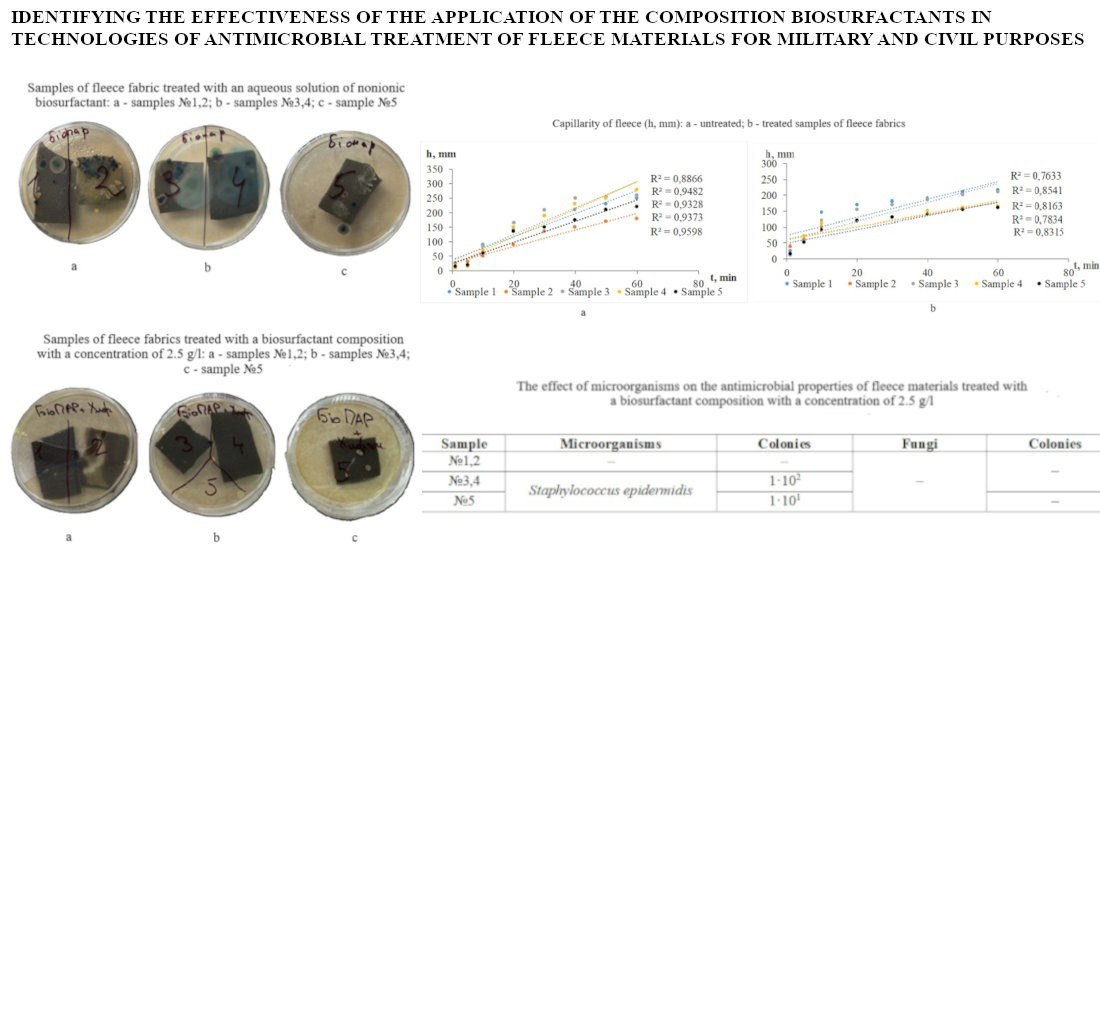
The effectiveness of using the composition of biological surface-active substances (biosurfactants) with a concentration of 2.5 g/l has been carried out for the technologies of antimicrobial treatment of fleece materials for military-civilian purposes. The effect of biosurfactant composition on the preservation of antimicrobial activity against a wide range of microorganisms (Acinetobacter spp., Enterococcus faecalis, Micrococcus spp., Staphylococcus epidermidis, Proteus vulgaris, Aspergillus) was studied.
The results indicate a decrease in the bacterial load to the level of 101–102 CFU/ml and a significant reduction or complete elimination of fungal contamination (up to 103 CFU/ml). The findings are attributed to the ability of biosurfactant to destroy cellular membranes of microorganisms, which provides increased biocidal resistance of the material.
A feature of the results is the achievement of a pronounced antimicrobial effect while maintaining the physical and mechanical properties of the fabric. After treatment, a slight increase in bending stiffness (10–20%) was observed, the wrinkle resistance coefficient was 44–72%. This ensures the proper level of comfort and functionality of the products.
The practical significance relates to the possibility of implementing the designed technological solutions in the production of military and civilian clothing, which is operated under conditions of increased requirements for hygiene, thermal insulation, and durability, enabling consumer protection from microbial contamination
References
- Bibi, A., Afza, G., Afzal, Z., Farid, M., Sumrra, S. H., Hanif, M. A., Kolita Kama Jinadasa, B. K., Zubair, M. (2024). Synthetic vs. natural antimicrobial agents for safer textiles: a comparative review. RSC Advances, 14 (42), 30688–30706. https://doi.org/10.1039/d4ra04519j
- Sathianarayanan, M. P., Bhat, N. V., Kokate, S. S., Walunj, V. E. (2010). Antibacterial finish for cotton fabric from herbal products. Indian Journal of Fibre & Textile Research, 35 (1), 50–58. Available at: https://nopr.niscpr.res.in/bitstream/123456789/7662/3/IJFTR%2035(1)%2050-58.pdf
- Paraska, O., Synyuk, O., Radek, N., Zolotenko, E., Mykhaylovskiy, Y. (2023). Usage of biosurfactants as environmental friendly detergents for textile products cleaning. Fibres and Textiles, 30 (5), 42–51. https://doi.org/10.15240/tul/008/2023-5-005
- Perelshtein, I., Applerot, G., Perkas, N., Wehrschetz-Sigl, E., Hasmann, A., Guebitz, G. M., Gedanken, A. (2008). Antibacterial Properties of an In Situ Generated and Simultaneously Deposited Nanocrystalline ZnO on Fabrics. ACS Applied Materials & Interfaces, 1 (2), 361–366. https://doi.org/10.1021/am8000743
- Wang, L., Hu, C., Shao, L. (2017). The antimicrobial activity of nanoparticles: present situation and prospects for the future. International Journal of Nanomedicine, 12, 1227–1249. https://doi.org/10.2147/ijn.s121956
- Puyol McKenna, P., Naughton, P. J., Dooley, J. S. G., Ternan, N. G., Lemoine, P., Banat, I. M. (2024). Microbial Biosurfactants: Antimicrobial Activity and Potential Biomedical and Therapeutic Exploits. Pharmaceuticals, 17 (1), 138. https://doi.org/10.3390/ph17010138
- Hossain, M. M., Islam, T., Jalil, M. A., Rakibuzzaman, S. M., Surid, S. M., Zabed, M. R. I. et al. (2024). Advancements of eco‐friendly natural antimicrobial agents and their transformative role in sustainable textiles. SPE Polymers, 5 (3), 241–276. Portico. https://doi.org/10.1002/pls2.10135
- Materials Market Report 2024 (2024). Textile Exchange. Available at: https://textileexchange.org/knowledge-center/reports/materials-market-report-2024/ Last accessed: 24.06.2025
- Flis. Tekstyl-Kontakt. Available at: https://tk.ua/ua/catalog/vse-tkani/flis.html?srsltid=AfmBOor9EjKcvjQ3iMTs9GSucg-TlFAE5Pd2qrG6-imWOUjuc0JTt8rw Last accessed: 24.06.2025
- TK-Style – shveina fabryka. Tekstyl-Kontakt. Available at: https://tk-company.com.ua/uk/tk-style/ Last accessed: 24.06.2025
- Kamuflovani kostiumy z flisu. Camotec.ua. Available at: https://camotec.ua/kostyumi-c118/ Last accessed: 24.06.2025
- Tkanyna flis optom. Grandtextile. Available at: https://grandtextile.com.ua/ua/opt/flis/ Last accessed: 24.06.2025
- Flisovi tkanyny. Van Tex. Available at: https://vantex.com.ua/ua/g107870695-flis/ Last accessed: 24.06.2025
- Granados, A., Pleixats, R., Vallribera, A. (2021). Recent Advances on Antimicrobial and Anti-Inflammatory Cotton Fabrics Containing Nanostructures. Molecules, 26 (10), 3008. https://doi.org/10.3390/molecules26103008
- Ali, M. A.-S., Abdel-Rahim, E. A.-M., Mahmoud, A. A.-A., Mohamed, S. E. (2024). Innovative textiles treated with TiO2-AgNPs with succinic acid as a cross-linking agent for medical uses. Scientific Reports, 14 (1). https://doi.org/10.1038/s41598-024-56653-7
- Schneider, G., Vieira, L. G., Carvalho, H. E. F. de, Sousa, Á. F. L. de, Watanabe, E., Andrade, D. de, Silveira, R. C. de C. P. (2023). Textiles impregnated with antimicrobial substances in healthcare services: systematic review. Frontiers in Public Health, 11. https://doi.org/10.3389/fpubh.2023.1130829
- Paraska, O. A., Rak, T. S., Karvan, S. A. (2019). Pat. No. 133668 UA. Kompozytsiia ekolohichno bezpechnykh poverkhnevo-aktyvnykh rechovyn dlia akvachyshchennia tekstylnykh vyrobiv. MPK D06M 11/00. No. a201811227; declareted: 15.11.2018; published: 25.04.2019, Bul. No. 8, 4.
- Ashar, A., Bhutta, Z. A., Shoaib, M., Alharbi, N. K., Fakhar-e-Alam, M., Atif, M. et al. (2023). Cotton fabric loaded with ZnO nanoflowers as a photocatalytic reactor with promising antibacterial activity against pathogenic E. coli. Arabian Journal of Chemistry, 16 (9), 105084. https://doi.org/10.1016/j.arabjc.2023.105084
- Morais, D., Guedes, R., Lopes, M. (2016). Antimicrobial Approaches for Textiles: From Research to Market. Materials, 9 (6), 498. https://doi.org/10.3390/ma9060498
- Giedraitienė, A., Ružauskas, M., Šiugždinienė, R., Tučkutė, S., Grigonis, K., & Milčius, D. (2024). ZnO Nanoparticles Enhance the Antimicrobial Properties of Two-Sided-Coated Cotton Textile. Nanomaterials, 14 (15), 1264. https://doi.org/10.3390/nano14151264
- Falk, N. A. (2019). Surfactants as Antimicrobials: A Brief Overview of Microbial Interfacial Chemistry and Surfactant Antimicrobial Activity. Journal of Surfactants and Detergents, 22 (5), 1119–1127. https://doi.org/10.1002/jsde.12293
- Zhou, C., Wang, Y. (2020). Structure–activity relationship of cationic surfactants as antimicrobial agents. Current Opinion in Colloid & Interface Science, 45, 28–43. https://doi.org/10.1016/j.cocis.2019.11.009
- Lourenço, M., Duarte, N., Ribeiro, I. A. C. (2024). Exploring Biosurfactants as Antimicrobial Approaches. Pharmaceuticals, 17 (9), 1239. https://doi.org/10.3390/ph17091239
- Antonioli Júnior, R., Poloni, J. de F., Pinto, É. S. M., Dorn, M. (2022). Interdisciplinary Overview of Lipopeptide and Protein-Containing Biosurfactants. Genes, 14 (1), 76. https://doi.org/10.3390/genes14010076
- Naebe, M., Haque, A. N. M. A., Haji, A. (2022). Plasma-Assisted Antimicrobial Finishing of Textiles: A Review. Engineering, 12, 145–163. https://doi.org/10.1016/j.eng.2021.01.011
- Espanhol-Soares, M., Costa, L., Silva, M. R. A., Soares Silva, F., Ribeiro, L. M. S., Gimenes, R. (2020). Super-hydrophobic coatings on cotton fabrics using sol-gel technique by spray. Journal of Sol-Gel Science and Technology, 95 (1), 22–33. https://doi.org/10.1007/s10971-020-05307-x
- Orasugh, J. T., Temane, L. T., Kesavan Pillai, S., Ray, S. S. (2025). Advancements in Antimicrobial Textiles: Fabrication, Mechanisms of Action, and Applications. ACS Omega, 10 (13), 12772–12816. https://doi.org/10.1021/acsomega.4c11356
Downloads
Published
How to Cite
Issue
Section
License
Copyright (c) 2025 Olga Paraska, Vita Nehorui, Andriy Gorban, Tomasz Buratowski

This work is licensed under a Creative Commons Attribution 4.0 International License.
The consolidation and conditions for the transfer of copyright (identification of authorship) is carried out in the License Agreement. In particular, the authors reserve the right to the authorship of their manuscript and transfer the first publication of this work to the journal under the terms of the Creative Commons CC BY license. At the same time, they have the right to conclude on their own additional agreements concerning the non-exclusive distribution of the work in the form in which it was published by this journal, but provided that the link to the first publication of the article in this journal is preserved.
A license agreement is a document in which the author warrants that he/she owns all copyright for the work (manuscript, article, etc.).
The authors, signing the License Agreement with TECHNOLOGY CENTER PC, have all rights to the further use of their work, provided that they link to our edition in which the work was published.
According to the terms of the License Agreement, the Publisher TECHNOLOGY CENTER PC does not take away your copyrights and receives permission from the authors to use and dissemination of the publication through the world's scientific resources (own electronic resources, scientometric databases, repositories, libraries, etc.).
In the absence of a signed License Agreement or in the absence of this agreement of identifiers allowing to identify the identity of the author, the editors have no right to work with the manuscript.
It is important to remember that there is another type of agreement between authors and publishers – when copyright is transferred from the authors to the publisher. In this case, the authors lose ownership of their work and may not use it in any way.








