Defining dust load patterns and assessing health risk to people from traffic flows near a quarry
DOI:
https://doi.org/10.15587/1729-4061.2025.340754Keywords:
dust pollution, quarry access roads, correlation-regression analysis, health risk assessment, environmental safetyAbstract
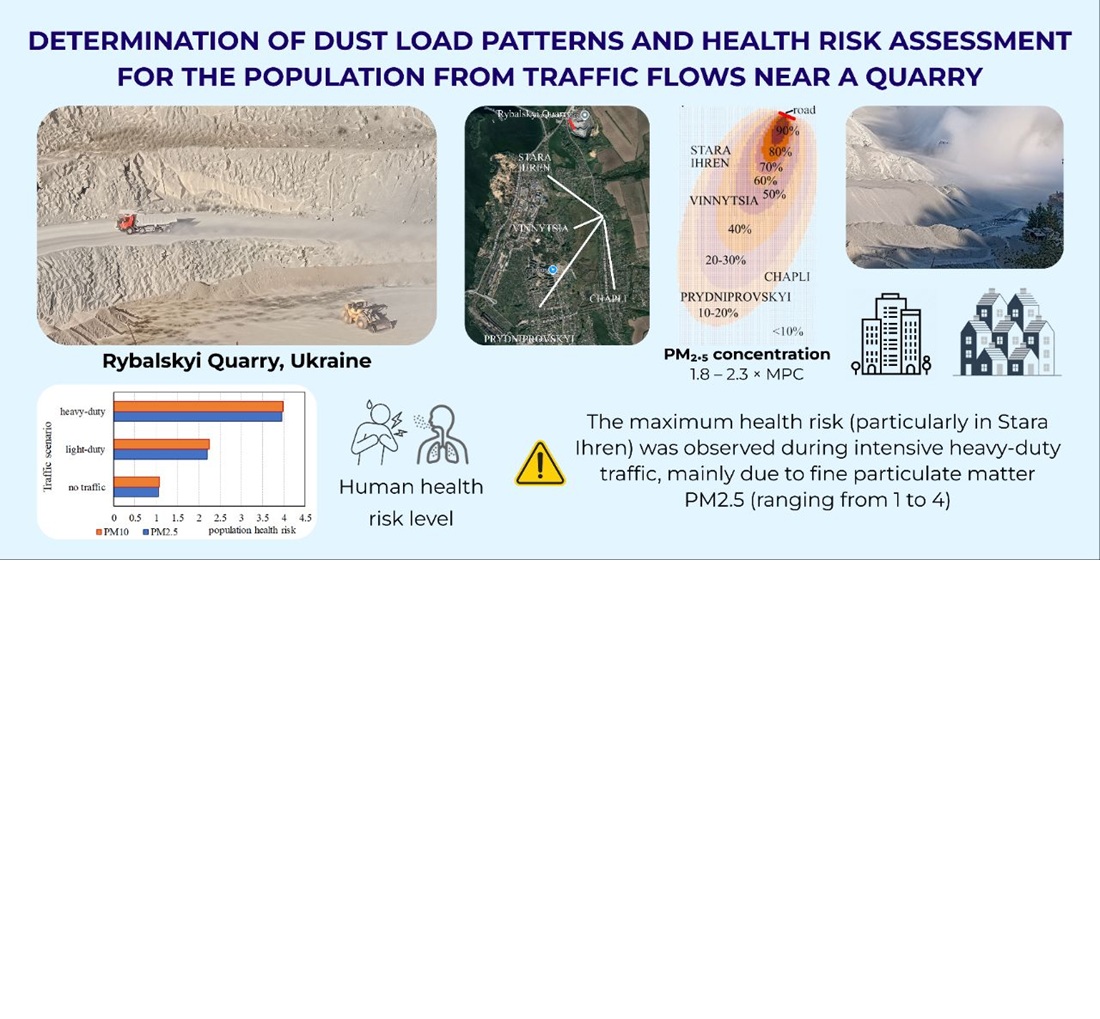
This study investigates atmospheric dust pollution generated by quarrying activities, particularly the impact of traffic on access roads. The task addressed relates to the lack of a comprehensive assessment of dust levels and associated health risks, considering the actual operation of quarry infrastructure and seasonal variability.
Emissions from quarrying during 2020–2024 have been analyzed, which made it possible to evaluate anthropogenic pressure. PM2.5 and PM10 measurements were conducted along the access road to the Rybalskyi quarry (Ukraine); the results were used for statistical processing and dust load modeling.
Correlation-regression models were built to assess the impact of environmental and transport factors, identifying key pollution drivers. A mathematical model of the spatial distribution of concentrations was constructed, including an evaluation of health risks for people.
Maximum recorded PM10 concentrations reached 312 μg/m3, thereby exceeding the permissible limit by 6.2 times. Considering meteorological conditions, vehicle types, as well as traffic intensity enabled quantitative assessment of each factor's contribution to dust load and identification of high-risk zones.
The results are attributed to the high sensitivity of dust concentrations to local changes, confirmed by determination coefficients and spatial modeling outcomes. The proposed approach is suitable for environmental protection measures aimed at reducing dust emission impact on the environment and public health. It could be applied to plan sanitary-protection zones, regulate traffic, and optimize logistics according to local conditions. This approach requires the availability of meteorological data and traffic information to provide reliable forecasts
References
- Kafu-Quvane, B., Mlaba, S. (2024). Assessing the Impact of Quarrying as an Environmental Ethic Crisis: A Case Study of Limestone Mining in a Rural Community. International Journal of Environmental Research and Public Health, 21 (4), 458. https://doi.org/10.3390/ijerph21040458
- Boutemedjet, A., Bounouala, M., Idres, A., Benselhoub, A. (2019). Assessment of dust pollution related to granite quarry operations in Kef Bouacida, Annaba (Algeria). Naukovyi Visnyk Natsionalnoho Hirnychoho Universytetu, 1, 117–124. https://doi.org/10.29202/nvngu/2019-1/13
- da Silva-Rêgo, L. L., de Almeida, L. A., Gasparotto, J. (2022). Toxicological effects of mining hazard elements. Energy Geoscience, 3 (3), 255–262. https://doi.org/10.1016/j.engeos.2022.03.003
- Pham, T. T. K., Le, S. H., Nguyen, T., Balasubramanian, R., Tran, P. T. M. (2024). Characteristics of airborne particles in stone quarrying areas: Human exposure assessment and mitigation. Environmental Research, 245, 118087. https://doi.org/10.1016/j.envres.2023.118087
- Saka, M. B., Hashim, M. H. bin M. (2024). Critical assessment of the effectiveness of different dust control measures in a granite quarry. Journal of Public Health Policy, 45 (2), 212–233. https://doi.org/10.1057/s41271-024-00481-6
- Khan, M. M. H., Kurniawan, T. A., Chandra, I., Lei, T. M. T. (2025). Modeling PM10 Emissions in Quarry and Mining Operations: Insights from AERMOD Applications in Malaysia. Atmosphere, 16 (4), 369. https://doi.org/10.3390/atmos16040369
- Demirarslan, K. O., Yener, İ. (2022). Investigation of total suspended particulate matter dispersion from quarries in Artvin, Turkey, using AERMOD and its relationship with topography. Air Quality, Atmosphere & Health, 15 (12), 2313–2327. https://doi.org/10.1007/s11869-022-01253-5
- Tripathi, A. K., Aruna, M., Parida, S., Nandan, D., Elumalai, P. V., Prakash, E. et al. (2024). Integrated smart dust monitoring and prediction system for surface mine sites using IoT and machine learning techniques. Scientific Reports, 14 (1). https://doi.org/10.1038/s41598-024-58021-x
- Sairanen, M., Pursio, S. (2020). Near field modelling of dust emissions caused by drilling and crushing. SN Applied Sciences, 2 (7). https://doi.org/10.1007/s42452-020-2976-9
- Peng, X., Shi, G.-L., Zheng, J., Liu, J.-Y., Shi, X.-R., Xu, J., Feng, Y.-C. (2016). Influence of quarry mining dust on PM 2.5 in a city adjacent to a limestone quarry: Seasonal characteristics and source contributions. Science of The Total Environment, 550, 940–949. https://doi.org/10.1016/j.scitotenv.2016.01.195
- Wang, H., Wang, Z., Wang, R. (2025). Characteristics of dust pollution and its influencing factors during cold period of open-pit coal mines in northern China. Frontiers in Earth Science, 13. https://doi.org/10.3389/feart.2025.1458847
- Chamdimba, G., Vunain, E., Maoni, M. (2023). Assessment of particulate matter exposure on ambient air and its impact on workers at two granite quarry mines at Njuli, Southern Malawi. Environmental Monitoring and Assessment, 195 (9). https://doi.org/10.1007/s10661-023-11708-6
- Leon-Kabamba, N., Ngatu, N. R., Muzembo, B. A., Kakoma, S., Michel-Kabamba, N., Danuser, B. et al. (2020). Air Quality in the Working Environment and Respiratory Health of Female Congolese Stone Quarry Workers. Tropical Medicine and Infectious Disease, 5 (4), 171. https://doi.org/10.3390/tropicalmed5040171
- Nemer, M., Giacaman, R., Husseini, A. (2020). Lung Function and Respiratory Health of Populations Living Close to Quarry Sites in Palestine: A Cross-Sectional Study. International Journal of Environmental Research and Public Health, 17 (17), 6068. https://doi.org/10.3390/ijerph17176068
- Hoang, A. N., Pham, T. T. K., Mai, D. T. T., Nguyen, T., Tran, P. T. M. (2022). Health risks and perceptions of residents exposed to multiple sources of air pollutions: A cross-sectional study on landfill and stone mining in Danang city, Vietnam. Environmental Research, 212, 113244. https://doi.org/10.1016/j.envres.2022.113244
- Bakamwesiga, H., Mugisha, W., Kisira, Y., Muwanga, A. (2022). An Assessment of Air and Water Pollution Accrued from Stone Quarrying in Mukono District, Central Uganda. Journal of Geoscience and Environment Protection, 10 (05), 25–42. https://doi.org/10.4236/gep.2022.105003
- Swangjang, K., Dantrakul, A., Panishkan, K. (2025). Potential Health Risk of Dust from Stone Mill Industries. Atmosphere, 16 (2), 230. https://doi.org/10.3390/atmos16020230
- Qian, Q., Cao, X., Qian, Q., Shen, F., Wang, Q., Liu, H., Tong, J. (2016). Relationship of cumulative dust exposure dose and cumulative abnormal rate of pulmonary function in coal mixture workers. The Kaohsiung Journal of Medical Sciences, 32 (1), 44–49. https://doi.org/10.1016/j.kjms.2015.11.003
- Laaouaoucha, D., Farhane, M., Essaouini, M., Souhar, O. (2021). Analytical model for the two-dimensional advection-diffusion equation with the logarithmic wind profile in unstable conditions. International Journal of Environmental Science and Technology, 19 (7), 6825–6832. https://doi.org/10.1007/s13762-021-03554-1
- Querol, X., Pérez, N., Reche, C., Ealo, M., Ripoll, A., Tur, J., Pandolfi, M. et al. (2019). African dust and air quality over Spain: Is it only dust that matters? Science of The Total Environment, 686, 737–752. https://doi.org/10.1016/j.scitotenv.2019.05.349
- Casotti Rienda, I., Alves, C. A. (2021). Road dust resuspension: A review. Atmospheric Research, 261, 105740. https://doi.org/10.1016/j.atmosres.2021.105740
- Zhao, Z., Tian, J., Zhang, W., Zhang, Q., Wu, Z., Xing, Y. et al. (2023). Chemical Source Profiles and Toxicity Assessment of Urban Fugitive Dust PM2.5 in Guanzhong Plain, China. Toxics, 11 (8), 676. https://doi.org/10.3390/toxics11080676
- Nath, P., Saha, P., Middya, A. I., Roy, S. (2021). Long-term time-series pollution forecast using statistical and deep learning methods. Neural Computing and Applications, 33 (19), 12551–12570. https://doi.org/10.1007/s00521-021-05901-2
- WHO global air quality guidelines: particulate matter (PM2.5 and PM10), ozone, nitrogen dioxide, sulfur dioxide and carbon monoxide. World Health Organization, 290. Available at: https://www.who.int/publications/i/item/9789240034228
- IARC Monographs Volume 136: Talc monograph now available (2025). IARC. Available at: https://monographs.iarc.who.int/news-events/iarc-monographs-volume-136-talc-monograph-now-available/
- EPA released the final report of the Integrated Science Assessment for Particulate Matter (EPA/600/AR-08/139F) (2009). Available at: https://www.epa.gov/isa/integrated-science-assessment-isa-particulate-matter?utm_source=chatgpt.com
Downloads
Published
How to Cite
Issue
Section
License
Copyright (c) 2025 Tetiana Rusakova, Kateryna Rusakova, Olena Zolotko, Olena Dolzhenkova, Yuliia Voitenko, Olena Gunko

This work is licensed under a Creative Commons Attribution 4.0 International License.
The consolidation and conditions for the transfer of copyright (identification of authorship) is carried out in the License Agreement. In particular, the authors reserve the right to the authorship of their manuscript and transfer the first publication of this work to the journal under the terms of the Creative Commons CC BY license. At the same time, they have the right to conclude on their own additional agreements concerning the non-exclusive distribution of the work in the form in which it was published by this journal, but provided that the link to the first publication of the article in this journal is preserved.
A license agreement is a document in which the author warrants that he/she owns all copyright for the work (manuscript, article, etc.).
The authors, signing the License Agreement with TECHNOLOGY CENTER PC, have all rights to the further use of their work, provided that they link to our edition in which the work was published.
According to the terms of the License Agreement, the Publisher TECHNOLOGY CENTER PC does not take away your copyrights and receives permission from the authors to use and dissemination of the publication through the world's scientific resources (own electronic resources, scientometric databases, repositories, libraries, etc.).
In the absence of a signed License Agreement or in the absence of this agreement of identifiers allowing to identify the identity of the author, the editors have no right to work with the manuscript.
It is important to remember that there is another type of agreement between authors and publishers – when copyright is transferred from the authors to the publisher. In this case, the authors lose ownership of their work and may not use it in any way.





