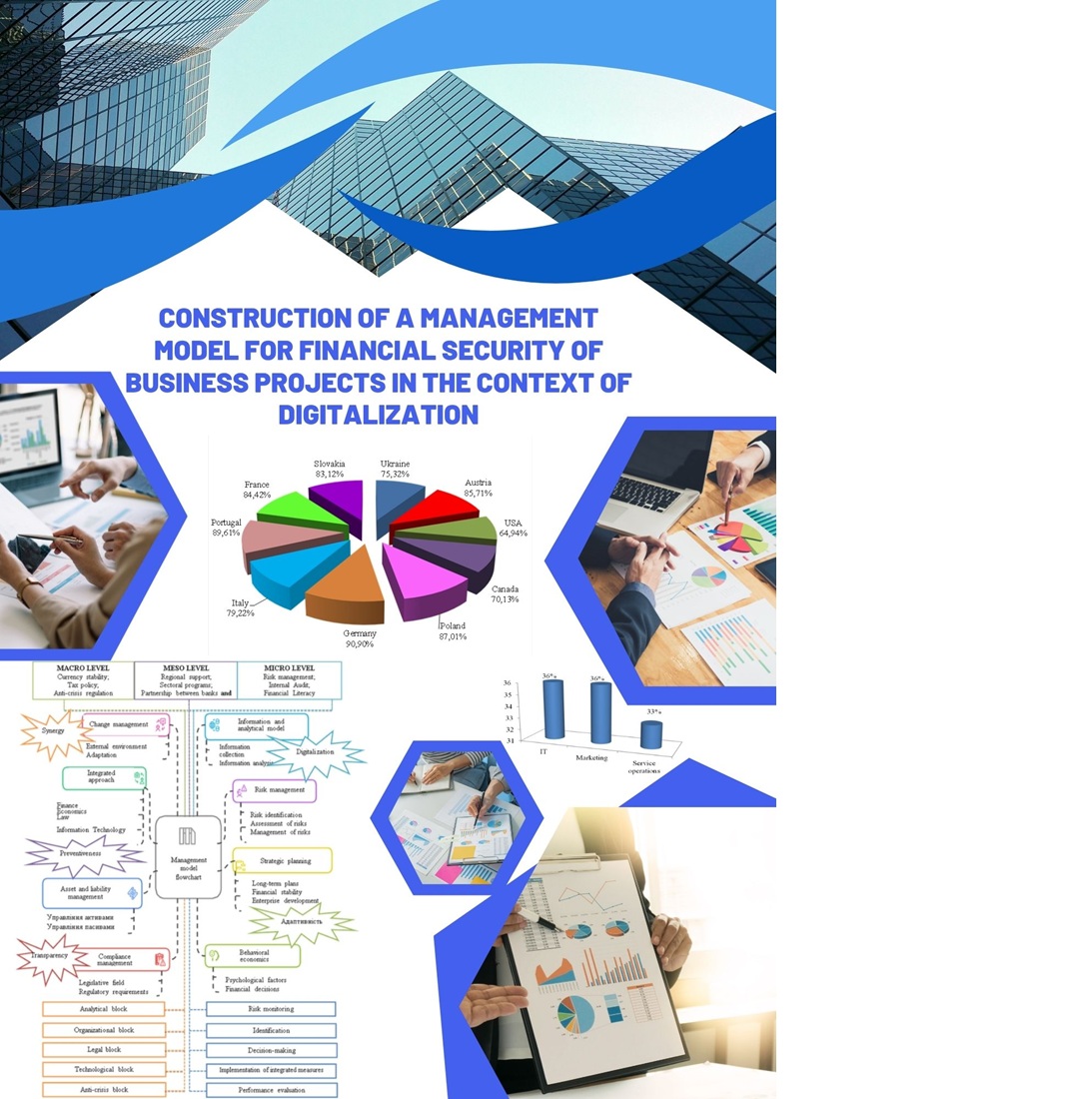
Construction of a management model for financial security of business projects in the context of digitalization
DOI:
https://doi.org/10.15587/1729-4061.2025.340920Keywords:
financial security, business project, risk management, artificial intelligence, blockchain, digital technologiesAbstract
The object of research is the financial security of business projects in the context of the digital transformation of the economy. The issue tackled relates to the increasing frequency of internal and external financial threats that undermine business stability while conventional management methods do not take into account the new challenges of the digital economy.
Methods of financial security management have been proposed that integrate classical approaches (administrative, economic, organizational, mathematical, socio-psychological) with digital technologies – artificial intelligence, Big Data, blockchain, and cloud platforms. Such integration provides multi-level protection against risks, allows for timely identification of threats, increases the accuracy of financial forecasting, as well as contributes to the adaptability and efficiency of management decisions.
The results make it possible to solve the task of increasing the financial stability of business projects in a changing environment through the comprehensive approach and adaptability of the model, which is based on a combination of systemic and interdisciplinary approaches with the active use of digital tools. The proposed structural diagram of the financial security management model of business projects makes it possible to minimize losses, increase investment attractiveness, and devise effective anti-crisis strategies.
Comparative analysis based on empirical data and international experience has revealed a significant advantage of digital models: the efficiency of systems using intelligent technologies exceeds the results of conventional approaches by an average of 30%. In particular, it was established that the use of adaptive digital models ensures operational identification of risks, increases the accuracy of financial forecasting, and minimizes the likelihood of crisis scenarios.
Practical areas for improving management strategies for financial security of business projects have been outlined, in particular through the development of digital infrastructure, automation of control, introduction of a dynamic budgeting system, as well as predictive and analytical risk management models
References
- Bubenko, P. T., Hlukhariev, S. M., Dymchenko, O. V. (2021). Finansova bezpeka innovatsiynoho biznesu yak faktor ekonomichnoho rozvytku. Kharkiv: KhNUMH im. O. M. Beketova, 164. Available at: https://eprints.kname.edu.ua/60193/1/14%20экз%20Фінансова%20безпека%202021_ПЕЧ_11%20МН.pdf
- Varnalii, Z. S., Cheberyako, O. V., Mykytiuk, O. P., Bondarenko, S. M. (2024). Actuality of the financial security of business entities of Ukraine under in the war and post-war period. Academic Review, 1 (60), 123–140. https://doi.org/10.32342/2074-5354-2024-1-60-9
- Berzhanir, I. (2023). Financial security management of enterprises in modern conditions. Zeszyty Naukowe Politechniki Częstochowskiej. Zarządzanie, 50 (1), 20–30. https://doi.org/10.17512/znpcz.2023.2.02
- Nosan, N., Nazarenko, S. (2022). Financial security management in economic security systems at different levels of management systems: methodological problems. Financial and Credit Activity Problems of Theory and Practice, 6 (41), 138–146. https://doi.org/10.18371/fcaptp.v6i41.251418
- Marusiak, N., Bak, N. (2022). Financial security of the enterprise and threats of its loss in the modern economic environment. Ekonomika Ta Derzhava, 2, 109. https://doi.org/10.32702/2306-6806.2022.2.109
- Varnalii, Z., Bondarenko, S. (2023). Financial security of Ukrainian enterprises during the war and post-war period. University Economic Bulletin, 56, 106–113. https://doi.org/10.31470/2306-546x-2023-56-106-113
- Koval, N., Korniyuk, K. (2024). Ensuring the financial security of the enterprise in the conditions of war: problems and features. Agrosvit, 4, 152–158. https://doi.org/10.32702/2306-6792.2024.4.152
- Zakharkin, О., Boiko, А., Sokol, L. (2023). Digital Technologies and Tools for the Financial Security of Business. Problems of Modern Transformations. Series: Economics and Management, 10. https://doi.org/10.54929/2786-5738-2023-10-08-02
- Mekhed, A., Varnalii, Z. (2021). Financial security of enterprises in the digital economy. Socio-Economic Relations in the Digital Society, 3 (42), 55–61. https://doi.org/10.18371/2221-755x3(42)2021253524
- Lesun, S. (2024). Financial security of enterprises and its features in the conditions of the digital economy. Problems and Prospects of Economics and Management, 3 (39), 341–352. https://doi.org/10.25140/2411-5215-2024-3(39)-341-352
- Zachosova, N., Herasymenko, O., Shevchenko, А. (2018). Risks and possibilities of the effect of financial inclusion on managing the financial security at the macro level. Investment Management and Financial Innovations, 15 (4), 304–319. https://doi.org/10.21511/imfi.15(4).2018.25
- Zachosova, N., Babina, N., Zanora, V. (2018). Research and methodological framework for managing the economic security of financial intermediaries in Ukraine. Banks and Bank Systems, 13 (4), 119–130. https://doi.org/10.21511/bbs.13(4).2018.11
- Maslii, O., Buriak, A., Chaikina, A., Cherviak, A. (2025). Improving conceptual approaches to ensuring state economic security under conditions of digitalization. Eastern-European Journal of Enterprise Technologies, 1 (13 (133)), 35–45. https://doi.org/10.15587/1729-4061.2025.319256
- Cheng, X., Du, A. M., Yan, C., Goodell, J. W. (2025). Internal business process governance and external regulation: How does AI technology empower financial performance? International Review of Financial Analysis, 99, 103927. https://doi.org/10.1016/j.irfa.2025.103927
- Vysotskyy, Y. (2025). The Process of Forming Accounting and Analytical Support for Management of the Enterprise’s Economic Security. Problems of Modern Transformations. Series: Economics and Management, 17. https://doi.org/10.54929/2786-5738-2025-17-09-02
- Bhattacharya, J. (2025). AI in Blockchain: Key Statistics and Insights. SEO Sandwitch. Available at: https://seosandwitch.com/ai-blockchain-stats/
- Azarenkova, G., Vepretska, S. (2024). System for ensuring the financial security of the enterprise. FINANCIAL AND CREDIT SYSTEMS: PROSPECTS FOR DEVELOPMENT, 4 (15), 32–42. https://doi.org/10.26565/2786-4995-2024-4-03
- Five digital tools to enhance your cash management advice (2024). Flagstone. Available at: https://www.flagstoneim.com/advisers/learn/wealth-management-opportunities/five-digital-tools-to-enhance-your-cash-management-advice
- Pronoza, P., Kuzenko, T., Sablina, N. (2024). Implementation of financial control tools in the adaptive management of enterprise financial security. Eastern-European Journal of Enterprise Technologies, 1 (13 (127)), 33–40. https://doi.org/10.15587/1729-4061.2024.294765
- Agres, O., Sodoma, R., Ilchyshyn, I., Kovalchuk, O., Shmatkovska, T. (2025). Regional development project management: financial aspect. Technology Audit and Production Reserves, 3 (4 (83)), 87–92. https://doi.org/10.15587/2706-5448.2025.330027
- Koncevičs, R., Peņicina, L., Gaidukovs, A., Darģis, M., Burbo, R., Auziņš, A. (2017). Comparative Analysis of Business Process Modelling Tools for Compliance Management Support. Applied Computer Systems, 21 (1), 22–27. https://doi.org/10.1515/acss-2017-0003
- Sodoma, R., Lesyk, L., Hryshchuk, A., Dubynetska, P., Shmatkovska, T. (2022). Innovative development of rural territories and agriculture in Ukraine. Scientific Papers. Series "Management, Economic Engineering in Agriculture and rural development", 22 (4), 685–696. Available at: https://managementjournal.usamv.ro/pdf/vol.22_4/Art73.pdf
Downloads
Published
How to Cite
Issue
Section
License
Copyright (c) 2025 Oksana Agres, Ruslana Sodoma, Olesya Binert, Andriy Samilo, Volodymyr Romaniv

This work is licensed under a Creative Commons Attribution 4.0 International License.
The consolidation and conditions for the transfer of copyright (identification of authorship) is carried out in the License Agreement. In particular, the authors reserve the right to the authorship of their manuscript and transfer the first publication of this work to the journal under the terms of the Creative Commons CC BY license. At the same time, they have the right to conclude on their own additional agreements concerning the non-exclusive distribution of the work in the form in which it was published by this journal, but provided that the link to the first publication of the article in this journal is preserved.
A license agreement is a document in which the author warrants that he/she owns all copyright for the work (manuscript, article, etc.).
The authors, signing the License Agreement with TECHNOLOGY CENTER PC, have all rights to the further use of their work, provided that they link to our edition in which the work was published.
According to the terms of the License Agreement, the Publisher TECHNOLOGY CENTER PC does not take away your copyrights and receives permission from the authors to use and dissemination of the publication through the world's scientific resources (own electronic resources, scientometric databases, repositories, libraries, etc.).
In the absence of a signed License Agreement or in the absence of this agreement of identifiers allowing to identify the identity of the author, the editors have no right to work with the manuscript.
It is important to remember that there is another type of agreement between authors and publishers – when copyright is transferred from the authors to the publisher. In this case, the authors lose ownership of their work and may not use it in any way.








