Determining the effect of phase modulation and optimal signal processing on HF communication system reliability and range
DOI:
https://doi.org/10.15587/1729-4061.2025.340994Keywords:
autocorrelation function, analog signal, Barker code, matched filter, phase modulationAbstract
This study considers analog high-frequency (HF) communication systems that use broadband signals modulated by the Barker code. The task addressed is to improve the efficiency of analog HF communication systems when transmitting broadband signals.
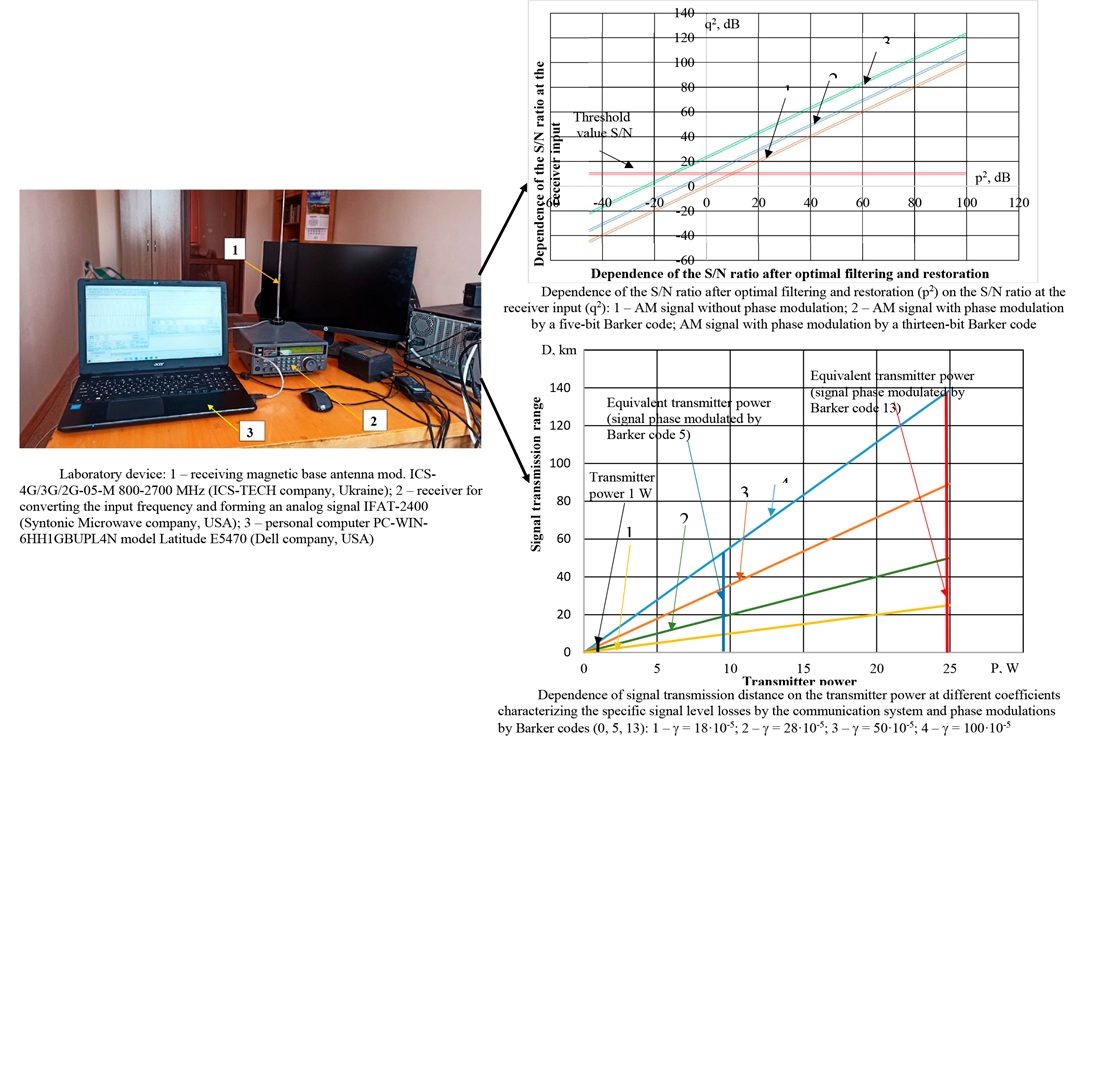
Patterns in the formation of a noise-resistant broadband signal with phase modulation by the Barker code and the operation of the signal spectrum expansion and restoration unit have been investigated. It was established that phase modulation makes it possible to achieve such a spectral width, amplitude of the main peak of the autocorrelation function, and time resolution, which enable effective correlation separation of the usable signal and increases its noise immunity.
It has been shown that signal modulation with a five-bit code forms a spectrum with a width of 1 MHz, the amplitude of the main peak of the autocorrelation function is 9 units, and a time resolution of 1–2 μs, which provides an increase in noise immunity to 9 dB at S/N=1 dB compared to the base signal without modulation. The use of a thirteen-bit code allows this indicator to be increased to 13 dB at S/N=–3 dB.
The effectiveness of the module for expanding and restoring the spectrum of the modulated signal when transmitting it over a distance without loss of communication quality has been confirmed. Signal modulation with a 5- and 13-bit code, compared to unmodulated, increased the communication range by 9 and 25 times, respectively. The results are attributed to the optimal autocorrelation properties of Barker codes and hardware solutions that form a broadband signal without complicating the circuit. This is explained by the ability of Barker codes to form a narrow correlation pulse and expand the signal spectrum, which reduces sensitivity to narrowband interference.
The results are valuable for applications in analog RF communication systems as well as power grids, in particular at low S/N ratios
References
- Giraneza, M., Abo-Al-Ez, K. (2022). Power line communication: A review on couplers and channel characterization. AIMS Electronics and Electrical Engineering, 6 (3), 265–284. https://doi.org/10.3934/electreng.2022016
- Del Puerto-Flores, J. A., Naredo, J. L., Peña-Campos, F., Del-Valle-Soto, C., Valdivia, L. J., Parra-Michel, R. (2022). Channel Characterization and SC-FDM Modulation for PLC in High-Voltage Power Lines. Future Internet, 14 (5), 139. https://doi.org/10.3390/fi14050139
- Girotto, M., Tonello, A. M. (2017). EMC Regulations and Spectral Constraints for Multicarrier Modulation in PLC. IEEE Access, 5, 4954–4966. https://doi.org/10.1109/access.2017.2676352
- Fan, Z., Rudlin, J., Asfis, G., Meng, H. (2019). Convolution of Barker and Golay Codes for Low Voltage Ultrasonic Testing. Technologies, 7 (4), 72. https://doi.org/10.3390/technologies7040072
- Ustun Ercan, S., Pena-Quintal, A., Thomas, D. (2023). The Effect of Spread Spectrum Modulation on Power Line Communications. Energies, 16 (13), 5197. https://doi.org/10.3390/en16135197
- Hernandez Fernandez, J., Jarouf, A., Omri, A., Di Pietro, R. (2023). Inferring Power Grid Information with Power Line Communications: Review and Insights. arXiv. https://doi.org/10.48550/arXiv.2308.10598
- Schmidt, K.-U., Willms, J. (2015). Barker sequences of odd length. Designs, Codes and Cryptography, 80 (2), 409–414. https://doi.org/10.1007/s10623-015-0104-4
- Maksimov, V., Khrapovitsky, I. (2020). New composite barker codes in the synchronization system of broadband signals. Information and Telecommunication Sciences, 2, 24–30. https://doi.org/10.20535/2411-2976.22020.24-30
- Maksymov, V., Noskov, V., Khrapovytsky, I. (2022). New Barker’s composite codes as modulation signals in broadband communication systems. Information and Telecommunication Sciences, 2, 15–20. https://doi.org/10.20535/2411-2976.22022.15-20
- Maksymov, V., Gatturov, V., Khrapovytsky, I. (2022). New composite Barker codes, gold codes and kasamisequences in broadband signal synchronization systems. Information and Telecommunication Sciences, 1, 14–21. https://doi.org/10.20535/2411-2976.12022.14-21
- Abdel-Rahman, M. A. A. (2018). Generation and Digital Correlation of Barker Code for Radars and Communication Systems. IJIREEICE, 6 (9), 1–6. https://doi.org/10.17148/ijireeice.2018.691
- Tsmots, I. G., Riznyk, O. Ya., Balych, B. I., Lvovskij, Ch. Z. (2021). The method and simulation model for the synthesis of barker-like code sequences. Ukrainian Journal of Information Technology, 3 (2), 45–50. https://doi.org/10.23939/ujit2021.02.045
- Siebert, W. M. (1988). The early history of pulse compression radar-the development of AN/FPS-17 coded-pulse radar at Lincoln Laboratory. IEEE Transactions on Aerospace and Electronic Systems, 24 (6), 833–837. https://doi.org/10.1109/7.18655
- Blunt, S. D., Mokole, E. L. (2016). Overview of radar waveform diversity. IEEE Aerospace and Electronic Systems Magazine, 31 (11), 2–42. https://doi.org/10.1109/maes.2016.160071
- Zhang, Y.-X., Liu, Q.-F., Hong, R.-J., Pan, P.-P., Deng, Z.-M. (2016). A Novel Monopulse Angle Estimation Method for Wideband LFM Radars. Sensors, 16 (6), 817. https://doi.org/10.3390/s16060817
- Seleym, A. (2016). Complementary phase coded LFM waveform for SAR. 2016 Integrated Communications Navigation and Surveillance (ICNS), 4C3-1-4C3-5. https://doi.org/10.1109/icnsurv.2016.7486346
- Levanon, N., Cohen, I., Itkin, P. (2017). Complementary pair radar waveforms–evaluating and mitigating some drawbacks. IEEE Aerospace and Electronic Systems Magazine, 32 (3), 40–50. https://doi.org/10.1109/maes.2017.160113
- Azouz, A., Abosekeen, A., Nassar, S., Hanafy, M. (2021). Design and Implementation of an Enhanced Matched Filter for Sidelobe Reduction of Pulsed Linear Frequency Modulation Radar. Sensors, 21 (11), 3835. https://doi.org/10.3390/s21113835
- Liu, M., Li, Z., Liu, L. (2018). A Novel Sidelobe Reduction Algorithm Based on Two-Dimensional Sidelobe Correction Using D-SVA for Squint SAR Images. Sensors, 18 (3), 783. https://doi.org/10.3390/s18030783
- Azouz, A. (2020). Novel Sidelobe cancellation for Compound-Barker Combined with LFM or Polyphase Waveform. 2020 12th International Conference on Electrical Engineering (ICEENG), 268–276. https://doi.org/10.1109/iceeng45378.2020.9171777
- Saari, V. (2011). Continuous-time low-pass filters for integrated wideband radio receivers. Aalto University. Available at: https://core.ac.uk/download/pdf/80703915.pdf
- Kiranmai, B., Rajesh Kumar, P. (2015). Performance Evaluation of Compound Barker Codes using Cascaded Mismatched Filter Technique. International Journal of Computer Applications, 121 (19), 31–34. https://doi.org/10.5120/21649-4844
- El-Tokhy, M. A., Mansour, H. A. K. (2008). A 2.3-mW 16.7-MHZ Analog Matched Filter Circuit For DS-CDMA Wireless Applications. Progress In Electromagnetics Research B, 5, 253–264. https://doi.org/10.2528/pierb08022406
- Haji Ali, S. M., Shaker, M. M., Salih, T. (2018). Design and implementation of a dynamic analog matched filter using FPAA technology. World Academy of Science, Engineering and Technology, 206–210. Available at: https://www.researchgate.net/publication/322683048_Design_and_Implementation_of_a_Dynamic_Analog_Matched_Filter_Using_FPAA_Technology
- Lari, M. (2023). Matched-filter design to improve self-interference cancellation in full-duplex communication systems. Wireless Networks, 29 (7), 3137–3150. https://doi.org/10.1007/s11276-023-03352-2
- Hahm, M. D., Friedman, E. G., Titlebaum, E. L. (1997). A comparison of analog and digital circuit implementations of low power matched filters for use in portable wireless communication terminals. IEEE Transactions on Circuits and Systems II: Analog and Digital Signal Processing, 44 (6), 498–506. https://doi.org/10.1109/82.592584
- Angarita Malaver, E. F., Barrera Lombana, N., Moreno Rubio, J. J. (2024). Smith Chart-Based Design of High-Frequency Broadband Power Amplifiers. Electronics, 13 (20), 4096. https://doi.org/10.3390/electronics13204096
- Chen, S., Sun, H., Weng, M., Wen, S., Li, L., Liu, B. (2023). Design and Research of Channel Circuit Based on Broadband Power Line Carrier. Journal of Physics: Conference Series, 2433 (1), 012017. https://doi.org/10.1088/1742-6596/2433/1/012017
- Thakur, S., Singh, R., Sharma, S. (2015). Dynamic Capacity Scheduling in Hadoop. International Journal of Computer Applications, 125 (15), 25–28. https://doi.org/10.5120/ijca2015906178
- Qian, N., Zhou, D., Shu, H., Zhang, M., Wang, X., Dai, D. et al. (2025). Analog parallel processor for broadband multifunctional integrated system based on silicon photonic platform. Light: Science & Applications, 14 (1). https://doi.org/10.1038/s41377-025-01753-w
- Oluwajobi, F., Wasiu, L. (2014). Multisim Design and Simulation of 2.2GHz LNA for Wireless Communication. International Journal of VLSI Design & Communication Systems, 5 (4), 65–74. https://doi.org/10.5121/vlsic.2014.5405
- Li, Z., Li, X., Jiang, D., Bao, X., He, Y. (2020). Application of Multisim Simulation Software in Teaching of Analog Electronic Technology. Journal of Physics: Conference Series, 1544 (1), 012063. https://doi.org/10.1088/1742-6596/1544/1/012063
- Berkman, L. N., Varfolomeieva, O. H., Hrushevska, V. P. (2015). Typovi syhnaly ta zavady v elektrozviazku. Kyiv: DUT NNITI, 92.
- Galli, S., Logvinov, O. (2008). Recent Developments in the Standardization of Power Line Communications within the IEEE. IEEE Communications Magazine, 46 (7), 64–71. https://doi.org/10.1109/mcom.2008.4557044
- Ndjiongue, A. R., Ferreira, H. C. (2019). Power line communications (PLC) technology: More than 20 years of intense research. Transactions on Emerging Telecommunications Technologies, 30 (7). https://doi.org/10.1002/ett.3575
- Ustun Ercan, S. (2024). Power line Communication: Revolutionizing data transfer over electrical distribution networks. Engineering Science and Technology, an International Journal, 52, 101680. https://doi.org/10.1016/j.jestch.2024.101680
- Balashov, V. O., Vorobienko, P. P., Liakhovetskyi, L. M., Pediash, V. V. (2012). Systemy peredavannia shyrokosmuhovymy syhnalamy. Odesa: Vyd. tsentr ONAZ im. O.S. Popova, 336. Available at: https://duikt.edu.ua/uploads/l_412_70653078.pdf
Downloads
Published
How to Cite
Issue
Section
License
Copyright (c) 2025 Yurii Honcharenko, Gennadii Golub, Nataliya Tsyvenkova, Ivan Poleshchuk, Anatolii Denysiuk, Ivan Omarov, Olena Sukmaniuk

This work is licensed under a Creative Commons Attribution 4.0 International License.
The consolidation and conditions for the transfer of copyright (identification of authorship) is carried out in the License Agreement. In particular, the authors reserve the right to the authorship of their manuscript and transfer the first publication of this work to the journal under the terms of the Creative Commons CC BY license. At the same time, they have the right to conclude on their own additional agreements concerning the non-exclusive distribution of the work in the form in which it was published by this journal, but provided that the link to the first publication of the article in this journal is preserved.
A license agreement is a document in which the author warrants that he/she owns all copyright for the work (manuscript, article, etc.).
The authors, signing the License Agreement with TECHNOLOGY CENTER PC, have all rights to the further use of their work, provided that they link to our edition in which the work was published.
According to the terms of the License Agreement, the Publisher TECHNOLOGY CENTER PC does not take away your copyrights and receives permission from the authors to use and dissemination of the publication through the world's scientific resources (own electronic resources, scientometric databases, repositories, libraries, etc.).
In the absence of a signed License Agreement or in the absence of this agreement of identifiers allowing to identify the identity of the author, the editors have no right to work with the manuscript.
It is important to remember that there is another type of agreement between authors and publishers – when copyright is transferred from the authors to the publisher. In this case, the authors lose ownership of their work and may not use it in any way.








