Розробка імітаційноїмоделі системи «бойок-інструмент-оброблювальне середовище»
DOI:
https://doi.org/10.15587/1729-4061.2025.341450Ключові слова:
Ansys Meсhanical, ударний пристрій, час співудару, ідентифікація моделі, енергетичні характеристикиАнотація
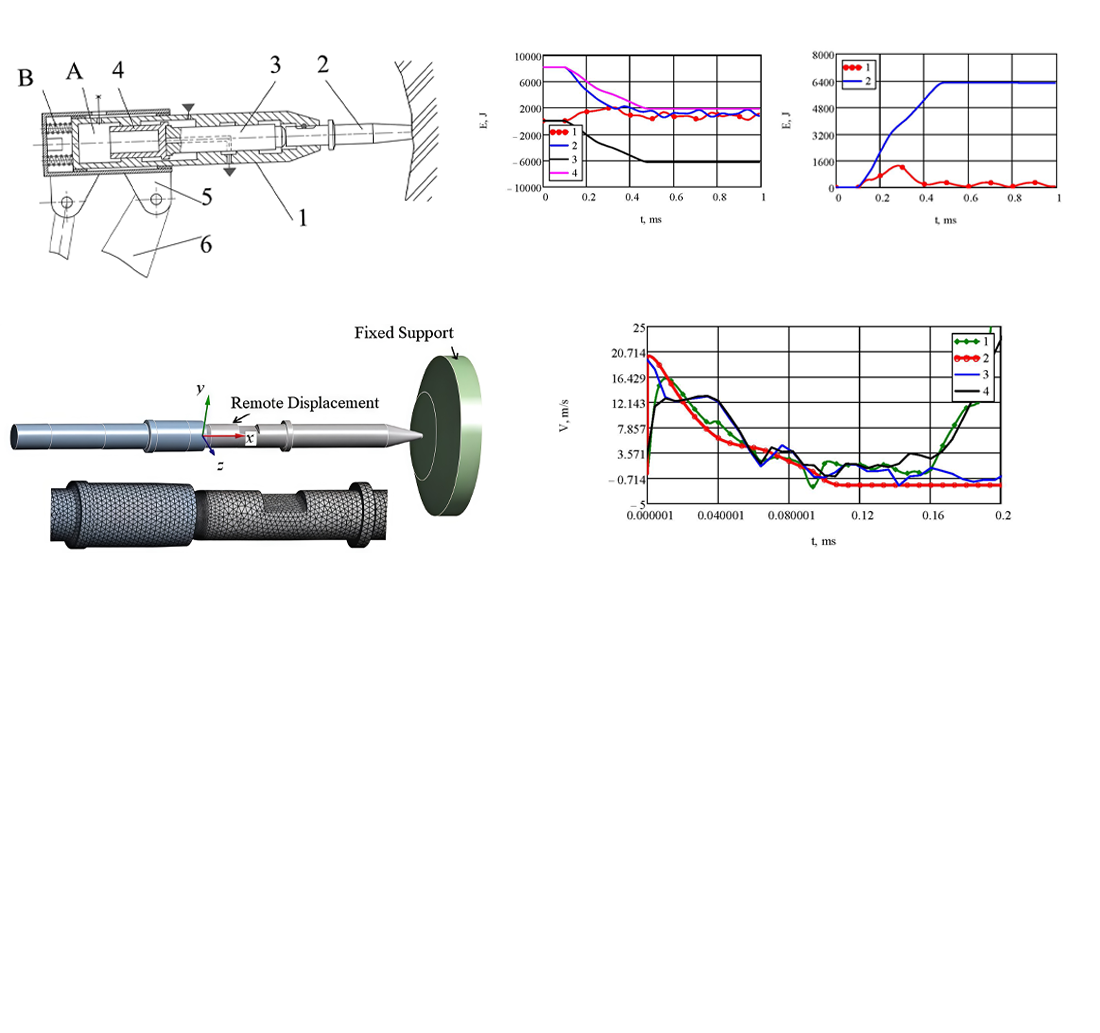
Об’єктом дослідження є процес імпульсної взаємодії елементів ударного пристрою та оброблювального середовища (ОС). Вирішувалась проблема поєднання імітаційного та математичного моделювання процесу. Розроблена імітаційна модель ударника із застосуванням системи програмування Ansys.У модулі Design Modeler побудовані основні елементи ударника в геометричній формі, наближеній до циліндричної, та імітатор ОС. Степені свободи елементів, їх фізичні властивості та зовнішні фактори прийняті відповідно до конструктивної схеми та режимів роботи ударника. Оцінка адекватності імітаційної моделі проведена порівнянням з дискретними та дискретно-континуальними моделями. Розв’язок системи диференціальних рівнянь при початкових та крайових умовах отримано методом скінченних різниць. Порівняння проводилося за параметрами ударної взаємодії: часу співудару, коливань контактного і ударного торців інструменту. Розглядалися бойки та інструменти різних розмірів при плоских контактних торцях. Час співудару визначався за різницею швидкостей та переміщень контактних торців бойка та інструменту, він становив 0,1–0,5 ms. При цьому швидкість бойка змінювалась в діапазоні 3–20 m/s. Високочастотні коливання торців інструменту складали величину 3000–6000 Hz і визначались розмірами бойка та інструменту. Розбіжність параметрів відносно системи Ansys становить не більше 10%. Імітаційна модель дозволила оцінити трансформацію енергії в системі «бойок-інструмент-ОС». Коефіцієнт передачі енергії до ОС від інструменту становить 0,55–0,65, від бойка до інструменту –0,75–0,8. Отримані результати є основою використання імітаційної моделі для проведення числових експериментів з елементами ударного пристрою складної геометричної форми. Імітаційна модель та дискретно-континуальні моделі можуть застосовуватися для вибору раціональних параметрів при проєктуванні ударних пристроїв.
Посилання
- GoldsmithW. (1960). Impact. The theory and physical behaviour of collidingsolids. London: Edvard Arnold LTD, 393. Available at: https://ia601507.us.archive.org/33/items/in.ernet.dli.2015.133946/2015.133946.Impact-The-Theory-And-Physical-Behaviour-Of-Colliding-Solids.pdf
- Batako, A. D., Babitsky, V. I., Halliwell, N. A. (2004). Modelling of vibro-impact penetration of self-exciting percussive-rotary drill bit. Journal of Sound and Vibration, 271 (1-2), 209–225. https://doi.org/10.1016/s0022-460x(03)00642-4
- Batako, A. D., Babitsky, V. I., Halliwell, N. A. (2003). A self-excited system for percussive-rotary drilling. Journal of Sound and Vibration, 259 (1), 97–118. https://doi.org/10.1006/jsvi.2002.5158
- Yu Neyman, V., Markov, A. V. (2018). Linear electromagnetic drive of impact machines with retaining striker. IOP Conference Series: Earth and Environmental Science, 194, 062023. https://doi.org/10.1088/1755-1315/194/6/062023
- Yang, G., Fang, J. (2012). Structure Parameters Optimization Analysis of Hydraulic Hammer System. Modern Mechanical Engineering, 2 (4), 137–142. https://doi.org/10.4236/mme.2012.24018
- Slidenko, V., Slidenko, O., Marchuk, L., But, V. (2023). Development of a discreet-continuous mathematical model of a percussion device with parameters of influence on the characteristics of an impact pulse. Eastern-European Journal of Enterprise Technologies, 5 (7 (125)), 70–79. https://doi.org/10.15587/1729-4061.2023.290029
- Slidenko, V., Slidenko, O., Listovschik, L., Novykov, A., But, V. (2025). Construction of a mathematical model of an impact device with a two-element striker. Eastern-European Journal of Enterprise Technologies, 1 (7 (133)), 38–49. https://doi.org/10.15587/1729-4061.2025.322728
- Zhukov, I. A., Molchanov, V. V. (2014). Rational Designing Two-Stage Anvil Block of Impact Mechanisms. Advanced Materials Research, 1040, 699–702. https://doi.org/10.4028/www.scientific.net/amr.1040.699
- Zhukov, I. A., Dvornikov, L. T., Nikitenko, S. M. (2016). About creation of machines for rock destruction with formation of apertures of various cross-sections. IOP Conference Series: Materials Science and Engineering, 124, 012171. https://doi.org/10.1088/1757-899x/124/1/012171
- Zhukov, I., Repin, A., Timofeev, E. (2018). Automated calculation and analysis of impacts generated in mining machine by anvil blocks of complex geometry. IOP Conference Series: Earth and Environmental Science, 134, 012071. https://doi.org/10.1088/1755-1315/134/1/012071
- Samarskii, A. (2001). The Theory of Difference Schemes. New York: CRC Press, 786. https://doi.org/10.1201/9780203908518
##submission.downloads##
Опубліковано
Як цитувати
Номер
Розділ
Ліцензія
Авторське право (c) 2025 Viktor Slidenko, Oleksandr Slidenko, Oksana Zamaraeva, Anton Novykov, Vladyslav Tkachenko

Ця робота ліцензується відповідно до Creative Commons Attribution 4.0 International License.
Закріплення та умови передачі авторських прав (ідентифікація авторства) здійснюється у Ліцензійному договорі. Зокрема, автори залишають за собою право на авторство свого рукопису та передають журналу право першої публікації цієї роботи на умовах ліцензії Creative Commons CC BY. При цьому вони мають право укладати самостійно додаткові угоди, що стосуються неексклюзивного поширення роботи у тому вигляді, в якому вона була опублікована цим журналом, але за умови збереження посилання на першу публікацію статті в цьому журналі.
Ліцензійний договір – це документ, в якому автор гарантує, що володіє усіма авторськими правами на твір (рукопис, статтю, тощо).
Автори, підписуючи Ліцензійний договір з ПП «ТЕХНОЛОГІЧНИЙ ЦЕНТР», мають усі права на подальше використання свого твору за умови посилання на наше видання, в якому твір опублікований. Відповідно до умов Ліцензійного договору, Видавець ПП «ТЕХНОЛОГІЧНИЙ ЦЕНТР» не забирає ваші авторські права та отримує від авторів дозвіл на використання та розповсюдження публікації через світові наукові ресурси (власні електронні ресурси, наукометричні бази даних, репозитарії, бібліотеки тощо).
За відсутності підписаного Ліцензійного договору або за відсутністю вказаних в цьому договорі ідентифікаторів, що дають змогу ідентифікувати особу автора, редакція не має права працювати з рукописом.
Важливо пам’ятати, що існує і інший тип угоди між авторами та видавцями – коли авторські права передаються від авторів до видавця. В такому разі автори втрачають права власності на свій твір та не можуть його використовувати в будь-який спосіб.