Evaluating an integrated user‑feedback approach to software quality monitoring: enhancing accuracy and timeliness
DOI:
https://doi.org/10.15587/1729-4061.2025.341516Keywords:
feedback analysis, software quality, sentiment analysis, issue detection, data processingAbstract
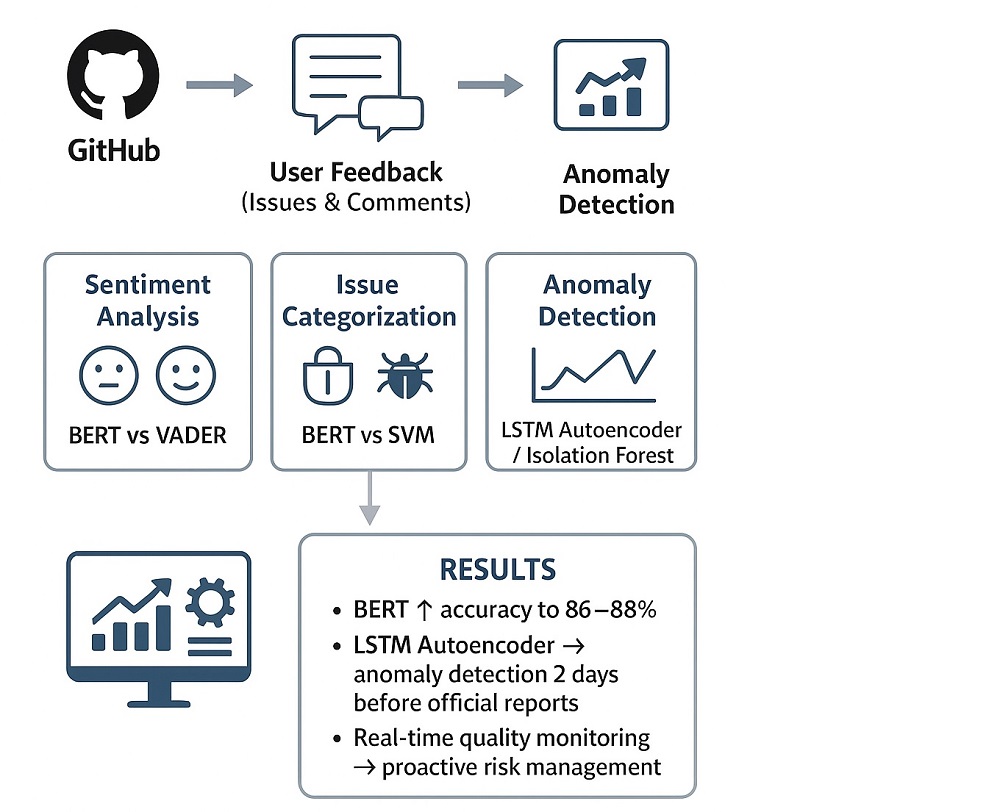
The object of the research is a monitoring and analysis system for software quality based on user feedback collected from open-source projects on GitHub. The problem addressed is the lack of effective automated tools that can process large volumes of unstructured user feedback to identify quality issues, prioritize tasks, and detect negative trends in real time. Traditional quality assurance methods, while important, fail to capture the nuance of user sentiment and the contextual details present in natural language feedback, leading to delays in problem detection and resolution. The developed system integrates three key modules: sentiment analysis for assessing user satisfaction, issue categorization for structuring feedback into actionable types, and anomaly detection for identifying sudden changes in sentiment or feedback dynamics. The results show that transformer-based models, particularly fine-tuned BERT, outperform rule-based and traditional machine learning approaches in both accuracy and robustness. This advantage is explained by their ability to capture domain-specific language, sarcasm, and contextual dependencies, enabling more precise interpretation of complex feedback. The anomaly detection component, using LSTM autoencoders and Isolation Forest, demonstrated the ability to identify critical quality regressions up to two days before official issue reporting. These results can be applied in practice for continuous software quality monitoring in agile, open-source, or user-centric development environments where timely, data-driven decision-making is essential. The approach supports real-time insight generation, helping development teams respond proactively to quality risks and improve overall user satisfaction
References
- Devlin, J., Chang, M.-W., Lee, K., Toutanova, K. (2019). BERT: Pre-training of deep bidirectional transformers for language understanding. Proceedings of NAACL-HLT, 4171–4186. https://doi.org/10.18653/v1/N19-1423
- Vaswani, A., Shazeer, N., Parmar, N., Uszkoreit, J., Jones, L., Gomez, A. N., Polosukhin, I. (2017). Attention is all you need. Advances in Neural Information Processing Systems, 30. https://papers.nips.cc/paper/7181-attention-is-all-you-need.pdf
- Bordoloi, M., Biswas, S. K. (2023). Sentiment analysis: A survey on design framework, applications and future scopes. Artificial Intelligence Review, 56 (11), 12505–12560. https://doi.org/10.1007/s10462-023-10442-2
- Barik, K., Misra, S. (2024). Analysis of customer reviews with an improved VADER lexicon classifier. Journal of Big Data, 11 (1). https://doi.org/10.1186/s40537-023-00861-x
- Ahmad, W., Chakraborty, S., Ray, B., Chang, K.-W. (2020). A Transformer-based Approach for Source Code Summarization. Proceedings of the 58th Annual Meeting of the Association for Computational Linguistics, 4998–5007. https://doi.org/10.18653/v1/2020.acl-main.449
- Nurgaliyeva, S., Amangali, M., Basheyeva, Z., Kashkimbayeva, N., Amantayev, D. (2025). Design and evaluation of an intelligent waste monitoring system based on RGIS integration for smart cities. Eastern-European Journal of Enterprise Technologies, 4 (9 (136)), 70–78. https://doi.org/10.15587/1729-4061.2025.337033
- Smailov, N., Batyrgaliyev, A., Seilova, N., Kuttybaeva, A., Ibrayev, A. (2020.) Some approaches to assessing the quality of masking noise interference of spatial noise generators. Journal of Theoretical and Applied Information Technology, 98 (17), 3555–3574. Available at: https://www.jatit.org/volumes/Vol98No17/12Vol98No17.pdf
- Panichella, S., Di Sorbo, A., Guzman, E., Visaggio, C. A., Canfora, G., Gall, H. C. (2015). How can i improve my app? Classifying user reviews for software maintenance and evolution. 2015 IEEE International Conference on Software Maintenance and Evolution (ICSME), 281–290. https://doi.org/10.1109/icsm.2015.7332474
- Villarroel, L., Bavota, G., Russo, B., Oliveto, R., Di Penta, M. (2016). Release planning of mobile apps based on user reviews. Proceedings of the 38th International Conference on Software Engineering, 14–24. https://doi.org/10.1145/2884781.2884818
- Di Sorbo, A., Panichella, S., Alexandru, C. V., Shimagaki, J., Visaggio, C. A., Canfora, G., Gall, H. C. (2016). What would users change in my app? summarizing app reviews for recommending software changes. Proceedings of the 2016 24th ACM SIGSOFT International Symposium on Foundations of Software Engineering, 499–510. https://doi.org/10.1145/2950290.2950299
- Maalej, W., Nabil, H. (2015). Bug report, feature request, or simply praise? On automatically classifying app reviews. 2015 IEEE 23rd International Requirements Engineering Conference (RE), 116–125. https://doi.org/10.1109/re.2015.7320414
- Shinykulova, A. B., Mailybayev, Y. K., Isaykin, D. V., Kosyakov, I. O., Umbetov, U. U. (2020). Optimization of tourist transportation. Journal of Theoretical and Applied Information Technology, 98 (19), 3032–3042. Available at: https://www.jatit.org/volumes/ninetyeight19.php
- Taissariyeva, K., Abdykadyrov, A., Mussilimov, K., Jobalayeva, G., Marxuly, S. (2025). Analysis and Modeling of Environmental Monitoring Using Multicopters. International Journal of Innovative Research and Scientific Studies, 8 (3), 2947–2960.
- Wójcik, W., Kalizhanova, A., Kulyk, Y., Knysh, B., Kvyetnyy, R., Kulyk, A. et al. (2022). The Method of Time Distribution for Environment Monitoring Using Unmanned Aerial Vehicles According to an Inverse Priority. Journal of Ecological Engineering, 23 (11), 179–187. https://doi.org/10.12911/22998993/153458
- Campos, G. O., Zimek, A., Sander, J., Campello, R. J. G. B., Micenková, B., Schubert, E. et al. (2016). On the evaluation of unsupervised outlier detection: measures, datasets, and an empirical study. Data Mining and Knowledge Discovery, 30 (4), 891–927. https://doi.org/10.1007/s10618-015-0444-8
- Smailov, N., Baryssova, A., Koshkinbayev, S., Mailybayev, Y., Batyrgaliyev, A. (2025). Monitoring of emergency situations using fiber-optic acoustic sensors and signal processing algorithms. International Journal of Innovative Research and Scientific Studies, 8 (5), 1295–1304. https://doi.org/10.53894/ijirss.v8i5.9093
- Smailov, N., Tolemanova, A., Ayapbergenova, A., Tashtay, Y., Amir, A. (2025). Modelling and Application of Fibre Optic Sensors for Concrete Structures: A Literature Review. Civil Engineering and Architecture, 13 (3), 1885–1897. https://doi.org/10.13189/cea.2025.130332
- Momynkulov, Z., Dosbayev, Z., Suliman, A., Abduraimova, B., Smailov, N., Zhekambayeva, M., Zhamangarin, D. (2023). Fast Detection and Classification of Dangerous Urban Sounds Using Deep Learning. Computers, Materials & Continua, 75 (1), 2191–2208. https://doi.org/10.32604/cmc.2023.036205
- Smailov, N., Kashkimbayeva, N., Kubanova, N., Sabibolda, A., Mailybayev, Y. (2025). Review of AI-augmented multisensor architectures for detecting and neutralizing UAV threats. International Journal of Innovative Research and Scientific Studies, 8 (5), 1281–1294. https://doi.org/10.53894/ijirss.v8i5.9091
- Seidaliyeva, U., Ilipbayeva, L., Utebayeva, D., Smailov, N., Matson, E. T., Tashtay, Y. et al. (2025). LiDAR Technology for UAV Detection: From Fundamentals and Operational Principles to Advanced Detection and Classification Techniques.
- Smailov, N., Dosbayev, Z., Omarov, N., Sadykova, B., Zhekambayeva, M., Zhamangarin, D., Ayapbergenova, A. (2023). A Novel Deep CNN-RNN Approach for Real-time Impulsive Sound Detection to Detect Dangerous Events. International Journal of Advanced Computer Science and Applications, 14 (4), 271–280. https://doi.org/10.14569/ijacsa.2023.0140431
- Cristea, V.-M., Baigulbayeva, M., Ongarbayev, Y., Smailov, N., Akkazin, Y., Ubaidulayeva, N. (2023). Prediction of Oil Sorption Capacity on Carbonized Mixtures of Shungite Using Artificial Neural Networks. Processes, 11 (2), 518. https://doi.org/10.3390/pr11020518
- Zhang, Z., Zhao, J., LeCun, Y. (2015). Character-level convolutional networks for text classification. Advances in Neural Information Processing Systems, 28. https://doi.org/10.48550/arXiv.1509.01626
- Mailybayev, Y., Muratbekova, G., Altayeva, Z., Zhatkanbayev, O. (2022). Development of models and improvement of methods for formalization of design problems and automating technical and operational works of railway stations. Eastern-European Journal of Enterprise Technologies, 4 (3 (118)), 6–16. https://doi.org/10.15587/1729-4061.2022.263167
- Morokina, G., Umbetov, U., Mailybayev, Y. (2019). Computer-Aided Design Systems of Decentralization on Basis of Trace Mode in Industry. 2019 International Russian Automation Conference (RusAutoCon), 1–5. https://doi.org/10.1109/rusautocon.2019.8867817
- Mailybayev, Y., Umbetov, U., Lakhno, V., Omarov, A., Abuova, A., Amanova, M., Sauanova, K. (2021). Development of mathematical and information support for solving prediction tasks of a railway station development. Journal of Theoretical and Applied Information Technology, 99 (3).
- McKinney, W. (2010). Data Structures for Statistical Computing in Python. Proceedings of the 9th Python in Science Conference, 56–61. https://doi.org/10.25080/majora-92bf1922-00a
- GitHub REST API Documentation. Available at: https://docs.github.com/en/rest Last accessed: 06.08.2025
- spaCy Documentation. Available at: https://spacy.io Last accessed: 06.08.2025
- Morokina, G. S., Umbetov, U., Mailybaev, Y. K. (2020). Automation design systems for mechanical engineering and device node design. Journal of Physics: Conference Series, 1515 (3), 032061. https://doi.org/10.1088/1742-6596/1515/3/032061
- Murzabekova, G., Glazyrina, N., Nekessova, A., Ismailova, A., Bazarova, M., Kashkimbayeva, N., Mukhametzhanova, B., Aldashova, M. (2023). Using deep learning algorithms to classify crop diseases. International Journal of Electrical and Computer Engineering (IJECE), 13 (6), 6737. https://doi.org/10.11591/ijece.v13i6.pp6737-6744
Downloads
Published
How to Cite
Issue
Section
License
Copyright (c) 2025 Nurzhamal Kashkimbayeva, Ulan Bekish, Gulsim Abdoldinova, Zhuldyz Basheyeva, Alina Mitroshina

This work is licensed under a Creative Commons Attribution 4.0 International License.
The consolidation and conditions for the transfer of copyright (identification of authorship) is carried out in the License Agreement. In particular, the authors reserve the right to the authorship of their manuscript and transfer the first publication of this work to the journal under the terms of the Creative Commons CC BY license. At the same time, they have the right to conclude on their own additional agreements concerning the non-exclusive distribution of the work in the form in which it was published by this journal, but provided that the link to the first publication of the article in this journal is preserved.
A license agreement is a document in which the author warrants that he/she owns all copyright for the work (manuscript, article, etc.).
The authors, signing the License Agreement with TECHNOLOGY CENTER PC, have all rights to the further use of their work, provided that they link to our edition in which the work was published.
According to the terms of the License Agreement, the Publisher TECHNOLOGY CENTER PC does not take away your copyrights and receives permission from the authors to use and dissemination of the publication through the world's scientific resources (own electronic resources, scientometric databases, repositories, libraries, etc.).
In the absence of a signed License Agreement or in the absence of this agreement of identifiers allowing to identify the identity of the author, the editors have no right to work with the manuscript.
It is important to remember that there is another type of agreement between authors and publishers – when copyright is transferred from the authors to the publisher. In this case, the authors lose ownership of their work and may not use it in any way.








