Detecting insulation defects in electrical machines’ multi-turn windings based on analysis of transient electromagnetic processes
DOI:
https://doi.org/10.15587/1729-4061.2025.342301Keywords:
high-frequency model, equivalent circuit, wave processes, diagnostics of winding insulationAbstract
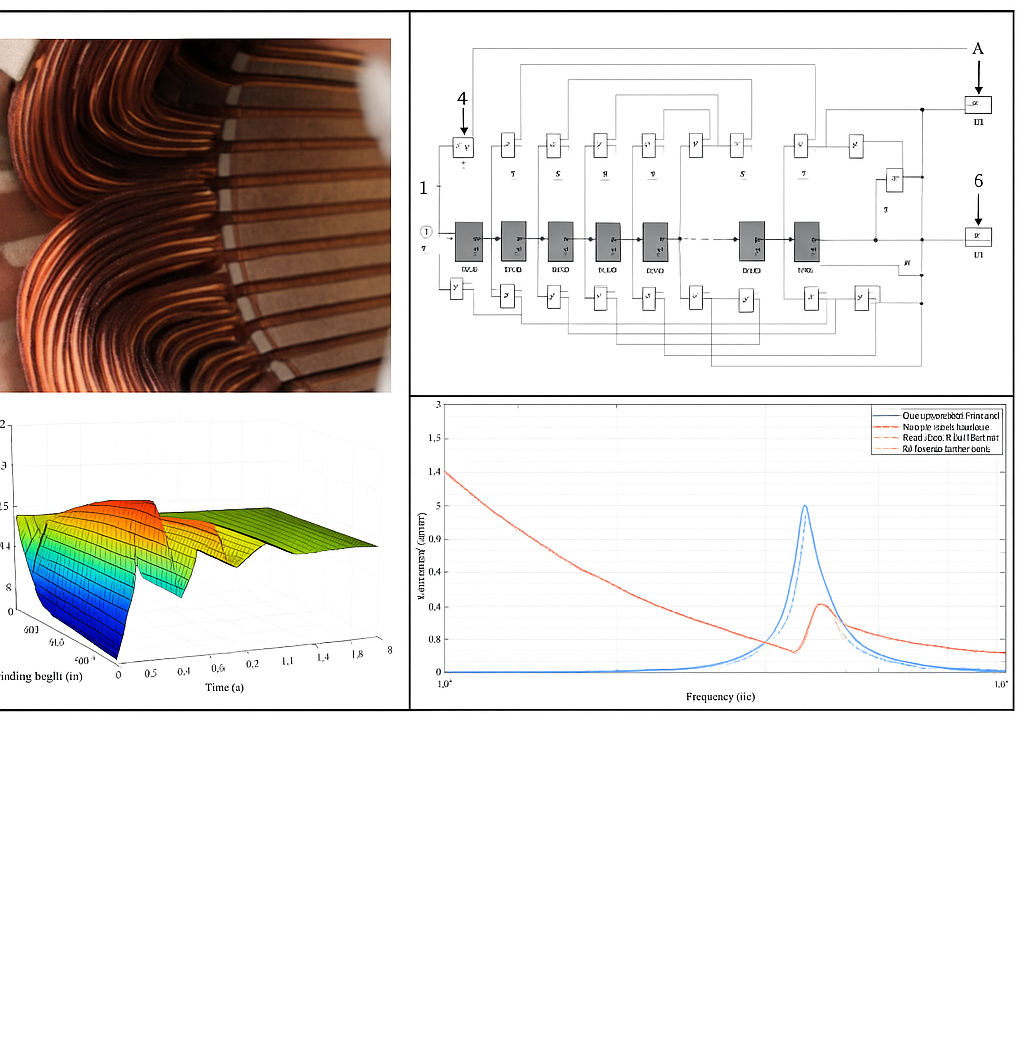
This study investigates transient processes occurring in a squirrel-cage induction motor with a stator’s multi-turn winding. These processes are used to devise efficient and simple diagnostic methods for assessing the condition of the least reliable element in an electrical machine – the winding insulation. This paper solves the task related to enhancing the operational reliability of electrical machines with multi-turn windings.
The proposed high-frequency model of transient processes in multi-turn windings of electrical machines aims to non-destructively diagnose the insulation. This model enables analysis of high-frequency and impulse phenomena with an equivalent frequency of up to tens of MHz, which may arise during the operation of the machine because of switching and atmospheric overvoltage, as well as when powering electric motors with inverters. Underlying the model is the frequency and time domain analyses under above-mentioned influences using a low-power multi-turn induction motor as an example.
To construct the model, a multi-segment equivalent circuit was used, represented as a series of connected four-poles with inductive-resistive-capacitive parameters corresponding to sections of the winding phase with conditionally uniform concentrated parameters.
The constructed model and the proposed method make it possible to achieve the necessary test overvoltage to detect hidden and undeveloped defects at minimal sparing energy impact, without causing its irreversible destruction. Taking into account the distributed parameters of the winding sections combined with the impulse nature of the excitation ensure non-destructive testing (or non-destructive evaluation) of multi-turn-wound AC machine windings compared to classical testing methods.
The proposed method makes it possible to obtain 2–2.5 times higher longitudinal test gradients with a comparable energetic impact at the level of 0.1 J. The results will contribute to improving the reliability of electrical machine operation in industrial settings by integrating the devised method into the system of planned preventive maintenance of electrical equipment.
References
- Asgari, A., Hanisch, L. V., Anspach, J., Franzki, J., Kahn, M., Kurrat, M., Henke, M. (2024). Reliability of Insulation Systems and Its Impact on Electric Machine Design for Automotive and Aviation Applications. Energies, 18 (1), 92. https://doi.org/10.3390/en18010092
- Zhang, J., Wang, J., Li, H., Zhang, Q., He, X., Meng, C. et al. (2025). A Review of Reliability Assessment and Lifetime Prediction Methods for Electrical Machine Insulation Under Thermal Aging. Energies, 18 (3), 576. https://doi.org/10.3390/en18030576
- Saeed, M., Fernández, D., Guerrero, J. M., Díaz, I., Briz, F. (2024). Insulation Condition Assessment in Inverter-Fed Motors Using the High-Frequency Common Mode Current: A Case Study. Energies, 17 (2), 470. https://doi.org/10.3390/en17020470
- Ghassemi, M. (2019). Accelerated insulation aging due to fast, repetitive voltages: A review identifying challenges and future research needs. IEEE Transactions on Dielectrics and Electrical Insulation, 26 (5), 1558–1568. https://doi.org/10.1109/tdei.2019.008176
- Hassan, W., Hussain, G. A., Wahid, A., Safdar, M., Khalid, H. M., Jamil, M. K. M. (2024). Optimum feature selection for classification of PD signals produced by multiple insulation defects in electric motors. Scientific Reports, 14 (1). https://doi.org/10.1038/s41598-024-73196-z
- Li, Z., Qian, Y., Wang, H., Zhou, X., Sheng, G., Jiang, X. (2021). A novel image‐orientation feature extraction method for partial discharges. IET Generation, Transmission & Distribution, 16 (6), 1139–1150. https://doi.org/10.1049/gtd2.12356
- Ji, Y., Giangrande, P., Madonna, V., Zhao, W., Galea, M. (2021). Reliability-Oriented Design of Inverter-Fed Low-Voltage Electrical Machines: Potential Solutions. Energies, 14 (14), 4144. https://doi.org/10.3390/en14144144
- Wang, J., Kong, Y., Cai, Y., Wang, Y. (2024). Effect of the repetition frequency and polarity of square wave voltage on the partial discharge of electric machine insulation for more electrical aircraft. Journal of Physics: Conference Series, 2820 (1), 012110. https://doi.org/10.1088/1742-6596/2820/1/012110
- Sun, H., Wang, Y., Lu, F., Ding, Y., Xinyang, Z., Yin, Y. (2023). Research on Partial Discharge of More Electric Aircraft Propulsion Motor Insulation Under Low Pressure and Square Wave Voltage. https://doi.org/10.13336/j.1003-6520.hve.20221785
- Jiang, J., Li, Z., Li, W., Ranjan, P., Wei, X., Zhang, X., Zhang, C. (2023). A review on insulation challenges towards electrification of aircraft. High Voltage, 8 (2), 209–230. https://doi.org/10.1049/hve2.12304
- Ji, Y., Giangrande, P., Zhao, W. (2024). Effect of Environmental and Operating Conditions on Partial Discharge Activity in Electrical Machine Insulation: A Comprehensive Review. Energies, 17 (16), 3980. https://doi.org/10.3390/en17163980
- Zhou, X., Giangrande, P., Ji, Y., Zhao, W., Ijaz, S., Galea, M. (2024). Insulation for Rotating Low-Voltage Electrical Machines: Degradation, Lifetime Modeling, and Accelerated Aging Tests. Energies, 17 (9), 1987. https://doi.org/10.3390/en17091987
- Chumack, V., Kovalenko, M., Tymoshchuk, O., Stulishenko, A., Ihnatiuk, Y. (2023). Design of a multilink system for calculating high-frequency processes in electric machines with mesh windings. Eastern-European Journal of Enterprise Technologies, 3 (8 (123)), 54–63. https://doi.org/10.15587/1729-4061.2023.282375
- Kovalenko, M., Chumack, V., Tymoshchuk, O., Kovalenko, M., Bazenov, V., Ihnatiuk, Y., Stulishenko, A. (2023). Research of high-frequency remagnetization model in laminated magnetic cores of electromechanical and electromagnetic energy converters. Eastern-European Journal of Enterprise Technologies, 4 (5 (124)), 6–15. https://doi.org/10.15587/1729-4061.2023.286002
- Chumak, V., Dukhno, R., Stulishenko, A., Svyatnenko, V. (2024). High-Frequency Processes In The Windings Of General-Purpose Electrical Machines In The Presence Of Defects In The Ground-Wall Insulation. Engineering, Energy, Transport AIC, 2 (125), 130–141. https://doi.org/10.37128/2520-6168-2024-2-15
- Kaganov, Z. G. (1990). Elektricheskie tsepi s raspredelyonnymi parametrami i cepnye skhemy. Moscow: Energoatomizdat, 248.
- Mahdavi, S., Hameyer, K. (2012). High frequency equivalent circuit model of the stator winding in electrical machines. 2012 XXth International Conference on Electrical Machines, 1706–1711. https://doi.org/10.1109/icelmach.2012.6350110
- Heller, B., Veverka, A. (1960). Vlnové procesy v elektrických strojích. Praha: SNTL – Nakladatelství technické literatury, 392.
- Boglietti, A., Carpaneto, E. (1999). Induction motor high frequency model. Conference Record of the 1999 IEEE Industry Applications Conference. Thirty-Forth IAS Annual Meeting (Cat. No.99CH36370), 3, 1551–1558. https://doi.org/10.1109/ias.1999.805947
- Ostroverkhov, M., Chumack, V., Kovalenko, M., Falchenko, M. (2022). Voltage Control of the Magnetoelectric Generator Based on the Change of the Magnetic Resistance of the Auxiliary Flux Circuits. 2022 IEEE 8th International Conference on Energy Smart Systems (ESS), 169–174. https://doi.org/10.1109/ess57819.2022.9969289
- Ostroverkhov, M., Chumack, V., Kovalenko, M., Ihnatiuk, Y. (2022). Magnetoelectric Generator with Magnetic Flux Shunting for Electric Power Complexes. 2022 IEEE 8th International Conference on Energy Smart Systems (ESS), 160–164. https://doi.org/10.1109/ess57819.2022.9969246
- Kovalenko, M. A., Kovalenko, I. Y., Tkachuk, I. V., Harford, A. G., Tsyplenkov, D. V. (2024). Mathematical modeling of a magnetic gear for an autonomous wind turbine. Naukovyi Visnyk Natsionalnoho Hirnychoho Universytetu, 2, 88–95. https://doi.org/10.33271/nvngu/2024-2/088
Downloads
Published
How to Cite
Issue
Section
License
Copyright (c) 2025 Vadim Chumack, Mykhailo Kovalenko, Oksana Tymoshchuk, Roman Dukhno

This work is licensed under a Creative Commons Attribution 4.0 International License.
The consolidation and conditions for the transfer of copyright (identification of authorship) is carried out in the License Agreement. In particular, the authors reserve the right to the authorship of their manuscript and transfer the first publication of this work to the journal under the terms of the Creative Commons CC BY license. At the same time, they have the right to conclude on their own additional agreements concerning the non-exclusive distribution of the work in the form in which it was published by this journal, but provided that the link to the first publication of the article in this journal is preserved.
A license agreement is a document in which the author warrants that he/she owns all copyright for the work (manuscript, article, etc.).
The authors, signing the License Agreement with TECHNOLOGY CENTER PC, have all rights to the further use of their work, provided that they link to our edition in which the work was published.
According to the terms of the License Agreement, the Publisher TECHNOLOGY CENTER PC does not take away your copyrights and receives permission from the authors to use and dissemination of the publication through the world's scientific resources (own electronic resources, scientometric databases, repositories, libraries, etc.).
In the absence of a signed License Agreement or in the absence of this agreement of identifiers allowing to identify the identity of the author, the editors have no right to work with the manuscript.
It is important to remember that there is another type of agreement between authors and publishers – when copyright is transferred from the authors to the publisher. In this case, the authors lose ownership of their work and may not use it in any way.








