Improving a method for determining the spatial parameters in the mathematical model of a distributed automated information-measuring system for real-time control over the quality of iron ore raw materials
DOI:
https://doi.org/10.15587/1729-4061.2025.343936Keywords:
Compton effect, albedo, gamma quantum, irradiation, rock, operational controlAbstract
This study investigates processes of irradiating iron ore raw materials by a source of low-energy gamma quanta and registering radiation scattered as a result of the Compton effect, as well as parameters of the irradiation geometry. This work addressed the task of improving the accuracy of existing nuclear-physical methods of control over the quality of iron ore raw materials, which make it possible to promptly determine the material composition of the crushed rock mass.
The results essentially indicate that when using a centrally shifted irradiation geometry, the sensitivity of registration of the integral backscatter flux increases compared to the side and central irradiation geometries. This is attributed to improved visibility conditions of the detector, and the formation of a scattering angle close to the optimal.
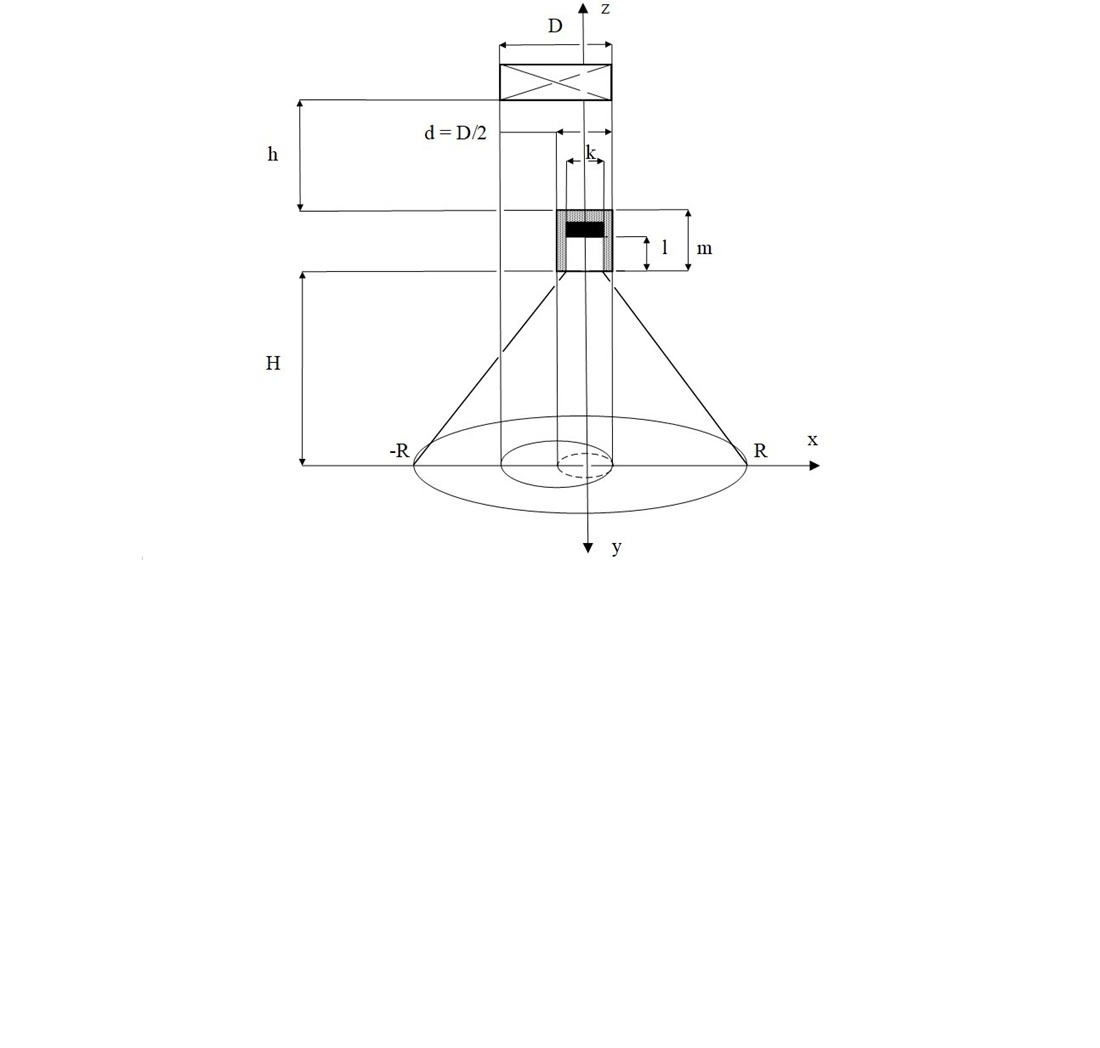
The constructed mathematical model has made it possible to identify the main geometric parameters for the system of operational control over the quality of iron ore raw materials. A formula has been derived that connects the basic parameters in the system of operational control over iron content in ore with the use of centrally shifted irradiation geometry.
The studies demonstrated changes in the sensitivity of the registration of the integral backscatter flux when changing the vertical location of the gamma-ray source. The results revealed a maximum sensitivity with a value of 6.08·10-7 at a minimum distance of the radiation source from the single crystal and a distance of 110 mm from the irradiated surface. The value of the correlation coefficient between the model and experimental data is 0.981.
The findings could be practically applied to improve the accuracy of methods for operational control over the content of a usable component in iron-containing ores under industrial conditions at ferrous metallurgy enterprises
References
- Hryhoriev, Y., Lutsenko, S., Joukov, S. (2023). Dominujące uwarunkowania adaptacji kompleksu górniczego w warunkach środowiska dynamicznego. Inżynieria Mineralna, 1 (1). https://doi.org/10.29227/im-2023-01-02
- Azaryan, A., Pikilnyak, A., Shvets, D. (2015). Complex automation system of iron ore preparation for beneficiation. Metallurgical and mining industry, 8, 64–66. Available at: https://www.metaljournal.com.ua/assets/Journal/english-edition/MMI_2015_8/011Azaryan.pdf
- Azaryan, A., Gritsenko, A., Trachuk, A., Shvets, D. (2018). Development of the method to operatively control quality of iron ore raw materials at open and underground extraction. Eastern-European Journal of Enterprise Technologies, 5 (5 (95)), 13–19. https://doi.org/10.15587/1729-4061.2018.144003
- Boisvert, L., Bazin, C., Caron, J., Lavoie, F. (2022). Development and Testing of a Method to Estimate the Mineral Composition of Ore from Chemical Assays with a View toward Geometallurgy: Application to an Iron Ore Concentrator. Geomaterials, 12 (04), 70–92. https://doi.org/10.4236/gm.2022.124006
- Satmagan 135. A fast, accurate and reliable instrument for measuring the magnetite content in samples. Available at: https://www.rapiscansystems.com/en/products/satmagan-135
- Morkun, V., Morkun, N., Fischerauer, G., Tron, V., Haponenko, A., Bobrov, Y. (2024). Identification of mineralogical ore varieties using ultrasonic measurement results. Mining of Mineral Deposits, 18 (3), 1–8. https://doi.org/10.33271/mining18.03.001
- Hryhoriev, Y., Lutsenko, S., Shvets, Y., Kuttybayev, A., Mukhamedyarova, N. (2024). Predictive calculation of blasting quality as a tool for estimation of production cost and investment attractiveness of a mineral deposit development. IOP Conference Series: Earth and Environmental Science, 1415 (1), 012027. https://doi.org/10.1088/1755-1315/1415/1/012027
- Porkuian, O., Morkun, V., Morkun, N., Tron, V., Haponenko, I., Davidkovich, A. (2020). Influence of the Magnetic Field on Love Waves Propagation in the Solid Medium. 2020 IEEE 40th International Conference on Electronics and Nanotechnology (ELNANO), 761–766. https://doi.org/10.1109/elnano50318.2020.9088802
- Krapyvnyi, N. S., Azaryan, A. A., Shvydkyi, O. V., Shvets, D. V., Hrytsenko, A. M. (2024). Development of an automated system for preparing mineral raw material samples for discrete analysis. CEUR Workshop Proceedings, 3917, 237–244. Available at: https://cssesw.easyscience.education/cssesw2024/CSSESW2024/paper41.pdf
- Zuo, Y.-H., Zhu, J.-H., Shang, P. (2021). Monte Carlo simulation of reflection effects of multi-element materials on gamma rays. Nuclear Science and Techniques, 32 (1). https://doi.org/10.1007/s41365-020-00837-z
- Kiran, K. U., Ravindraswami, K., Eshwarappa, K. M., Somashekarappa, H. M. (2016). Albedo factors of 123, 320, 511, 662 and 1115 keV gamma photons in carbon, aluminium, iron and copper. The European Physical Journal Plus, 131 (4). https://doi.org/10.1140/epjp/i2016-16087-5
- Turşucu, A. (2023). Seryum ve Bazı Seçilmiş Seryum Bileşiklerinde Gama Radyasyonu Yansıtma Parametreleri. Karadeniz Fen Bilimleri Dergisi, 13 (4), 1242–1250. https://doi.org/10.31466/kfbd.1180268
- Qin, R., Li, C., Qin, Z., Zhang, Z., Cai, J. (2025). A Compton scattering background subtraction method of gamma energy spectrum based on Gaussian function convolution. Radiation Physics and Chemistry, 226, 112202. https://doi.org/10.1016/j.radphyschem.2024.112202
- Abdelnour, M. R., Liu, J., Hossny, K., Wajid, A. M., Li, W., Liu, Z. (2025). Prompt gamma neutron activation analysis: A review of applications, design, analytics, challenges, and prospects. Radiation Physics and Chemistry, 234, 112693. https://doi.org/10.1016/j.radphyschem.2025.112693
- Huang, H., Cai, P., Jia, W., Zhang, Y. (2023). Identification of Pb–Zn ore under the condition of low count rate detection of slim hole based on PGNAA technology. Nuclear Engineering and Technology, 55 (5), 1708–1717. https://doi.org/10.1016/j.net.2023.01.005
- Jie, C., Reng-Bo, W., Yan, Z., Wen-bao, J., Chong-gui, Z., Rui, C. et al. (2024). MCNP simulation and experimental study in situ low-grade copper analysis based on PGNAA. Applied Radiation and Isotopes, 206, 111224. https://doi.org/10.1016/j.apradiso.2024.111224
- PTC Mathcad Prime. Available at: https://www.mathcad.com/
- Microsoft Excel. Available at: https://www.microsoft.com/uk-ua/microsoft-365/excel
- Makek, M., Bosnar, D., Pavelić, L. (2019). Scintillator Pixel Detectors for Measurement of Compton Scattering. Condensed Matter, 4 (1), 24. https://doi.org/10.3390/condmat4010024
- Kaur, T., Sharma, J., Singh, T. (2020). Experimental measurement of effective atomic numbers and albedo factors for some alloys using the backscattering technique. Applied Radiation and Isotopes, 158, 109065. https://doi.org/10.1016/j.apradiso.2020.109065
- Azaryan, A. (2015). Research of influence single crystal thickness NaJ (TL) on the intensity of the integrated flux of scattered gamma radiation. Metallurgical and Mining Industry, 2, 43–46.
- Chaddock, R. E. (1925). Principles and methods of statistics. Boston: Houghton Mifflin Company, 471.
- Azaryan, A., Gritsenko, A., Trachuk, A., Serebrenikov, V., Shvets, D. (2019). Using the intensity of absorbed gamma radiation to control the content of iron in ore. Eastern-European Journal of Enterprise Technologies, 3 (5 (99)), 29–35. https://doi.org/10.15587/1729-4061.2019.170341
- Azarian, A. A., Azarian, V. V., Trachuk, A. A. (2021). Operatyvnyi kontrol ta upravlinnia yakistiu pry rozrobtsi zalizorudnykh rodovyshch. Praha: OKTAN PRINT, 144. https://doi.org/10.46489/oktuj-11
Downloads
Published
How to Cite
Issue
Section
License
Copyright (c) 2025 Albert Azaryan, Dmitriy Shvets, Andrіі Hrytsenko, Annait Trachuk, Oleksii Cherkasov, Oleksandr Shvydky

This work is licensed under a Creative Commons Attribution 4.0 International License.
The consolidation and conditions for the transfer of copyright (identification of authorship) is carried out in the License Agreement. In particular, the authors reserve the right to the authorship of their manuscript and transfer the first publication of this work to the journal under the terms of the Creative Commons CC BY license. At the same time, they have the right to conclude on their own additional agreements concerning the non-exclusive distribution of the work in the form in which it was published by this journal, but provided that the link to the first publication of the article in this journal is preserved.
A license agreement is a document in which the author warrants that he/she owns all copyright for the work (manuscript, article, etc.).
The authors, signing the License Agreement with TECHNOLOGY CENTER PC, have all rights to the further use of their work, provided that they link to our edition in which the work was published.
According to the terms of the License Agreement, the Publisher TECHNOLOGY CENTER PC does not take away your copyrights and receives permission from the authors to use and dissemination of the publication through the world's scientific resources (own electronic resources, scientometric databases, repositories, libraries, etc.).
In the absence of a signed License Agreement or in the absence of this agreement of identifiers allowing to identify the identity of the author, the editors have no right to work with the manuscript.
It is important to remember that there is another type of agreement between authors and publishers – when copyright is transferred from the authors to the publisher. In this case, the authors lose ownership of their work and may not use it in any way.








