Construction of a simulation model for monitoring and managing environmental risks in railroad transportation accidents involving hazardous goods
DOI:
https://doi.org/10.15587/1729-4061.2025.344643Keywords:
simulation model, environmental risk management, uncertainty, hazardous goods, rail transportAbstract
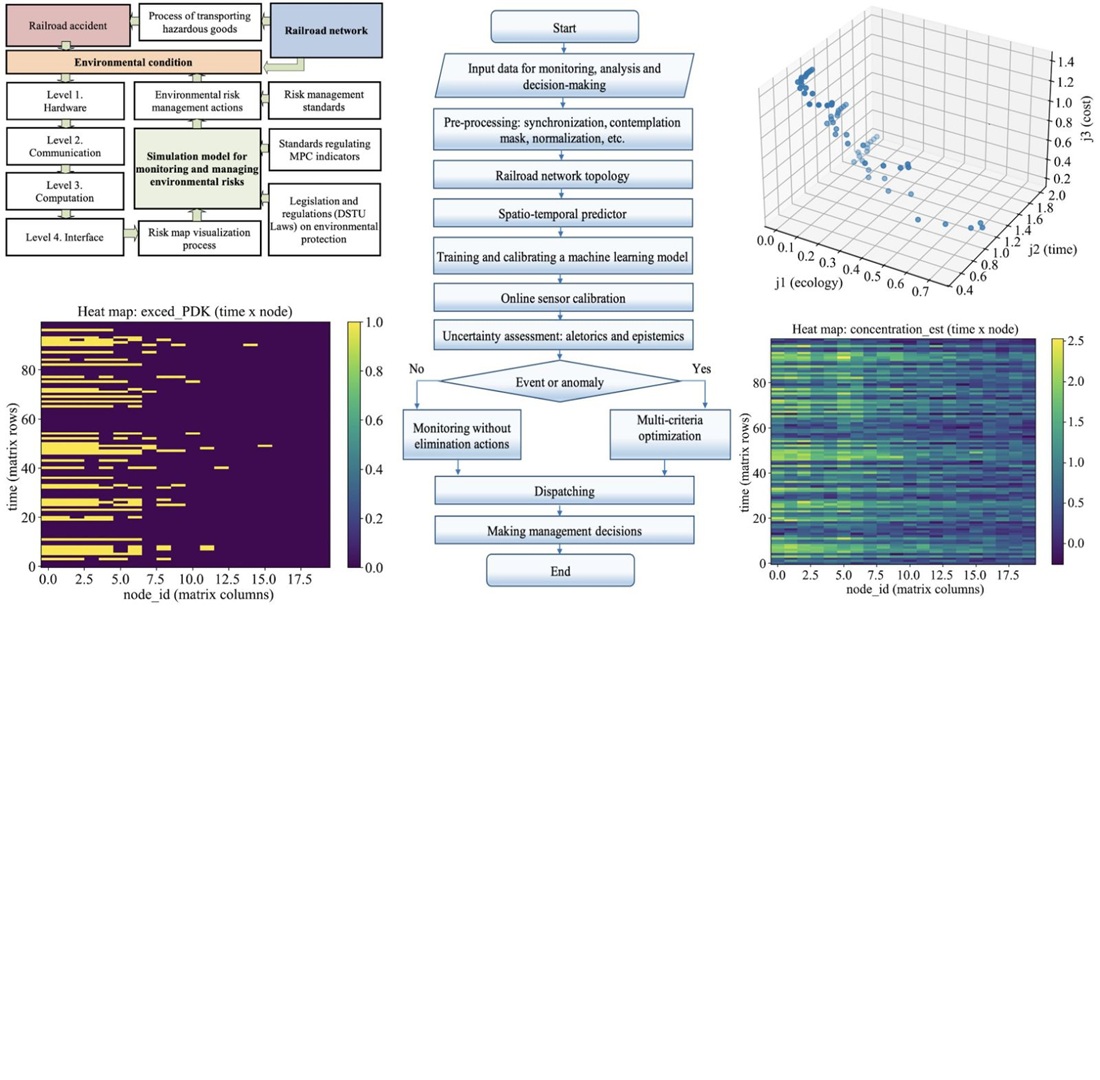
This study’s object is the process of monitoring and managing environmental risks in railroad accidents involving transportation of hazardous goods.
A problem has been identified, related to the absence of a single, holistic approach to risk management during transportation, which would integrate methods of spatial-temporal forecasting with a formal assessment of uncertainty. A mathematical model has been suggested that makes it possible to process and analyze data acquired from a mobile automated air quality monitoring system (MAAQMS). The established dependences laid the foundation for the machine learning and statistical analysis model used in the operation of a simulation model (SM) of monitoring and managing environmental risks.
The simulation model, unlike similar ones, has been developed in the following directions:
1) representation of data and processing of omissions;
2) construction of probabilistic risk maps taking into account uncertainty and calibration of forecasts of the state of environmental pollution at the accident site;
3) adaptation of the model in case of data variability at the accident site;
4) multi-criteria optimization of management decisions.
In summary, the simulation model reported in this study provides decision-makers with the prospect of not only predicting the probability of exceeding the maximum permissible concentrations (MPC) of pollutants on the railroad infrastructure but also forming confidence risk maps.
Unlike similar solutions, the constructed model is ML-oriented. In other words, the prediction of risk level is built in a spatial-temporal statement on a railroad network graph taking into account data received from MAAQMS. The adequacy of the model was confirmed by achieving the area under the ROC curve (AUC = 0.990) and the PR analysis indicator (AP = 0.940)
References
- Jalolova, M., Amirov, L., Askarova, M., Zakhidov, G. (2022). Territorial features of railway transport control mechanisms. Transportation Research Procedia, 63, 2645–2652. https://doi.org/10.1016/j.trpro.2022.06.305
- Yurchenko, O., Strelko, O., Rudiuk, M., Horban, A., Bernatskyi, A. (2023). Forecasting and Modeling of the Consequences of Transport Events During the Transportation of Dangerous Goods by Rail Transport. Smart Technologies in Urban Engineering, 378–389. https://doi.org/10.1007/978-3-031-46874-2_33
- Zaporozhets, O., Katsman, M., Matsiuk, V., Myronenko, V. (2024). Study of the functioning of a multi-component and multi-phase queuing system under the conditions of the implementation of disruptive technologies in air transportation. Reliability: Theory Applications, 19 (2 (78)), 576–593. https://doi.org/10.24412/1932-2321-2024-278-576-593
- Zelenko, Y., Dzhus, O., Dzhus, V., Yanchenko, D. (2019). Methodology of risk assessment and forms of environmental safety management for the transport of dangerous goods by railway transport. MATEC Web of Conferences, 294, 03011. https://doi.org/10.1051/matecconf/201929403011
- Akhmetov, B., Lakhno, V., Blozva, A., Shalabayeva, M., Abuova, A., Skladannyi, P., Sagyndykova, Sh. (2022). Development of a mobile automated air quality monitoring system for use in places of technogenic accidents on railway transport. Journal of Theoretical and Applied Information Technology, 100 (5), 1287–1300. Available at: https://www.jatit.org/volumes/Vol100No5/8Vol100No5.pdf
- Lakhno, V., Shalabayeva, M., Kryvoruchko, O., Desiatko, A., Chubaievskyi, V., Alibiyeva, Z. (2023). Hardware-Software Complex for Predicting the Development of an Ecologically Hazardous Emergency Situation on the Railway. International Journal of Electronics and Telecommunications, 707–712. https://doi.org/10.24425/ijet.2023.147691
- Ditta, A., Figueroa, O., Galindo, G., Yie-Pinedo, R. (2019). A review on research in transportation of hazardous materials. Socio-Economic Planning Sciences, 68, 100665. https://doi.org/10.1016/j.seps.2018.11.002
- Shen, X., Wei, S. (2021). Severity analysis of road transport accidents of hazardous materials with machine learning. Traffic Injury Prevention, 22 (4), 324–329. https://doi.org/10.1080/15389588.2021.1900569
- Vahabzadeh, S., Haghshenas, S. S., Ghoushchi, S. J., Guido, G., Simic, V., Marinkovic, D. (2025). A New Framework For Risk Assessment Of Road Transportation Of Hazardous Substances. Facta Universitatis, Series: Mechanical Engineering. https://doi.org/10.22190/fume240801007v
- Yu, S., Li, Y., Xuan, Z., Li, Y., Li, G. (2022). Real-Time Risk Assessment for Road Transportation of Hazardous Materials Based on GRU-DNN with Multimodal Feature Embedding. Applied Sciences, 12 (21), 11130. https://doi.org/10.3390/app122111130
- Liu, L., Wu, Q., Li, S., Li, Y., Fan, T. (2021). Risk Assessment of Hazmat Road Transportation Considering Environmental Risk under Time-Varying Conditions. International Journal of Environmental Research and Public Health, 18 (18), 9780. https://doi.org/10.3390/ijerph18189780
- Li, Y., Xu, D., Shuai, J. (2020). Real-time risk analysis of road tanker containing flammable liquid based on fuzzy Bayesian network. Process Safety and Environmental Protection, 134, 36–46. https://doi.org/10.1016/j.psep.2019.11.033
- Dong, S., Zhou, J., Ma, C. (2020). Design of a Network Optimization Platform for the Multivehicle Transportation of Hazardous Materials. International Journal of Environmental Research and Public Health, 17 (3), 1104. https://doi.org/10.3390/ijerph17031104
- Ebrahimi, H. (2023). Analyzing the risks associated with railway transportation of hazardous materials and developing process models for railway incidents with high potential for release using machine learning and data analytics. Hadiseh Ebrahimi. https://doi.org/10.7939/r3-d5hg-3937
- Jin, G., Liang, Y., Fang, Y., Shao, Z., Huang, J., Zhang, J., Zheng, Y. (2024). Spatio-Temporal Graph Neural Networks for Predictive Learning in Urban Computing: A Survey. IEEE Transactions on Knowledge and Data Engineering, 36 (10), 5388–5408. https://doi.org/10.1109/tkde.2023.3333824
- Sahili, Z. A., Awad, M. (2023). Spatio-temporal graph neural networks: A survey. Computer Science: arXiv. https://doi.org/10.48550/arXiv.2301.10569
- Jin, X.-B., Wang, Z.-Y., Kong, J.-L., Bai, Y.-T., Su, T.-L., Ma, H.-J., Chakrabarti, P. (2023). Deep Spatio-Temporal Graph Network with Self-Optimization for Air Quality Prediction. Entropy, 25 (2), 247. https://doi.org/10.3390/e25020247
- Prins, M., O’Connell, T. M., Earthperson, A., Alzahrani, Y. A., Diaconeasa, M. A. (2023). Leveraging Probabilistic Risk Assessment and Machine Learning for Safety and Cost Optimization in HAZMAT Transportation. Volume 13: Research Posters; Safety Engineering, Risk and Reliability Analysis. https://doi.org/10.1115/imece2023-114273
- Hüllermeier, E., Waegeman, W. (2021). Aleatoric and epistemic uncertainty in machine learning: an introduction to concepts and methods. Machine Learning, 110 (3), 457–506. https://doi.org/10.1007/s10994-021-05946-3
- Karagulian, F., Barbiere, M., Kotsev, A., Spinelle, L., Gerboles, M., Lagler, F. et al. (2019). Review of the Performance of Low-Cost Sensors for Air Quality Monitoring. Atmosphere, 10 (9), 506. https://doi.org/10.3390/atmos10090506
- Concas, F., Mineraud, J., Lagerspetz, E., Varjonen, S., Liu, X., Puolamäki, K. et al. (2021). Low-Cost Outdoor Air Quality Monitoring and Sensor Calibration. ACM Transactions on Sensor Networks, 17 (2), 1–44. https://doi.org/10.1145/3446005
- Lin, T.-Y., Goyal, P., Girshick, R., He, K., Dollar, P. (2017). Focal Loss for Dense Object Detection. 2017 IEEE International Conference on Computer Vision (ICCV), 2999–3007. https://doi.org/10.1109/iccv.2017.324
- Abdel-Mooty, M. N., El-Dakhakhni, W., Coulibaly, P. (2022). Data-Driven Community Flood Resilience Prediction. Water, 14 (13), 2120. https://doi.org/10.3390/w14132120
- Hamzah, F. B., Mohd Hamzah, F., Mohd Razali, S. F., Samad, H. (2021). A Comparison of Multiple Imputation Methods for Recovering Missing Data in Hydrological Studies. Civil Engineering Journal, 7 (9), 1608–1619. https://doi.org/10.28991/cej-2021-03091747
- Liu, B., Qi, Z., Gao, L. (2024). Enhanced Air Quality Prediction through Spatio-temporal Feature Sxtraction and Fusion: A Self-tuning Hybrid Approach with GCN and GRU. Water, Air, & Soil Pollution, 235 (8). https://doi.org/10.1007/s11270-024-07346-4
- Chen, Y., Xie, Y., Dang, X., Huang, B., Wu, C., Jiao, D. (2024). Spatiotemporal prediction of carbon emissions using a hybrid deep learning model considering temporal and spatial correlations. Environmental Modelling & Software, 172, 105937. https://doi.org/10.1016/j.envsoft.2023.105937
- Krishnan, R., Shalit, U., Sontag, D. (2017). Structured Inference Networks for Nonlinear State Space Models. Proceedings of the AAAI Conference on Artificial Intelligence, 31 (1). https://doi.org/10.1609/aaai.v31i1.10779
- Li, Y., Yu, R., Shahabi, C., Liu, Y. (2017). Diffusion convolutional recurrent neural network: Data-driven traffic forecasting. arXiv. https://doi.org/10.48550/arXiv.1707.01926
- Akhmetov, B., Lakhno, V., Malyukov, V., Omarov, A., Abuova, K., Issaikin, D., Lakhno, M. (2019). Developing a mathematical model and intellectual decision support system for the distribution of financial resources allocated for the elimination of emergency situations and technogenic accidents on railway transport. Journal of Theoretical and Applied Information Technology, 97 (16), 4401–4411.
Downloads
Published
How to Cite
Issue
Section
License
Copyright (c) 2025 Olena Kryvoruchko, Maira Shalabayeva, Svitlana Tsiutsiura, Mykola Tsiutsiura, Valentyna Makoiedova, Valerii Lakhno, Oleksandr Alieksieienko, Yaroslav Shestak, Alina Korchevska

This work is licensed under a Creative Commons Attribution 4.0 International License.
The consolidation and conditions for the transfer of copyright (identification of authorship) is carried out in the License Agreement. In particular, the authors reserve the right to the authorship of their manuscript and transfer the first publication of this work to the journal under the terms of the Creative Commons CC BY license. At the same time, they have the right to conclude on their own additional agreements concerning the non-exclusive distribution of the work in the form in which it was published by this journal, but provided that the link to the first publication of the article in this journal is preserved.
A license agreement is a document in which the author warrants that he/she owns all copyright for the work (manuscript, article, etc.).
The authors, signing the License Agreement with TECHNOLOGY CENTER PC, have all rights to the further use of their work, provided that they link to our edition in which the work was published.
According to the terms of the License Agreement, the Publisher TECHNOLOGY CENTER PC does not take away your copyrights and receives permission from the authors to use and dissemination of the publication through the world's scientific resources (own electronic resources, scientometric databases, repositories, libraries, etc.).
In the absence of a signed License Agreement or in the absence of this agreement of identifiers allowing to identify the identity of the author, the editors have no right to work with the manuscript.
It is important to remember that there is another type of agreement between authors and publishers – when copyright is transferred from the authors to the publisher. In this case, the authors lose ownership of their work and may not use it in any way.








