Construction of a mathematical model of an induction motor for a transport power plant incorporating magnetic saturation processes
DOI:
https://doi.org/10.15587/1729-4061.2025.345066Keywords:
induction motor, power plant, mathematical model, electromagnetic processes, dynamic inductancesAbstract
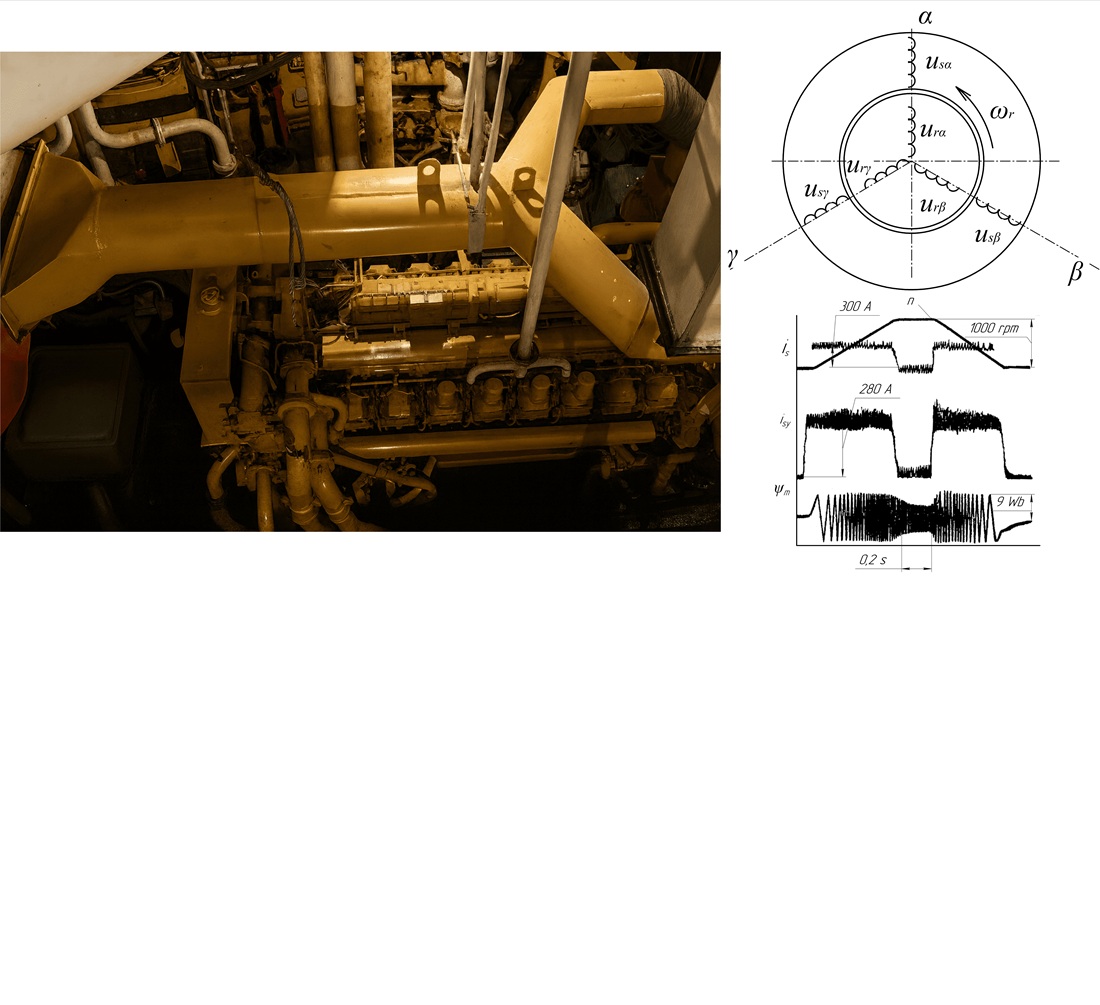
This study considers the electromagnetic and electromechanical processes in a traction induction motor. The task addressed relates to the absence of a universal mathematical model of a high-power induction motor that accounts for magnetic circuit saturation, cross-saturation, and core losses. Such a model is required for an adequate description of transient processes under the operating conditions of marine power plants.
The essence of the results reported here is the construction of a system of equations describing the electromagnetic and electromechanical processes in a traction induction motor, taking into account magnetic circuit saturation. The proposed model includes four differential and two algebraic equations, providing complete controllability over the machine dynamics on both linear and nonlinear segments of the magnetization characteristic. By applying the dynamic inductance method, the model accounts for the interdependence between flux linkages and currents in different coordinate axes, as well as for the nonlinear variations of inductance parameters under magnetic saturation. These specific features have made it possible to accurately reproduce the real physical processes in the motor, as confirmed by bench verification based on the Caterpillar 3516 marine power plant. The results are attributed to the use of a generalized spatial model and dynamic inductances that reflect the variability of the motor’s magnetic state under different load conditions.
The built model could be used in the synthesis of automatic control systems, analysis of transient processes, diagnostics of electric drives, as well as optimization of power plants. It could be practically implemented under conditions of stable thermal regime of the motor and availability of reliable experimental data for identification of saturation parameters
References
- Maslov, I., Tymoshchuk, O., Kulagin, D. (2025). Determining the causes of major energy losses in a ship’s unified AC power system. Modern Automotive Industry, Transport And Road Infrastructure ’2024 (MAITRI2024), 3428, 020021. https://doi.org/10.1063/12.0038611
- Kulagin, D., Maslov, I. (2024). Mathematical Model of Electromagnetic Transients of a Frequency-Controlled Propeller’s Induction Motor. 2024 IEEE 5th KhPI Week on Advanced Technology (KhPIWeek), 1–5. https://doi.org/10.1109/khpiweek61434.2024.10877991
- Kulahin, D. O. (2016). Rolling electrical complex on the basis of the criterion of minimizing the area under the curve of motion. Naukovyi Visnyk Natsionalnoho Hirnychoho Universytetu, 2, 60–67. Available at: https://nvngu.in.ua/index.php/en/archive/on-the-issues/1214-2016/contents-no-2-2016/electrical-complexes-and-systems/3396-rolling-electrical-complex-on-the-basis-of-the-criterion-of-minimizing-the-area-under-the-curve-of-motion
- Kulagin, D. O. (2014). The mathematical model of asynchronous traction motor taking into account the saturation of magnetic circuits. Naukovyi Visnyk Natsionalnoho Hirnychoho Universytetu, 6, 103–110. Available at: https://nvngu.in.ua/index.php/en/archive/on-the-issues/1012-2014/contents-no-6-2014/electrical-complexes-and-systems/2867-the-mathematical-model-of-asynchronous-traction-motor-taking-into-account-the-saturation-of-magnetic-circuits
- Kulagin, D. O. (2014). Mathematical model of asynchronous traction motor taking into account the saturation. Technical Electrodynamics, 6, 49–55. Available at: https://techned.org.ua/index.php/techned/article/view/1126/1001
- Konuhova, M. (2024). Modeling of Induction Motor Direct Starting with and without Considering Current Displacement in Slot. Applied Sciences, 14 (20), 9230. https://doi.org/10.3390/app14209230
- Gupta, V. K., Samanta, P., Sahay, P. K., Srinivas, V. L. (2025). From Conveyor Belts to Crushers: A Review on Radial and Axial Flux Induction Motor Advances and Applications in Industrial Mining Operations. 2025 IEEE 1st International Conference on Smart and Sustainable Developments in Electrical Engineering (SSDEE), 01–06. https://doi.org/10.1109/ssdee64538.2025.10968154
- Chen, H., Bi, C., Li, S., Peng, Z., Chen, Z. (2024). New Approach to Improve Starting Performance of Induction Motor Based on Optimal Starting Frequency. IEEE Access, 12, 136515–136523. https://doi.org/10.1109/access.2024.3463424
- Larabee, J., Pellegrino, B., Flick, B. (2005). Induction Motor Starting Methods and Issues. Record of Conference Papers Industry Applications Society 52nd Annual Petroleum and Chemical Industry Conference, 217–222. https://doi.org/10.1109/pcicon.2005.1524557
- Park, D.-H., Song, C.-H., Won, Y.-J., Park, J.-C., Kim, H.-S., Park, H.-R. et al. (2024). Magnetizing Inductance Estimation Method of Induction Motor for EV Traction Considering Magnetic Saturation Changes According to Current and Slip Frequency. IEEE Transactions on Magnetics, 60 (9), 1–5. https://doi.org/10.1109/tmag.2024.3426663
- Masadeh, M. A., Amitkumar, K. S., Pillay, P. (2018). Power Electronic Converter-Based Induction Motor Emulator Including Main and Leakage Flux Saturation. IEEE Transactions on Transportation Electrification, 4 (2), 483–493. https://doi.org/10.1109/tte.2018.2824619
- Accetta, A., Alonge, F., Cirrincione, M., D’Ippolito, F., Pucci, M., Sferlazza, A. (2017). GA-based off-line parameter estimation of the induction motor model including magnetic saturation and iron losses. 2017 IEEE Energy Conversion Congress and Exposition (ECCE), 2420–2426. https://doi.org/10.1109/ecce.2017.8096466
- Zhang, Y., Baig, S., Vahabzadeh, T., Jatskevich, J. (2022). Maximum Efficiency Volts-per-Hertz Control of Induction Motor Drives Considering Core Losses, Saturation, and Inverter Losses. 2022 International Conference on Electrical, Computer and Energy Technologies (ICECET), 1–7. https://doi.org/10.1109/icecet55527.2022.9872679
- Iegorov, O., Iegorova, O., Potryvaieva, N., Zaluzhna, H. (2021). The Traction Induction Motor Magnetic Circuit Saturation Influence on the Variable Electric Drive Energy Efficiency. 2021 IEEE International Conference on Modern Electrical and Energy Systems (MEES), 1–5. https://doi.org/10.1109/mees52427.2021.9598686
- Siddique, A., Yadava, G. S., Singh, B. (2005). A Review of Stator Fault Monitoring Techniques of Induction Motors. IEEE Transactions on Energy Conversion, 20 (1), 106–114. https://doi.org/10.1109/tec.2004.837304
- Jang, J.-H., Sul, S.-K., Jung-Ik Ha, Ide, K., Sawamura, M. (2003). Sensorless drive of surface-mounted permanent-magnet motor by high-frequency signal injection based on magnetic saliency. IEEE Transactions on Industry Applications, 39 (4), 1031–1039. https://doi.org/10.1109/tia.2003.813734
- Palma Garcia, M. T., Caceres Cardenas, F. V., Kuong, J. L., Quispe, E. C. (2018). Transient Analysis of Induction Motors Considering the Saturation Effect Applying the Finite Element Method. 2018 IEEE ANDESCON, 1–6. https://doi.org/10.1109/andescon.2018.8564699
- Kulagin, D. O., Fedosha, D. V., Nitsenko, V. V., Shevchenko, S. Yu., Danylchenko, D. O. (2019). Using a phase-differential busbar protection for switchgears of power system facilities. Naukovyi Visnyk Natsionalnoho Hirnychoho Universytetu, 4. https://doi.org/10.29202/nvngu/2019-4/10
- Nitsenko, V., Kulagin, D. (2017). Improvement implementation methods of relay busbars protection of switchgears. Tekhnichna Elektrodynamika, 6, 61–71. https://doi.org/10.15407/techned2017.06.061
- Nitsenko, V. V., Kulahin, D. O. (2017). Research on effect of differential-phase protection of busbars system with voltage of 110-750 kv. Naukovyi Visnyk Natsionalnoho Hirnychoho Universytetu, 4, 72–79. Available at: https://www.researchgate.net/publication/321157798_Research_on_effect_of_differential-phase_protection_of_busbars_system_with_voltage_of_110-750_kv
- Korobko, B., Kivshyk, A., Kulagin, D. (2021). Experimental Study of the Efficiency of the Differential Pump of Electromagnetic Action on the Basis of Mathematical Modeling of the Parameters of Its Operation. Proceedings of the 3rd International Conference on Building Innovations, 203–213. https://doi.org/10.1007/978-3-030-85043-2_20
- Bratkovska, K., Makhlin, P., Shram, A., Kulagin, D., Fedosha, D. (2022). Estimation of Optimization Approaches of the Energy Intensive Equipment’s Power-Time Diagrams of Industrial Enterprises. 2022 IEEE 8th International Conference on Energy Smart Systems (ESS), 277–281. https://doi.org/10.1109/ess57819.2022.9969248
- Yekimov, S., Nianko, V., Kulagin, D., Lunkina, T., Haponenko, S. (2021). The importance of environmental education for effective environmental management. E3S Web of Conferences, 296, 08002. https://doi.org/10.1051/e3sconf/202129608002
- Masadeh, M. A., Pillay, P. (2017). Induction motor emulation including main and leakage flux saturation effects. 2017 IEEE International Electric Machines and Drives Conference (IEMDC), 1–7. https://doi.org/10.1109/iemdc.2017.8002207
- Kulagin, D., Maslov, I., Lysechko, V., Prokopenko, V., Shram, A., Pastushenko, V. (2023). Analysis Of Current Approaches to Modernizing the Electric Power Scheme of Diesel Generator Transport. 2023 IEEE 4th KhPI Week on Advanced Technology (KhPIWeek), 1–6. https://doi.org/10.1109/khpiweek61412.2023.10312881
- Molsa, E., Saarakkala, S. E., Hinkkanen, M. (2018). Influence of Magnetic Saturation on Modeling of an Induction Motor. 2018 XIII International Conference on Electrical Machines (ICEM), 1572–1578. https://doi.org/10.1109/icelmach.2018.8506746
- Dalal, A., Singh, A. K., Kumar, P. (2013). Effect of saturation on equivalent circuit analysis of induction motor in practical scenario. 2013 Annual IEEE India Conference (INDICON), 1–5. https://doi.org/10.1109/indcon.2013.6726122
- Nishihama, K., Ide, K., Mikami, H., Fujigaki, T., Mizutani, S. (2009). Starting torque analysis of cage induction motor using permeance model considering magnetic saturation by leakage flux. 2009 International Conference on Electrical Machines and Systems, 1–6. https://doi.org/10.1109/icems.2009.5382970
- Novotnak, R. T., Chiasson, J., Bodson, M. (1999). High-performance motion control of an induction motor with magnetic saturation. IEEE Transactions on Control Systems Technology, 7 (3), 315–327. https://doi.org/10.1109/87.761052
- Faiz, J., Ebrahimi, B. M., Toliyat, H. A. (2009). Effect of Magnetic Saturation on Static and Mixed Eccentricity Fault Diagnosis in Induction Motor. IEEE Transactions on Magnetics, 45 (8), 3137–3144. https://doi.org/10.1109/tmag.2009.2016416
- Sprooten, J., Maun, J.-C. (2009). Influence of Saturation Level on the Effect of Broken Bars in Induction Motors Using Fundamental Electromagnetic Laws and Finite Element Simulations. IEEE Transactions on Energy Conversion, 24 (3), 557–564. https://doi.org/10.1109/tec.2009.2016126
- Faiz, J., Ojaghi, M. (2011). Stator Inductance Fluctuation of Induction Motor as an Eccentricity Fault Index. IEEE Transactions on Magnetics, 47 (6), 1775–1785. https://doi.org/10.1109/tmag.2011.2107562
- Kwon, S. O., Lee, J. J., Lee, B. H., Kim, J. H., Ha, K. H., Hong, J. P. (2009). Loss Distribution of Three-Phase Induction Motor and BLDC Motor According to Core Materials and Operating. IEEE Transactions on Magnetics, 45 (10), 4740–4743. https://doi.org/10.1109/tmag.2009.2022749
- Fernandez-Bernal, F., Garcia-Cerrada, A., Faure, R. (2000). Model-based loss minimization for DC and AC vector-controlled motors including core saturation. IEEE Transactions on Industry Applications, 36 (3), 755–763. https://doi.org/10.1109/28.845050
Downloads
Published
How to Cite
Issue
Section
License
Copyright (c) 2025 Dmytro Kulagin, Igor Maslov

This work is licensed under a Creative Commons Attribution 4.0 International License.
The consolidation and conditions for the transfer of copyright (identification of authorship) is carried out in the License Agreement. In particular, the authors reserve the right to the authorship of their manuscript and transfer the first publication of this work to the journal under the terms of the Creative Commons CC BY license. At the same time, they have the right to conclude on their own additional agreements concerning the non-exclusive distribution of the work in the form in which it was published by this journal, but provided that the link to the first publication of the article in this journal is preserved.
A license agreement is a document in which the author warrants that he/she owns all copyright for the work (manuscript, article, etc.).
The authors, signing the License Agreement with TECHNOLOGY CENTER PC, have all rights to the further use of their work, provided that they link to our edition in which the work was published.
According to the terms of the License Agreement, the Publisher TECHNOLOGY CENTER PC does not take away your copyrights and receives permission from the authors to use and dissemination of the publication through the world's scientific resources (own electronic resources, scientometric databases, repositories, libraries, etc.).
In the absence of a signed License Agreement or in the absence of this agreement of identifiers allowing to identify the identity of the author, the editors have no right to work with the manuscript.
It is important to remember that there is another type of agreement between authors and publishers – when copyright is transferred from the authors to the publisher. In this case, the authors lose ownership of their work and may not use it in any way.








