Development of an intelligent control and energy management system for stratospheric telecommunication airships
DOI:
https://doi.org/10.15587/1729-4061.2025.346938Keywords:
high-altitude platform systems (HAPS), airships, PID-fuzzy, LoRa, MatLab, aerodynamic modeling, energy managementAbstract
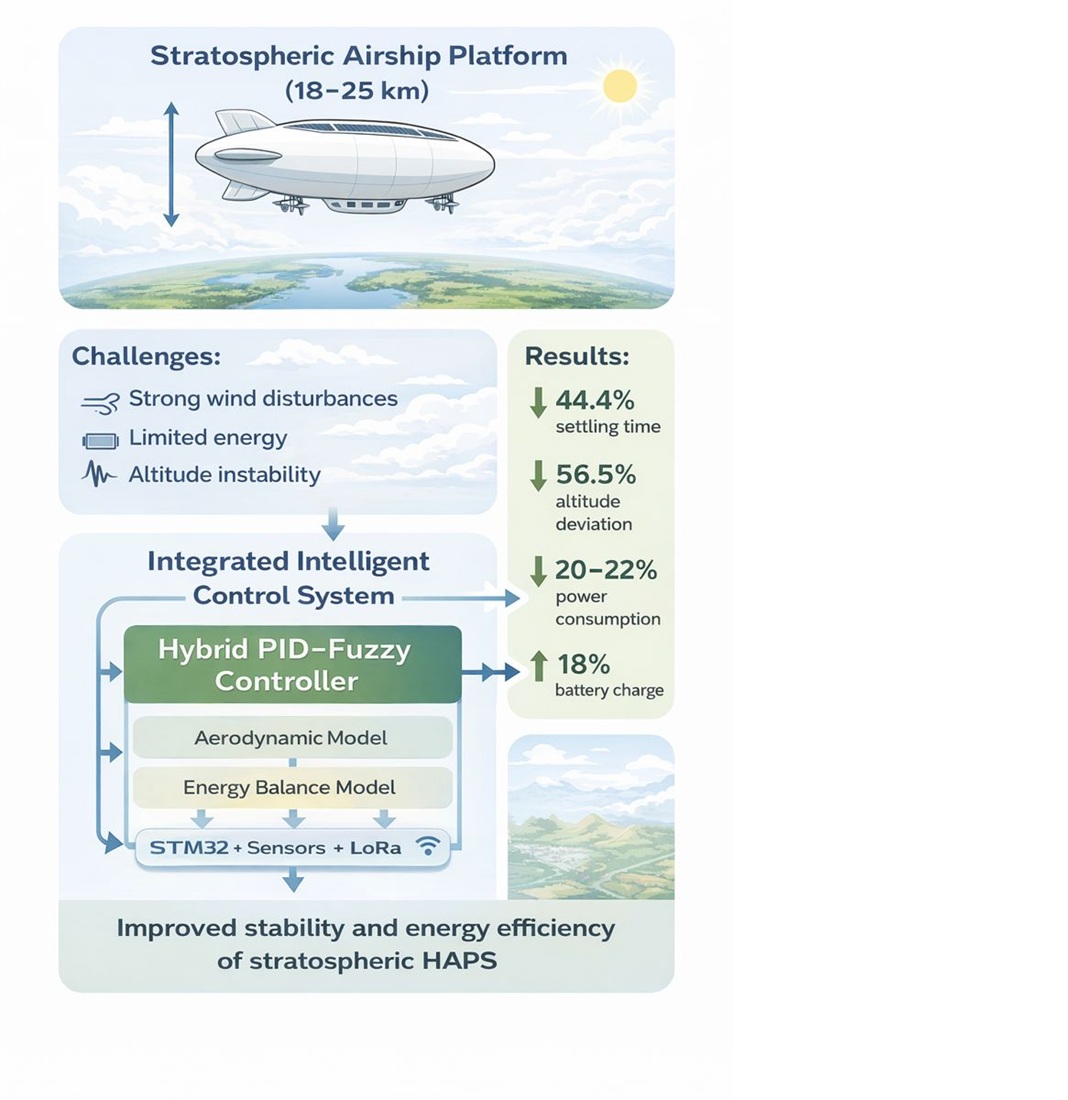
The object of the study is an autonomous high-altitude airship platform. This type of high-altitude platform is designed for long-term telecommunication retransmission at altitudes of 18–25 km. The main problem lies in the insufficient stability of flight at the height of the stratosphere and the limited energy capabilities of aircraft. An integrated intelligent control system and energy management have been developed to solve the problems. This architecture in portable form includes a sensor module, an STM32 microcontroller, a LoRa telemetry channel, a mathematical model of dynamics taking into account lift, aerodynamic drag, external factors and atmospheric parameters, and most importantly, a hybrid adaptive PID-fuzzy controller was proposed. Additionally, a model of the energy balance was proposed, which directly interacts with solar panels, energy consumption of drives and battery operation. The simulation data obtained shows that the use of the PID-fuzzy controller provides a significant increase in the stability of the platform. The transition time is reduced by 44.4%, the maximum deviation from the set altitude and flight path is reduced by 56.5%, and the average drive consumption is reduced by 20–22%. The energy balance model demonstrates that the developed system is capable of retaining up to 46% of the battery charge after 24 hours of battery life, which is 18% higher compared to a system without adaptive energy management.
The practical significance of the project lies in the possibility of using the developed system as part of autonomous telecommunications networks, balloons, an emergency communication system, remote sensing of the earth, as well as in elements of promising 6G and NTN networks.
References
- Abdykadyrov, A., Abdullayev, M., Kuttybayeva, A., Tazhen, K., Kystaubayev, N., Ermekbayev, M. et al. (2025). Development and evaluation of radio frequency management approaches for stratospheric communication systems. Eastern-European Journal of Enterprise Technologies, 3 (5 (135)), 17–29. https://doi.org/10.15587/1729-4061.2025.331607
- Abdullayev, M., Kuttybayeva, A., Tazhen, K., Khabay, A., Ospanova, N., Tashtay, Y. et al. (2025). Development of a stratospheric airship-based network architecture for telecommunication in remote areas. Eastern-European Journal of Enterprise Technologies, 5 (9 (137)), 82–92. https://doi.org/10.15587/1729-4061.2025.340990
- Sabibolda, A., Tsyporenko, V., Smailov, N., Tsyporenko, V., Abdykadyrov, A. (2024). Estimation of the Time Efficiency of a Radio Direction Finder Operating on the Basis of a Searchless Spectral Method of Dispersion-Correlation Radio Direction Finding. Advances in Asian Mechanism and Machine Science, 62–70. https://doi.org/10.1007/978-3-031-67569-0_8
- Seidaliyeva, U., Ilipbayeva, L., Utebayeva, D., Smailov, N., Matson, E. T., Tashtay, Y. et al. (2025). LiDAR Technology for UAV Detection: From Fundamentals and Operational Principles to Advanced Detection and Classification Techniques. Sensors, 25 (9), 2757. https://doi.org/10.3390/s25092757
- Smailov, N., Tsyporenko, V., Ualiyev, Z., Issova, А., Dosbayev, Z., Tashtay, Y. et al. (2025). Improving accuracy of the spectral-correlation direction finding and delay estimation using machine learning. Eastern-European Journal of Enterprise Technologies, 2 (5 (134)), 15–24. https://doi.org/10.15587/1729-4061.2025.327021
- Widiawan, A. K., Tafazolli, R. (2006). High Altitude Platform Station (HAPS): A Review of New Infrastructure Development for Future Wireless Communications. Wireless Personal Communications, 42 (3), 387–404. https://doi.org/10.1007/s11277-006-9184-9
- Karabulut Kurt, G., Khoshkholgh, M. G., Alfattani, S., Ibrahim, A., Darwish, T. S. J., Alam, M. S. et al. (2021). A Vision and Framework for the High Altitude Platform Station (HAPS) Networks of the Future. IEEE Communications Surveys & Tutorials, 23 (2), 729–779. https://doi.org/10.1109/comst.2021.3066905
- Beşkardeş, A., Hameş, Y., Kaya, K. (2024). A comprehensive review on fuzzy logic control systems for all, hybrid, and fuel cell electric vehicles. Soft Computing, 28 (13-14), 8183–8221. https://doi.org/10.1007/s00500-023-09454-5
- Jin, B., Zhang, L., Chen, Q., Fu, Z. (2023). Energy management strategy of fuzzy logic control for fuel cell truck. Energy Reports, 9, 247–255. https://doi.org/10.1016/j.egyr.2023.05.058
- Hokazono, Y., Kishiyama, Y., Asai, T. (2022). Studies toward Practical Application of HAPS in the Space RAN. NTT Technical Review, 20 (12), 28–35. https://doi.org/10.53829/ntr202212fa3
- Arum, S. C., Grace, D., Mitchell, P. D. (2020). A review of wireless communication using high-altitude platforms for extended coverage and capacity. Computer Communications, 157, 232–256. https://doi.org/10.1016/j.comcom.2020.04.020
- Cavus, M., Dissanayake, D., Bell, M. (2025). Deep-Fuzzy Logic Control for Optimal Energy Management: A Predictive and Adaptive Framework for Grid-Connected Microgrids. Energies, 18 (4), 995. https://doi.org/10.3390/en18040995
- Assem, H., Azib, T., Bouchafaa, F., Laarouci, C., Belhaouas, N., Hadj Arab, A. (2023). Adaptive Fuzzy Logic-Based Control and Management of Photovoltaic Systems with Battery Storage. International Transactions on Electrical Energy Systems, 2023, 1–18. https://doi.org/10.1155/2023/9065061
- Seane, T. B., Samikannu, R. (2023). Energy management of solar microgrids through fuzzy logic control: A review. AIP Conference Proceedings. https://doi.org/10.1063/5.0126181
- Mershad, K., Dahrouj, H., Sarieddeen, H., Shihada, B., Al-Naffouri, T., Alouini, M.-S. (2021). Cloud-Enabled High-Altitude Platform Systems: Challenges and Opportunities. Frontiers in Communications and Networks, 2. https://doi.org/10.3389/frcmn.2021.716265
- Baset, D. A.-E., Rezk, H., Hamada, M. (2020). Fuzzy Logic Control Based Energy Management Strategy for Renewable Energy System. 2020 International Youth Conference on Radio Electronics, Electrical and Power Engineering (REEPE), 1–5. https://doi.org/10.1109/reepe49198.2020.9059203
- D’Oliveira, F. A., Melo, F. C. L. de, Devezas, T. C. (2016). High-Altitude Platforms - Present Situation and Technology Trends. Journal of Aerospace Technology and Management, 8 (3), 249–262. https://doi.org/10.5028/jatm.v8i3.699
- Bagarić, T., Rezo, Z., Steiner, S. (2025). High-Altitude Pseudo-Satellite platforms as support to air traffic management. Transportation Research Procedia, 83, 593–600. https://doi.org/10.1016/j.trpro.2025.03.030
- Acun, F., Çunkaş, M. (2023). Low-cost fuzzy logic-controlled home energy management system. Journal of Electrical Systems and Information Technology, 10 (1). https://doi.org/10.1186/s43067-023-00100-6
- Subramanian, V., Bereznychenko, V. (2025). Cognitive fuzzy logic-integrated energy management for self-sustaining hybrid renewable microgrids. Scientific Reports, 15 (1). https://doi.org/10.1038/s41598-025-94077-z
- Lin, G., Yang, J., Sun, H., Li, H., Liu, W., Zhu, Q. (2025). Optimization of energy management strategy with fuzzy logic control and low-pass filtering for hydrogen production system. International Journal of Hydrogen Energy, 116, 473–485. https://doi.org/10.1016/j.ijhydene.2025.02.245
- Chu, Y., Donaldson, R., Kumar, R., Grace, D. (2021). Feasibility of quantum key distribution from high altitude platforms. Quantum Science and Technology, 6 (3), 035009. https://doi.org/10.1088/2058-9565/abf9ae
- Elkhazraji, A., Alouini, M.-S., Farooq, A. (2025). HAPS Communication Networks: A Tutorial-cum-Survey on Integration with Optical Atmospheric Sensing. arXiv. https://doi.org/10.48550/arXiv.2511.05877
- Abdullaev, M., Esnazarov, E. (2012). Organization of Broadband Communication Based on Stratospheric High-Altitude Platforms in the Territory of Kazakhstan. Information and Telecommunication Technologies: Education, Science, Practice, 232–236.
Downloads
Published
How to Cite
Issue
Section
License
Copyright (c) 2025 Ainur Kuttybayeva, Samal Zhamalova, Mukhit Abdullayev, Gaziz Zhampeissov, Kalmukhamed Tazhen, Anar Khabay, Aigul Orazymbetova, Askar Kanzhar, Tatyana Mechsheryakova, Vladimir Domrachev

This work is licensed under a Creative Commons Attribution 4.0 International License.
The consolidation and conditions for the transfer of copyright (identification of authorship) is carried out in the License Agreement. In particular, the authors reserve the right to the authorship of their manuscript and transfer the first publication of this work to the journal under the terms of the Creative Commons CC BY license. At the same time, they have the right to conclude on their own additional agreements concerning the non-exclusive distribution of the work in the form in which it was published by this journal, but provided that the link to the first publication of the article in this journal is preserved.
A license agreement is a document in which the author warrants that he/she owns all copyright for the work (manuscript, article, etc.).
The authors, signing the License Agreement with TECHNOLOGY CENTER PC, have all rights to the further use of their work, provided that they link to our edition in which the work was published.
According to the terms of the License Agreement, the Publisher TECHNOLOGY CENTER PC does not take away your copyrights and receives permission from the authors to use and dissemination of the publication through the world's scientific resources (own electronic resources, scientometric databases, repositories, libraries, etc.).
In the absence of a signed License Agreement or in the absence of this agreement of identifiers allowing to identify the identity of the author, the editors have no right to work with the manuscript.
It is important to remember that there is another type of agreement between authors and publishers – when copyright is transferred from the authors to the publisher. In this case, the authors lose ownership of their work and may not use it in any way.








