Development of an intelligent support system for hepatocellular carcinoma treatment selection
DOI:
https://doi.org/10.15587/1729-4061.2025.347800Keywords:
hepatocellular carcinoma, treatment selection, intelligent decision support system, knowledge baseAbstract
The object of the study is the clinical decision-making process for selecting of hepatocellular carcinoma (HCC) treatment method based on the patient's medical data. The process of the HCC treatment method selection remains poorly formalized and is characterized by multi-criteria and the presence of numerous clinical situations, for each of which it is necessary to promptly identify the most accurate therapeutic solution.
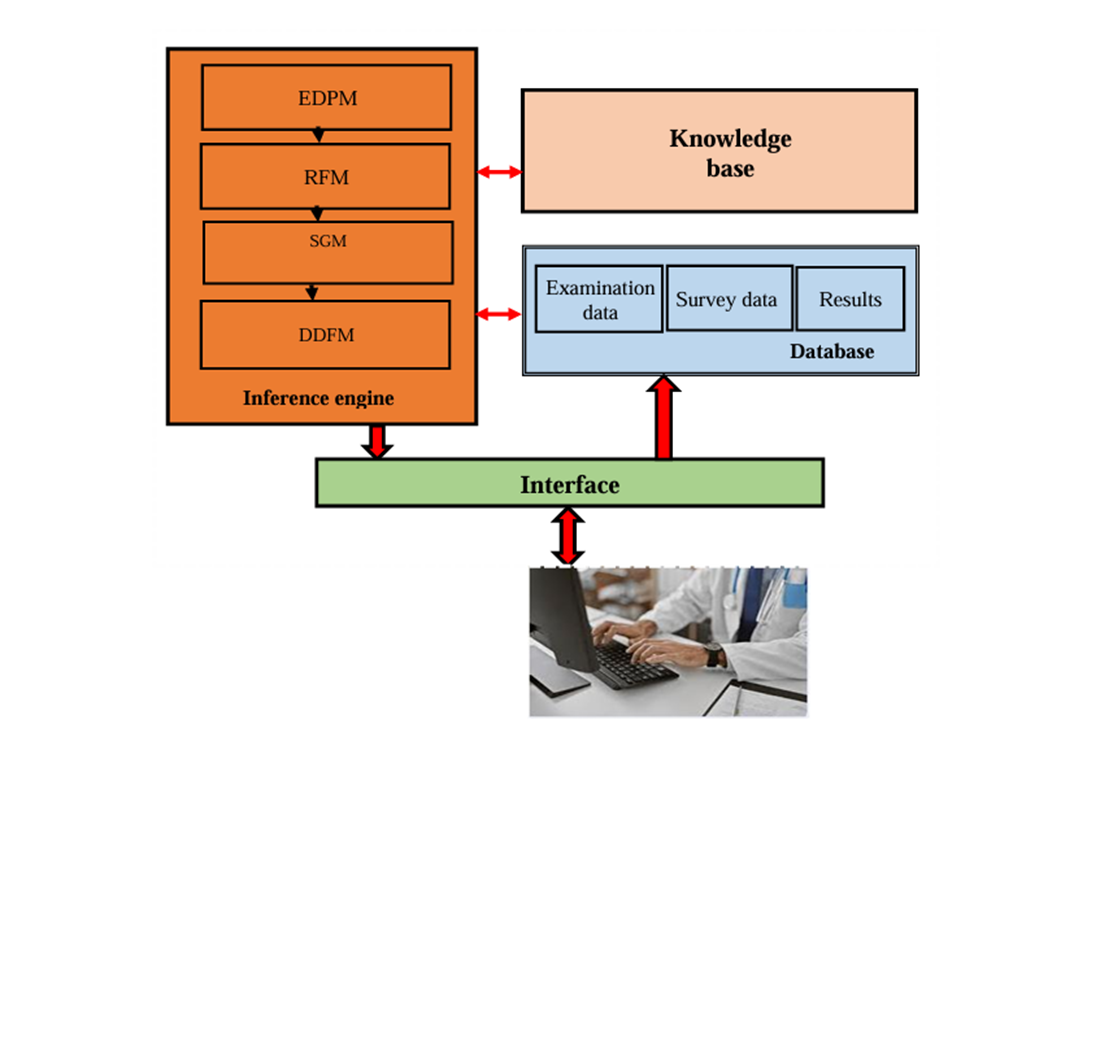
This study develops an intelligent medical decision support system for HCC treatment method selection based on knowledge applicable in clinical practice.
It offers architectural and functional principles of the intelligent decision support system, classifying clinical situations by HCC treatment method, consisting of multiple possible combinations of 44 informative parameters. Based on the current values of these parameters, expert knowledge is transformed into production rules identifying HCC treatment methods.
A heuristic procedure treatment selection is developed based on production rule analysis in accordance with current parameter values, reproducing the reasoning patterns of participants in a multidisciplinary council during their consensus decision-making process regarding HCC treatment appointment. A software implementation of a decision-making model for HCC treatment selection, implemented in C# using the Visual Study 2019 platform, enabled the integration of an intelligent system with web technologies.
The intelligent medical decision support system automates the unique experience of professionals and helps physicians in a multidisciplinary consultation make prompt and informed decisions online regarding the appointment of personalized therapy. The system was piloted with expert physicians in several iterations until complete match between the consensus decision of the multidisciplinary council and the decision made by the developed system in accordance with clinical recommendations was achieved
References
- Reynolds, A. R., Furlan, A., Fetzer, D. T., Sasatomi, E., Borhani, A. A., Heller, M. T., Tublin, M. E. (2015). Infiltrative Hepatocellular Carcinoma: What Radiologists Need to Know. RadioGraphics, 35 (2), 371–386. https://doi.org/10.1148/rg.352140114
- Bayramov, N., Mammadova, Sh. (2022). A review of the current ERAS guidelines for liver resection, liver transplantation and pancreatoduodenectomy. Annals of Medicine & Surgery, 82. https://doi.org/10.1016/j.amsu.2022.104596
- Huang, D. Q., Tran, A., Tan, E. X., Nerurkar, S. N., Teh, R., Teng, M. L. P. et al. (2022). Characteristics and outcomes of hepatocellular carcinoma patients with macrovascular invasion following surgical resection: a meta-analysis of 40 studies and 8,218 patients. Hepatobiliary Surgery and Nutrition, 11 (6), 848–860. https://doi.org/10.21037/hbsn-21-419
- Ray, S., Mehta, N. N., Golhar, A., Nundy, S. (2018). Post hepatectomy liver failure – A comprehensive review of current concepts and controversies. Annals of Medicine and Surgery, 34, 4–10. https://doi.org/10.1016/j.amsu.2018.08.012
- Calderon, F., Masino, E., Caram, L., Ardiles, V. (2021). Short-and-Long-Term Outcomes of Hepatic Resection for Hepatocellular Carcinoma in Cirrhotic and Non-Cirrhotic Liver Parenchyma., 1 (1), 12–19. Journal of Surgery and Clinical Reports. Available at: https://www.researchgate.net/publication/351706093_Journal_of_Surgery_and_Clinical_Reports_Short-and-Long-Term_Outcomes_of_Hepatic_Resection_for_Hepatocellular_Carcinoma_in_Cirrhotic_and_Non-Cirrhotic_Liver_Parenchyma
- Citterio, D., Facciorusso, A., Sposito, C., Rota, R., Bhoori, S., Mazzaferro, V. (2016). Hierarchic Interaction of Factors Associated With Liver Decompensation After Resection for Hepatocellular Carcinoma. JAMA Surgery, 151 (9), 846. https://doi.org/10.1001/jamasurg.2016.1121
- Park, S., Davis, A. M., Pillai, A. A. (2024). Prevention, Diagnosis, and Treatment of Hepatocellular Carcinoma. JAMA, 332 (12), 1013. https://doi.org/10.1001/jama.2024.14101
- Brown, Z. J., Tsilimigras, D. I., Ruff, S. M., Mohseni, A., Kamel, I. R., Cloyd, J. M., Pawlik, T. M. (2023). Management of Hepatocellular Carcinoma. JAMA Surgery, 158 (4), 410. https://doi.org/10.1001/jamasurg.2022.7989
- Singh, A., Pandey, B. (2016). An Efficient Diagnosis System for Detection of Liver Disease Using a Novel Integrated Method Based on Principal Component Analysis and K-Nearest Neighbor (PCA-KNN). International Journal of Healthcare Information Systems and Informatics, 11 (4), 56–69. https://doi.org/10.4018/ijhisi.2016100103
- Sartakhti, J. S., Zangooei, M. H., Mozafari, K. (2012). Hepatitis disease diagnosis using a novel hybrid method based on support vector machine and simulated annealing (SVM-SA). Computer Methods and Programs in Biomedicine, 108 (2), 570–579. https://doi.org/10.1016/j.cmpb.2011.08.003
- Gorunescu, F., Belciug, S., Gorunescu, M., Badea, R. (2012). Intelligent decision-making for liver fibrosis stadialization based on tandem feature selection and evolutionary-driven neural network. Expert Systems with Applications, 39 (17), 12824–12832. https://doi.org/10.1016/j.eswa.2012.05.011
- Li, B. N., Chui, C. K., Chang, S., Ong, S. H. (2012). A new unified level set method for semi-automatic liver tumor segmentation on contrast-enhanced CT images. Expert Systems with Applications, 39 (10), 9661–9668. https://doi.org/10.1016/j.eswa.2012.02.095
- Farahi, R., Derakhshanfard, N., Ghaffari, A. (2025). Intelligent Decision Support System for Liver Disease Diagnosis with MLP Network Optimized by Genetic Algorithm. International Journal of Computational Intelligence Systems, 18 (1). https://doi.org/10.1007/s44196-025-01013-0
- Curtidor, A., Kussul, E., Baydyk, T., Mammadova, M. (2023). Analysis and automated classification of images of blood cells to diagnose acute lymphoblastic leukemia. EUREKA: Physics and Engineering, 5, 177–190. https://doi.org/10.21303/2461-4262.2023.003070
- Curtidor, A., Mammadova, M., Velasco Herrera, G., Baydyk, T., Kussul, E. (2023). Recognition of images of blood cells using texture and neural networks to diagnose leukemia. Expert Assessments in Decision Making: Risks and Safety, 36–65. https://doi.org/10.21303/978-9916-9850-2-1.ch2
- Curtidor, A., Baydyk, T., Kussul, E. (2025). Classification based on Neural Networks to Detect Acute Lymphoblastic Leukemia. Wseas Transactions On Signal Processing, 21, 25–30. https://doi.org/10.37394/232014.2025.21.4
- Schuler, K., Jung, I.-C., Zerlik, M., Hahn, W., Sedlmayr, M., Sedlmayr, B. (2025). Context factors in clinical decision-making: a scoping review. BMC Medical Informatics and Decision Making, 25 (1). https://doi.org/10.1186/s12911-025-02965-1
- Mirmozaffari, M. (2019). Developing an Expert System for Diagnosing Liver Diseases. European Journal of Engineering Research and Science, 4 (3), 1–5. https://doi.org/10.24018/ejers.2019.4.3.1168
- Mammadova, M., Bayramov, N., Jabrayilova, Z. (2021). Development of the principles of fuzzy rule-based system for hepatocelular carcinoma staging. EUREKA: Physics and Engineering, 3, 3–13. https://doi.org/10.21303/2461-4262.2021.001829
- Məmmədova, M. H., Bayramov, N. Y., Cəbrayılova, Z. G., Manaflı, M. İ., Hüseynova, M. R. (2024). Hepatosellülyar karsinomanin diaqnostikasi üçün həkim qərarlarinin dəstəklənməsi sistemi. Azerbaijan Medical Journal, 4, 163–169. https://doi.org/10.34921/amj.2024.4.026
Downloads
Published
How to Cite
Issue
Section
License
Copyright (c) 2025 Masuma Mammadova, Nuru Bayramov, Zarifa Jabrayilova, Tetyana Baydyk, Mehriban Huseynova

This work is licensed under a Creative Commons Attribution 4.0 International License.
The consolidation and conditions for the transfer of copyright (identification of authorship) is carried out in the License Agreement. In particular, the authors reserve the right to the authorship of their manuscript and transfer the first publication of this work to the journal under the terms of the Creative Commons CC BY license. At the same time, they have the right to conclude on their own additional agreements concerning the non-exclusive distribution of the work in the form in which it was published by this journal, but provided that the link to the first publication of the article in this journal is preserved.
A license agreement is a document in which the author warrants that he/she owns all copyright for the work (manuscript, article, etc.).
The authors, signing the License Agreement with TECHNOLOGY CENTER PC, have all rights to the further use of their work, provided that they link to our edition in which the work was published.
According to the terms of the License Agreement, the Publisher TECHNOLOGY CENTER PC does not take away your copyrights and receives permission from the authors to use and dissemination of the publication through the world's scientific resources (own electronic resources, scientometric databases, repositories, libraries, etc.).
In the absence of a signed License Agreement or in the absence of this agreement of identifiers allowing to identify the identity of the author, the editors have no right to work with the manuscript.
It is important to remember that there is another type of agreement between authors and publishers – when copyright is transferred from the authors to the publisher. In this case, the authors lose ownership of their work and may not use it in any way.








