Devising a method for large-scale modeling of non-stationary electromagnetic processes in power transformer equipment under sharply changing loads
DOI:
https://doi.org/10.15587/1729-4061.2025.348152Keywords:
sharply changing loads, non-stationary electromagnetic processes, cumulative effect, magnetostriction, non-sinusoidal current, equivalence method, streamers, ferroresonance processes, skin effectAbstract
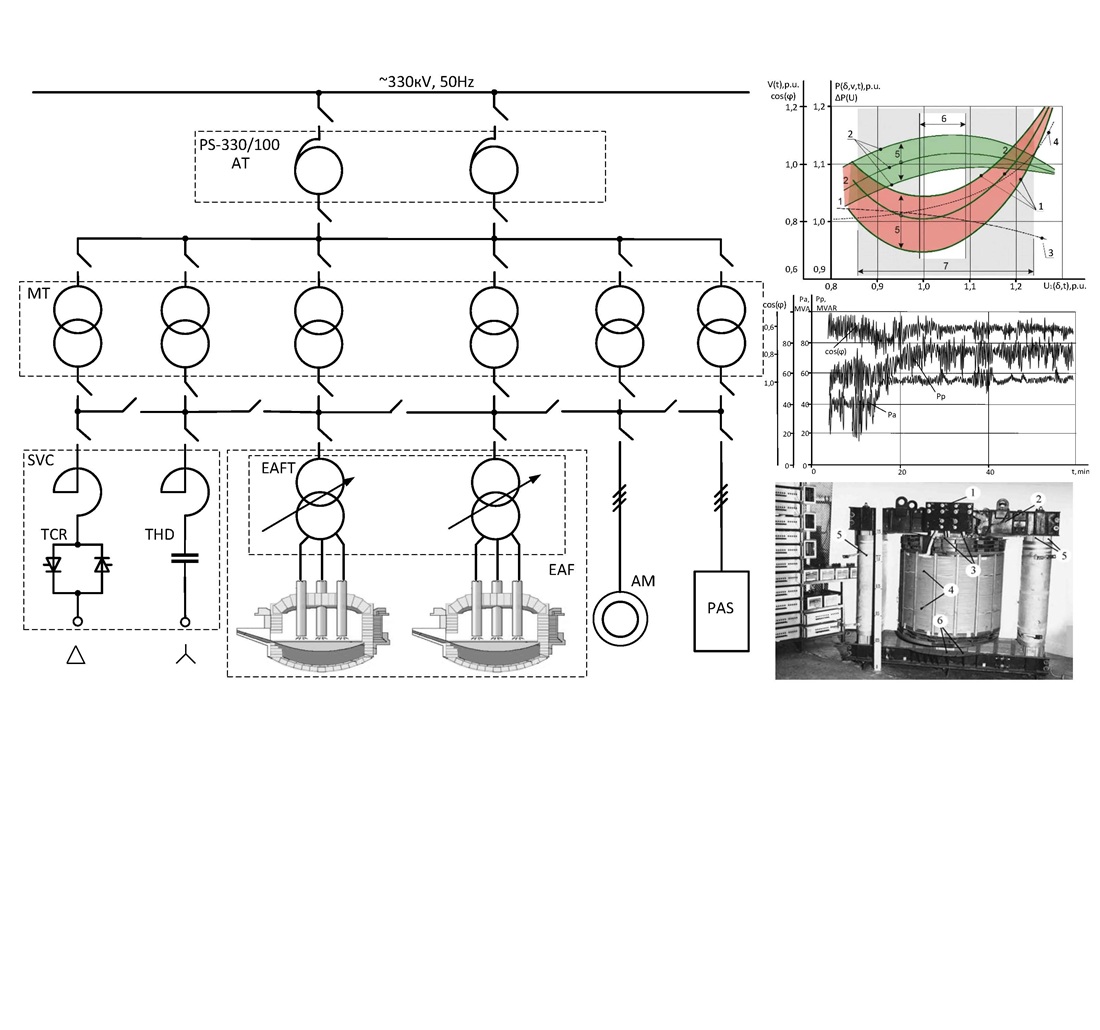
This study considers the sharply changing loads on powerful transformers and the non-stationary electromagnetic processes they excite, consisting of a set of parameters of different physical nature. The task addressed relates to the fact that powerful transformers used in modern electrical technologies fail almost twice as often as those operating in public networks. This encourages the design of special-purpose transformer equipment and requires establishing causal factors of accidents, their development, and new research methods.
This work reports a method for large-scale modeling of non-stationary electromagnetic processes in transformers.
The proposed criteria for the physical similarity of electromagnetic processes in the model and the original have been confirmed experimentally on a physical model and a real special-purpose transformer. A distinctive feature of the results is a method devised for the formation of sharply changing currents, which are characteristic of the electro-technological process in arc steelmaking furnaces.
The results of investigating additional losses and thermal overload of the transformer coincide, with reasonable accuracy for practice, with the experimental ones with an error not exceeding 5.7%. This makes it possible to compile project documentation for designing new types of special-purpose transformers. This is achieved by improving engineering methods for calculating additional losses and thermal overloads of inactive parts of transformer structures. In practice, the results allow for the correction of acceptance tests both at the design stages and under industrial conditions
References
- Zinovkin, V., Antonov, M., Krysan, I. (2020). Research of Electromagnetic Parameters of Complex Electromechanical System Under Hardly Varying Loads. 2020 IEEE 7th International Conference on Energy Smart Systems (ESS), 267–272. https://doi.org/10.1109/ess50319.2020.9160022
- Zhezhelenko, Yu. S., Sheinkman, L. M., Stepanov, V. B. (2012). Yakist elektroenerhiyi na promyslovykh pidpryiemstvakh. Kyiv: Tekhnika, 384.
- Rashid, N. (2011). Short-time Overloading of Power Transformers. Stockholm. Available at: http://www.diva-portal.org/smash/get/diva2:511551/fulltext01
- Zinovkin, V., Antonov, M., Pyroshok, A., Krysan, I. (2022). Influence of Sharp Load Fluctuations on Electromagnetic Processes in Electrical Equipment. 2022 IEEE 3rd KhPI Week on Advanced Technology (KhPIWeek), 1–5. https://doi.org/10.1109/khpiweek57572.2022.9916410
- Liang, B., Sun, Z., Yang, Z., Tao, W., Huo, C., Xiao, S. (2025). Data augmentation and optimization method based on conditional generative adversarial network and convolutional neural network for transformer fault diagnosis. Measurement, 254, 117872. https://doi.org/10.1016/j.measurement.2025.117872
- Murugan, R., Ramasamy, R. (2015). Failure analysis of power transformer for effective maintenance planning in electric utilities. Engineering Failure Analysis, 55, 182–192. https://doi.org/10.1016/j.engfailanal.2015.06.002
- Zinovkin, V., Antonov, M., Krysan, I., Pyrozhok, A. (2024). Multiparametric System for Automated Analysis of the Current Technical Condition of Power Transformers. 2024 IEEE 5th KhPI Week on Advanced Technology (KhPIWeek), 1–6. https://doi.org/10.1109/khpiweek61434.2024.10877956
- Liu, X. H., Zhao, G., Yu, J. J. (2004). Simulation research on the influence of electric arc furnace nonlinear characteristics on power supply network. Proceedings of the Chinese Society of Electrical Engineering, 34–38.
- Čerňan, M., Müller, Z., Tlustý, J., Valouch, V. (2021). An improved SVC control for electric arc furnace voltage flicker mitigation. International Journal of Electrical Power & Energy Systems, 129, 106831. https://doi.org/10.1016/j.ijepes.2021.106831
- Turkovskyi, V. H., Zhovnir, Yu. M. (1999). Enerhooshchadna systema elektropostachannia duhovykh staleplavylnykh pechei zminnoho strumu. Visnyk DU «Lvivska politekhnika». Problemy ekonomiyi enerhiyi, 2, 113–115.
- Abbasi, M. K., Dezfuli, H. (2022). Smart Maintenance Planning For Distribution Transformers Using Discrete-time Markov Chain. 2022 26th International Electrical Power Distribution Conference (EPDC), 8–17. https://doi.org/10.1109/epdc56235.2022.9817256
- Rama Rao, K. S., Karsiti, M. N. (2012). Optimal design of a furnace transformer by intelligent evolutionary methods. International Journal of Electrical Power & Energy Systems, 43 (1), 1056–1062. https://doi.org/10.1016/j.ijepes.2012.06.019
- Samet, H., Hamedani Golshan, M. E. (2012). A wide nonlinear analysis of reactive power time series related to electric arc furnaces. International Journal of Electrical Power & Energy Systems, 36 (1), 127–134. https://doi.org/10.1016/j.ijepes.2011.10.033
- Lozynskyi, O. Y., Lozynskyi, A. O., Paranchuk, Y. S., Paranchuk, R. Y. (2019). Synthesis and analysis of arc furnace electrical mode control system on the basis of three-dimensional phase currents vector distribution. Electrical Engineering & Electromechanics, 4, 26–34. https://doi.org/10.20998/2074-272x.2019.4.04
- Zinovkin, V., Antonov, M., Krysan, I. (2021). Multi-parameter Technological Process Optimization Functional Similarity Criteria. 2021 IEEE 2nd KhPI Week on Advanced Technology (KhPIWeek), 490–495. https://doi.org/10.1109/khpiweek53812.2021.9570014
- Zinovkin, V., Blyzniakov, O., Krysan, Y., Zaluzhnyi, M. (2021). Physical modeling of unsteady electromagnetic processes in power transformer under sharp load fluctuations. Electrical Engineering and Power Engineering, 3, 21–30. https://doi.org/10.15588/1607-6761-2021-3-2
- Kravchenko, A. M., Metielskyi, V. P., Sytnikov, A. M. (1999). Osnovni napriamky udoskonalennia konstruktsiyi merezhnykh transformatoriv dlia elektrometalurhiynoho vyrobnytstva. Pratsi instytutu elektrodynamiky NAN Ukrainy. K.: IED NAN Ukrainy, 195–200.
- Olczykowski, Z. (2021). Electric Arc Furnaces as a Cause of Current and Voltage Asymmetry. Energies, 14 (16), 5058. https://doi.org/10.3390/en14165058
- Czarnecki, L. S. (1996). Comments on active power flow and energy accounts in electrical systems with nonsinusoidal waveforms and asymmetry. IEEE Transactions on Power Delivery, 11 (3), 1244–1250. https://doi.org/10.1109/61.517478
- Awadallah, S. K. E., Milanovic, J. V., Jarman, P. N. (2015). The Influence of Modeling Transformer Age Related Failures on System Reliability. IEEE Transactions on Power Systems, 30 (2), 970–979. https://doi.org/10.1109/tpwrs.2014.2331103
- Ebrahim, E. A. (2023). Optimal Design of SAPFs for Harmonic Mitigation of Electric Arc Furnaces with Real-Time Digital Simulation Hardware. 2023 24th International Middle East Power System Conference (MEPCON), 1–8. https://doi.org/10.1109/mepcon58725.2023.10462253
- So, E., Arseneau, R., Hanique, E. (2004). Measurement and Correction of No-Load Losses of Power Transformers. 2004 Conference on Precision Electromagnetic Measurements, 570–570. https://doi.org/10.1109/cpem.2004.305383
Downloads
Published
How to Cite
Issue
Section
License
Copyright (c) 2025 Volodymyr Zinovkin, Yurii Krysan, Serhii Shylo

This work is licensed under a Creative Commons Attribution 4.0 International License.
The consolidation and conditions for the transfer of copyright (identification of authorship) is carried out in the License Agreement. In particular, the authors reserve the right to the authorship of their manuscript and transfer the first publication of this work to the journal under the terms of the Creative Commons CC BY license. At the same time, they have the right to conclude on their own additional agreements concerning the non-exclusive distribution of the work in the form in which it was published by this journal, but provided that the link to the first publication of the article in this journal is preserved.
A license agreement is a document in which the author warrants that he/she owns all copyright for the work (manuscript, article, etc.).
The authors, signing the License Agreement with TECHNOLOGY CENTER PC, have all rights to the further use of their work, provided that they link to our edition in which the work was published.
According to the terms of the License Agreement, the Publisher TECHNOLOGY CENTER PC does not take away your copyrights and receives permission from the authors to use and dissemination of the publication through the world's scientific resources (own electronic resources, scientometric databases, repositories, libraries, etc.).
In the absence of a signed License Agreement or in the absence of this agreement of identifiers allowing to identify the identity of the author, the editors have no right to work with the manuscript.
It is important to remember that there is another type of agreement between authors and publishers – when copyright is transferred from the authors to the publisher. In this case, the authors lose ownership of their work and may not use it in any way.








