A system of information support to the ecological-economic mechanism of land use within the paradigm of sustainable development
DOI:
https://doi.org/10.15587/1729-4061.2025.348374Keywords:
ecological-economic mechanism, land use, single information space, regionality, digital technologiesAbstract
This study focuses on the processes and mechanisms of land use management in the context of sustainable development. The task under consideration is associated with the fragmentation of information support to the ecological-economic mechanism behind land use (EEMLU), which complicates the objective assessment of land resources.
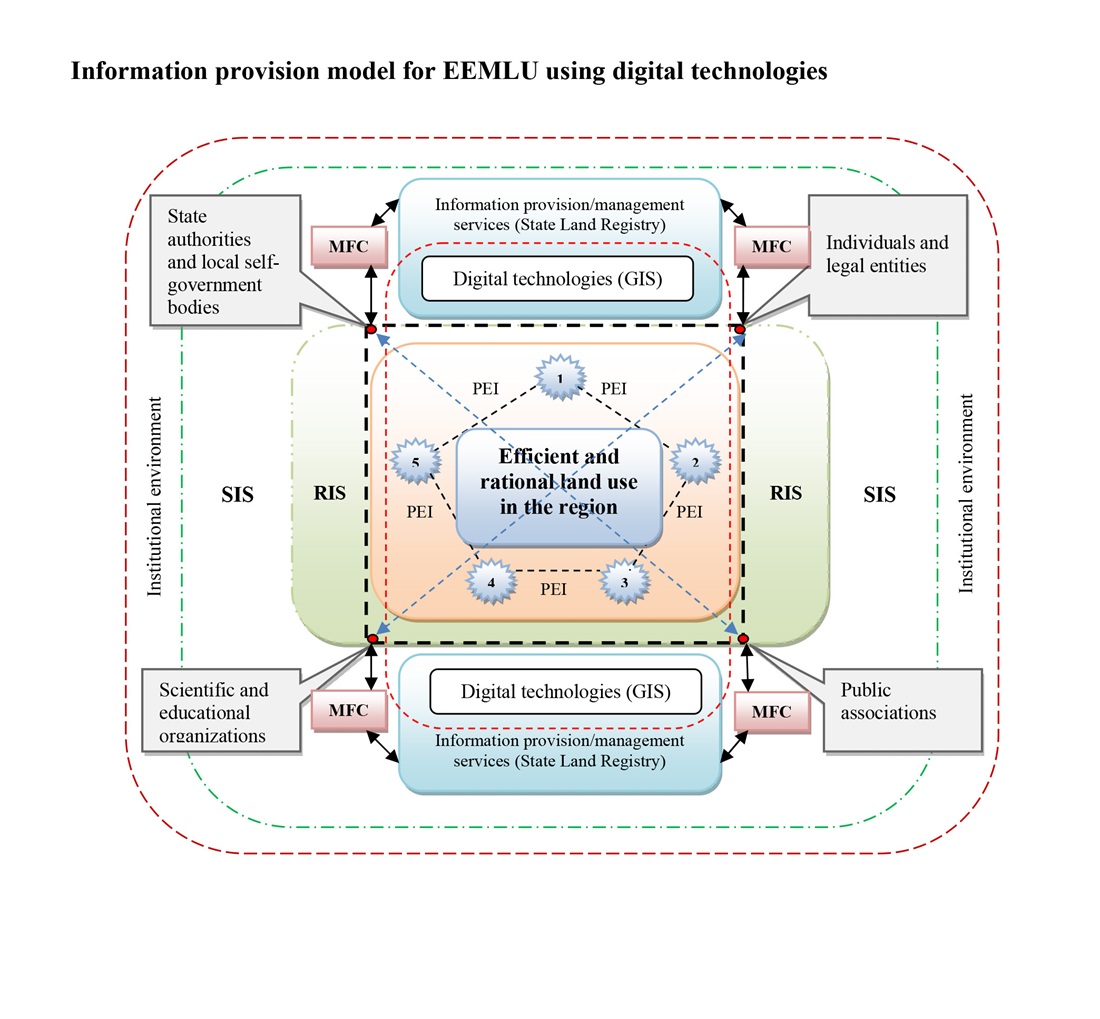
The feasibility of a conceptual approach to improving EEMLU information support at various levels of management has been substantiated. A multi-level land information system has been designed, categorized by type and content, and consolidated into a single information space (SIS), taking into account regional characteristics.
An approach to designing an EEMLU information support system has been proposed, taking into account the potential of the latest digital technologies and the principles of open data. The principles of forming and functioning of information support were outlined and categorized; the factors influencing its effectiveness were systematized.
An algorithm has been developed to enhance the significance of land efficiency assessment methods through the use of integrated indicators, which enables comprehensive consideration of the environmental, economic, and social outcomes of land use. A model has been built to substantiate the effectiveness of EEMLU information support, which makes it possible to assess the range of benefits for all participants in land and property relations.
The results are attributed to a comprehensive approach that took into account regional characteristics and modern information and analytical tools. The findings could be practically implemented provided that a SIS for land resources is constructed and the proposed model is applied in state and local government, taking into account regional characteristics, in order to improve the effectiveness of land use assessment
References
- Yarmol, L., Baik, O., Bernaziuk, O., Stetsyuk, N., Ilkiv, N. (2024). The right to a safe environment: economic and legal guarantees of provision in Ukraine. Naukovyi Visnyk Natsionalnoho Hirnychoho Universytetu, 4, 106–113. https://doi.org/10.33271/nvngu/2024-4/106
- Hryhoruk, I., Yakubiv, V., Sydoryk, Y., Maksymiv, Y., Popadynets, N. (2021). Modelling of prognosis for bioenergy production in Ukraine. International Journal of Energy Economics and Policy, 11 (6), 27–34. https://doi.org/10.32479/ijeep.11741
- Rajasekaran, R., Agarwal, R., Srivastava, A., Ivanyshyn, V., Masih, J., Yasinetska, I. (2020). Intelligent smart farming and crop visualization. Independent Journal of Management & Production, 11 (9), 2470–2482. https://doi.org/10.14807/ijmp.v11i9.1420
- Melnyk, V., Hrebenozhko, V. (2024). Fiscal Mechanism for Countering Negative Environmental Externalities. Journal of Vasyl Stefanyk Precarpathian National University, 11 (4), 111–121. https://doi.org/10.15330/jpnu.11.4.111-121
- Gazuda, S., Hotra, V., Gazuda, M., Kovalska, L., Kifor, H., Omarov, S. (2024). Assessment of the potential of agricultural regions as a prerequisite for the formation and development of their branding. Management Theory and Studies for Rural Business and Infrastructure Development, 46 (2), 122–130. https://doi.org/10.15544/mts.2024.13
- Hurnyak, I., Hrytsyshyn, A., Kuzenko, N., Moskalyk, L., Tsapko-Piddubna, O., Yemelyanova, L. (2024). Transformational processes in resource-rich countries: from natural resources to innovation and technology-based economy. Financial and Credit Activity Problems of Theory and Practice, 2 (55), 317–332. https://doi.org/10.55643/fcaptp.2.55.2024.4329
- Sobol, S. (2023). Environmental Policy and Sustainable Development: Challenges and Prospects for Ukraine. World scientific and technical trends, 1, 65–66. https://doi.org/10.30890/2709-1783.2023-30-00-013
- Truba, V. I., Bernaziuk, O. O., Yesimov, S. S., Zilnyk, N. M., Tarnavska, M. I. (2023). The legal mechanism for environmental protection in Ukraine. Naukovyi Visnyk Natsionalnoho Hirnychoho Universytetu, 5, 114–121. https://doi.org/10.33271/nvngu/2023-5/114
- Sukach, O., Sarana, L., Savchenko, S. (2024). The influence of financial innovations on the development of the financial services market. Scientific Bulletin of International Association of Scientists. Series: Economy, Management, Security, Technologies, 3 (1). https://doi.org/10.56197/2786-5827/2024-3-1-6
- Yasinetska, I., Kushniruk, T., Kharchenko, O. (2024). Multifactor approach to the development of rational land use methodology. Social Economics, 68, 105–114. https://doi.org/10.26565/2524-2547-2024-68-09
- Okhota, Y., Chikov, I., Bilokinna, I. (2024). Conceptual polycomponent model of an innovative mechanism for improving the competitiveness of agro-industrial complex enterprises. Baltic Journal of Economic Studies, 10 (2), 196–210. https://doi.org/10.30525/2256-0742/2024-10-2-196-210
- Artyushok, K., Verstiak, A., Kravchuk, P., Dorofyeyev, O., Polova, O., Kapelista, I. (2023). Institutional security in relations of ownership of natural resources: state environmental and economic policy and decentralization. Financial and Credit Activity Problems of Theory and Practice, 6 (53), 376–391. https://doi.org/10.55643/fcaptp.6.53.2023.4233
- Blahun, I. I., Suduk, N. V. (2022). Land resources as a component of the country’s economic potential. Scientific Perspectives, 6 (24), 230–241. https://doi.org/10.52058/2708-7530-2022-6(24)-230-241
- Liu, Y., Timo de Vries, W., Zhang, G., Cui, X. (2024). From tradition to smart: A comprehensive review of the evolution and prospects of land use planning tools. Heliyon, 10 (23), e40857. https://doi.org/10.1016/j.heliyon.2024.e40857
- Yasinetska, I., Kushniruk, T., Hryb, V. V. (2025). Use of digital technologies in land resources management. Review of transport economics and management, 12 (28), 164–173. https://doi.org/10.15802/rtem2024/327794
- Danshyna, S., Cheranovskiy, V. (2022). Formalizing the land inventory process for information support of land projects management. Radioelectronic And Computer Systems, 3, 7–19. https://doi.org/10.32620/reks.2022.3.01
- Ostrovska, H., Tsikh, H., Strutynska, I., Kinash, I., Pietukhova, O., Golovnya, О., Shehynska, N. (2021). Building an effective model of intelligent entrepreneurship development in digital economy. Eastern-European Journal of Enterprise Technologies, 6 (13 (114)), 49–59. https://doi.org/10.15587/1729-4061.2021.244916
- Kravchuk, O., Nesterenko, S., Kasyanov, V. (2024). Monitoring and administration of urban environment using geoinformation Technologies. Deutsche Internationale Zeitschrift Für Zeitgenössische Wissenschaft, 83, 46–50. https://doi.org/10.5281/zenodo.12657254
- Ostrovska, H. Y., Verbovska, L. S., Tarayevska, L. S., Haliuk, I. B., Petryna, M. J. (2025). Building a technological ecosystem in the context of digital transformation. Naukovyi Visnyk Natsionalnoho Hirnychoho Universytetu, 4, 195–205. https://doi.org/10.33271/nvngu/2025-4/195
- Ostrovska, H. Y., Shelestovskyi, B. G., Pietukhova, O. M., Yasinetska, I. A., Tarayevska, L. S. (2024). Intellectual potential assessing methodology of an innovation-oriented enterprise. Naukovyi Visnyk Natsionalnoho Hirnychoho Universytetu, 4, 141–148. https://doi.org/10.33271/nvngu/2024-4/141
Downloads
Published
How to Cite
Issue
Section
License
Copyright (c) 2025 Halyna Ostrovska, Iryna Yasinetska, Tetiana Kushniruk, Volodymyr Hryb, Oleksandr Kharchenko

This work is licensed under a Creative Commons Attribution 4.0 International License.
The consolidation and conditions for the transfer of copyright (identification of authorship) is carried out in the License Agreement. In particular, the authors reserve the right to the authorship of their manuscript and transfer the first publication of this work to the journal under the terms of the Creative Commons CC BY license. At the same time, they have the right to conclude on their own additional agreements concerning the non-exclusive distribution of the work in the form in which it was published by this journal, but provided that the link to the first publication of the article in this journal is preserved.
A license agreement is a document in which the author warrants that he/she owns all copyright for the work (manuscript, article, etc.).
The authors, signing the License Agreement with TECHNOLOGY CENTER PC, have all rights to the further use of their work, provided that they link to our edition in which the work was published.
According to the terms of the License Agreement, the Publisher TECHNOLOGY CENTER PC does not take away your copyrights and receives permission from the authors to use and dissemination of the publication through the world's scientific resources (own electronic resources, scientometric databases, repositories, libraries, etc.).
In the absence of a signed License Agreement or in the absence of this agreement of identifiers allowing to identify the identity of the author, the editors have no right to work with the manuscript.
It is important to remember that there is another type of agreement between authors and publishers – when copyright is transferred from the authors to the publisher. In this case, the authors lose ownership of their work and may not use it in any way.








