Assessment of energy efficiency and environmental performance of led light sources by the ecodesign methods
DOI:
https://doi.org/10.15587/1729-4061.2025.348864Keywords:
light sources, lighting systems, LED lighting systems, light pollution, environmentAbstract
The object of the study is the processes and factors that determine the energy efficiency and environmental friendliness of LED light sources and contribute to reducing negative impacts on the environment and human health.
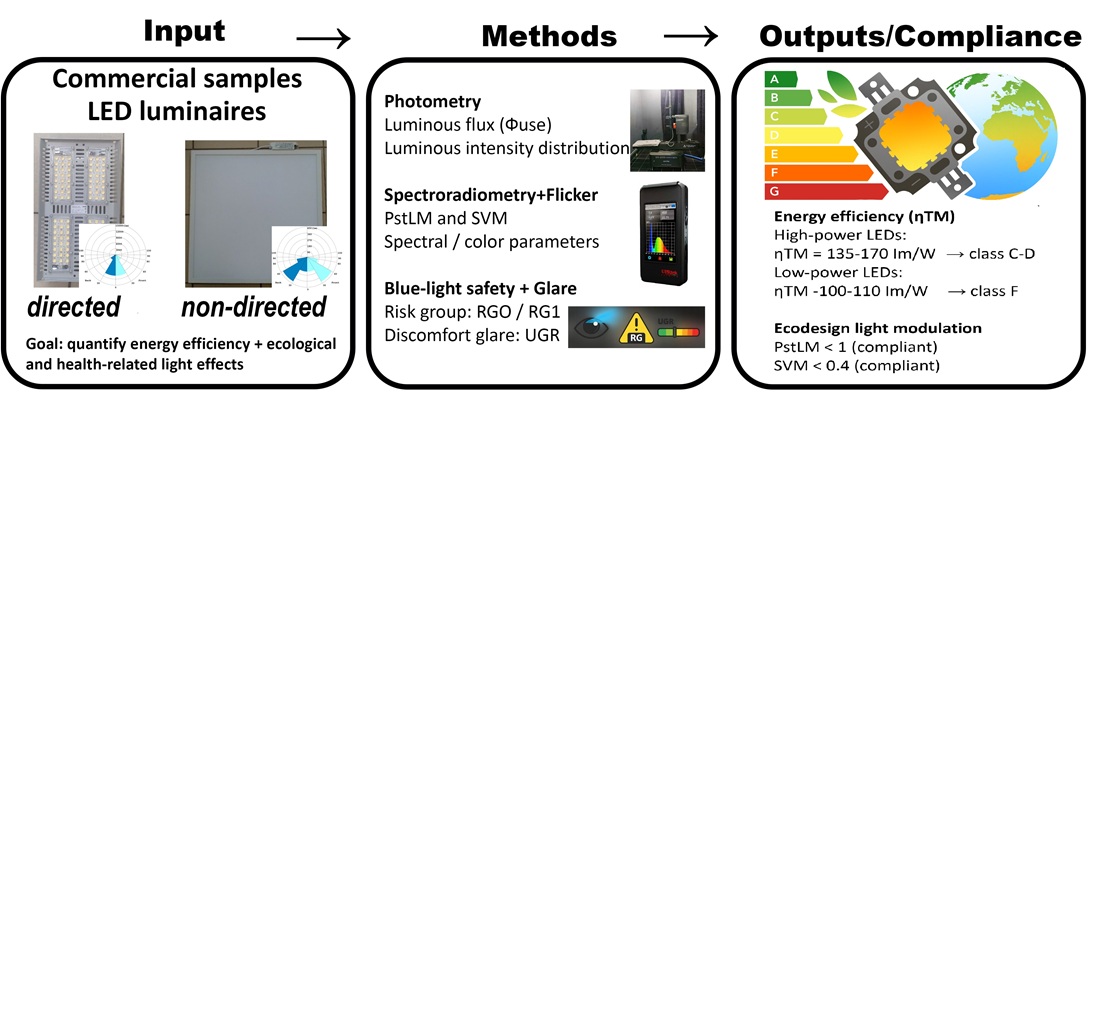
The work investigated the levels of energy efficiency and environmental friendliness of commercial samples of LED luminaires for compliance with the requirements of the EU Commission Regulations on Energy Labeling No. 2019/2015 and on Ecodesign No. 2019/2020. The network efficiency coefficient hTM (lm/W) was taken as the energy efficiency criterion. The main environmental friendliness criteria: the limit level of flicker luminance PstLM and the visibility of the stroboscopic effect SVM are established by the EU Commission Regulation No. 2019/2020; the limit level of blue light hazard should not exceed the risk group RG1 according to EN 62471:2018; the limit levels of the Unified Glare Rating UGR according to ISO 8995-1:2025.
LED luminaires using high-power LEDs have a hTM coefficient of 135–170 lm/W and comply with energy efficiency classes D and C according to Commission Regulation EU No. 2019/2015. The hTM coefficient of luminaires with low-power LEDs is 100 lm/W, energy efficiency class F.
Luminaires with low-power LEDs correspond to the RG0 risk group in terms of blue light safety, and luminaires with high-power LEDs correspond to the RG1 risk group. All tested luminaires meet the requirements of Commission Regulation EU No. 2019/2020 in terms of flicker luminance and visibility of the stroboscopic effect (PstLM < 1, SVM < 0.4). Light exceeding the established limit values for these indicators has a negative impact on health and can be classified as light pollution.
Light sources have the greatest impact on the environment as a result of the consumption of electrical energy
References
- Foster, G. (2020). Circular economy strategies for adaptive reuse of cultural heritage buildings to reduce environmental impacts. Resources, Conservation and Recycling, 152, 104507. https://doi.org/10.1016/j.resconrec.2019.104507
- Sompolska-Rzechuła, A., Bąk, I., Becker, A., Marjak, H., Perzyńska, J. (2024). The Use of Renewable Energy Sources and Environmental Degradation in EU Countries. Sustainability, 16 (23), 10416. https://doi.org/10.3390/su162310416
- Document 32009L0125. Directive 2009/125/EC of the European Parliament and of the Council of 21 October 2009 establishing a framework for the setting of ecodesign requirements for energy-related products (recast). Available at: https://eur-lex.europa.eu/eli/dir/2009/125/oj/eng
- Document 32024R1781. Regulation (EU) 2024/1781 of the European Parliament and of the Council of 13 June 2024 establishing a framework for the setting of ecodesign requirements for sustainable products, amending Directive (EU) 2020/1828 and Regulation (EU) 2023/1542 and repealing Directive 2009/125/EC. Available at: https://eur-lex.europa.eu/eli/reg/2024/1781/oj/eng
- Wu, Y., Su, D. (2021). LCA of an industrial luminaire using product environmental footprint method. Journal of Cleaner Production, 305, 127159. https://doi.org/10.1016/j.jclepro.2021.127159
- Lozano-Miralles, J. A., Hermoso-Orzáez, M. J., Gago-Calderón, A., Brito, P. (2019). LCA Case Study to LED Outdoor Luminaries as a Circular Economy Solution to Local Scale. Sustainability, 12 (1), 190. https://doi.org/10.3390/su12010190
- Franz, M., Wenzl, F. P. (2017). Critical review on life cycle inventories and environmental assessments of LED-lamps. Critical Reviews in Environmental Science and Technology, 47 (21), 2017–2078. https://doi.org/10.1080/10643389.2017.1370989
- Hölker, F., Jechow, A., Schroer, S., Tockner, K., Gessner, M. O. (2023). Light pollution of freshwater ecosystems: principles, ecological impacts and remedies. Philosophical Transactions of the Royal Society B: Biological Sciences, 378 (1892). https://doi.org/10.1098/rstb.2022.0360
- Widmer, K., Beloconi, A., Marnane, I., Vounatsou, P. (2022). Review and Assessment of Available Information on Light Pollution in Europe. ETC HE Report 2022/8. Zenodo. https://doi.org/10.5281/zenodo.7314224
- Document 32019R2020. Commission Regulation (EU) 2019/2020 of 1 October 2019 laying down ecodesign requirements for light sources and separate control gears pursuant to Directive 2009/125/EC of the European Parliament and of the Council and repealing Commission Regulations (EC) No 244/2009, (EC) No 245/2009 and (EU) No 1194/2012. Available at: https://eur-lex.europa.eu/eli/reg/2019/2020/oj/eng
- Document 32019R2015. Commission Delegated Regulation (EU) 2019/2015 of 11 March 2019 supplementing Regulation (EU) 2017/1369 of the European Parliament and of the Council with regard to energy labelling of light sources and repealing Commission Delegated Regulation (EU) No 874/2012. Available at: https://eur-lex.europa.eu/eli/reg_del/2019/2015/oj/eng
- Baghirov, S., Kharchenko, V., Shpak, S., Pitiakov, O., Kyslytsia, S., Sakhno, Т., Kozhushko, H. (2025). Influence of Eco-Design Policy and Energy Labeling on the Level of Energy Efficiency and Functionality of Led Lamps. Latvian Journal of Physics and Technical Sciences, 62 (2), 42–59. https://doi.org/10.2478/lpts-2025-0012
- Shang, Y.-M., Wang, G.-S., Sliney, D. H., Yang, C.-H., Lee, L.-L. (2017). Light-emitting-diode induced retinal damage and its wavelength dependency in vivo. International Journal of Ophthalmology, 10 (2), 191–202. https://doi.org/10.18240/ijo.2017.02.03
- Krigel, A., Berdugo, M., Picard, E., Levy-Boukris, R., Jaadane, I., Jonet, L. et al. (2016). Light-induced retinal damage using different light sources, protocols and rat strains reveals LED phototoxicity. Neuroscience, 339, 296–307. https://doi.org/10.1016/j.neuroscience.2016.10.015
- Ratnayake, K., Payton, J. L., Lakmal, O. H., Karunarathne, A. (2018). Blue light excited retinal intercepts cellular signaling. Scientific Reports, 8 (1). https://doi.org/10.1038/s41598-018-28254-8
- Batra, S., Pandav, C. S., Ahuja, S. (2019). Light Emitting Diode Lighting Flicker, its Impact on Health and the Need to Minimise it. Journal of Clinical and Diagnostic Research. https://doi.org/10.7860/jcdr/2019/41491.12880
- Baghirov, S. Pitiakov, O., Shpak, S., Kyslytsia, S., Sakhno, T., Kozhushko, H. (2023). Research of Problems Flicker Level of LED Lamps and Luminaires for General Lighting. Przegląd Elektrotechniczny, 1 (12), 121–125. https://doi.org/10.15199/48.2023.12.22
- Gaston, K. J., Ackermann, S., Bennie, J., Cox, D. T. C., Phillips, B. B., Sánchez de Miguel, A., Sanders, D. (2021). Pervasiveness of Biological Impacts of Artificial Light at Night. Integrative and Comparative Biology, 61 (3), 1098–1110. https://doi.org/10.1093/icb/icab145
- climate & energy framework (2020). European Commission. Available at: https://build-up.ec.europa.eu/en/resources-and-tools/links/2030-climate-energy-framework
- Baghirov, S., Kharchenko, V., Shpak, S., Kyslytsia, S., Shefer, O., Kozhushko, H. (2024) Investigation of discomfort and dazzling glare from led lighting systems. International Journal on “Technical and Physical Problems of Engineering” (IJTPE), 16 (4 (61)). Available at: https://www.researchgate.net/publication/391209156
- Kohko, S., Ayama, M., Iwata, M., Kyoto, N., Toyota, T. (2015). Study on Evaluation of LED Lighting Glare in Pedestrian Zones. Journal of Light & Visual Environment, 39, 15–25. https://doi.org/10.2150/jlve.ieij150000566
- Abboushi, B., Miller, N. (2022). What to measure and report in studies of discomfort from glare for pedestrian applications. Lighting Research & Technology, 56 (3), 250–259. https://doi.org/10.1177/14771535221087133
- Cougnard-Gregoire, A., Merle, B. M. J., Aslam, T., Seddon, J. M., Aknin, I., Klaver, C. C. W. et al. (2023). Blue Light Exposure: Ocular Hazards and Prevention – A Narrative Review. Ophthalmology and Therapy, 12 (2), 755–788. https://doi.org/10.1007/s40123-023-00675-3
- Position Statement on the Blue Light Hazard (April 23, 2019). Vienna. Available at: https://cie.co.at/publications/position-statement-blue-light-hazard-april-23-2019
- Lo Verso, V. R. M., Pellegrino, A. (2019). Energy Saving Generated Through Automatic Lighting Control Systems According to the Estimation Method of the Standard EN 15193-1. Journal of Daylighting, 6 (2), 131–147. https://doi.org/10.15627/jd.2019.13
- Sakhno, T. V., Kozhushko, G. M., Nazarenko, V. I. (2024). Light pollution from led lighting systems and ways of reducing its environmental consequences. Ukrainian Journal of Occupational Health, 20 (2), 138–147. https://doi.org/10.33573/ujoh2024.02.138
Downloads
Published
How to Cite
Issue
Section
License
Copyright (c) 2025 Vasyl Nazarenko, Viktor Sorokin, Demyd Pekur, Svitlana Shpak, Iuliia Basova, Sabir Baghirov, Gregory Kozhushko

This work is licensed under a Creative Commons Attribution 4.0 International License.
The consolidation and conditions for the transfer of copyright (identification of authorship) is carried out in the License Agreement. In particular, the authors reserve the right to the authorship of their manuscript and transfer the first publication of this work to the journal under the terms of the Creative Commons CC BY license. At the same time, they have the right to conclude on their own additional agreements concerning the non-exclusive distribution of the work in the form in which it was published by this journal, but provided that the link to the first publication of the article in this journal is preserved.
A license agreement is a document in which the author warrants that he/she owns all copyright for the work (manuscript, article, etc.).
The authors, signing the License Agreement with TECHNOLOGY CENTER PC, have all rights to the further use of their work, provided that they link to our edition in which the work was published.
According to the terms of the License Agreement, the Publisher TECHNOLOGY CENTER PC does not take away your copyrights and receives permission from the authors to use and dissemination of the publication through the world's scientific resources (own electronic resources, scientometric databases, repositories, libraries, etc.).
In the absence of a signed License Agreement or in the absence of this agreement of identifiers allowing to identify the identity of the author, the editors have no right to work with the manuscript.
It is important to remember that there is another type of agreement between authors and publishers – when copyright is transferred from the authors to the publisher. In this case, the authors lose ownership of their work and may not use it in any way.








