Patterns in the formation and parameterization of the fracture system emerging during a multi-stage hydraulic fracturing in tight reservoirs under different modeling approaches
DOI:
https://doi.org/10.15587/1729-4061.2026.350413Keywords:
explicit modeling, reservoirs with low permeability, multi-stage hydraulic fracturing, shadow fracturing effectAbstract
A system of artificially created fractures formed during multi-stage hydraulic fracturing in a low-permeable gas-saturated reservoirs has been investigated in this study. The task addressed is to parameterize the object under consideration given limited input geomechanical information.
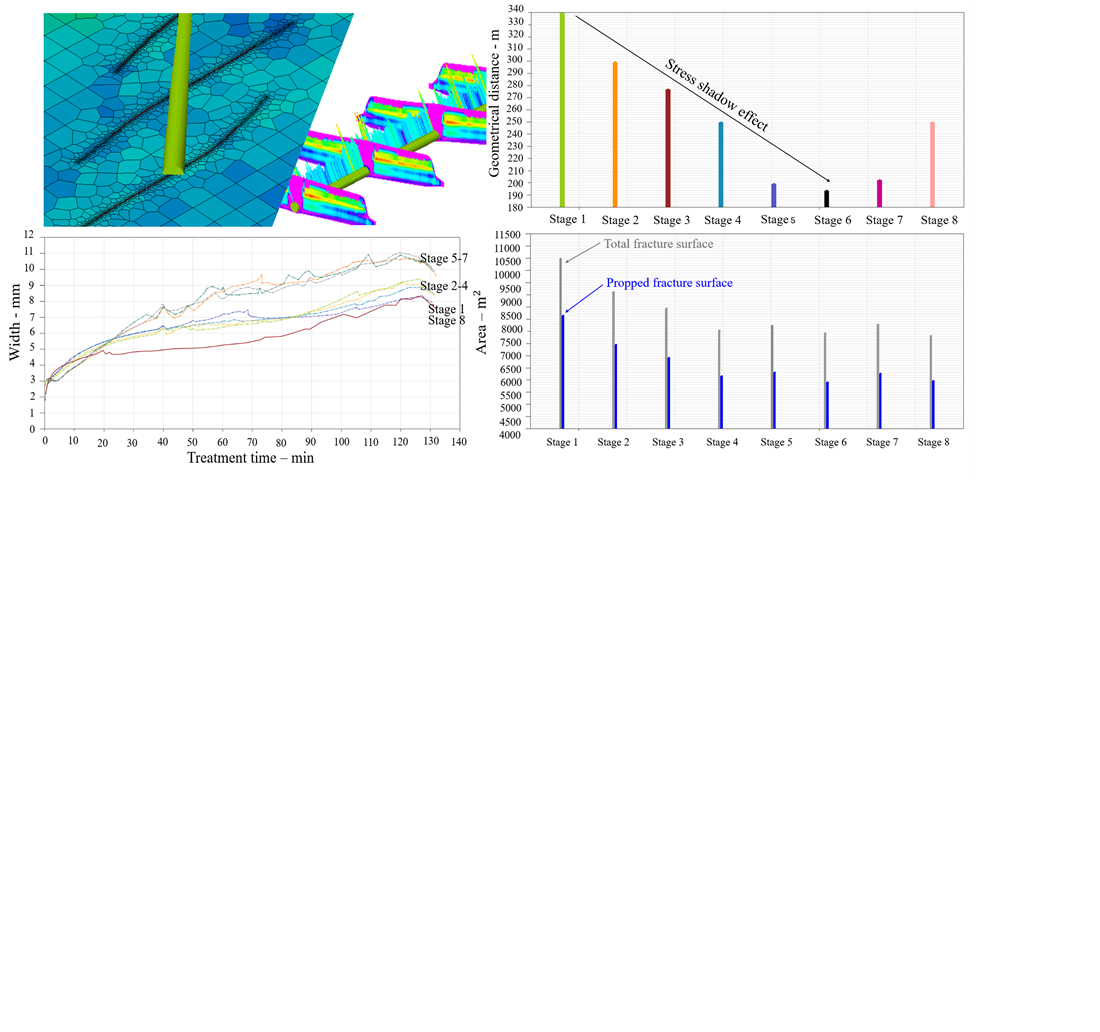
The results of hydraulic fractures modeling have been obtained, as well as their geometric and filtration parameters, by using analytical and explicit numerical methods. Interpretation of the findings revealed the limitations in analytical methods when considering the geomechanical properties of rocks; specifically, their reservoir and geomechanical heterogeneities and stimulation design. The consequence is the greatly increased uncertainty in production forecasting because fractures are represented by average values of key parameters (L = 120–330 m, w = 2.4–7.8 mm) for determining well productivity.
The explicit method demonstrated higher flexibility and adaptability depending on the available input data. The average results, which were obtained by applying both methods, showed similarity between key parameters (L = 199–339 m, w = 7–10 mm, Cf = 774–1098 mD*m), which confirms these methods' validity. However, the ability of the explicit modeling approach to provide a detailed description of key fracture parameters, including 3D geometry, variation of fracture width (w = 3–11 mm), and proppant saturation over the fractured area (Cp = 75%), gives a higher priority to this method during research.
The use of an explicit method, in contrast to the analytical one, makes it possible to determine the asymmetry of the fracture flanks, relative to the direction of the minimum horizontal stress, the change in thickness and permeability along the fracture, the distribution and concentration of proppant. All this leads to an uncertainty ranges reduction in the production forecast from horizontal wells with multi-stage hydraulic fracturing, during the development of shale reservoirs. This is the next step for further use of the results.
References
- Chen, B., Barboza, B. R., Sun, Y., Bai, J., Thomas, H. R., Dutko, M., Cottrell, M., Li, C. (2021). A Review of Hydraulic Fracturing Simulation. Archives of Computational Methods in Engineering, 29 (4), 1–58. https://doi.org/10.1007/s11831-021-09653-z
- Ju, Y., Wu, G., Wang, Y., Liu, P., Yang, Y. (2021). 3D Numerical Model for Hydraulic Fracture Propagation in Tight Ductile Reservoirs, Considering Multiple Influencing Factors via the Entropy Weight Method. SPE Journal, 26 (05), 2685–2702. https://doi.org/10.2118/205385-pa
- Hu, Y., Li, X., Zhang, Z., He, J., Li, G. (2021). Numerical modeling of complex hydraulic fracture networks based on the discontinuous deformation analysis (DDA) method. Energy Exploration & Exploitation, 39 (5), 1640–1665. https://doi.org/10.1177/0144598720981532
- Liu, C., Wang, Z. (2022). Numerical simulation of hydraulic fracture propagation in shale with plastic deformation. International Journal of Fracture, 238 (2), 115–132. https://doi.org/10.1007/s10704-022-00659-7
- State Research and Development Enterprise “State Geological Information Fund of Ukraine”. Available at: https://geoinf.kiev.ua/wp/index-eng.html
- Ukraine Oil & Gas Industry Guide 2021. Embracing investment opportunities. Available at: https://www.geo.gov.ua/wp-content/uploads/presentations/en/oil-and-gas-guide-2021.pdf
- Adachi, J., Siebrits, E., Peirce, A., Desroches, J. (2007). Computer simulation of hydraulic fractures. International Journal of Rock Mechanics and Mining Sciences, 44 (5), 739–757. https://doi.org/10.1016/j.ijrmms.2006.11.006
- Li, W., Liang, Z., Zhao, C. (2025). Hydraulic fracturing of reservoirs containing rough discrete fracture networks: FDEM-UPM approach. Journal of Rock Mechanics and Geotechnical Engineering. https://doi.org/10.1016/j.jrmge.2025.05.023
- Zhang, R.-H., Zhang, L.-H., Wang, R.-H., Zhao, Y.-L., Huang, R. (2018). Simulation of a multistage fractured horizontal well in a water-bearing tight fractured gas reservoir under non-Darcy flow. Journal of Geophysics and Engineering, 15 (3), 877–894. https://doi.org/10.1088/1742-2140/aaa5ce
- Suri, Y., Zahidul Islam, S., Hossain, M. (2020). Numerical Modelling of Proppant Transport in Hydraulic Fractures. Fluid Dynamics & Materials Processing, 16 (2), 297–337. https://doi.org/10.32604/fdmp.2020.08421
- Shi, X., Huang, H., Zeng, B., Guo, T., Jiang, S. (2022). Perforation cluster spacing optimization with hydraulic fracturing-reservoir simulation modeling in shale gas reservoir. Geomechanics and Geophysics for Geo-Energy and Geo-Resources, 8 (5). https://doi.org/10.1007/s40948-022-00448-5
- Krasnikova, O., Lisny, G., Vyzhva, S. (2021). Current state of application of hydraulic fracturing microseismic monitoring methods. Visnyk of Taras Shevchenko National University of Kyiv. Geology, 4 (95), 64–71. https://doi.org/10.17721/1728-2713.95.08
- Nasiri, A. (2015). A Comparison Study of KGD, PKN and a Modified P3D Model. https://doi.org/10.13140/RG.2.1.3860.7201
- Al Mteiri, S., Suboyin, A., Rahman, M. M., Haroun, M. (2020). Hydraulic Fracture Propagation and Analysis in Heterogeneous Middle Eastern Tight Gas Reservoirs: Influence of Natural Fractures and Well Placement. ACS Omega, 6 (1), 799–815. https://doi.org/10.1021/acsomega.0c05380
- Ibrahim, A. F. (2024). Optimizing cluster spacing in multistage hydraulically fractured shale gas wells: balancing fracture interference and stress shadow impact. Journal of Petroleum Exploration and Production Technology, 14 (7), 2297–2313. https://doi.org/10.1007/s13202-024-01831-6
- Al-Attar, H., Alshadafan, H., Al Kaabi, M., Al Hassani, A., Al Mheiri, S. (2020). Integrated optimum design of hydraulic fracturing for tight hydrocarbon-bearing reservoirs. Journal of Petroleum Exploration and Production Technology, 10 (8), 3347–3361. https://doi.org/10.1007/s13202-020-00990-6
- Shi, X., Ge, X., Gao, Q., Han, S., Zhang, Y., Kong, X. (2024). Numerical simulation of hydraulic fracture propagation from recompletion in refracturing with dynamic stress modeling. Geomechanics and Geophysics for Geo-Energy and Geo-Resources, 10 (1). https://doi.org/10.1007/s40948-024-00880-9
- Sun, C., Zhang, Y., Han, L., Liu, M., Hu, J. (2025). Impacts of fracturing fluid viscosity and injection rate variations on the fracture network propagation in deep coalbed reservoirs. AIP Advances, 15 (6). https://doi.org/10.1063/5.0278402
- Wang, J., Peng, G., Cong, Z., Hu, B. (2023). Hydraulic Fracture Propagation and Proppant Transport Mechanism in Interlayered Reservoir. Energies, 16 (13), 5017. https://doi.org/10.3390/en16135017
- Alajmei, S. (2023). Accurate Prediction of the Proppant Distribution in a Hydraulically Fractured Stage. ACS Omega, 8 (40), 37080–37089. https://doi.org/10.1021/acsomega.3c04509
- Lukin, O., Kondrat, O. (2024). Utilizing well-reservoir pseudo-connections for multi-stage hydraulic fracturing modeling in tight gas saturated formations. Mining of Mineral Deposits, 18 (2), 113–121. https://doi.org/10.33271/mining18.02.113
Downloads
Published
How to Cite
Issue
Section
License
Copyright (c) 2026 Oleh Lukin, Oleksandr Kondrat

This work is licensed under a Creative Commons Attribution 4.0 International License.
The consolidation and conditions for the transfer of copyright (identification of authorship) is carried out in the License Agreement. In particular, the authors reserve the right to the authorship of their manuscript and transfer the first publication of this work to the journal under the terms of the Creative Commons CC BY license. At the same time, they have the right to conclude on their own additional agreements concerning the non-exclusive distribution of the work in the form in which it was published by this journal, but provided that the link to the first publication of the article in this journal is preserved.
A license agreement is a document in which the author warrants that he/she owns all copyright for the work (manuscript, article, etc.).
The authors, signing the License Agreement with TECHNOLOGY CENTER PC, have all rights to the further use of their work, provided that they link to our edition in which the work was published.
According to the terms of the License Agreement, the Publisher TECHNOLOGY CENTER PC does not take away your copyrights and receives permission from the authors to use and dissemination of the publication through the world's scientific resources (own electronic resources, scientometric databases, repositories, libraries, etc.).
In the absence of a signed License Agreement or in the absence of this agreement of identifiers allowing to identify the identity of the author, the editors have no right to work with the manuscript.
It is important to remember that there is another type of agreement between authors and publishers – when copyright is transferred from the authors to the publisher. In this case, the authors lose ownership of their work and may not use it in any way.