Development of immersive life-like virtual environments for next-generation education
DOI:
https://doi.org/10.15587/1729-4061.2026.350506Keywords:
selective realism, rule-based geometric reduction, navigation metrics, immersive STEM educationAbstract
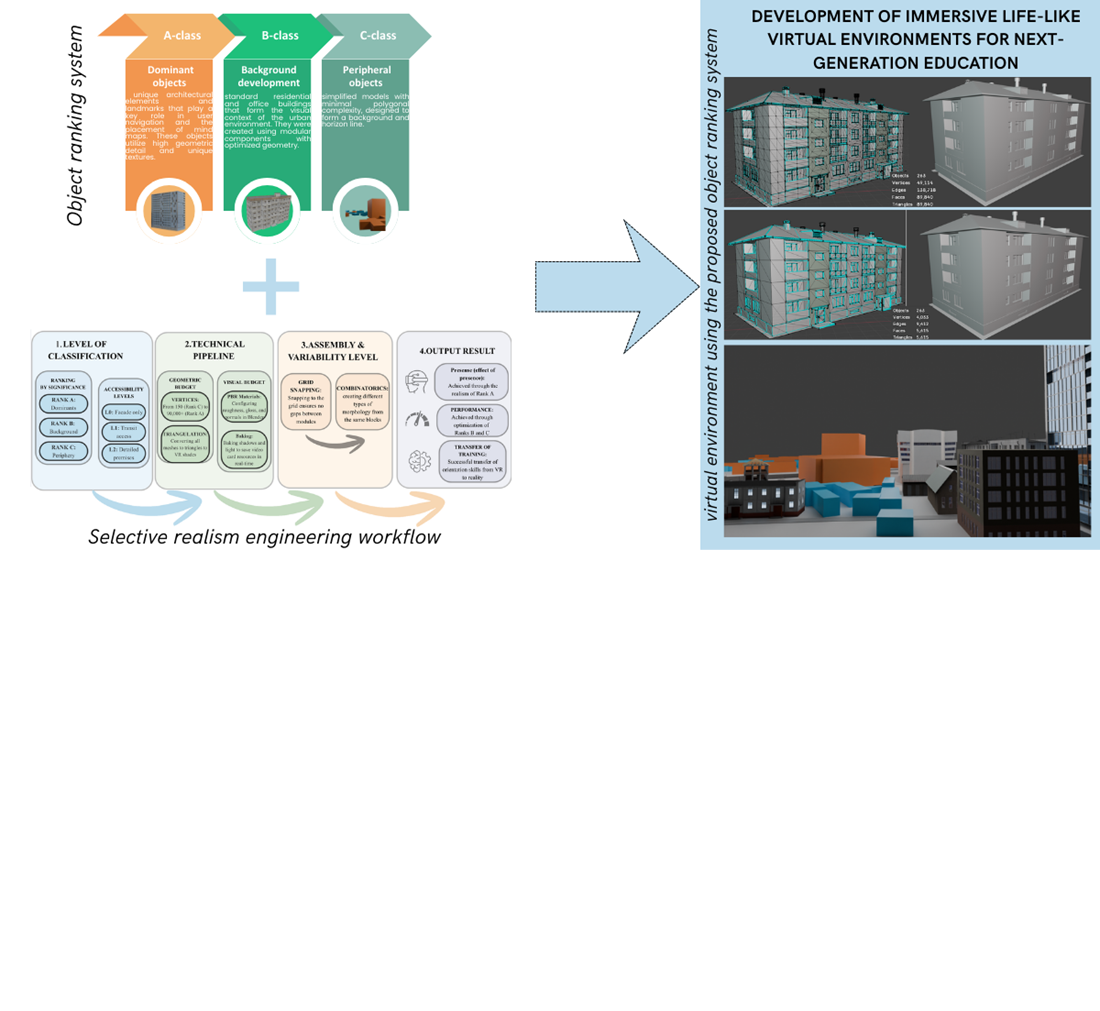
The object of the study was a modular large-scale urban VR system designed for real-time standalone execution. The study addressed the absence of an engineering asset based on modular design and rule-based geometric reduction for developing large-scale urban virtual reality (VR) environments that preserve navigation-relevant realism under standalone real-time performance constraints. Existing study primarily focused on small-scale scenes or treated realism as a global aesthetic property without systematic resource allocation strategies for city-scale environments.
To solve this problem, a rule-based geometric reduction asset grounded in selective realism was developed and experimentally validated. Architectural objects were classified by spatial and functional significance (Classes A-C), and interior accessibility levels were introduced to regulate geometric complexity. A modular urban prototype comprising more than thirty architectural assets was implemented on a unified metric grid.
Geometric reduction decreased vertex count from 49,114 to 4,033 and polygon count from 89,840 to 5,615, representing more than a fifteenfold complexity reduction while preserving object hierarchy. Experimental validation (n = 20) demonstrated high perceived spatial clarity (5.9/7), low navigation error rate (1.3 errors), mean completion time of 4.8 ± 1.2 minutes, and 18% average route deviation. The framework proved applicable to standalone VR education scenarios under strict rendering constraints
References
- Ghoshal, M., Ong, J., Won, H., Koutsonikolas, D., Yildirim, C. (2022). Co-located Immersive Gaming: A Comparison between Augmented and Virtual Reality. 2022 IEEE Conference on Games (CoG), 594–597. https://doi.org/10.1109/cog51982.2022.9893708
- Hawkinson, E. (2023). Automation in Education with Digital Twins: Trends and Issues. International Journal on Open and Distance E-Learning, 8 (2). https://doi.org/10.58887/ijodel.v8i2.229
- Lexman, R. R., Baral, R. (2023). Digital twins in MOOCs: exploring ways to enhance interactivity. Development and Learning in Organizations: An International Journal, 38 (4), 23–26. https://doi.org/10.1108/dlo-04-2023-0091
- Rovati, L., Gary, P. J., Cubro, E., Dong, Y., Kilickaya, O., Schulte, P. J. et al. (2024). Development and usability testing of a patient digital twin for critical care education: a mixed methods study. Frontiers in Medicine, 10. https://doi.org/10.3389/fmed.2023.1336897
- Kim, S. J., Laine, T. H., Suk, H. J. (2021). Presence Effects in Virtual Reality Based on User Characteristics: Attention, Enjoyment, and Memory. Electronics, 10 (9), 1051. https://doi.org/10.3390/electronics10091051
- Psotka, J. (1995). Immersive training systems: Virtual reality and education and training. Instructional Science, 23 (5-6), 405–431. https://doi.org/10.1007/bf00896880
- Slater, M., Wilbur, S. (1997). A Framework for Immersive Virtual Environments (FIVE): Speculations on the Role of Presence in Virtual Environments. Presence: Teleoperators and Virtual Environments, 6 (6), 603–616. https://doi.org/10.1162/pres.1997.6.6.603
- Alexander, A. L., Brunyé, T., Sidman, J., Weil, S. A. (2005). From gaming to training: A review of studies on fidelity, immersion, presence, and buy-in and their effects on transfer in PC-based simulations and games. DARWARS Training Impact Group. Aptima, Inc. https://cs.uky.edu/~sgware/reading/papers/alexander2005gaming.pdf
- Radianti, J., Majchrzak, T. A., Fromm, J., Wohlgenannt, I. (2020). A systematic review of immersive virtual reality applications for higher education: Design elements, lessons learned, and research agenda. Computers & Education, 147, 103778. https://doi.org/10.1016/j.compedu.2019.103778
- Parsons, S. A., Vaughn, M., Scales, R. Q., Gallagher, M. A., Parsons, A. W., Davis, S. G. et al. (2017). Teachers’ Instructional Adaptations: A Research Synthesis. Review of Educational Research, 88 (2), 205–242. https://doi.org/10.3102/0034654317743198
- Dey, A., Phoon, J., Saha, S., Dobbins, C., Billinghurst, M. (2020). Neurophysiological Effects of Presence in Calm Virtual Environments. 2020 IEEE Conference on Virtual Reality and 3D User Interfaces Abstracts and Workshops (VRW), 744–745. https://doi.org/10.1109/vrw50115.2020.00223
- Petersen, G. B., Petkakis, G., Makransky, G. (2022). A study of how immersion and interactivity drive VR learning. Computers & Education, 179, 104429. https://doi.org/10.1016/j.compedu.2021.104429
- Daineko, Y., Tsoy, D., Seitnur, A., Ipalakova, M. (2022). Development of a Mobile e-Learning Platform on Physics Using Augmented Reality Technology. International Journal of Interactive Mobile Technologies (IJIM), 16 (05), 4–18. https://doi.org/10.3991/ijim.v16i05.26961
- Huang, J., Klippel, A. (2020). The Effects of Visual Realism on Spatial Memory and Exploration Patterns in Virtual Reality. 26th ACM Symposium on Virtual Reality Software and Technology, 1–11. https://doi.org/10.1145/3385956.3418945
- Peschel, A. O., Frank, D.-A., Blumenkranz, D., Steinmann, S. (2024). Visual fidelity in the metaverse matters for memory performance. Technological Forecasting and Social Change, 205, 123511. https://doi.org/10.1016/j.techfore.2024.123511
- Slater, M. (2009). Place illusion and plausibility can lead to realistic behaviour in immersive virtual environments. Philosophical Transactions of the Royal Society B: Biological Sciences, 364 (1535), 3549–3557. https://doi.org/10.1098/rstb.2009.0138
- Grassini, S., Laumann, K. (2020). Questionnaire Measures and Physiological Correlates of Presence: A Systematic Review. Frontiers in Psychology, 11. https://doi.org/10.3389/fpsyg.2020.00349
- Makransky, G., Petersen, G. B. (2021). The Cognitive Affective Model of Immersive Learning (CAMIL): a Theoretical Research-Based Model of Learning in Immersive Virtual Reality. Educational Psychology Review, 33 (3), 937–958. https://doi.org/10.1007/s10648-020-09586-2
- Dong, W., Qin, T., Yang, T., Liao, H., Liu, B., Meng, L., Liu, Y. (2021). Wayfinding Behavior and Spatial Knowledge Acquisition: Are They the Same in Virtual Reality and in Real-World Environments? Annals of the American Association of Geographers, 112 (1), 226–246. https://doi.org/10.1080/24694452.2021.1894088
- Feng, Y., Duives, D. C., Hoogendoorn, S. P. (2022). Development and evaluation of a VR research tool to study wayfinding behaviour in a multi-story building. Safety Science, 147, 105573. https://doi.org/10.1016/j.ssci.2021.105573
- Rogla, O., Patow, G. A., Pelechano, N. (2021). Procedural crowd generation for semantically augmented virtual cities. Computers & Graphics, 99, 83–99. https://doi.org/10.1016/j.cag.2021.06.014
- Ding, Y., Song, Y. (2025). Vision-Degree-Driven Loading Strategy for Real-Time Large-Scale Scene Rendering. Computers, 14 (7), 260. https://doi.org/10.3390/computers14070260
- Pan, S., Zhang, R., Liu, Y., Gong, M., Huang, H. (2025). Building LOD representation for 3D urban scenes. ISPRS Journal of Photogrammetry and Remote Sensing, 226, 16–32. https://doi.org/10.1016/j.isprsjprs.2025.04.026
- Mizuho, T., Narumi, T., Kuzuoka, H. (2023). Effects of the Visual Fidelity of Virtual Environments on Presence, Context-dependent Forgetting, and Source-monitoring Error. IEEE Transactions on Visualization and Computer Graphics, 29 (5), 2607–2614. https://doi.org/10.1109/tvcg.2023.3247063
- Austermann, C., Blanckenburg, F., Blanckenburg, K., Utesch, T. (2025). Exploring the impact of virtual reality on presence: findings from a classroom experiment. Frontiers in Education, 10. https://doi.org/10.3389/feduc.2025.1560626
- Hu, X., Wu, X., Ma, M., Xu, X., Gu, Y., Wang, G. et al. (2025). Efficient VR rendering: Survey on foveated, stereo, cloud, and low-power rendering techniques. Virtual Reality & Intelligent Hardware, 7 (5), 421–452. https://doi.org/10.1016/j.vrih.2025.08.003
- Wang, L., Shi, X., Liu, Y. (2023). Foveated rendering: A state-of-the-art survey. Computational Visual Media, 9 (2), 195–228. https://doi.org/10.1007/s41095-022-0306-4
- Najafi, P., Mohammadi, M., van Wesemael, P., Le Blanc, P. M. (2023). A user-centred virtual city information model for inclusive community design: State-of-art. Cities, 134, 104203. https://doi.org/10.1016/j.cities.2023.104203
- Rodriguez-Garcia, B., Miguel-Alonso, I., Guillen-Sanz, H., Bustillo, A. (2025). LoDCalculator: A level of detail classification software for 3D models in the Blender environment. SoftwareX, 30, 102107. https://doi.org/10.1016/j.softx.2025.102107
Downloads
Published
How to Cite
Issue
Section
License
Copyright (c) 2026 Yevgeniya Daineko, Dana Tsoy, Kuandyk Akshulakov, Askar Mustabekov, Evgenij Makarov, Umitkhan Turzhanov, Uali Miras, Regina Sharshova

This work is licensed under a Creative Commons Attribution 4.0 International License.
The consolidation and conditions for the transfer of copyright (identification of authorship) is carried out in the License Agreement. In particular, the authors reserve the right to the authorship of their manuscript and transfer the first publication of this work to the journal under the terms of the Creative Commons CC BY license. At the same time, they have the right to conclude on their own additional agreements concerning the non-exclusive distribution of the work in the form in which it was published by this journal, but provided that the link to the first publication of the article in this journal is preserved.
A license agreement is a document in which the author warrants that he/she owns all copyright for the work (manuscript, article, etc.).
The authors, signing the License Agreement with TECHNOLOGY CENTER PC, have all rights to the further use of their work, provided that they link to our edition in which the work was published.
According to the terms of the License Agreement, the Publisher TECHNOLOGY CENTER PC does not take away your copyrights and receives permission from the authors to use and dissemination of the publication through the world's scientific resources (own electronic resources, scientometric databases, repositories, libraries, etc.).
In the absence of a signed License Agreement or in the absence of this agreement of identifiers allowing to identify the identity of the author, the editors have no right to work with the manuscript.
It is important to remember that there is another type of agreement between authors and publishers – when copyright is transferred from the authors to the publisher. In this case, the authors lose ownership of their work and may not use it in any way.








