Розробка імерсивних реальних віртуальних середовищ для освіти наступного покоління
DOI:
https://doi.org/10.15587/1729-4061.2026.350506Ключові слова:
вибірковий реалізм, геометрична редукція на основі правил, метрики навігації, імерсивна STEM-освітаАнотація
Об’єктом дослідження виступала великомасштабна міська VR-система, розроблена для автономного (standalone) режиму реального часу. У дослідженні розглядалася проблема відсутності структурованої інженерної основи для розробки великомасштабних міських середовищ віртуальної реальності (VR), які б зберігали реалізм, необхідний для навігації, за обмежень продуктивності в реальному часі. Існуючі дослідження в основному зосереджувалися на дрібномасштабних сценах або розглядали реалізм як глобальну естетичну властивість без систематичних стратегій розподілу ресурсів для середовищ міського масштабу.
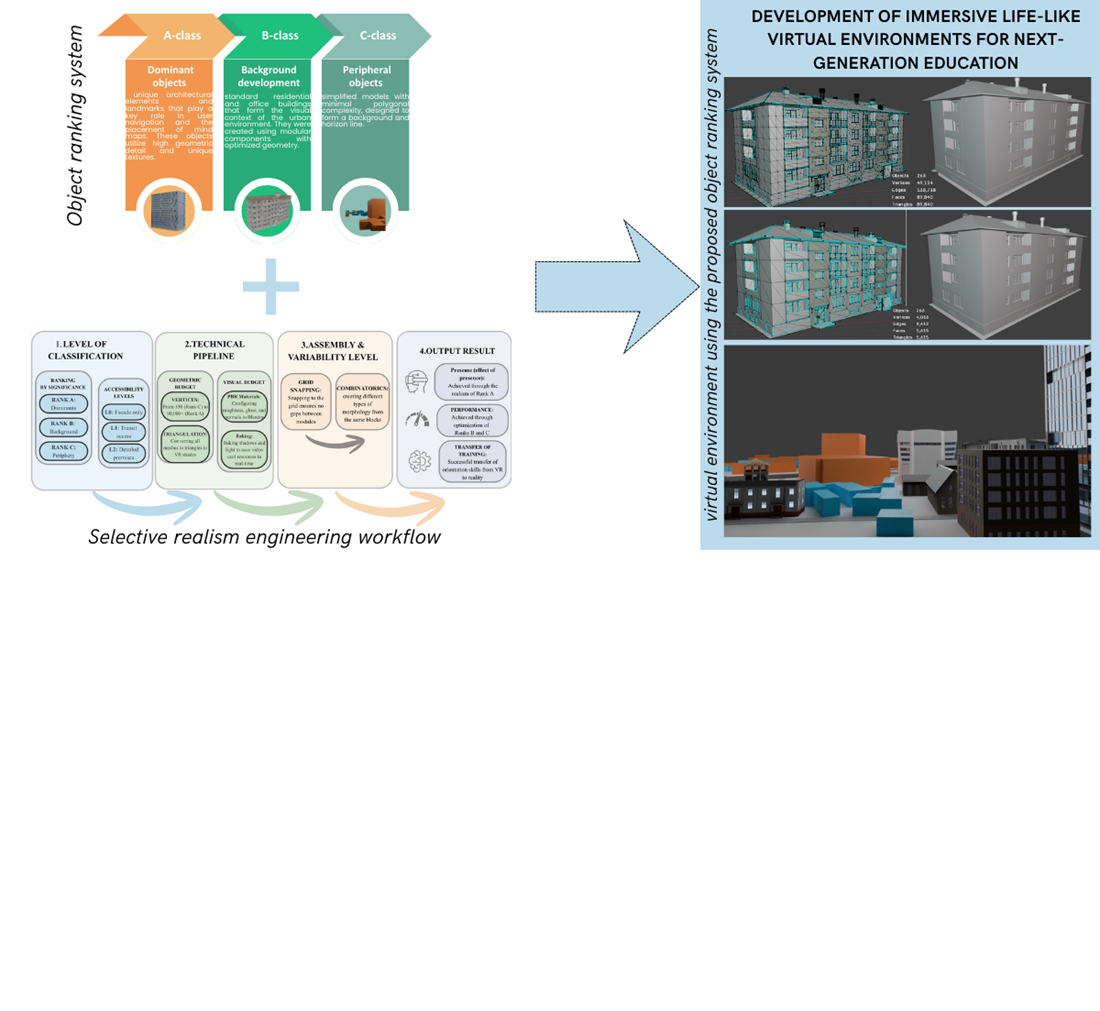
Було розроблено та перевірено масштабовану основу оптимізації, засновану на вибірковому реалізмі. Архітектурні об'єкти були класифіковані за просторовою значущістю (класи A-C), а для контролю геометричної складності були введені рівні доступності всередині. Модульне міське середовище, що складається з понад тридцяти архітектурних об'єктів, було побудовано на єдиній метричній сітці.
Геометрична оптимізація зменшила кількість вершин з 49 114 до 4033, а кількість полігонів — з 89 840 до 5615, що представляє собою більш ніж п'ятнадцятикратне зменшення складності при збереженні структурної композиції. Двадцять учасників експериментальної валідації продемонстрували високу сприйняту просторову чіткість (5,9/7 за шкалою Лікерта), низький рівень помилок навігації (1,3 помилки на учасника), стабільну продуктивність навігації (середній час виконання завдання 4,8 ± 1,2 хвилини) та середнє відхилення маршруту від оптимальних шляхів на 18%.
Результати показали, що оптимізація, заснована на вибірковому реалізмі, значно зменшила обчислювальне навантаження, зберігаючи при цьому когнітивну когерентність та ефективність навігації, тим самим сприяючи створенню масштабованих міських середовищ віртуальної реальності для дослідницьких та навчальних цілей
Посилання
- Ghoshal, M., Ong, J., Won, H., Koutsonikolas, D., Yildirim, C. (2022). Co-located Immersive Gaming: A Comparison between Augmented and Virtual Reality. 2022 IEEE Conference on Games (CoG), 594–597. https://doi.org/10.1109/cog51982.2022.9893708
- Hawkinson, E. (2023). Automation in Education with Digital Twins: Trends and Issues. International Journal on Open and Distance E-Learning, 8 (2). https://doi.org/10.58887/ijodel.v8i2.229
- Lexman, R. R., Baral, R. (2023). Digital twins in MOOCs: exploring ways to enhance interactivity. Development and Learning in Organizations: An International Journal, 38 (4), 23–26. https://doi.org/10.1108/dlo-04-2023-0091
- Rovati, L., Gary, P. J., Cubro, E., Dong, Y., Kilickaya, O., Schulte, P. J. et al. (2024). Development and usability testing of a patient digital twin for critical care education: a mixed methods study. Frontiers in Medicine, 10. https://doi.org/10.3389/fmed.2023.1336897
- Kim, S. J., Laine, T. H., Suk, H. J. (2021). Presence Effects in Virtual Reality Based on User Characteristics: Attention, Enjoyment, and Memory. Electronics, 10 (9), 1051. https://doi.org/10.3390/electronics10091051
- Psotka, J. (1995). Immersive training systems: Virtual reality and education and training. Instructional Science, 23 (5-6), 405–431. https://doi.org/10.1007/bf00896880
- Slater, M., Wilbur, S. (1997). A Framework for Immersive Virtual Environments (FIVE): Speculations on the Role of Presence in Virtual Environments. Presence: Teleoperators and Virtual Environments, 6 (6), 603–616. https://doi.org/10.1162/pres.1997.6.6.603
- Alexander, A. L., Brunyé, T., Sidman, J., Weil, S. A. (2005). From gaming to training: A review of studies on fidelity, immersion, presence, and buy-in and their effects on transfer in PC-based simulations and games. DARWARS Training Impact Group. Aptima, Inc. https://cs.uky.edu/~sgware/reading/papers/alexander2005gaming.pdf
- Radianti, J., Majchrzak, T. A., Fromm, J., Wohlgenannt, I. (2020). A systematic review of immersive virtual reality applications for higher education: Design elements, lessons learned, and research agenda. Computers & Education, 147, 103778. https://doi.org/10.1016/j.compedu.2019.103778
- Parsons, S. A., Vaughn, M., Scales, R. Q., Gallagher, M. A., Parsons, A. W., Davis, S. G. et al. (2017). Teachers’ Instructional Adaptations: A Research Synthesis. Review of Educational Research, 88 (2), 205–242. https://doi.org/10.3102/0034654317743198
- Dey, A., Phoon, J., Saha, S., Dobbins, C., Billinghurst, M. (2020). Neurophysiological Effects of Presence in Calm Virtual Environments. 2020 IEEE Conference on Virtual Reality and 3D User Interfaces Abstracts and Workshops (VRW), 744–745. https://doi.org/10.1109/vrw50115.2020.00223
- Petersen, G. B., Petkakis, G., Makransky, G. (2022). A study of how immersion and interactivity drive VR learning. Computers & Education, 179, 104429. https://doi.org/10.1016/j.compedu.2021.104429
- Daineko, Y., Tsoy, D., Seitnur, A., Ipalakova, M. (2022). Development of a Mobile e-Learning Platform on Physics Using Augmented Reality Technology. International Journal of Interactive Mobile Technologies (IJIM), 16 (05), 4–18. https://doi.org/10.3991/ijim.v16i05.26961
- Huang, J., Klippel, A. (2020). The Effects of Visual Realism on Spatial Memory and Exploration Patterns in Virtual Reality. 26th ACM Symposium on Virtual Reality Software and Technology, 1–11. https://doi.org/10.1145/3385956.3418945
- Peschel, A. O., Frank, D.-A., Blumenkranz, D., Steinmann, S. (2024). Visual fidelity in the metaverse matters for memory performance. Technological Forecasting and Social Change, 205, 123511. https://doi.org/10.1016/j.techfore.2024.123511
- Slater, M. (2009). Place illusion and plausibility can lead to realistic behaviour in immersive virtual environments. Philosophical Transactions of the Royal Society B: Biological Sciences, 364 (1535), 3549–3557. https://doi.org/10.1098/rstb.2009.0138
- Grassini, S., Laumann, K. (2020). Questionnaire Measures and Physiological Correlates of Presence: A Systematic Review. Frontiers in Psychology, 11. https://doi.org/10.3389/fpsyg.2020.00349
- Makransky, G., Petersen, G. B. (2021). The Cognitive Affective Model of Immersive Learning (CAMIL): a Theoretical Research-Based Model of Learning in Immersive Virtual Reality. Educational Psychology Review, 33 (3), 937–958. https://doi.org/10.1007/s10648-020-09586-2
- Dong, W., Qin, T., Yang, T., Liao, H., Liu, B., Meng, L., Liu, Y. (2021). Wayfinding Behavior and Spatial Knowledge Acquisition: Are They the Same in Virtual Reality and in Real-World Environments? Annals of the American Association of Geographers, 112 (1), 226–246. https://doi.org/10.1080/24694452.2021.1894088
- Feng, Y., Duives, D. C., Hoogendoorn, S. P. (2022). Development and evaluation of a VR research tool to study wayfinding behaviour in a multi-story building. Safety Science, 147, 105573. https://doi.org/10.1016/j.ssci.2021.105573
- Rogla, O., Patow, G. A., Pelechano, N. (2021). Procedural crowd generation for semantically augmented virtual cities. Computers & Graphics, 99, 83–99. https://doi.org/10.1016/j.cag.2021.06.014
- Ding, Y., Song, Y. (2025). Vision-Degree-Driven Loading Strategy for Real-Time Large-Scale Scene Rendering. Computers, 14 (7), 260. https://doi.org/10.3390/computers14070260
- Pan, S., Zhang, R., Liu, Y., Gong, M., Huang, H. (2025). Building LOD representation for 3D urban scenes. ISPRS Journal of Photogrammetry and Remote Sensing, 226, 16–32. https://doi.org/10.1016/j.isprsjprs.2025.04.026
- Mizuho, T., Narumi, T., Kuzuoka, H. (2023). Effects of the Visual Fidelity of Virtual Environments on Presence, Context-dependent Forgetting, and Source-monitoring Error. IEEE Transactions on Visualization and Computer Graphics, 29 (5), 2607–2614. https://doi.org/10.1109/tvcg.2023.3247063
- Austermann, C., Blanckenburg, F., Blanckenburg, K., Utesch, T. (2025). Exploring the impact of virtual reality on presence: findings from a classroom experiment. Frontiers in Education, 10. https://doi.org/10.3389/feduc.2025.1560626
- Hu, X., Wu, X., Ma, M., Xu, X., Gu, Y., Wang, G. et al. (2025). Efficient VR rendering: Survey on foveated, stereo, cloud, and low-power rendering techniques. Virtual Reality & Intelligent Hardware, 7 (5), 421–452. https://doi.org/10.1016/j.vrih.2025.08.003
- Wang, L., Shi, X., Liu, Y. (2023). Foveated rendering: A state-of-the-art survey. Computational Visual Media, 9 (2), 195–228. https://doi.org/10.1007/s41095-022-0306-4
- Najafi, P., Mohammadi, M., van Wesemael, P., Le Blanc, P. M. (2023). A user-centred virtual city information model for inclusive community design: State-of-art. Cities, 134, 104203. https://doi.org/10.1016/j.cities.2023.104203
- Rodriguez-Garcia, B., Miguel-Alonso, I., Guillen-Sanz, H., Bustillo, A. (2025). LoDCalculator: A level of detail classification software for 3D models in the Blender environment. SoftwareX, 30, 102107. https://doi.org/10.1016/j.softx.2025.102107
##submission.downloads##
Опубліковано
Як цитувати
Номер
Розділ
Ліцензія
Авторське право (c) 2026 Yevgeniya Daineko, Dana Tsoy, Kuandyk Akshulakov, Askar Mustabekov, Evgenij Makarov, Umitkhan Turzhanov, Uali Miras, Regina Sharshova

Ця робота ліцензується відповідно до Creative Commons Attribution 4.0 International License.
Закріплення та умови передачі авторських прав (ідентифікація авторства) здійснюється у Ліцензійному договорі. Зокрема, автори залишають за собою право на авторство свого рукопису та передають журналу право першої публікації цієї роботи на умовах ліцензії Creative Commons CC BY. При цьому вони мають право укладати самостійно додаткові угоди, що стосуються неексклюзивного поширення роботи у тому вигляді, в якому вона була опублікована цим журналом, але за умови збереження посилання на першу публікацію статті в цьому журналі.
Ліцензійний договір – це документ, в якому автор гарантує, що володіє усіма авторськими правами на твір (рукопис, статтю, тощо).
Автори, підписуючи Ліцензійний договір з ПП «ТЕХНОЛОГІЧНИЙ ЦЕНТР», мають усі права на подальше використання свого твору за умови посилання на наше видання, в якому твір опублікований. Відповідно до умов Ліцензійного договору, Видавець ПП «ТЕХНОЛОГІЧНИЙ ЦЕНТР» не забирає ваші авторські права та отримує від авторів дозвіл на використання та розповсюдження публікації через світові наукові ресурси (власні електронні ресурси, наукометричні бази даних, репозитарії, бібліотеки тощо).
За відсутності підписаного Ліцензійного договору або за відсутністю вказаних в цьому договорі ідентифікаторів, що дають змогу ідентифікувати особу автора, редакція не має права працювати з рукописом.
Важливо пам’ятати, що існує і інший тип угоди між авторами та видавцями – коли авторські права передаються від авторів до видавця. В такому разі автори втрачають права власності на свій твір та не можуть його використовувати в будь-який спосіб.