Development of a method for energy-efficient control of parallel pump units using the covariance matrix adaptation evolution strategy
DOI:
https://doi.org/10.15587/1729-4061.2026.351680Keywords:
parallel pump units, variable frequency drive, energy efficiency, optimization, CMA-ES, constraint handling, MATLABAbstract
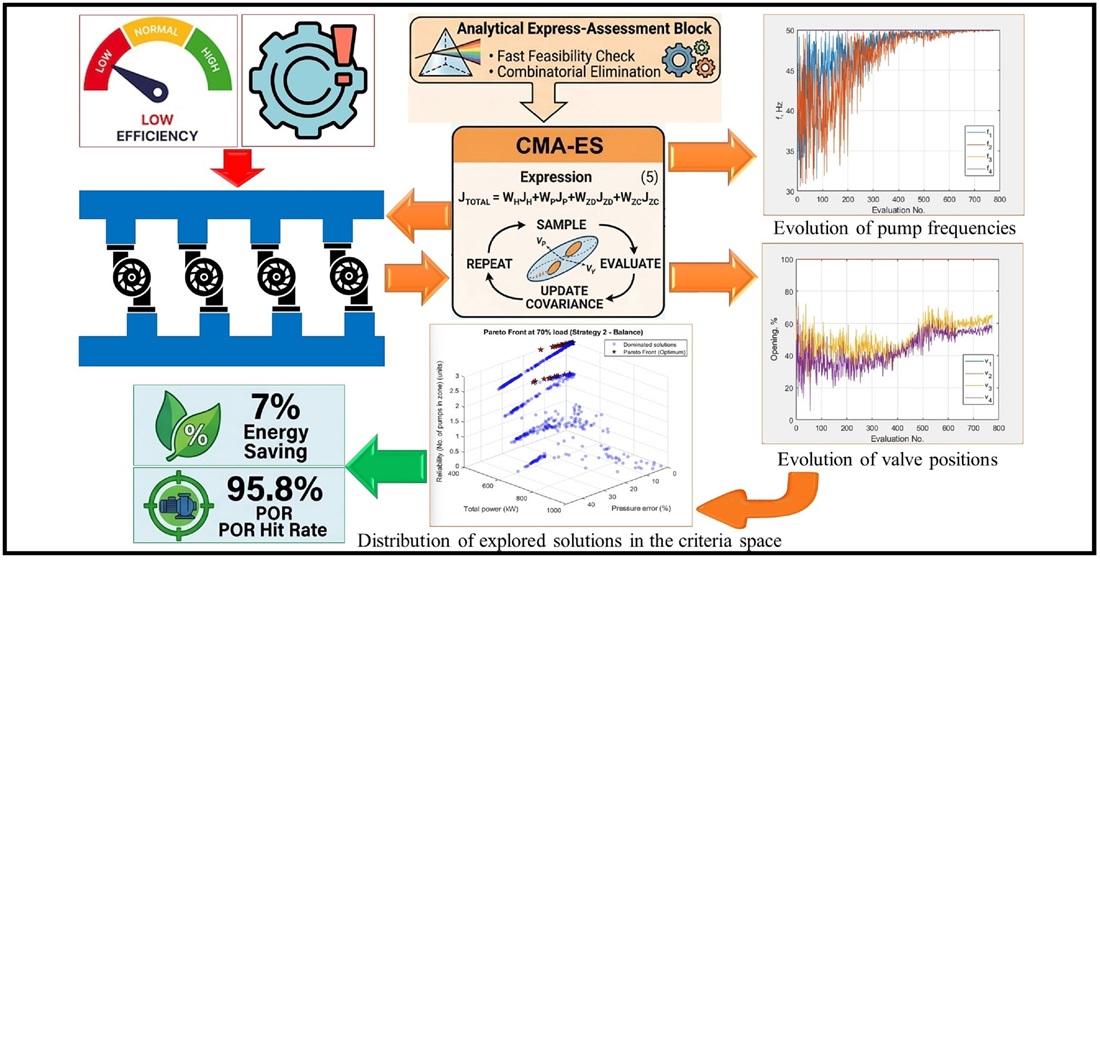
The object of the study is a pumping station with four parallel-connected centrifugal pump units driven by asynchronous electric motors. The problem to be solved is that modern stations, partially equipped with variable frequency drive (VFDs), allow only maintaining the head without observing allowable modes, failing to ensure reliability and energy efficiency. This leads to rapid wear and efficiency reduction. The solution lies in optimizing energy consumption and keeping operating points within the POR (preferred operating region), to prevent accelerated wear.
The essence of the results obtained lies in the development of a method for energy-efficient control based on the CMA-ES strategy integrated with a model in MATLAB (California, USA). Experiments showed that the balanced strategy reduces energy consumption by 7% while maintaining equipment in the POR zone for 95.8% of the time. Comparative analysis showed that a configuration with two VFDs is a rational compromise, limiting energy overconsumption to 25% relative to systems fully equipped with VFDs.
These results allowed to solve the specified problem due to the introduction of a block performing an analytical express assessment of the required number of units based on affinity laws, using adaptive penalty functions and CMA-ES tuning. This allowed excluding combinatorial enumeration and reducing the search time for the optimal solution to 60–80 seconds, ensuring speed unavailable to standard genetic algorithms.
The conditions under which they can be used on practice involve the application of the developed method as a supervisory control (SCADA) for water supply pumping stations to generate control setpoints with a periodicity of 1–2 minutes without the need for complete equipment replacement.
References
- Electric Motor Systems Annex Overview 2019-2024. EMSA. Availbable at: https://www.iea-4e.org/wp-content/uploads/2022/06/EMSA_Policy_Brief_0_updated_2022.pdf
- van Werkhoven, M., Werle, R. (2016). Policy Guidelines for Motor Driven Units. 4E Executive Committee. Available at: https://www.iea-4e.org/wp-content/uploads/2020/12/PGmdu_oct2016.pdf
- Energy-Efficiency Policy Opportunities for Electric Motor-Driven Systems (2011). International Energy Agency (IEA). Available at: https://iea.blob.core.windows.net/assets/d69b2a76-feb9-4a74-a921-2490a8fefcdf/EE_for_ElectricSystems.pdf
- de Almeida, A. T., Ferreira, F. J. T. E., Fong, J. (2023). Perspectives on Electric Motor Market Transformation for a Net Zero Carbon Economy. Energies, 16 (3), 1248. https://doi.org/10.3390/en16031248
- Zdor, G. N., Sinitsyn, A. V., Avrutin, O. A. (2017). Pump group automatic control for reducing its energy consumption. Energetika. Proceedings of CIS Higher Education Institutions and Power Engineering Associations, 60 (1), 54–66. https://doi.org/10.21122/1029-7448-2017-60-1-54-66
- SINAMICS G120X converter. Operating Instructions (2021). Siemens. Available at: https://cache.industry.siemens.com/dl/files/512/109801512/att_1078791/v1/G120X_op_instr_0621_en-US.pdf
- Altivar Process ATV600. Programming Manual (2025). Schneider Electric. Available at: https://download.schneider-electric.com/files?p_Doc_Ref=EAV64318&p_enDocType=User+guide&p_File_Name=ATV600_Programming_Manual_EN_EAV64318_13.pdf
- Barbul, M. L., Staroverov, S. V. (2018). Method for controlling multi-pump stations considering current water consumption. The Eurasian Scientific Journal, 5 (10).
- Elovik, V. L. (2019). Calculation and analyses methodology of the working conditions of pumping units, equipped with adjustable drive. Trudy BGTU, 2 (2), 204–213.
- Voitov, I., Yalovik, V. (2022). Modern methods for calculation and analysis of the operating modes of centrifugal pumps with variable drive as a part of water supply and water drainage systems. Herald of Polotsk State University. Series F. Civil Engineering. Applied Sciences, 31 (8), 2–9. https://doi.org/10.52928/2070-1683-2022-31-8-2-9
- Koor, M., Vassiljev, A., Koppel, T. (2014). Optimal Pump Count Prediction Algorithm for Identical Pumps Working in Parallel Mode. Procedia Engineering, 70, 951–958. https://doi.org/10.1016/j.proeng.2014.02.106
- Wu, P., Lai, Z., Wu, D., Wang, L. (2015). Optimization Research of Parallel Pump System for Improving Energy Efficiency. Journal of Water Resources Planning and Management, 141 (8). https://doi.org/10.1061/(asce)wr.1943-5452.0000493
- Olszewski, P. (2016). Genetic optimization and experimental verification of complex parallel pumping station with centrifugal pumps. Applied Energy, 178, 527–539. https://doi.org/10.1016/j.apenergy.2016.06.084
- Olszewski, P., Arafeh, J. (2018). Parametric analysis of pumping station with parallel-configured centrifugal pumps towards self-learning applications. Applied Energy, 231, 1146–1158. https://doi.org/10.1016/j.apenergy.2018.09.173
- Oshurbekov, S., Kazakbaev, V., Prakht, V., Dmitrievskii, V. (2021). Increasing Service Life and System Efficiency of Parallel Pumps Using Combined Pump Regulation. Water, 13 (13), 1808. https://doi.org/10.3390/w13131808
- Gao, Q., Xue, J., Yan, H. (2022). Optimization Analysis of Full Life Cycle Energy Efficiency Multi-Objective Parallel Pump Sets. IEEE Access, 10, 105578–105588. https://doi.org/10.1109/access.2022.3209381
- Qin, X., Luo, Y., Chen, S., Chen, Y., Han, Y. (2022). Investigation of Energy-Saving Strategy for Parallel Variable Frequency Pump System Based on Improved Differential Evolution Algorithm. Energies, 15 (15), 5360. https://doi.org/10.3390/en15155360
- Sun, X., Feng, X. (2024). Application of intelligent algorithms in optimal operation of pumping stations. Journal of Physics: Conference Series, 2854 (1), 012044. https://doi.org/10.1088/1742-6596/2854/1/012044
- Hansen, N. (2016). The CMA Evolution Strategy: A Tutorial. arXiv. https://doi.org/10.48550/arXiv.1604.00772
- Usachev, A. P. (2018). Metodika otsenki effektivnosti chastotnogo regulirovaniya proizvoditelnosti nasosnykh agregatov. Vodosnabzhenie i sanitarnaya tekhnika, 7, 57–63.
Downloads
Published
How to Cite
Issue
Section
License
Copyright (c) 2026 Yuliya Bulatbayeva, Rauan Kossymbayev, Victoria Tsypkina, Vera Ivanova, Felix Bulatbayev

This work is licensed under a Creative Commons Attribution 4.0 International License.
The consolidation and conditions for the transfer of copyright (identification of authorship) is carried out in the License Agreement. In particular, the authors reserve the right to the authorship of their manuscript and transfer the first publication of this work to the journal under the terms of the Creative Commons CC BY license. At the same time, they have the right to conclude on their own additional agreements concerning the non-exclusive distribution of the work in the form in which it was published by this journal, but provided that the link to the first publication of the article in this journal is preserved.
A license agreement is a document in which the author warrants that he/she owns all copyright for the work (manuscript, article, etc.).
The authors, signing the License Agreement with TECHNOLOGY CENTER PC, have all rights to the further use of their work, provided that they link to our edition in which the work was published.
According to the terms of the License Agreement, the Publisher TECHNOLOGY CENTER PC does not take away your copyrights and receives permission from the authors to use and dissemination of the publication through the world's scientific resources (own electronic resources, scientometric databases, repositories, libraries, etc.).
In the absence of a signed License Agreement or in the absence of this agreement of identifiers allowing to identify the identity of the author, the editors have no right to work with the manuscript.
It is important to remember that there is another type of agreement between authors and publishers – when copyright is transferred from the authors to the publisher. In this case, the authors lose ownership of their work and may not use it in any way.








