Applying international technology transfer to devise management strategies for mining and metallurgical enterprises in a circular economy
DOI:
https://doi.org/10.15587/1729-4061.2026.352197Keywords:
international transfer, sustainable development, technologies, innovations, strategies, adaptive management, mining and metallurgical, circular economyAbstract
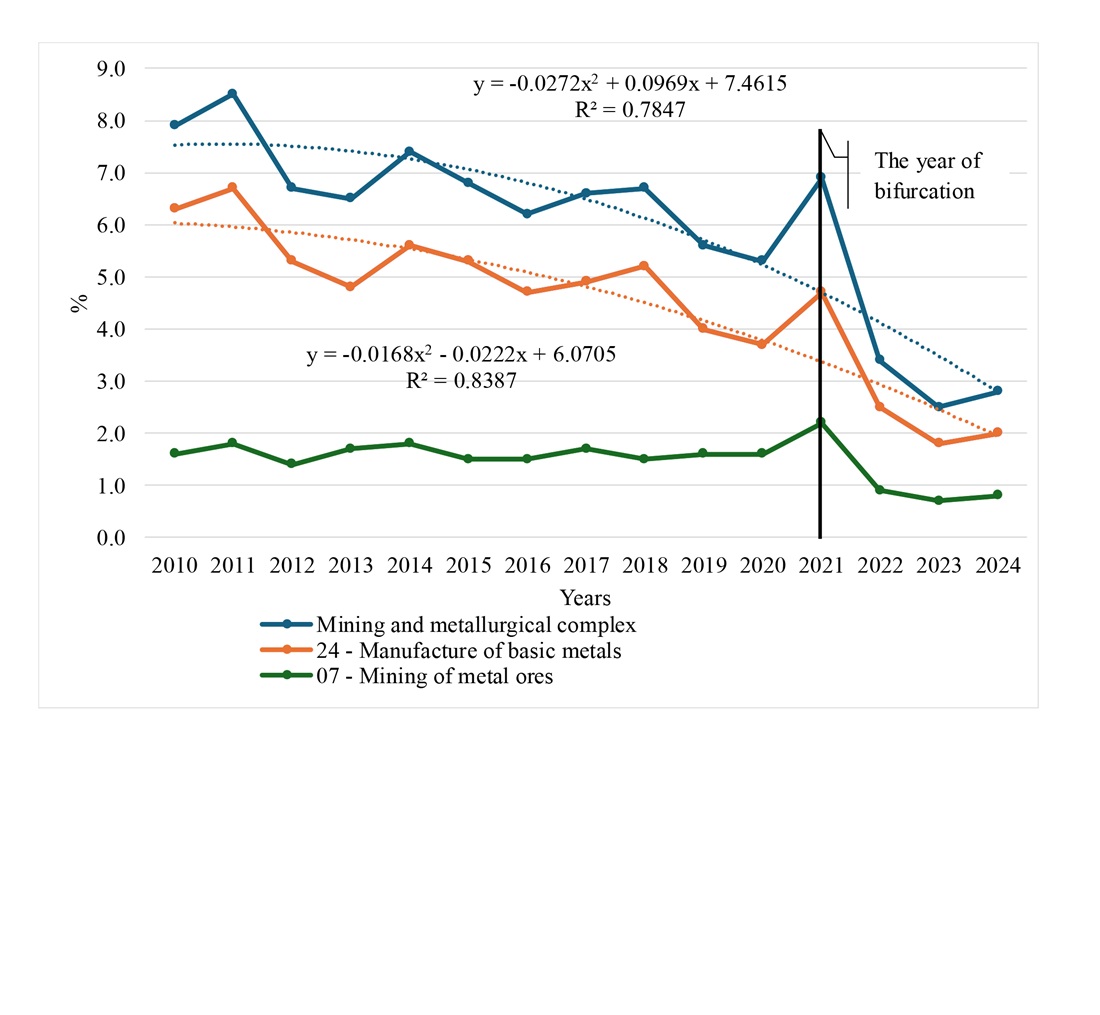
This study investigates processes of managing enterprises in the mining and metals production sector in the framework of a circular economy based on international technology transfer. The task addressed relates to the issue of adapting strategic mechanisms of industry management to the conditions of a circular economy. The result is the construction of trend models based on actual data for 2010–2023 and extrapolated to 2024–2025. They are used as the basis for assessing business activity and determining the competitiveness of the industry and its subsectors. Special features of the study are the application of a strategic approach to managing enterprises in the mining and metals production sector based on modernization and the use of international technology transfer. The effect obtained is to enable the transition to higher technological structures, to strengthen the internal and external competitiveness of enterprises. It is shown that 2021 became a bifurcation point when the positive trend in sales growth over 2020–2021 increased from UAH 543.8 billion to UAH 959.9 billion but, during 2021–2022, it changed sharply to negative with the analyzed indicator decreasing to UAH 392.8 billion.
This study's results are distinguished by the substantiation of a strategic approach to the development of the mining and metals industry in the risk-oriented environment of the circular economy. Unlike existing approaches, the proposed one is based on the synthesis of adaptive mechanisms and principles of sustainable development. The scope of the findings covers ways devised to solve the tasks of this sector's development on an innovative basis. Conditions for the practical application of the results are the design and implementation of strategic target programs for engaging enterprises from the mining and metals production sector in international technology transfer
References
- Brovender, Yu. M. (2021). Donetsk mining and metallurgical center and production hubs of the Eastern European steppe of the bronze age: a comparative analysis of production activities. Archaeology and Early History of Ukraine, 39 (2), 109–118. https://doi.org/10.37445/adiu.2021.02.05
- Honcharuk, O., Riabko, O., Overkovskyi, B. (2021). Mining and metallurgical complex of Ukraine: current trends and results. Market Infrastructure, 55. https://doi.org/10.32843/infrastruct55-15
- Beridze, T., Baranik, Z., Dashko, I., Hamova, O., Tkachenko, S. (2023). Fundamental imperatives of eliminating uncertainty on the basis of monitoring the activity of the iron ore enterprise. Naukovyi Visnyk Natsionalnoho Hirnychoho Universytetu, 3, 151–156. https://doi.org/10.33271/nvngu/2023-3/151
- Morkun, V. S., Kotov, І. А., Serdiuk, O. Y., Haponenko, І. А. (2021). Knowledge representation in intelligent automation systems for control of power systems of the mining and metallurgical complex under uncertainty. Visnik of the Volodymyr Dahl East Ukrainian National University, 4 (268), 40–48. https://doi.org/10.33216/1998-7927-2021-268-4-40-48
- Vagonova, O. G., Metelenko, N. G., Shapurov, O. O., Chornobayev, V. V. (2023). Efficiency and internationalization of mining and metallurgical groups of Ukraine. Naukovyi Visnyk Natsionalnoho Hirnychoho Universytetu, 2, 177–183. https://doi.org/10.33271/nvngu/2023-2/177
- Latysheva, O., Rovenska, V., Smyrnova, I., Tripak, M., Tepliuk, M. (2024). Ensuring operational efficiency of mining and metallurgical enterprises on the basis of sustainable development. Naukovyi Visnyk Natsionalnoho Hirnychoho Universytetu, 6, 200–206. https://doi.org/10.33271/nvngu/2024-6/200
- Fu, Y., Wen, P., Wu, J., Shu, Y. (2025). Exploring knowledge structure of “dual carbon” policies: Combining computational text mining and knowledge graph. Energy Strategy Reviews, 62, 101976. https://doi.org/10.1016/j.esr.2025.101976
- Qin, J., Li, S., Zhao, L., Liu, B., Zhang, Y. (2025). Precious metal recycling technology in electronic waste: Progress, challenges, and sustainable development path. Green and Smart Mining Engineering, 2 (4), 459–482. https://doi.org/10.1016/j.gsme.2025.10.005
- Standar, A., Genstwa-Namysł, N., Kozera, A. (2025). Do regions with high CO2 emissions actively invest in energy transition? – examples of local investments in Poland. Journal of Cleaner Production, 514, 145688. https://doi.org/10.1016/j.jclepro.2025.145688
- Smol, M., Kulczycka, J. (2019). Towards innovations development in the European raw material sector by evolution of the knowledge triangle. Resources Policy, 62, 453–462. https://doi.org/10.1016/j.resourpol.2019.04.006
- Povedano-Priego, C., Jroundi, F., Lopez-Fernandez, M., Ruiz-Fresneda, M. A., Newman-Portela, A., Hlavackova, V. et al. (2025). From waste to resource: A review on biological and physicochemical metal remediation and recovery in the light of the circular economy. Journal of Hazardous Materials, 498, 139991. https://doi.org/10.1016/j.jhazmat.2025.139991
- Xie, S., Yu, Y., Xie, Y., Chen, X., Tang, Z. (2025). Overview and prospects of modeling and optimal control for non-ferrous metallurgical processes and mineral processing. Green and Smart Mining Engineering, 2 (4), 440–458. https://doi.org/10.1016/j.gsme.2025.10.006
- Roy, S., Dvořáková Lišková, Z. (2025). Environmental management through the Driver-Pressure-State-Impact-Response framework: Challenges and adaptive indicators in India and the Czech Republic. Journal of Environmental Management, 395, 128023. https://doi.org/10.1016/j.jenvman.2025.128023
- Guo, X., Huang, L., Miao, H., Mi, L., Han, Z. (2025). Exploring carbon reduction pathways in the steel industry from the perspective of emerging technologies for achieving carbon neutrality. Journal of Environmental Management, 385, 125768. https://doi.org/10.1016/j.jenvman.2025.125768
- Shamsi, M., Zakerinejad, M. (2025). Towards mining 4.0: A novel multi-criteria simulation-optimization fuzzy framework for effective slag utilization overcoming green waste management promotion. Technological Forecasting and Social Change, 219, 124271. https://doi.org/10.1016/j.techfore.2025.124271
- Lv, B. (2026). Toward industry 5.0: Quantum-biological synergistic mechanisms for lithium battery recycling through multiscale optimization. Journal of Cleaner Production, 538, 147274. https://doi.org/10.1016/j.jclepro.2025.147274
- Islam, M. T., Ali, A., Abdul Qadir, S., Shahid, M. (2025). Policy and regulatory perspectives of waste battery management and recycling: A review and future research agendas. Waste Management Bulletin, 3 (1), 301–331. https://doi.org/10.1016/j.wmb.2025.01.011
- Tabares, S., Parida, V., Chirumalla, K. (2025). Twin transition in industrial organizations: Conceptualization, implementation framework, and research agenda. Technological Forecasting and Social Change, 213, 123995. https://doi.org/10.1016/j.techfore.2025.123995
- Lo Basso, G., Pastore, L. M., Sgaramella, A., Mojtahed, A., Ciancio, A., Massulli, A. R. et al. (2025). Status and perspectives of hydrogen role for decarbonising industry: a comprehensive review. Renewable and Sustainable Energy Reviews, 224, 116083. https://doi.org/10.1016/j.rser.2025.116083
- Makedon, V., Myachin, V., Kuriacha, N., Chaika, Y., Koptilyi, D. (2025). Development of strategic management of a corporation through the implementation of scenario analysis. Scientific Bulletin of Mukachevo State University. Series “Economics,” 12 (2), 135–146. https://doi.org/10.52566/msu-econ2.2025.135
- Turnover of enterprises by type of economic activity in 2010–2024 (by institutional and functional approach). State Statistics Service of Ukraine. Available at: https://www.ukrstat.gov.ua/operativ/operativ2021/fin/fin_new/orppved_10_20_ue.xlsx
- Parfentieva, О., Grechan, А., Bezuglyi, A., Kompanets, K., Salimon, О. (2022). The role of organizational and economic mechanism of strategic company management in the national economy. Financial and Credit Activity Problems of Theory and Practice, 6 (41), 307–317. https://doi.org/10.18371/fcaptp.v6i41.251463
- Baranets, H. V., Hrebenko, D. O., Klodchyk, O. O. (2022). Specifics of anti-crisis management of Ukrainian mining and steel enterprises in the conditions of military aggression. Economic Bulletin of Dnipro University of Technology, 80, 94–106. https://doi.org/10.33271/ebdut/80.094
- Hramm, O. O., Romanov, S. O., Savytskyi, O. I. (2021). Main factors influencing the electricity consumption for the system of automatic forecasting of consumption of the mining and metallurgical complex. Mining Journal of Kryvyi Rih National University, 109, 67–73. https://doi.org/10.31721/2306-5435-2021-1-109-67-73
- Minakova, I., Nosachevsky, K. (2019). Management control in the big companies: new approaches. Economic Annals-ХХI, 180 (11-12), 130–137. https://doi.org/10.21003/ea.v180-14
- Padilla Bejarano, J. B., Zartha Sossa, J. W., Ocampo-López, C., Ramírez-Carmona, M. (2023). University Technology Transfer from a Knowledge-Flow Approach – Systematic Literature Review. Sustainability, 15 (8), 6550. https://doi.org/10.3390/su15086550
- Chervinska, L., Kalina, I., Chervinska, T., Milenkyi, V., Grishchenko, A., Khorosheniuk, A. (2025). Technology transfer in the system of innovation development: challenges and opportunities. Technology Audit and Production Reserves, 2 (4 (82)), 80–87. https://doi.org/10.15587/2706-5448.2025.327378
- Nazarenko, I. I. (2025). The Evolutionary Development of the Formation of Conceptions and Principles of Circular Economy Business Models. Business Inform, 2 (565), 115–122. https://doi.org/10.32983/2222-4459-2025-2-115-122
- Shevchenko, I. O., Heydarov, F. A. oghly (2025). Features of business process transformation in the conditions of a circular economy. Time description of economic reforms, 1, 54–60. https://doi.org/10.32620/cher.2025.1.06
- Tverda, O., Repin, M., Tkachuk, K., Horbachova, K. (2020). The implementation of the circular economy model in the mining industry. Ecological Sciences, 1 (2), 34–57. https://doi.org/10.32846/2306-9716/2020.eco.2-29.1.8
- Kоsova, Т., Smerichevskyi, S., Antypenko, N., Mykhalchenko, O., Raicheva, L. (2023). Innovative and financial modernization of transportation system based on international technology transfer. Eastern-European Journal of Enterprise Technologies, 5 (13 (125)), 47–56. https://doi.org/10.15587/1729-4061.2023.289101
- Harris, D., Harris, F. J. (2004). Evaluating the transfer of technology between application domains: a critical evaluation of the human component in the system. Technology in Society, 26 (4), 551–565. https://doi.org/10.1016/j.techsoc.2004.08.003
- Smirnova, N. (2015). The objective necessity of technology transfer at the enterprises of mining-metallurgical complex of Ukraine. Ekonomika ta derzhava, 6, 121–125. Available at: http://www.economy.in.ua/pdf/6_2015/29.pdf
- Kolosok, V., Ugrovata, Y. (2013). The analysis of the transfer pricing influence of mining and metallurgical holdings enterprises to the revenues to the state budget of Ukraine. Skhid, 4, 19–25. Available at: http://nbuv.gov.ua/UJRN/Skhid_2013_4_5
- Speldekamp, D., Knoben, J., Saka-Helmhout, A. (2020). Clusters and firm-level innovation: A configurational analysis of agglomeration, network and institutional advantages in European aerospace. Research Policy, 49 (3), 103921. https://doi.org/10.1016/j.respol.2020.103921
- ArcelorMittal. Available at: https://ukraine.arcelormittal.com
Downloads
Published
How to Cite
Issue
Section
License
Copyright (c) 2026 Тetiana Kоsova, Larysa Raicheva, Stanislav Cherednichenko, Kateryna Nesterova, Natalia Yakobchuk

This work is licensed under a Creative Commons Attribution 4.0 International License.
The consolidation and conditions for the transfer of copyright (identification of authorship) is carried out in the License Agreement. In particular, the authors reserve the right to the authorship of their manuscript and transfer the first publication of this work to the journal under the terms of the Creative Commons CC BY license. At the same time, they have the right to conclude on their own additional agreements concerning the non-exclusive distribution of the work in the form in which it was published by this journal, but provided that the link to the first publication of the article in this journal is preserved.
A license agreement is a document in which the author warrants that he/she owns all copyright for the work (manuscript, article, etc.).
The authors, signing the License Agreement with TECHNOLOGY CENTER PC, have all rights to the further use of their work, provided that they link to our edition in which the work was published.
According to the terms of the License Agreement, the Publisher TECHNOLOGY CENTER PC does not take away your copyrights and receives permission from the authors to use and dissemination of the publication through the world's scientific resources (own electronic resources, scientometric databases, repositories, libraries, etc.).
In the absence of a signed License Agreement or in the absence of this agreement of identifiers allowing to identify the identity of the author, the editors have no right to work with the manuscript.
It is important to remember that there is another type of agreement between authors and publishers – when copyright is transferred from the authors to the publisher. In this case, the authors lose ownership of their work and may not use it in any way.








