Intellectualization of Ukraine’s economy: internal determinants and strategic priorities for post-war reconstruction
DOI:
https://doi.org/10.15587/1729-4061.2026.352364Keywords:
post-war reconstruction, intellectualization of the economy, intellectual potential, STI policy, intellectual security, European integrationAbstract
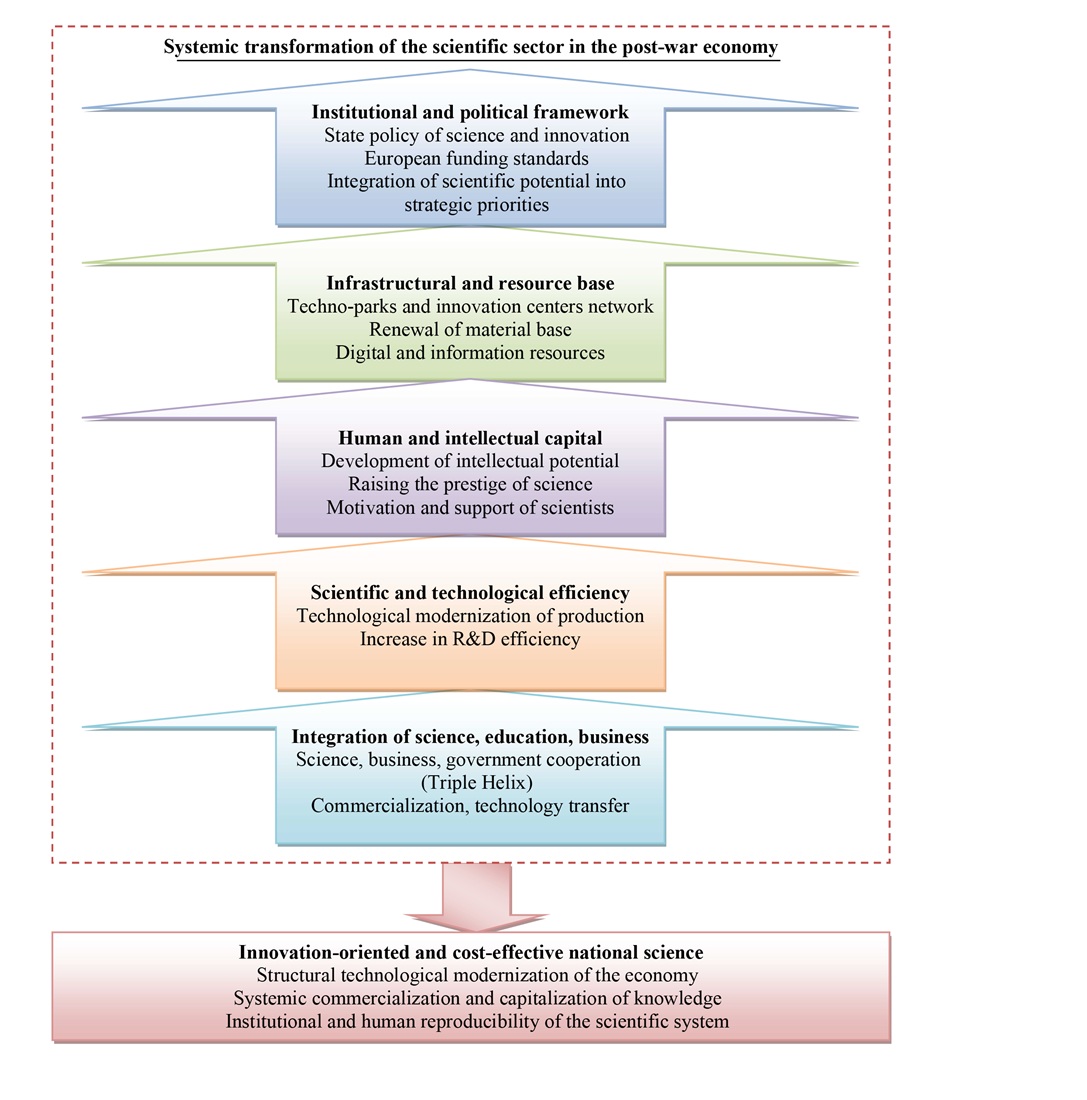
The object of the study is the processes of intellectualization of Ukraine’s economy in the context of post-war reconstruction, structural modernization, digital transformation, and the formation of a knowledge-based economy. The problem addressed in the study is the low efficiency of managing the intellectualization of Ukraine’s economy, which hinders innovation development and European integration. It is substantiated that intellectual potential is a systemic factor of socio-economic development and a key driver of the post-war economic reconstruction of Ukraine. In order to increase the innovation activity of the national economy, a holistic mechanism for the protection and commercialization of intellectual property objects integrated into the state science, technology and innovation policy is formed. A comprehensive political roadmap with cross-sectoral coordination and focus on the synergy of science, business and the state is designed, which allows bridge the gap between knowledge creation and its economic realization. The directions and tools for the effective use of intellectual potential based on its targeted integration with the technological modernization of key sectors of the economy are elaborated. The priorities for the development of the knowledge economy, structured according to sectoral and institutional principles, are substantiated, which made it possible to overcome the dispersion of strategic guidelines for innovation policy. It is pointed out that Ukraine needs to implement smart solutions and consolidate all entities of the national economic system in order to revive at a new higher level of intellectual and socio-economic development. The need for Ukraine's integration into European value chains was emphasized. Practical application of the results is possible subject to the implementation of comprehensive programs to strengthen the Ukrainian model on the path of an intellectual society in the process of modernization
References
- Carmine, P., Primario, S., Pierluigi, R. (2025). The influence of knowledge and intellectual capital on the economic outcomes of academic spin-offs: Evidence from Italy. Journal of Innovation & Knowledge, 10 (5), 100768. https://doi.org/10.1016/j.jik.2025.100768
- Heitsia, V. M., Hrytsenka, A. A. (2019). Sotsialno-klasovi transformatsii i formuvannia novoi yakosti osvity yak skladovi rekonstruktyvnoho rozvytku ekonomiky Ukrainy. Kyiv, 388. Available at: https://ief.org.ua/publication/zbirnyk-naukovykh-prac/2019/socialno-klasovi-transformacii-i-formuvannja-novoi-jakosti-osvity-jak-
- Pysarenko, T. V., Kvasha, T. K., Musina, L. A., Bohomazova, V. V., Kovalenko, O. I., Rozhkova, L. V. (2024). Wartime Risks: Impact on Science, Technology, Innovation, and Prospects for Sustainable Development in Ukraine. State Institution “Ukrainian Institute of Scientific and Technical Expertise and Information”. https://doi.org/10.35668/978-966-479-150-9
- Zamula, I., Shavurska, O., Kireitseva, H. (2024). Sustainable Development of Ukraine as an Innovative Approach to Its Post-War Recovery. Science and Innovation, 20 (3), 3–16. https://doi.org/10.15407/scine20.03.003
- Voloshchuk, Y., Lavruk, N., Derlytsia, A., Havryliuk, V., Kulii-Demianiuk, Y. (2025). The role of public investment in innovative projects during martial law. Economics of Development, 24 (1), 45–56. https://doi.org/10.63341/econ/1.2025.45
- Shevchenko, I., Ukhova, N. (2025). Advancing european digital economic integration in the context of ukraine’s post-war recovery. Journal of European Economy, 24 (2), 211–226. https://doi.org/10.35774/jee2025.02.211
- Kholiavko, N. (2025). Towards a sustainable post-war recovery: the role of universities in ukraine’s economic, environmental, and social transformation. Baltic Journal of Economic Studies, 11 (3), 146–153. https://doi.org/10.30525/2256-0742/2025-11-3-146-153
- Kraus, K. (2024). Monitoring of Digital Competitiveness in the Context of Sustainable Development and Economic Growth: Global Trends and Ukrainian Realities. Journal of Vasyl Stefanyk Precarpathian National University, 11 (2), 91–102. https://doi.org/10.15330/jpnu.11.2.91-102
- Pleshkanovska, A. (2021). Innovation-Based City as a Result of the Evolution of the Smart City Spatial Organization. Science and Innovation, 17 (6), 110–122. https://doi.org/10.15407/scine17.06.110
- Bryukhovetska, N., Buleev, I., Chorna, O., Bryl, I., Korytko , T. (2025). Formation of Human Capital in Enterprises Amidst Digitalization and Artificial Intelligence Advancement. Science and Innovation, 21 (2), 15–27. https://doi.org/10.15407/scine21.02.015
- Ostrovska, H., Tsikh, H., Strutynska, I., Kinash, I., Pietukhova, O., Golovnya, О., Shehynska, N. (2021). Building an effective model of intelligent entrepreneurship development in digital economy. Eastern-European Journal of Enterprise Technologies, 6 (13 (114)), 49–59. https://doi.org/10.15587/1729-4061.2021.244916
- Ostrovska, H. Y., Sherstiuk, R. Р., Tsikh, H. V., Ivata, V. V., Tur, O. V. (2025). Talent management: a strategic priority for developing the enterprise’s intellectual potential in digitalization. Naukovyi Visnyk Natsionalnoho Hirnychoho Universytetu, 1, 147–156. https://doi.org/10.33271/nvngu/2025-1/147
- Égert, B., de la Maisonneuve, C. (2023). The impact of the war on human capital and productivity in Ukraine. Policy Studies, 45 (3-4), 282–292. https://doi.org/10.1080/01442872.2023.2288687
- Cirella, G. T. (Ed). (2024). Handbook on Post-War Reconstruction and Development Economics of Ukraine: Cata-lyzing Progress. Cham: Springer Nature Switzerland. https://doi.org/10.1007/978-3-031-48735-4
- Danylyshyn, B. (2023). Ensuring Macroeconomic Stability under the Martial Law. Science and Innovation, 19 (1), 3–19. https://doi.org/10.15407/scine19.01.003
- Pysarenko, T. V., Kuranda, T. K. et al. (2025). Naukova, naukovo-tekhnichna ta innovatsiina diialnist v Ukraini u 2024 rotsi. Kyiv: UkrINTEI, 115. Available at: https://mon.gov.ua/static-objects/mon/sites/1/nauka/informatsiyno-analitychni/2025/18-07-2025/naukovo-analitychna-dopovid-naukova-naukovo-tekhnichna-ta-innovatsiyna-diyalnist-v-ukrayini-u-2024-rotsi-18-07-2025.pdf
- Directive (EU) 2019/790 of the European Parliament and of the Council of 17 April 2019 on copyright and related rights in the Digital Single Market and amending Directives 96/9/EC and 2001/29/EC (Text with EEA relevance.) (2019). Official Journal of the European Union, 130, 92–125. Available at: https://www.wipo.int/wipolex/en/legislation/details/18927
- Kapitsa, Yu. (2019). Dyrektyva YeS pro avtorske pravo v yedynomu tsyfrovomu rynku: novi vymiry chy novi vyprobuvannia? Intelektualna vlasnist, 8, 6–22. Available at: https://ipr.nas.gov.ua/wp-content/uploads/2019/09/Stattia_Dyrektyva_ES_Avtorske_Pravo_i_tsyfrovyi_rynok_Zhurnal_IV_-8_2019.pdf
- Ostrovska, H. Y., Verbovska, L. S., Tarayevska, L. S., Haliuk, I. B., Petryna, M. J. (2025). Building a technological ecosystem in the context of digital transformation. Naukovyi Visnyk Natsionalnoho Hirnychoho Universytetu, 4, 195–205. https://doi.org/10.33271/nvngu/2025-4/195
- Plan Ukraine Facility 2024–2027. Available at: https://www.ukrainefacility.me.gov.ua/
Downloads
Published
How to Cite
Issue
Section
License
Copyright (c) 2026 Halyna Ostrovska, Roman Sherstiuk, Vyacheslav Ivata, Mykhailo Mykhailov, Oleksiy Pashchenko, Olena Volska

This work is licensed under a Creative Commons Attribution 4.0 International License.
The consolidation and conditions for the transfer of copyright (identification of authorship) is carried out in the License Agreement. In particular, the authors reserve the right to the authorship of their manuscript and transfer the first publication of this work to the journal under the terms of the Creative Commons CC BY license. At the same time, they have the right to conclude on their own additional agreements concerning the non-exclusive distribution of the work in the form in which it was published by this journal, but provided that the link to the first publication of the article in this journal is preserved.
A license agreement is a document in which the author warrants that he/she owns all copyright for the work (manuscript, article, etc.).
The authors, signing the License Agreement with TECHNOLOGY CENTER PC, have all rights to the further use of their work, provided that they link to our edition in which the work was published.
According to the terms of the License Agreement, the Publisher TECHNOLOGY CENTER PC does not take away your copyrights and receives permission from the authors to use and dissemination of the publication through the world's scientific resources (own electronic resources, scientometric databases, repositories, libraries, etc.).
In the absence of a signed License Agreement or in the absence of this agreement of identifiers allowing to identify the identity of the author, the editors have no right to work with the manuscript.
It is important to remember that there is another type of agreement between authors and publishers – when copyright is transferred from the authors to the publisher. In this case, the authors lose ownership of their work and may not use it in any way.








