Design of biocomposites based on a glutinous matrix with a combined content of wood flour and chopped stalks of grain crops
DOI:
https://doi.org/10.15587/1729-4061.2026.352742Keywords:
biopolymer, plant fillers, moisture content, compressive strength, impact strengthAbstract
This study considers biocomposite materials based on a glutinous matrix and fillers of plant origin. Waste from the woodworking industry and the agricultural sector is a promising raw material for obtaining fillers for biocomposite materials, which are characterized by a high degree of environmental safety and renewable raw material base.
The task addressed is to optimize the amount of technological additive (water) in the glutinous composition, which contributes to the formation of a dense structure of the biocomposite material with a compact arrangement of particles of the combined mixture of fillers.
In the process of research, the effectiveness of using fillers of different granulometric composition against the effect of mechanical loads was determined. The complex effect of fillers of plant origin on the mechanical characteristics of biocomposite materials was studied, which made it possible to define the optimal composition of the biocomposite.
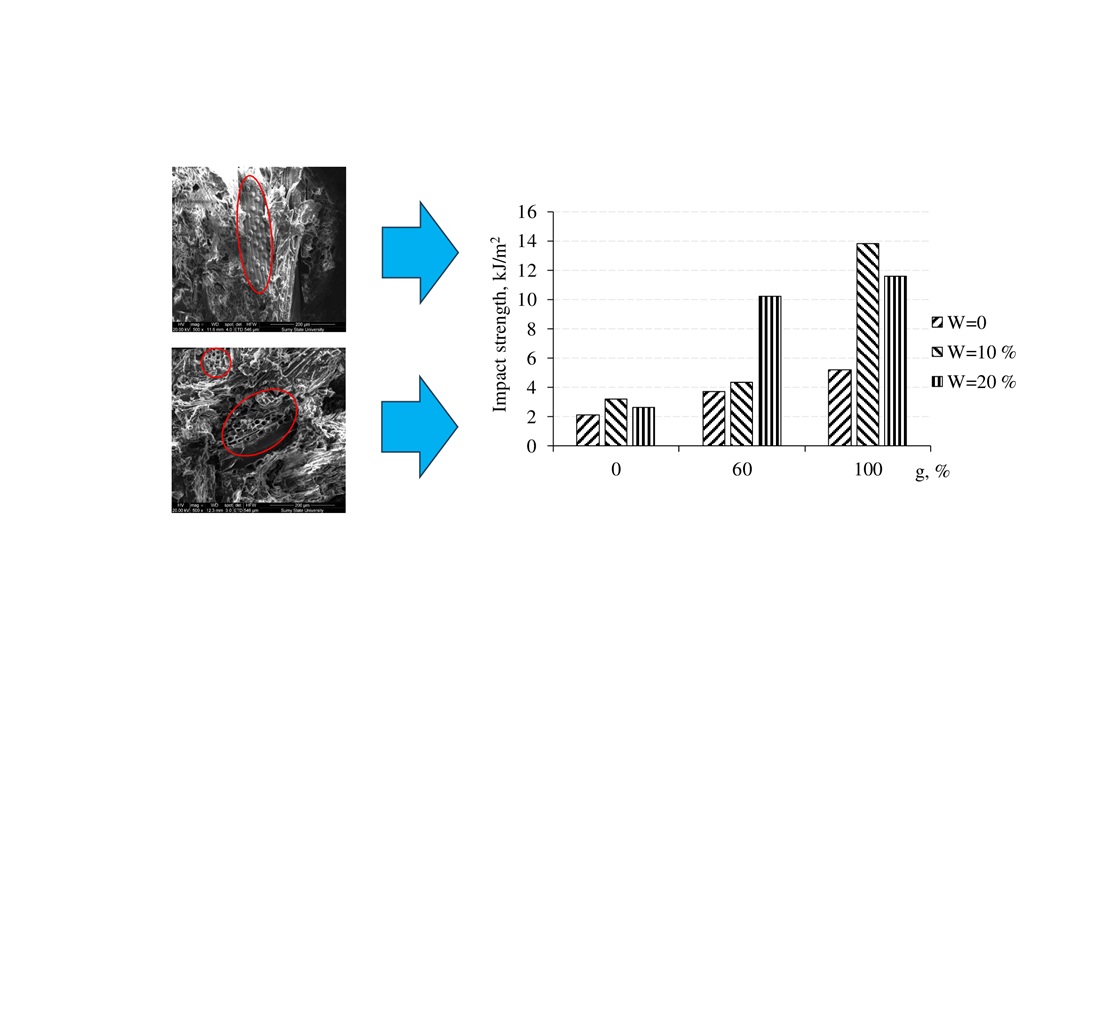
An analysis of the effect of the amount of moisture in the composition on the formation of the structure and the resistance of the biocomposite material to the effect of static and dynamic loads was carried out. The maximum values of the ultimate compressive strength (115–120 MPa) were obtained for biocomposites containing a mixture of fillers of different granulometric composition (40–80% of cereal stalk particles, the remaining particles of wood flour) provided that 30% of moisture is removed from the composition. The maximum impact strength (13.8 kJ/m2) was established for biocomposites containing 100% of crushed cereal stalks provided that 10% of moisture is removed from the composition.
The designed materials could be used to manufacture packaging elements that are disposed of after operation by recycling or through safe decomposition at landfills without harm to the environment
References
- Kim, S., Lee, J., Roh, C., Eun, J., Kang, C. (2019). Evaluation of carbon fiber and p-aramid composite for industrial helmet using simple cross-ply for protecting human heads. Mechanics of Materials, 139, 103203. https://doi.org/10.1016/j.mechmat.2019.103203
- Singh, Y., Singh, J., Sharma, S., Lam, T.-D., Nguyen, D.-N. (2020). Fabrication and characterization of coir/carbon-fiber reinforced epoxy based hybrid composite for helmet shells and sports-good applications: influence of fiber surface modifications on the mechanical, thermal and morphological properties. Journal of Materials Research and Technology, 9 (6), 15593–15603. https://doi.org/10.1016/j.jmrt.2020.11.023
- Prajapati, P., Sharma, C., Shrivastava, R., Rana, R. S. (2018). Evaluation of Mechanical Properties of Coir and Glass Fiber Hybrid Composites. Materials Today: Proceedings, 5 (9), 19056–19062. https://doi.org/10.1016/j.matpr.2018.06.258
- Guillaumat, L., Baley, C. (2008). Statistical behaviour of hemp and sisal fiber reinforced polypropylene composites. Available at: https://www.researchgate.net/publication/237649784_Statistical_behaviour_of_hemp_and_sisal_fiber_reinforced_polypropylene_composites
- Kumar, A., Kumar, S., Kumar, D., Mahakur, V. K., Bhowmik, S. (2024). Utilization of banana peel as bio-filler to develop bio-composite materials and characterize their physical, mechanical, thermal, and tribological characteristics. Polymer Bulletin, 81 (17), 16175–16196. https://doi.org/10.1007/s00289-024-05464-x
- Kamal, I., Thirmizir, M. Z., Beyer, G., Saad, M. J., Abdul Rashid, N. A., Abdul Kadir, Y. (2014). Kenaf for biocomposite: An overview. Journal of Science and Technology, 6 (2), 41–166. Available at: https://publisher.uthm.edu.my/ojs/index.php/JST/article/view/796/681
- Akhtar, M. N., Sulong, A. B., Nazir, M. S., Majeed, K., Khairul Fadzly Radzi, Mohd., Ismail, N. F., Raza, M. R. (2016). Kenaf-Biocomposites: Manufacturing, Characterization, and Applications. Green Biocomposites, 225–254. https://doi.org/10.1007/978-3-319-46610-1_10
- Shahzad, A. (2013). A Study in Physical and Mechanical Properties of Hemp Fibres. Advances in Materials Science and Engineering, 2013, 1–9. https://doi.org/10.1155/2013/325085
- Ramli, N., Mazlan, N., Ando, Y., Leman, Z., Abdan, K., Aziz, A. A., Sairy, N. A. (2018). Natural fiber for green technology in automotive industry: A brief review. IOP Conference Series: Materials Science and Engineering, 368, 012012. https://doi.org/10.1088/1757-899x/368/1/012012
- Chard, J. M., Creech, G., Jesson, D. A., Smith, P. A. (2013). Green composites: sustainability and mechanical performance. Plastics, Rubber and Composites, 42 (10), 421–426. https://doi.org/10.1179/1743289812y.0000000041
- Melnychuk, M., Shevchuk, I., Kashytskyi, V., Feshcuk, Y., Polivoda, N. (2023). Mechanical Properties of Hybrid Composites Based on Polypropylene Modified with Natural Fillers. Advances in Design, Simulation and Manufacturing VI, 221–229. https://doi.org/10.1007/978-3-031-32774-2_22
- Meinathan, S., Nandhini, T. (2022). Structural improvement in industrial helmet by combining low and medium based elastic modulus value composite fibre. International Journal of Health Sciences, 6 (S4), 9999–10012. https://doi.org/10.53730/ijhs.v6ns4.10890
- Paglicawan, M. A., Emolaga, C. S., Sudayon, J. M. B., Tria, K. B. (2021). Mechanical Properties of Abaca–Glass Fiber Composites Fabricated by Vacuum-Assisted Resin Transfer Method. Polymers, 13 (16), 2719. https://doi.org/10.3390/polym13162719
- Salman, S. D., Leman, Z., Ishak, M., Sultan, M., Cardona, F. (2017). Quasi-static penetration behavior of plain woven kenaf/aramid reinforced polyvinyl butyral hybrid laminates. Journal of Industrial Textiles, 47 (7), 1427–1446. https://doi.org/10.1177/1528083717692593
- Chen, L., Yu, Z., Fei, B., Lin, C., Fang, C., Liu, H. et al. (2022). Study on Performance and Structural Design of Bamboo Helmet. Forests, 13 (7), 1091. https://doi.org/10.3390/f13071091
- Shivhare, Y., Narwariya, M., Sharma, C., Verma, V., Pandey, A. (2022). Effect of Coconut Husk Layer on the Behavior of Industrial Helmet. International Journal of Engineering Research in Mechanical and Civil Engineering (IJERMCE), 9 (6), 6–11. https://doi.org/10.36647/ijermce/09.06.a002
- Shukla, D. K., Sonia, P., Verma, V. (2013). Characterization of Fracture Properties of Epoxy-Alumina Polymer Nanocomposite. Applied Mechanics and Materials, 390, 557–561. https://doi.org/10.4028/www.scientific.net/amm.390.557
- Verma, V., Sayyed, A. H. M., Sharma, C., Shukla, D. K. (2020). Tensile and fracture properties of epoxy alumina composite: role of particle size and morphology. Journal of Polymer Research, 27 (12). https://doi.org/10.1007/s10965-020-02359-z
- Verma, V., Sharma, C. (2020). Fatigue behavior of epoxy alumina nanocomposite – role of particle morphology. Theoretical and Applied Fracture Mechanics, 110, 102807. https://doi.org/10.1016/j.tafmec.2020.102807
- Verma, V., Tiwari, H. (2020). Role of filler morphology on friction and dry sliding wear behavior of epoxy alumina nanocomposites. Proceedings of the Institution of Mechanical Engineers, Part J: Journal of Engineering Tribology, 235 (8), 1614–1626. https://doi.org/10.1177/1350650120970433
- Verma, V., Pandey, A. K., Sharma, C. (2021). Fatigue Behavior of Particulate-Reinforced Polymer Composites. Advanced Materials and Manufacturing Processes, 155–171. https://doi.org/10.1201/9781003093213-10
- Thakur, V. K., Singha, A. S. (2010). Natural fibres-based polymers: Part I – Mechanical analysis of Pine needles reinforced biocomposites. Bulletin of Materials Science, 33 (3), 257–264. https://doi.org/10.1007/s12034-010-0040-x
- Singha, A. S., Thakur, V. K. (2008). Mechanical properties of natural fibre reinforced polymer composites. Bulletin of Materials Science, 31 (5), 791–799. https://doi.org/10.1007/s12034-008-0126-x
- Bodur, M. S., Gülmez, T., Durademir, A. (2012). Investigations on Tensile Properties of Waste Fillers Reinforced Composites. Defect and Diffusion Forum, 326-328, 354–359. https://doi.org/10.4028/www.scientific.net/ddf.326-328.354
- Kashytskyi, V. P., Sadova, O. L., Yanchuk, S. L. (2023). Intensification of the formation process of sodium sulfate-modified biocomposite materials based on the glutinous matrix. Functional Materials, 30 (1). https://doi.org/10.15407/fm30.01.35
- ASTM D695. Compression Test on Composites and Plastics. Available at: https://www.zwickroell.com/industries/composites/end-loading-compression-astm-d695/
- ISO 179-1:2023. Plastics – Determination of Charpy impact properties – Part 1: Non-instrumented impact test. Available at: https://cdn.standards.iteh.ai/samples/84393/c5581746f5fa4df4830d0b7257272d21/ISO-179-1-2023.pdf
Downloads
Published
How to Cite
Issue
Section
License
Copyright (c) 2026 Vitalii Kashytskyi, Oksana Sadova, Valentyna Tkachuk, Yevhenii Chernota, Nazarii Marchuk

This work is licensed under a Creative Commons Attribution 4.0 International License.
The consolidation and conditions for the transfer of copyright (identification of authorship) is carried out in the License Agreement. In particular, the authors reserve the right to the authorship of their manuscript and transfer the first publication of this work to the journal under the terms of the Creative Commons CC BY license. At the same time, they have the right to conclude on their own additional agreements concerning the non-exclusive distribution of the work in the form in which it was published by this journal, but provided that the link to the first publication of the article in this journal is preserved.
A license agreement is a document in which the author warrants that he/she owns all copyright for the work (manuscript, article, etc.).
The authors, signing the License Agreement with TECHNOLOGY CENTER PC, have all rights to the further use of their work, provided that they link to our edition in which the work was published.
According to the terms of the License Agreement, the Publisher TECHNOLOGY CENTER PC does not take away your copyrights and receives permission from the authors to use and dissemination of the publication through the world's scientific resources (own electronic resources, scientometric databases, repositories, libraries, etc.).
In the absence of a signed License Agreement or in the absence of this agreement of identifiers allowing to identify the identity of the author, the editors have no right to work with the manuscript.
It is important to remember that there is another type of agreement between authors and publishers – when copyright is transferred from the authors to the publisher. In this case, the authors lose ownership of their work and may not use it in any way.








